Ideas & Symbols: A Reader’s Guide
The Contemplative Craftsman
Symbols, philosophy, and the liberal arts
A stone can help build a wall. It can also give us something to think about.
This collection explores symbols, classical stories, philosophy, and learning as ways of examining character, judgment, responsibility, and the inward life.
Some essays begin in the lodge room. Others begin with Plato, a myth, a difficult choice, or the ordinary problem of paying attention. This guide shows how those paths connect.
No prior knowledge — or secret decoder ring — is required.
On this page: Start Here · Liberal Arts · Light & Understanding · Classical Stories · Independent Judgment
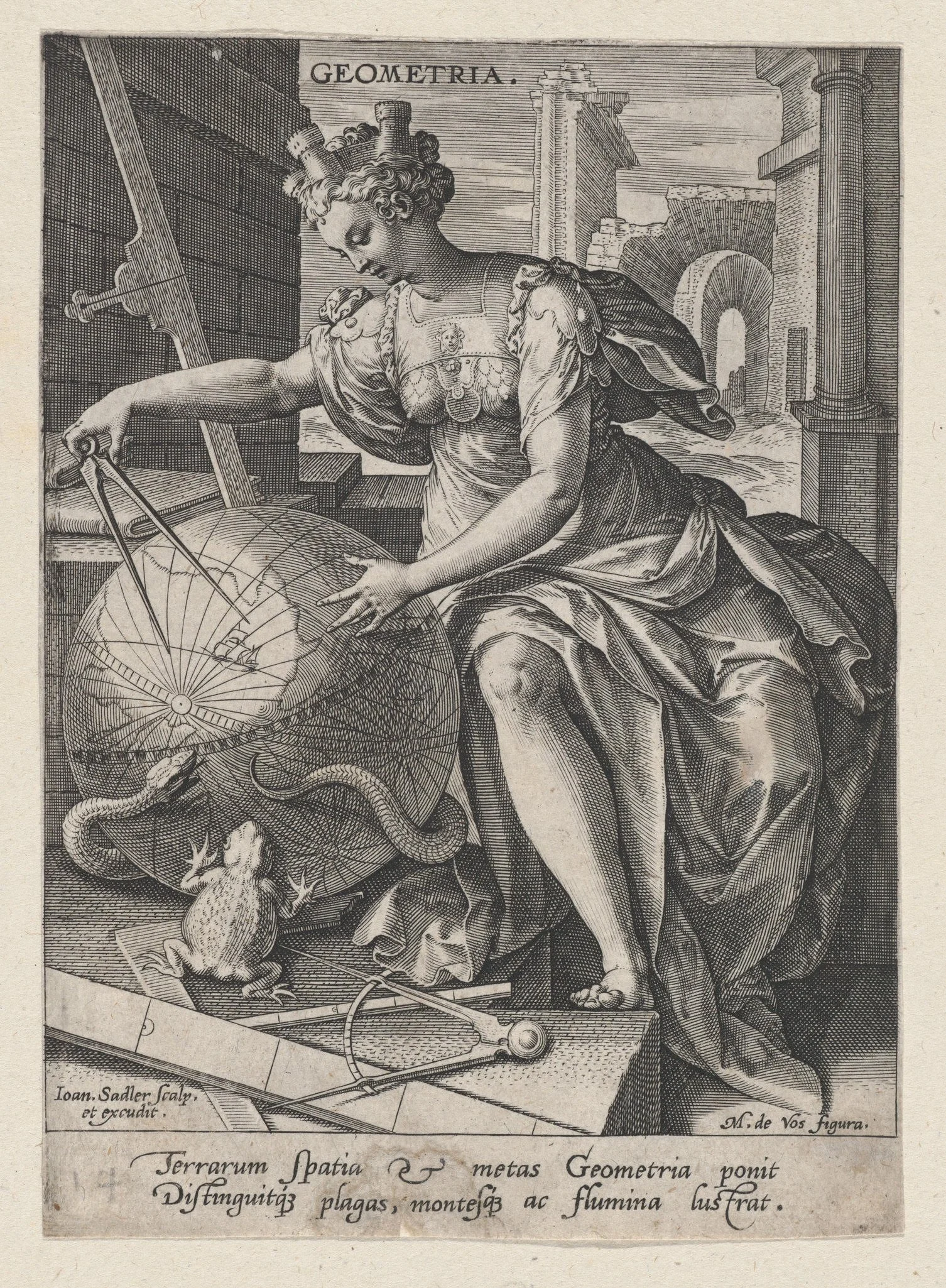
Image: Johann Sadeler I after Maerten de Vos, Geometria, c. 1570–1600. The Metropolitan Museum of Art, The Elisha Whittelsey Collection, 1949.
Start here: language, judgment, and understanding
For a first visit, follow this sequence:
-
Begin with the purpose of learning, rather than a list of subjects.
-
Continue into language and the responsibility of saying what we mean.
-
Turn from expression to the examination of claims and arguments.
Rhetoric and the Responsible Tongue
Consider how persuasion relates to the responsible use of speech.
-
Continue into a connected collection on learning, understanding, and responsibility.
The liberal arts: learning to think, speak, and see relationships
Choose this path if your central question is: What is an education supposed to do for a person?
After the introductory articles above, continue with:
These readings offer a route from language and reasoning into questions of proportion, harmony, attention, and the conditions for learning.
The Work of Light: from seeing to understanding
Choose this series if you are interested in the difference between possessing information and changing how you understand something.
Start with The Work of Light Series.
Suggested continuation:
For the Masonic foundations behind some of this language, return to the Freemasonry Guide.
Freemasonry, Ancient Traditions, and Symbolic Resemblance
When does a shared symbol suggest influence — and when does it simply invite comparison?
More Light: Freemasonry and the Ancient Past explores Masonic origins, Solomon’s Temple, ancient Egypt, the mysteries, chivalry, and occult reputation while keeping historical evidence and symbolic interpretation distinct.
Explore the Freemasonry Reader’s Guide for a suggested reading path through the series.
Classical stories: choose a question, then follow a series
You do not need to begin with every ancient name. Begin with a question that interests you.
| Your question | Suggested starting point |
|---|---|
| How do we understand competing impulses within ourselves? | The Chariot Within |
| What does the work of self-mastery involve? | Heracles Within: The Labors of the Soul |
| What might a journey home reveal about a life? | The Long Way Home: Ulysses, the Soul, and the Philosophy of Return |
| How do love and difficulty become occasions for growth? | The Soul and Love |
| What happens when curiosity outruns judgment? | The Ass and the Soul |
| What responsibility comes with the ability to make things? | The Labyrinth and the Wings |
| What connects foresight, power, and suffering? | Bound to the Rock |
| What can a story of loss ask us to consider? | Don’t Look Back Yet |
| What does a shared undertaking require of its participants? | The Golden Fleece Within |
| What do we carry from the past into an uncertain future? | Aeneas Below the Earth |
Read these as entrances into particular interpretations, not as a claim that every story or tradition says the same thing.
Corn, Wine and Oil
Ordinary things can invite questions that are anything but ordinary. This series takes corn, wine, and oil as its starting point, moving from Masonic ceremony to nourishment, refreshment, care, scripture, and the responsibilities of everyday life. Read it as a connected exploration of symbolism, or begin with the subject that interests you most.
Start here: Corn, Wine and Oil — Series Introduction
- Corn, Wine and Oil in Masonic Cornerstone Ceremonies — Begin with the ceremonial setting and the three materials considered together.
- Corn: Grain and Nourishment — Consider nourishment as a starting point for reflection on what sustains a life.
- Wine: Refreshment and Restraint — Explore refreshment alongside the question of measure.
- Oil: Joy, Peace and Care — Turn toward care and the quieter responsibilities suggested by joy and peace.
- Grain, Wine and Oil in Scripture: Blessings and Debts — Extend the discussion into scripture and the relationship between receiving and owing.
- Readings, Not Equations — Pause over interpretation: how to read a symbol without reducing it to a fixed formula.
- Gratitude, Measure and Ordinary Life — Finish with the series’ return to daily conduct and the work of putting reflection into practice.
Independent judgment and the pressure of the crowd
Choose this collection if you want to explore the relationship between education, conformity, and personal responsibility.
Begin with:
The Liberal Mind and the Crowd
Then choose a perspective:
For a more inward continuation, read Solitude, Silence, and the Inner Chamber.
Where to go next
Return to the Freemasonry Guide for introductory articles on Masonic symbols and the lodge.
Visit the Queens History Guide for the people, buildings, and communities explored elsewhere on the site.
Browse All Articles to choose your own route.