Alchemy, Transformation, and the Risk of Overinterpretation
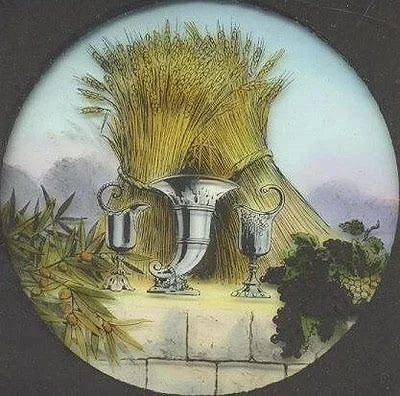
Corn wine and oil theme: surreal chalice artwork featuring golden corn-like strands.
Three goods, three columns, one tempting table. What transformation-minded readings can help us notice about corn, wine, and oil, and where they begin to outrun the evidence.
The napkin
It takes about ninety seconds. Corn goes in the first column and is labeled salt: the body, the earthy residue, what is left when the burning is done. Wine goes in the second as mercury, a liquid imagined rising as vapor and returning changed, with a change of its own for the person who drinks it. Oil goes in the third as sulphur, because it burns, and because anointing sounds like consecration. Three goods, three principles, one tidy diagonal.
The napkin has a way of getting kept.
This is a table I have constructed for the argument, not one recovered from a lodge document or an alchemical manuscript. There is nothing foolish about the impulse behind it. Grain, grapes, and olives are all worked on before they reach a table, and a reader who sees stages in them is seeing something that happened.
The trouble starts when the table stops feeling like a doodle and starts feeling like a discovery. This article is about that moment. It asks what a transformation-minded reading can show us about corn, wine, and oil, and where it begins, quietly, to say more than anyone has demonstrated.
Resemblance is cheap
Notice first how easily the napkin rearranges itself. Give the wine column its distilled spirit and the association with fire becomes available, so wine can be moved toward sulphur. Oil flows and spreads, which supplies another reader with a reason to put it under mercury. Grain can be made to stand for a beginning, an ending, a body, or a promise.
None of those moves establishes a correspondence. That is the point. A scheme that accommodates several arrangements is not telling you which one is true. It is telling you that threes are easy to fill.
The categories need to stay apart here. The earlier articles documented corn, wine, and oil in particular public cornerstone ceremonies. The napkin table is my addition. The ceremonial accounts examined in this series do not establish it as their explanation, and I will not write as though they do.
That is a statement about the evidence used here, not a declaration about every Masonic publication. An unexamined New York text cannot be made to agree with me by remaining unexamined.
None of this makes resemblance worthless. A resemblance is a reason to go and look at the thing it resembles.
So: what was alchemy?
What the word covered
Alchemy is not one tradition with one set of instructions. Its history includes Greek writing from Roman Egypt, a large Arabic literature, medieval Latin works, and the furnace-heavy practice of early modern Europe. Its practitioners pursued metals and medicines, investigated materials, and sometimes placed those investigations inside philosophical or theological accounts of the world. The range is part of the subject, not an inconvenience to be cleared away.[1][2]
Its working vocabulary was matter and process. Practitioners distilled, dissolved, sublimed, calcined, combined, and separated. Sometimes an obscure image concealed a practical operation. Sometimes an apparently straightforward recipe concealed an ingredient. Neither circumstance gives a reader permission to supply whatever meaning happens to fit.
The three-part scheme of salt, sulphur, and mercury belongs particularly to Paracelsus and the traditions that followed him. The principles were not simply three jars of familiar substances. They were ways of accounting for the properties and behavior of matter. That gives the napkin a historical vocabulary, but not an ancient and universal alphabet.[3]
Historians William Newman and Lawrence Principe proposed using “chymistry” for the early modern field in which activities later divided between alchemy and chemistry were still intertwined. The spelling is a reminder not to carry a later boundary backward and expect everyone to have observed it.[4]
The same care applies to the spiritual boundary. A furnace does not prove that its owner had no religious ideas. A religious image does not prove that the furnace was really a metaphor.
A book from 1685
Rather than argue in the abstract, take one book and see whether the napkin survives contact with it.
published in London in 1685. The University of Michigan’s catalogue gives the imprint as Will. Bonny for Tho. Howkins—not Hawkins—and identifies the author under the shorter form Johann Seger Weidenfeld. The preliminary matter includes a dedication to Robert Boyle.[5]
The title promises a practical work. It offers young practitioners a way to distinguish true preparations from counterfeit ones and to avoid “imaginary processes” and the ruin of estates. Even before the recipes begin, somebody is worried about the cost of believing the wrong thing.
The volume opens with a book of menstruums, solvents or dissolving preparations. Its catalogue runs to 150 numbered entries. That is not 150 demonstrations that worked. It is 150 preparations assembled, attributed, and arranged by an author who believes he can reconcile his authorities.[5]
Wine runs through the arrangement. But the catalogue repeatedly calls for the spirit of “Philosophical Wine,” not simply a cup taken from the supper table. It includes preparations involving the spirit of wine and salts, tartar, metals, mineral acids, and substances described as oils. The name on the page belongs to a particular recipe and an author’s vocabulary. It is not a modern ingredient label.
“Lully” needs the same treatment. A large body of alchemical writing circulated under the name of Ramon Llull, the Catalan philosopher. The Science History Institute identifies the Liber de secretis naturae seu de quinta essentia
as a central work of that Pseudo-Lullian corpus. Its catalogue explains that the work borrowed extensively from John of Rupescissa’s earlier account of the quintessence. A name on an alchemical title is not always the name of the person who wrote it.[6]
Rupescissa, writing in the fourteenth century, sought a substance that could resist corruption and preserve health. He found his candidate in distilled wine, aqua vitae, the water of life. Lawrence Principe’s account connects the claim with observations about alcohol’s preservative properties, while also placing Rupescissa’s work inside his religious expectations. The practical and the theological were not obliged to take turns.[1]
That is a documented ancestry for wine-quintessence writing. It runs through texts, preparations, medicine, and religious argument. It does not, by itself, run into a lodge.
The columns will not stay put
Now look at the catalogue’s nouns.
There is a preparation made with salt of tartar. There is “Vegetable Mercury” associated with that salt. There are mercurial waters, spirits of mercury, oils of vitriol, and an oil of Mars and Venus. The book’s headings distinguish vegetable from mineral preparations, then combine them again in further kinds.[5]
The napkin wants mercury to occupy one column and oil another. The book keeps putting those words to different jobs.
Nor does an “oil” in an alchemical catalogue necessarily mean pressed olive oil. The same volume that speaks of wine also lists oils associated with vitriol and metals. Recognizing the noun does not identify the substance. You have to read the preparation.
This is a smaller claim than saying the book disproves every possible correspondence. One solvent catalogue could not do that. What it does show is enough: these words do not arrive with the fixed meanings the napkin requires.
The title’s warning about imaginary processes belongs here too. A seventeenth-century author promising a remedy for bad interpretation may be selling a very confident interpretation of his own. He is evidence that the problem existed, not proof that he solved it.
The book’s catalogue and dedication establish no Masonic application. Weidenfeld’s solvent headings cannot be turned into a lodge explanation by placing them beside three ceremonial vessels. Names in the same neighborhood are not a chain.
A man in both rooms
There are people, though, whose lives put alchemy and Freemasonry in the same biography.
Elias Ashmole’s Masonic initiation is recorded as October 16, 1646, at Warrington.
The United Grand Lodge of England likewise identifies his diary account as evidence of his initiation there. In 1652, he published Theatrum Chemicum Britannicum, an annotated collection of English alchemical writing, much of it in verse.[7][8][9]
That is a documented overlap between one man’s life and one printed library.
It is not a doctrine. His initiation does not tell us that the lodge taught alchemy, that his alchemical interests brought him there, or that corn, wine, and oil represented three alchemical principles. A person can belong to more than one history without joining all their propositions together.
Ashmole is a reason to investigate contact. He is not a substitute for finding it.
Why the materials ask for a reading anyway
Alchemical or not, the three goods reach us through work.
Grain is sown, reaped, threshed, winnowed, and, for bread, ground. If barley is to be malted instead, it is steeped, allowed to germinate, and dried to stop the growth. Michigan State University’s account of malting
describes those stages plainly. Controlled sprouting is not a picturesque name for decay.[10]
Grapes are crushed and fermented. Yeast makes ethanol and carbon dioxide from sugar; the alcohol is not drawn from a hiding place inside the fruit. Distilling a fermented liquid is a further operation, producing something different from the wine with which it began.
Olives are crushed, their paste worked, and the oil separated from the other material. In that process, the oil is recovered from the fruit rather than made by alcoholic fermentation. The distinction matters. “Transformation” can cover several operations, but calling them by one name does not make them the same.
Each good passes through stages in which something is separated, something is retained, and someone has to wait. No esoteric apparatus is needed to see this. The stages sit in the cellar and the mill.
Even “oil” shifts underfoot. Pressed olive oil, an essential oil obtained by distillation, and the “oil of vitriol” in an old chemical text are not one material merely because English gives them the same noun. A reading that treats “the oil” as one principle has already skipped a question.
Later readers
The idea that alchemy was really about the inner person has a history of its own.
Mary Anne Atwood’s A Suggestive Inquiry into the Hermetic Mystery
appeared anonymously in 1850. The University of Kent’s Special Collections account describes its withdrawal shortly afterward, when Atwood and her father decided that it should not remain on sale. Ethan Allen Hitchcock’s [Remarks upon Alchemy and the Alchemists](The Online Books Page
The Online Books Page
followed in 1857. His title announces the argument: the search for the philosophers’ stone was not, he maintained, a search for an agent that would turn metals into gold.[11][12][13][14]
Jung’s Psychology and Alchemy, first published in German in 1944, made alchemical imagery material for psychological interpretation. Jung belongs in the history of what people have made of alchemy. He is not a witness to what a fourteenth-century distiller intended, and citing him does not settle that question.[15][16]
The scholarship complicates the story in a useful way. Principe’s work restores the practical investigations and varied purposes of historical alchemy. Mike A. Zuber’s Spiritual Alchemy: From Jacob Boehme to Mary Anne Atwood,
published by Oxford University Press in 2021, traces a particular spiritual tradition through Boehme’s followers into Atwood’s work. His study draws on manuscript evidence rather than simply assuming that similar language must have carried the same meaning.[1][17][18]
These are not interchangeable claims, and the debate is not resolved by choosing “material” or “spiritual” as a team. A documented spiritual strand does not make every furnace text an inward allegory. A working recipe does not make religious purposes disappear.
The book on our bench gives preparations, dissolving agents, ingredients, and operations. Whatever else a reader finds there, those things need to remain on the bench.
A reading, with receipts
What follows is mine, offered as a reading.
The preparations considered here keep returning to separation, combination, and the work required to make a material useful for a particular purpose. Read this way, the loaf, the cup, and the lamp can send us back through the things removed before they became familiar.
Husk, skin, pulp, and sediment all went somewhere. Something was kept and something discarded. Somebody decided when to stop.
What this may help us notice is that a finished good conceals decisions as well as labor. Even “purity” needs a question attached: pure enough for what? What improves a solvent is not necessarily what improves a supper. The word sounds like a verdict until somebody names the task.
The reading also hides things, and they are worth naming:
Hierarchy. A scheme of stages starts to feel like a ladder, with grain as the rough draft and oil as the polished copy. Wheat is not a draft of anything.
Labor. Once transformation becomes the topic, the person at the press turns into a figure of speech.
Appetite. Nobody has ever been fed by a principle.
A useful interpretation should not make the materials harder to see. If the grain disappears behind salt, the wine behind mercury, and the olive oil behind sulphur, the table has not explained the goods. It has replaced them.
If I had to give the discipline in three questions, they would be these:
Whose reading is this?
What contact would a historical claim require—a text, a person, a date—and have we found it?
Does the reading make us look harder at the material, or past it?
The first question identifies the interpreter. The second asks for evidence. The third is the one the napkin is least likely to ask on its own.
Back to the bread
The napkin can go back in the drawer.
What is worth keeping is the habit it started: look at a loaf and ask what was taken away, how long it waited, and who did the work. Those questions do not establish an alchemical origin for a ceremony. They do not need to.
The next two pieces leave the alchemist’s bench for the kitchen floor. They ask what these goods do to the person who works with them, and what a table asks of the people who share it.
A reading has earned its place when it sends you back to the bread.
Source notes
Weidenfeld: the 1685 book
University of Michigan Library, Early English Books Online 2. Source for the author’s catalogue form, publication details, dedication to Robert Boyle, title-page promises, and the numbered catalogue of 150 preparations. The imprint reads “Howkins.”[5]
The catalogue notes irregular pagination, including misprinted and missing page numbers.[19]
The discussion uses the accessible catalogue and contents rather than presenting the draft’s OCR-dependent details as independently verified. The exact royal-licence date, the count of substances called mercury, the grain anecdotes, the Rosicrucian remark, and the precise circulation procedure have therefore been omitted. The book’s title and contents establish a discussion of alchemical preparations; they do not establish a Masonic application.
Alchemy and early modern chymistry
- [Lawrence M. Principe, “The Secrets of Alchemy,” Science History Institute, January 30, 2013](The Secrets of Alchemy
The Secrets of Alchemy Lawrence Principe is one of the foremost scholars of alchemy in the world. He earned his first PhD in chemistry and his second in the history of science. Here is a taste of his book The Secrets of Alchemy.
Includes excerpts from The Secrets of Alchemy. Source for alchemy’s varied practical, philosophical, and theological purposes; its Greco-Egyptian background; the need to interpret recipes carefully; and Rupescissa’s wine-distillate investigations.[1]
- [“Al-Kimiya: Notes on Arabic Alchemy,” Science History Institute](Al-Kimiya: Notes on Arabic Alchemy
Al-Kimiya: Notes on Arabic Alchemy Historians have uncovered evidence of the immense influence of Arabic alchemy—a largely unexplored piece of the alchemical puzzle.
Source for the Arabic-language tradition, its inherited materials and ideas, and its practical operations.[2]
Source for Newman and Principe’s proposal to use “chymistry” for early modern ideas and practices not adequately described by a later alchemy–chemistry division.[4]
Supporting reference for the salt–sulphur–mercury scheme and its association with Paracelsus. The article does not claim that he supplied a universal vocabulary used identically by all alchemists.[3]
Pseudo-Lull and John of Rupescissa
Source for identification of the Pseudo-Lullian corpus, its attribution to Ramon Llull, and the work’s extensive use of Rupescissa’s earlier quintessence text. The catalogue distinguishes the later work’s broader alchemical purposes from Rupescissa’s medical emphasis.[6]
Source for Rupescissa’s religious setting, distillation of wine, and arguments about preservation and health. These are historical claims made by Rupescissa, not modern medical recommendations.[1]
Elias Ashmole
Source for the October 16, 1646, initiation date and the diary references. The page cites Ars Quatuor Coronatorum.[7]
Source for Ashmole’s diary account of initiation at Warrington in 1646.[8]
Source for Ashmole’s collection and annotation of English alchemical literature, including works previously circulating in manuscript.[9]
The article relies on identified institutional accounts of the diary, not a fresh examination of Josten’s scholarly edition. Ashmole’s involvement in both alchemical publishing and Freemasonry is not treated as proof that a lodge taught an alchemical doctrine.
Later spiritual and psychological readings
Source for the original publication date and anonymous publication.[11]
- [University of Kent Special Collections, “Women and Girls in Science: Mary Anne Atwood, Alchemical Thinker”](Women and Girls in Science: Mary Anne Atwood, alchemical thinker and spiritualist | University of Kent Special Collections & Archives
Women and Girls in Science: Mary Anne Atwood, alchemical thinker and spiritualist | University of Kent Special Collections & Archives
Source for withdrawal of the book shortly after publication.[12]
- [University of Pennsylvania, Online Books Page: Ethan Allen Hitchcock, Remarks upon Alchemy and the Alchemists](The Online Books Page
The Online Books Page
Confirms the Boston publication by Crosby, Nichols, and Co. in 1857.[13]
Source for the title’s stated argument against interpreting the philosophers’ stone as an agent of metallic transmutation.[14]
- [C. G. Jung, Psychologie und Alchemie, original-edition catalogue record](Psychologie und Alchemie by Carl Gustav Jung | Open Library
Psychologie und Alchemie by Carl Gustav Jung | Open Library Psychologie und Alchemie by Carl Gustav Jung, 1944, Rascher edition, in German / Deutsch
Source for the 1944 German publication.[15]
- [Collected Works of C. G. Jung, Volume 12, Psychology and Alchemy, Princeton University Press edition, via JSTOR](Client Challenge
Client Challenge
Source for the work’s psychological treatment of alchemical symbolism. The cited edition is later than the original German publication.[16]
Source for the book’s documented spiritual lineage through Boehme’s followers to Atwood.[17]
Source for the study’s definition, scope, and manuscript-based argument. The dissertation and the 2021 book are distinct versions of the research.[18]
The discussion attributes the broad scholarly arguments without claiming to have adjudicated every disagreement between these authors.
Material processes
Source for steeping, germination, and kiln-drying to stop germination.[10]
Source for yeast’s conversion of sugars into ethanol and carbon dioxide.
- [“Archaeology in Israel: Ekron,” Jewish Virtual Library](Archaeology in Israel: Ekron
Archaeology in Israel: Ekron Tel Mikne, identified as the biblical city of Ekron, reveals insights into Philistine culture and history through extensive archaeological findings.
Source used earlier in the series for crushing olives, pressing the paste, collecting liquid, and separating the oil.
Source for “oil of vitriol” as concentrated sulfuric acid.
The napkin and the limits of the argument
The corn–salt, wine–mercury, and oil–sulphur table is the author’s constructed analogy, not a historical table attributed to a lodge or alchemical writer. Alternative arrangements illustrate its flexibility; they do not establish alternative doctrines.
No claim is made about unexamined Grand Lodge of New York publications, private ritual, or a universal Masonic interpretation. The closing references to the next two articles describe the planned direction of this series, not a historical finding.
Sources
[1] The Secrets of Alchemy | Science History Institute The Secrets of Alchemy
The Secrets of Alchemy Lawrence Principe is one of the foremost scholars of alchemy in the world. He earned his first PhD in chemistry and his second in the history of science. Here is a taste of his book The Secrets of Alchemy.
[2] Al-Kimiya: Notes on Arabic Alchemy | Science History Institute Al-Kimiya: Notes on Arabic Alchemy
Al-Kimiya: Notes on Arabic Alchemy Historians have uncovered evidence of the immense influence of Arabic alchemy—a largely unexplored piece of the alchemical puzzle.
[3] Paracelsus - Wikipedia Paracelsus - Wikipedia
Paracelsus - Wikipedia Theophrastus Bombast von Hohenheim[https://books.google.com/books?id=ltxLAAAAcAAJ Philippus Aureolus Theophrastus Paracelsus, genannt Bombast von Hohenheim: ein schweizerischer Medicus, gestorben 1541], Hilscher, 1764, p. 13.</ref> His family nam
[4] Lawrence M. Principe (ed.), Chymists and Chymistry. Studies ... Lawrence M. Principe (ed.), Chymists and Chymistry. Studies in the History of Alchemy and Early Modern Chemistry - Minerva
Lawrence M. Principe (ed.), Chymists and Chymistry. Studies in the History of Alchemy and Early Modern Chemistry - Minerva By Abbri, Ferdinando
Minerva -
[5] Four books of Johannes Segerus Weidenfeld concerning the secrets ... https://quod.lib.umich.edu/e/eebo2/A65379.0001.001?view=toc
[6] Liber de secretis naturae seu de quinta essentia Liber de secretis naturae seu de quinta essentia
Liber de secretis naturae seu de quinta essentia The Liber de secretis naturae seu de quinta essentia is the central work in the Pseudo-Lullian Alchemical corpus, a large collection of as many as 143 different texts that circulated as the work of Raymond Lull (Ramon Llull or Raimundus Lullus; 1232-
[7] Elias Ashmole - BC&Y Elias Ashmole
Elias Ashmole By Trevor W. McKeown
The Grand Lodge of British Columbia and Yukon Ancient Free and Accepted Masons website contains philosophy, symbolism and history textfiles, print-quality graphics, biographies, international links and local information.
[8] History of Freemasonry - United Grand Lodge of England History of Freemasonry | United Grand Lodge of England
History of Freemasonry | United Grand Lodge of England Travel back in time through the history of Freemasonry: from the medieval era to United Grand Lodge of Englands 300th anniversary in 2017.
[9] Theatrum Chemicum Britannicum - Science History Institute ... Theatrum Chemicum Britannicum
Theatrum Chemicum Britannicum First published in 1652, this compilation of English alchemical literature was collected and annotated by Elias Ashmole. The book made available many works that had previously existed only in privately held manuscripts, and features alchemical verse
[10] Malting Barley - MSU College of Agriculture and Natural Resources https://www.canr.msu.edu/malting_barley/malting
[11] A suggestive inquiry into the hermetic mystery : with a dissertation ... A suggestive inquiry into the hermetic mystery : with a dissertation on the more celebrated of the alchemical philosophers : being an attempt towards the recovery of the ancient experiment of nature : Atwood, Mary Anne, 1817-1910 : Free Download, Bor
A suggestive inquiry into the hermetic mystery : with a dissertation on the more celebrated of the alchemical philosophers : being an attempt towards the recovery of the ancient experiment of nature : Atwood, Mary Anne, 1817-1910 : Free Download, Bor Published anonymously. Authors name appears in later ed., published: London : W. Tait, 1918
[12] Women and Girls in Science: Mary Anne Atwood, alchemical thinker ... Women and Girls in Science: Mary Anne Atwood, alchemical thinker and spiritualist | University of Kent Special Collections & Archives
Women and Girls in Science: Mary Anne Atwood, alchemical thinker and spiritualist | University of Kent Special Collections & Archives
[13] Remarks Upon Alchemy and the Alchemists: Indicating a Method of ... Remarks Upon Alchemy and the Alchemists: Indicating a Method of Discovering the True Nature of Hermetic Philosophy, by Ethan Allen Hitchcock | The Online Books Page
Remarks Upon Alchemy and the Alchemists: Indicating a Method of Discovering the True Nature of Hermetic Philosophy, by Ethan Allen Hitchcock | The Online Books Page
[14] Remarks upon alchemy and the alchemists : indicating a method ... Remarks upon alchemy and the alchemists : indicating a method of discovering the true nature of hermetic philosophy : and showing that the search after the philosophers stone had not for its object the discovery of an agent for the transmutation of
Remarks upon alchemy and the alchemists : indicating a method of discovering the true nature of hermetic philosophy : and showing that the search after the philosophers stone had not for its object the discovery of an agent for the transmutation of Librarys copy rebound; spine title: Alchemy and the alchemists
[15] Psychologie und Alchemie by Carl Gustav Jung | Open Library Psychologie und Alchemie by Carl Gustav Jung | Open Library
Psychologie und Alchemie by Carl Gustav Jung | Open Library Psychologie und Alchemie by Carl Gustav Jung, 1944, Rascher edition, in German / Deutsch
[16] Collected Works of C. G. Jung, Volume 12: Psychology and ... Client Challenge
Client Challenge
[17] Spiritual Alchemy: From Jacob Boehme to Mary Anne Atwood Spiritual Alchemy
Spiritual Alchemy Most professional historians see the relationship between pre-modern and modern alchemy as one of discontinuity and contrast. Mike A. Zuber challenges this dominant understanding and explores aspects of alchemy that have been neglected by recent work
[18] Spiritual alchemy from the age of Jacob Boehme to Mary Anne ... UvA DARE | Spiritual alchemy from the age of Jacob Boehme to Mary Anne Atwood, 1600–1900
UvA DARE | Spiritual alchemy from the age of Jacob Boehme to Mary Anne Atwood, 1600–1900
[19] Four books of Johannes Segerus Weidenfeld, concerning the ... Four books of Johannes Segerus Weidenfeld, concerning the secrets of adepts, or, Of the use of Lullys spirit of wine : a practical work : with very great study collected out of the ancient as well as modern fathers of adept philosophy, reconciled to
Four books of Johannes Segerus Weidenfeld, concerning the secrets of adepts, or, Of the use of Lullys spirit of wine : a practical work : with very great study collected out of the ancient as well as modern fathers of adept philosophy, reconciled to Translators preface signed: G.C
[20] Description: Spiritual alchemy - ixtheo.de Verifying your browser
Verifying your browser
[21] Spiritual Alchemy: From Jacob Boehme to Mary Anne Atwood https://data.isiscb.org/p/isis/citation/CBB053241027/
[22] Four books of Johannes Segerus Weidenfeld : concerning the ... Four books of Johannes Segerus Weidenfeld : concerning the secrets of the adepts, or, of the use of Lullys spirit of wine : a practical work, with very great study collected out of the ancient as well as modern fathers of adept philosophy : reconcil
Four books of Johannes Segerus Weidenfeld : concerning the secrets of the adepts, or, of the use of Lullys spirit of wine : a practical work, with very great study collected out of the ancient as well as modern fathers of adept philosophy : reconcil Four books of Johannes Segerus Weidenfeld : concerning the secrets of the adepts, or, of the use of Lullys spirit of wine : a practical work, with very great study collected out of the ancient as well as modern fathers of adept philosophy : reconcil
[23] Spiritual alchemy from the age of Jacob Boehme to Mary Anne ... https://wellcomecollection.org/works/bndgdaqd
[24] Four books of Johannes Segerus Weidenfeld concerning the ... https://quod.lib.umich.edu/e/eebo2/A65379.0001.001/1:22.2?rgn=div2&view=fulltext
[25] Theatrum Chemicum Britannicum - Wikipedia Theatrum Chemicum Britannicum - Wikipedia
Theatrum Chemicum Britannicum - Wikipedia Theatrum Chemicum Britannicum first published in 1652, is an extensively annotated compilation of English alchemical literature acquired by the English alchemist and antiquarian Elias Ashmole. The book preserved and made available many works that ha
[26] Ashmole E Theatrum Chemicum Britannicum 1652 - Archive.org Ashmole E Theatrum Chemicum Britannicum 1652 : Free Download, Borrow, and Streaming : Internet Archive
Ashmole E Theatrum Chemicum Britannicum 1652 : Free Download, Borrow, and Streaming : Internet Archive Ashmole E Theatrum Chemicum Britannicum 1652
[27] Mike A. Zuber - Google Scholar Mike A. Zuber
Mike A. Zuber Rachel Carson Center for Environment and Society, Ludwig Maximilian University of Munich - Cited by 106 - Environmental History - History of Science - German Literature - History of the Book - Church History
[28] Search Results - "Böhme, Jakob," - Libraries Catalog Search Results - Böhme, Jakob,
Search Results - Böhme, Jakob,
[29] Four books of Johannes Segerus Weidenfeld, concerning the ... https://openlibrary.org/books/OL24360968M/Four_books_of_Johannes_Segerus_Weidenfeld_concerning_the_secrets_of_adepts_or_Of_the_use_of_Lully's_
[30] Theatrum chemicum britannicum : containing severall poeticall ... Theatrum chemicum britannicum : containing severall poeticall pieces of our famous English philosophers, who have written the hermetique mysteries in their owne ancient language : Ashmole, Elias, 1617-1692 : Free Download, Borrow, and Streaming : Int
Theatrum chemicum britannicum : containing severall poeticall pieces of our famous English philosophers, who have written the hermetique mysteries in their owne ancient language : Ashmole, Elias, 1617-1692 : Free Download, Borrow, and Streaming : Int Signatures: A-3S
[31] The malting parameters: steeping, germination, withering, and ... The malting parameters: steeping, germination, withering, and kilning temperature and aeration rate as possibilities for styrene mitigation in wheat beer - European Food Research and Technology
The malting parameters: steeping, germination, withering, and kilning temperature and aeration rate as possibilities for styrene mitigation in wheat beer - European Food Research and Technology By Kalb, Valerian
Aiming at the mitigation of the toxicologically relevant styrene formed during wheat beer brewing, different malting parameters, such as steeping temperature, germination temperature, withering and kilning temperatures applied during kiln-drying, and
[32] Malting Barley - an overview | ScienceDirect Topics https://www.sciencedirect.com/topics/agricultural-and-biological-sciences/malting-barley
[33] Home Malting - Brew Your Own Magazine Home Malting - Brew Your Own
Home Malting - Brew Your Own Take a step back and learn make your own malt. If you want to take your brewing from grain to grass, heres how.
[34] [PDF] 1 The Technology of Malting - Wiley-VCH https://application.wiley-vch.de/books/sample/3527347348_c01.pdf
[35] Mary Anne Atwood - Wikipedia Mary Anne Atwood - Wikipedia
Mary Anne Atwood - Wikipedia Mary Anne Atwood (née South; 1817 – 1910) was an English writer on hermeticism and spiritual alchemy.
[36] Psychology and alchemy : Jung, C. G. (Carl Gustav), 1875-1961 ... Psychology and alchemy : Jung, C. G. (Carl Gustav), 1875-1961 : Free Download, Borrow, and Streaming : Internet Archive
Psychology and alchemy : Jung, C. G. (Carl Gustav), 1875-1961 : Free Download, Borrow, and Streaming : Internet Archive xxxiv, 581 pages : 24 cm
[37] Malting Process Malting Process
Malting Process Discover the history of the malting process with Great Western Malting, tracing its origins back to ancient Egyptians around 4000 BC.
[38] (PDF) Psychology and Alchemy | Academia.edu Psychology and Alchemy
Psychology and Alchemy Carl Gustav Jung, Collected Works, Volume 12, Psychology and Alchemy
[39] How Malt is Made - The Maltsters' Association of Great Britain How Malt is Made - The Maltsters’ Association of Great Britain
How Malt is Made - The Maltsters’ Association of Great Britain
[40] Process | Rahr Malting Co. Process | Rahr Malting Co.
Process | Rahr Malting Co. Learn about Rahrs malting process: From steeping to storage, we break down starches into sugars and optimize enzyme potential for premium malt.
[41] Chemistry and Alchemy in Early Modern Philosophy: An ... Chemistry and Alchemy in Early Modern Philosophy: An Introduction
Chemistry and Alchemy in Early Modern Philosophy: An Introduction Chemistry and Alchemy in Early Modern Philosophy: An Introduction published in Encyclopedia of Early Modern Philosophy and the Sciences
[42] Liber de secretis naturae seu de quinta essentia - Science ... Liber de secretis naturae seu de quinta essentia
Liber de secretis naturae seu de quinta essentia The Liber de secretis naturae seu de quinta essentia is the central work in the Pseudo-Lullian Alchemical corpus, a large collection of as many as 143 different texts that circulated as the work of Raymond Lull (Ramon Llull or Raimundus Lullus; 1232-
[43] Miscellany of medical, magical, and alchemical recipes Miscellany of medical, magical, and alchemical recipes
Miscellany of medical, magical, and alchemical recipes Found in its original plain binding of parchment, this work was most likely compiled by a practitioner of alchemy and medicine. Containing a handwritten copy of Liber lucis by John of Rupescissa (Johannes de Rupescissa) which contains a recipe for th
[44] Alchemy and Chemistry: Chemical Discourses in the ... - JSTOR Client Challenge
Client Challenge
[45] Elias Ashmole - mastermason.com Elias Ashmole
Elias Ashmole
[46] Freemasons For Dummies: October 16, 1646: Elias Ashmole October 16, 1646: Elias Ashmole
October 16, 1646: Elias Ashmole Freemasonry around the world, featuring Masonic news, history, trivia, and more. By the author of Freemasons For Dummies, Christopher Hodapp.
[47] ASHMOLE, ELIAS | Encyclopedia Masonica | Universal Co-Masonry ASHMOLE, ELIAS | Encyclopedia Masonica | Universal Co-Masonry
ASHMOLE, ELIAS | Encyclopedia Masonica | Universal Co-Masonry By Masonic Order of Universal Co-Freemasonry
A celebreted antiquary, and a the author of, among other works, the well-known History of the Order of the Garter, and founder of the Ashmolean Museum at Oxford
[48] The tria prima: sulfur, mercury and salt in Paracelsian ... Stellarme
Stellarme Stellarme reads your full birth chart in plain sentences. Sun, Moon and Ascendant free. Built on Swiss Ephemeris, no fortune-telling.
[49] De secretis nature siue de quinta essentia libellus De secretis nature siue de quinta essentia libellus : Llull, Ramón, 1232?-1316 : Free Download, Borrow, and Streaming : Internet Archive
De secretis nature siue de quinta essentia libellus : Llull, Ramón, 1232?-1316 : Free Download, Borrow, and Streaming : Internet Archive De secretis naturae is a Lullian version of De consideratione quintae essentiae by Johannes de Rupescissa
[50] The alchemical elements: salt, sulfur and mercury The alchemical elements: salt, sulfur and mercury
The alchemical elements: salt, sulfur and mercury A blacksmith in 15th-century Prague watched a lump of lead sweat droplets of silvery liquid.
[51] Alchemical Salt, Mercury, and Sulfur - The Graycloak Grimoires Alchemical Salt, Mercury, and Sulfur - The Three Primes (Tria Prima)
Alchemical Salt, Mercury, and Sulfur - The Three Primes (Tria Prima) One of the fundamental tenants of Alchemy, cemented by the Swiss German Renaissance physician/alchemist/occultist Theophrastus Phillippus Aureolus Bombastus von Hohenheim (or, as he is more commonly...
[52] Freemasons For Dummies: Elias Ashmole – October 16, 1646 Elias Ashmole – October 16, 1646
Elias Ashmole – October 16, 1646 Freemasonry around the world, featuring Masonic news, history, trivia, and more. By the author of Freemasons For Dummies, Christopher Hodapp.
[53] Alchemy - Science History Institute Alchemy
Alchemy
[54] Science History Institute Science History Institute
Science History Institute The Science History Institute is a free museum and library that collects, preserves, interprets, and shares the stories behind the science.
[55] Remarks upon alchemy and the alchemists, indicating a method ... https://iapsop.com/ssoc/1857__hitchcock___remarks_upon_alchemy.pdf
[56] Remarks Upon Alchemy and the Alchemists, Indicating a Method ... Remarks Upon Alchemy and the Alchemists, Indicating a Method of Discovering the True Nature of Hermetic Philosophy; and Showing that the Search After the Philosophers Stone Had Not for Its Object the Discovery of an Agent for the Transmutation of Me
Remarks Upon Alchemy and the Alchemists, Indicating a Method of Discovering the True Nature of Hermetic Philosophy; and Showing that the Search After the Philosophers Stone Had Not for Its Object the Discovery of an Agent for the Transmutation of Me
[57] Remarks Upon Alchemy & the Alchemists 1857 - Google Books Remarks Upon Alchemy & the Alchemists 1857
Remarks Upon Alchemy & the Alchemists 1857 1857. This work includes remarks upon alchemy and the alchemists, indicating a method of discovering the true nature of Hermetic philosophy; and showing that the search after the philosophers stone had not for its object the discovery of an agent fo
[58] Remarks upon alchemy and the alchemists - Open Library Remarks upon alchemy and the alchemists by Ethan Allen Hitchcock | Open Library
Remarks upon alchemy and the alchemists by Ethan Allen Hitchcock | Open Library Remarks upon alchemy and the alchemists by Ethan Allen Hitchcock, 1857, Crosby, Nichols edition, Microform in English
[59] Remarks upon alchemy and the alchemists - Open Library Remarks upon alchemy and the alchemists by Ethan Allen Hitchcock | Open Library
Remarks upon alchemy and the alchemists by Ethan Allen Hitchcock | Open Library Remarks upon alchemy and the alchemists by Ethan Allen Hitchcock, 1857, Crosby, Nichols and Company ... edition, in English
[60] Ethan Allen Hitchcock’s Remarks upon Alchemy and the ... Ethan Allen Hitchcock’s Remarks upon Alchemy and the Alchemists (1857). PDF
Ethan Allen Hitchcock’s Remarks upon Alchemy and the Alchemists (1857). PDF Hitchcock’s Remarks is not a manual of laboratory alchemy, but a philosophical reinterpretation. He argues that the “Philosopher’s Stone”
[61] The secrets of alchemy : Principe, Lawrence, author : Free ... The secrets of alchemy : Principe, Lawrence, author : Free Download, Borrow, and Streaming : Internet Archive
The secrets of alchemy : Principe, Lawrence, author : Free Download, Borrow, and Streaming : Internet Archive v, 281 pages, 8 unnumbered pages of plates : 24 cm
[62] The History of Alchemy: From Ancient Egypt to Modern Chemistry The History of Alchemy: From Ancient Egypt to Modern Chemistry
The History of Alchemy: From Ancient Egypt to Modern Chemistry Traces alchemy’s evolution from ancient Egypt and Islam to medieval Europe, exploring its shift into modern chemistry and historical impact.
[63] The History of Chemistry: From Alchemy to Modern Science The History of Chemistry: From Alchemy to Modern Science
The History of Chemistry: From Alchemy to Modern Science Traces chemistry’s evolution from alchemy to modern science, covering atomic theory, the periodic table, organic breakthroughs, and green chemistry.
[64] Index | Early English Books Online Collections https://quod.lib.umich.edu/e/eebogroup/
[65] A Full relation of a barbarous murther committed upon the ... https://quod.lib.umich.edu/e/eebo/a40617.0001.001/1:2?rgn=div1&view=fulltext
[66] Early English Books Online Collections https://quod.lib.umich.edu/e/eebo/A10675.0001.001?c=eebo;c=eebo2;g=eebogroup;id=DLPS153;lvl=1;note=inline;rgn=div3;view=trgt;xc=1;q1=Reuben
[67] Item Information | A Full relation of a barbarous murther ... https://quod.lib.umich.edu/e/eebo/a40617.0001.001?view=toc
[68] Everything - Library Search U-M Library Search
U-M Library Search
[69] Home page | Digital Collections A-Z List - University of Michigan https://quod.lib.umich.edu/
[70] A Full relation of a barbarous murther committed upon the ... https://quod.lib.umich.edu/e/eebo/a40617.0001.001
[71] Help Guide | Early English Books Online 2 - Digital Collections https://quod.lib.umich.edu/e/eebo2?page=help
[72] Item Information | A Full account of a bold and barbarous ... https://quod.lib.umich.edu/e/eebo2/A84949.0001.001?rgn=main;view=fulltext
[73] Index | Eighteenth Century Collections Online https://quod.lib.umich.edu/e/ecco/
[74] University of Michigan Finding Aids University of Michigan Finding Aids
University of Michigan Finding Aids
[75] Index | Corpus of Middle English Prose and Verse - Digital Collections https://quod.lib.umich.edu/c/cme/
[76] Item Information | The fixed saint held forth in a farwell ... https://quod.lib.umich.edu/e/eebo2/A49504.0001.001?view=toc
[77] Notes - Digital Collections - University of Michigan https://quod.lib.umich.edu/e/eebo/A09377.0001.001?id=DLPS20;lvl=1;note=inline;rgn=main;view=trgt
[78] August, 1684 SEASON I683-I684. https://londonstage.blob.core.windows.net/lsdb-files/pdfs/vol1/524-525.pdf
[79] Files Files | U.S. Representative
Files | U.S. Representative
[80] Paracelsus | Biography & Facts | Britannica Paracelsus | Biography & Facts | Britannica
Paracelsus | Biography & Facts | Britannica Paracelsus, German-Swiss physician and alchemist who established the role of chemistry in medicine. His chemical remedies, including those containing mercury, sulfur, iron, and copper sulfate, united medicine with chemistry and contributed substantia
[81] Paracelsus summary | Britannica Paracelsus summary | Britannica
Paracelsus summary | Britannica Paracelsus , orig.
[82] Brieven 82-89. Letters 82-89., Alle de brieven. Deel 5: 1685 ... Brieven 82-89. Letters 82-89., Alle de brieven. Deel 5: 1685-1686, Anthoni van Leeuwenhoek - DBNL
Brieven 82-89. Letters 82-89., Alle de brieven. Deel 5: 1685-1686, Anthoni van Leeuwenhoek - DBNL By DBNL
Op deze pagina lees je de tekst Alle de brieven. Deel 5: 1685-1686 van Anthoni van Leeuwenhoek
[83] George Weidenfeld, Baron Weidenfeld - Wikipedia George Weidenfeld, Baron Weidenfeld - Wikipedia
George Weidenfeld, Baron Weidenfeld - Wikipedia George Weidenfeld, Baron Weidenfeld (13 September 1919 – 20 January 2016) was a British publisher, philanthropist, and newspaper columnist. He was also a lifelong Zionist[1] and renowned networker. He was on good terms with prime ministers and presid
[84] Mercury dime - Wikipedia Mercury dime - Wikipedia
Mercury dime - Wikipedia The Mercury dime is a ten-cent coin struck by the United States Mint from late 1916 to 1945. Designed by Adolph Weinman and also referred to as the Winged Liberty Head dime, it gained its common name because the obverse depiction of a young Liberty,
[85] Three Primes of Alchemy (Paracelsus Tria Prima) - ThoughtCo What Are the Three Primes of Alchemy?
What Are the Three Primes of Alchemy? Paracelsus identified three primes (tria prima) of alchemy. Here is an explanation of what these are and what they mean.
[86] George Weidenfeld – Wikipedia George Weidenfeld – Wikipedia
George Weidenfeld – Wikipedia
[87] Rapid City Journal from Rapid City, South Dakota - Newspapers ... Rapid City Journal (Thursday, November 19, 1953) - Rapid City, South Dakota | Page 25 archive
Rapid City Journal (Thursday, November 19, 1953) - Rapid City, South Dakota | Page 25 archive Rapid City Journal (Thursday, November 19, 1953) - Rapid City, South Dakota • Page 25. Explore local news, historical archives, and genealogy records. Start your free trial.
[88] French-Language Print Publications in England to 1685 French-Language Print Publications in England to 1685
French-Language Print Publications in England to 1685 By University of Birmingham
French-Language Print Publications in England to 1685 database at the University of Birmingham
[89] Paracelsus - Chemistry Encyclopedia - water, elements, metal ... Paracelsus - Chemistry Encyclopedia - water, elements, metal, name, salt
Paracelsus - Chemistry Encyclopedia - water, elements, metal, name, salt
[90] Paracelsus's Three Primes! On the 'Sulfur-Mercury-Salt Theory ... Paracelsuss Three Primes! On the Sulfur-Mercury-Salt Theory [Alchemy]|ミーティア魔法学園
Paracelsuss Three Primes! On the Sulfur-Mercury-Salt Theory [Alchemy]|ミーティア魔法学園 Here is a question. What are all metals made of?“That’s obvious, iron is made of iron elements, and copper is made of copper elements.”“Elements are composed of protons, neutrons, and the electrons surrounding them.”I can almost hear those voices.In
[91] Rare Dimes By Year: 1796 To Present (Rare U.S. Dime Values ... Rare Dimes: A List Of Rare U.S. Dimes By Year (And Their Values)
Rare Dimes: A List Of Rare U.S. Dimes By Year (And Their Values) By Joshua McMorrow-Hernandez
Rare Dime Years: Some rare dimes are worth over $1M! Use this list of old valuable dimes by year to find rarities in pocket change, in coin rolls, and more!
——————-
SEO
Readings, Not Equations: Alchemy, Transformation, and the Risk of Overinterpretation
Three goods, three columns, one tempting table. What transformation-minded readings can help us notice about corn, wine, and oil, and where they begin to outrun the evidence.
The napkin
It takes about ninety seconds. Corn goes in the first column and is labeled salt: the body, the earthy residue, what is left when the burning is done. Wine goes in the second as mercury, a liquid imagined rising as vapor and returning changed, with a change of its own for the person who drinks it. Oil goes in the third as sulphur, because it burns, and because anointing sounds like consecration. Three goods, three principles, one tidy diagonal.
The napkin has a way of getting kept.
This is a table I have constructed for the argument, not one recovered from a lodge document or an alchemical manuscript. There is nothing foolish about the impulse behind it. Grain, grapes, and olives are all worked on before they reach a table, and a reader who sees stages in them is seeing something that happened.
The trouble starts when the table stops feeling like a doodle and starts feeling like a discovery. This article is about that moment. It asks what a transformation-minded reading can show us about corn, wine, and oil, and where it begins, quietly, to say more than anyone has demonstrated.
Resemblance is cheap
Notice first how easily the napkin rearranges itself. Give the wine column its distilled spirit and the association with fire becomes available, so wine can be moved toward sulphur. Oil flows and spreads, which supplies another reader with a reason to put it under mercury. Grain can be made to stand for a beginning, an ending, a body, or a promise.
None of those moves establishes a correspondence. That is the point. A scheme that accommodates several arrangements is not telling you which one is true. It is telling you that threes are easy to fill.
The categories need to stay apart here. The earlier articles documented corn, wine, and oil in particular public cornerstone ceremonies. The napkin table is my addition. The ceremonial accounts examined in this series do not establish it as their explanation, and I will not write as though they do.
That is a statement about the evidence used here, not a declaration about every Masonic publication. An unexamined New York text cannot be made to agree with me by remaining unexamined.
None of this makes resemblance worthless. A resemblance is a reason to go and look at the thing it resembles.
So: what was alchemy?
What the word covered
Alchemy is not one tradition with one set of instructions. Its history includes Greek writing from Roman Egypt, a large Arabic literature, medieval Latin works, and the furnace-heavy practice of early modern Europe. Its practitioners pursued metals and medicines, investigated materials, and sometimes placed those investigations inside philosophical or theological accounts of the world. The range is part of the subject, not an inconvenience to be cleared away.[1][2]
Its working vocabulary was matter and process. Practitioners distilled, dissolved, sublimed, calcined, combined, and separated. Sometimes an obscure image concealed a practical operation. Sometimes an apparently straightforward recipe concealed an ingredient. Neither circumstance gives a reader permission to supply whatever meaning happens to fit.
The three-part scheme of salt, sulphur, and mercury belongs particularly to Paracelsus and the traditions that followed him. The principles were not simply three jars of familiar substances. They were ways of accounting for the properties and behavior of matter. That gives the napkin a historical vocabulary, but not an ancient and universal alphabet.[3]
Historians William Newman and Lawrence Principe proposed using “chymistry” for the early modern field in which activities later divided between alchemy and chemistry were still intertwined. The spelling is a reminder not to carry a later boundary backward and expect everyone to have observed it.[4]
The same care applies to the spiritual boundary. A furnace does not prove that its owner had no religious ideas. A religious image does not prove that the furnace was really a metaphor.
A book from 1685
Rather than argue in the abstract, take one book and see whether the napkin survives contact with it.
published in London in 1685. The University of Michigan’s catalogue gives the imprint as Will. Bonny for Tho. Howkins—not Hawkins—and identifies the author under the shorter form Johann Seger Weidenfeld. The preliminary matter includes a dedication to Robert Boyle.[5]
The title promises a practical work. It offers young practitioners a way to distinguish true preparations from counterfeit ones and to avoid “imaginary processes” and the ruin of estates. Even before the recipes begin, somebody is worried about the cost of believing the wrong thing.
The volume opens with a book of menstruums, solvents or dissolving preparations. Its catalogue runs to 150 numbered entries. That is not 150 demonstrations that worked. It is 150 preparations assembled, attributed, and arranged by an author who believes he can reconcile his authorities.[5]
Wine runs through the arrangement. But the catalogue repeatedly calls for the spirit of “Philosophical Wine,” not simply a cup taken from the supper table. It includes preparations involving the spirit of wine and salts, tartar, metals, mineral acids, and substances described as oils. The name on the page belongs to a particular recipe and an author’s vocabulary. It is not a modern ingredient label.
“Lully” needs the same treatment. A large body of alchemical writing circulated under the name of Ramon Llull, the Catalan philosopher. The Science History Institute identifies the Liber de secretis naturae seu de quinta essentia
as a central work of that Pseudo-Lullian corpus. Its catalogue explains that the work borrowed extensively from John of Rupescissa’s earlier account of the quintessence. A name on an alchemical title is not always the name of the person who wrote it.[6]
Rupescissa, writing in the fourteenth century, sought a substance that could resist corruption and preserve health. He found his candidate in distilled wine, aqua vitae, the water of life. Lawrence Principe’s account connects the claim with observations about alcohol’s preservative properties, while also placing Rupescissa’s work inside his religious expectations. The practical and the theological were not obliged to take turns.[1]
That is a documented ancestry for wine-quintessence writing. It runs through texts, preparations, medicine, and religious argument. It does not, by itself, run into a lodge.
The columns will not stay put
Now look at the catalogue’s nouns.
There is a preparation made with salt of tartar. There is “Vegetable Mercury” associated with that salt. There are mercurial waters, spirits of mercury, oils of vitriol, and an oil of Mars and Venus. The book’s headings distinguish vegetable from mineral preparations, then combine them again in further kinds.[5]
The napkin wants mercury to occupy one column and oil another. The book keeps putting those words to different jobs.
Nor does an “oil” in an alchemical catalogue necessarily mean pressed olive oil. The same volume that speaks of wine also lists oils associated with vitriol and metals. Recognizing the noun does not identify the substance. You have to read the preparation.
This is a smaller claim than saying the book disproves every possible correspondence. One solvent catalogue could not do that. What it does show is enough: these words do not arrive with the fixed meanings the napkin requires.
The title’s warning about imaginary processes belongs here too. A seventeenth-century author promising a remedy for bad interpretation may be selling a very confident interpretation of his own. He is evidence that the problem existed, not proof that he solved it.
The book’s catalogue and dedication establish no Masonic application. Weidenfeld’s solvent headings cannot be turned into a lodge explanation by placing them beside three ceremonial vessels. Names in the same neighborhood are not a chain.
A man in both rooms
There are people, though, whose lives put alchemy and Freemasonry in the same biography.
Elias Ashmole’s Masonic initiation is recorded as October 16, 1646, at Warrington.
The United Grand Lodge of England likewise identifies his diary account as evidence of his initiation there. In 1652, he published Theatrum Chemicum Britannicum, an annotated collection of English alchemical writing, much of it in verse.[7][8][9]
That is a documented overlap between one man’s life and one printed library.
It is not a doctrine. His initiation does not tell us that the lodge taught alchemy, that his alchemical interests brought him there, or that corn, wine, and oil represented three alchemical principles. A person can belong to more than one history without joining all their propositions together.
Ashmole is a reason to investigate contact. He is not a substitute for finding it.
Why the materials ask for a reading anyway
Alchemical or not, the three goods reach us through work.
Grain is sown, reaped, threshed, winnowed, and, for bread, ground. If barley is to be malted instead, it is steeped, allowed to germinate, and dried to stop the growth. Michigan State University’s account of malting
describes those stages plainly. Controlled sprouting is not a picturesque name for decay.[10]
Grapes are crushed and fermented. Yeast makes ethanol and carbon dioxide from sugar; the alcohol is not drawn from a hiding place inside the fruit. Distilling a fermented liquid is a further operation, producing something different from the wine with which it began.
Olives are crushed, their paste worked, and the oil separated from the other material. In that process, the oil is recovered from the fruit rather than made by alcoholic fermentation. The distinction matters. “Transformation” can cover several operations, but calling them by one name does not make them the same.
Each good passes through stages in which something is separated, something is retained, and someone has to wait. No esoteric apparatus is needed to see this. The stages sit in the cellar and the mill.
Even “oil” shifts underfoot. Pressed olive oil, an essential oil obtained by distillation, and the “oil of vitriol” in an old chemical text are not one material merely because English gives them the same noun. A reading that treats “the oil” as one principle has already skipped a question.
Later readers
The idea that alchemy was really about the inner person has a history of its own.
Mary Anne Atwood’s A Suggestive Inquiry into the Hermetic Mystery
appeared anonymously in 1850. The University of Kent’s Special Collections account describes its withdrawal shortly afterward, when Atwood and her father decided that it should not remain on sale. Ethan Allen Hitchcock’s Remarks upon Alchemy and the Alchemists followed in 1857. His title announces the argument: the search for the philosophers’ stone was not, he maintained, a search for an agent that would turn metals into gold.[11][12][13][14]
Jung’s Psychology and Alchemy, first published in German in 1944, made alchemical imagery material for psychological interpretation. Jung belongs in the history of what people have made of alchemy. He is not a witness to what a fourteenth-century distiller intended, and citing him does not settle that question.[15][16]
The scholarship complicates the story in a useful way. Principe’s work restores the practical investigations and varied purposes of historical alchemy. Mike A. Zuber’s Spiritual Alchemy: From Jacob Boehme to Mary Anne Atwood,
published by Oxford University Press in 2021, traces a particular spiritual tradition through Boehme’s followers into Atwood’s work. His study draws on manuscript evidence rather than simply assuming that similar language must have carried the same meaning.[1][17][18]
These are not interchangeable claims, and the debate is not resolved by choosing “material” or “spiritual” as a team. A documented spiritual strand does not make every furnace text an inward allegory. A working recipe does not make religious purposes disappear.
The book on our bench gives preparations, dissolving agents, ingredients, and operations. Whatever else a reader finds there, those things need to remain on the bench.
A reading, with receipts
What follows is mine, offered as a reading.
The preparations considered here keep returning to separation, combination, and the work required to make a material useful for a particular purpose. Read this way, the loaf, the cup, and the lamp can send us back through the things removed before they became familiar.
Husk, skin, pulp, and sediment all went somewhere. Something was kept and something discarded. Somebody decided when to stop.
What this may help us notice is that a finished good conceals decisions as well as labor. Even “purity” needs a question attached: pure enough for what? What improves a solvent is not necessarily what improves a supper. The word sounds like a verdict until somebody names the task.
The reading also hides things, and they are worth naming:
Hierarchy. A scheme of stages starts to feel like a ladder, with grain as the rough draft and oil as the polished copy. Wheat is not a draft of anything.
Labor. Once transformation becomes the topic, the person at the press turns into a figure of speech.
Appetite. Nobody has ever been fed by a principle.
A useful interpretation should not make the materials harder to see. If the grain disappears behind salt, the wine behind mercury, and the olive oil behind sulphur, the table has not explained the goods. It has replaced them.
If I had to give the discipline in three questions, they would be these:
Whose reading is this?
What contact would a historical claim require—a text, a person, a date—and have we found it?
Does the reading make us look harder at the material, or past it?
The first question identifies the interpreter. The second asks for evidence. The third is the one the napkin is least likely to ask on its own.
Back to the bread
The napkin can go back in the drawer.
What is worth keeping is the habit it started: look at a loaf and ask what was taken away, how long it waited, and who did the work. Those questions do not establish an alchemical origin for a ceremony. They do not need to.
The next two pieces leave the alchemist’s bench for the kitchen floor. They ask what these goods do to the person who works with them, and what a table asks of the people who share it.
A reading has earned its place when it sends you back to the bread.
Source notes
Weidenfeld: the 1685 book
University of Michigan Library, Early English Books Online 2. Source for the author’s catalogue form, publication details, dedication to Robert Boyle, title-page promises, and the numbered catalogue of 150 preparations. The imprint reads “Howkins.”[5]
The catalogue notes irregular pagination, including misprinted and missing page numbers.[19]
The discussion uses the accessible catalogue and contents rather than presenting the draft’s OCR-dependent details as independently verified. The exact royal-licence date, the count of substances called mercury, the grain anecdotes, the Rosicrucian remark, and the precise circulation procedure have therefore been omitted. The book’s title and contents establish a discussion of alchemical preparations; they do not establish a Masonic application.
Alchemy and early modern chymistry
Includes excerpts from The Secrets of Alchemy. Source for alchemy’s varied practical, philosophical, and theological purposes; its Greco-Egyptian background; the need to interpret recipes carefully; and Rupescissa’s wine-distillate investigations.[1]
Source for the Arabic-language tradition, its inherited materials and ideas, and its practical operations.[2]
Source for Newman and Principe’s proposal to use “chymistry” for early modern ideas and practices not adequately described by a later alchemy–chemistry division.[4]
Supporting reference for the salt–sulphur–mercury scheme and its association with Paracelsus. The article does not claim that he supplied a universal vocabulary used identically by all alchemists.[3]
Pseudo-Lull and John of Rupescissa
Source for identification of the Pseudo-Lullian corpus, its attribution to Ramon Llull, and the work’s extensive use of Rupescissa’s earlier quintessence text. The catalogue distinguishes the later work’s broader alchemical purposes from Rupescissa’s medical emphasis.[6]
Source for Rupescissa’s religious setting, distillation of wine, and arguments about preservation and health. These are historical claims made by Rupescissa, not modern medical recommendations.[1]
Elias Ashmole
Source for the October 16, 1646, initiation date and the diary references. The page cites Ars Quatuor Coronatorum.[7]
Source for Ashmole’s diary account of initiation at Warrington in 1646.[8]
Source for Ashmole’s collection and annotation of English alchemical literature, including works previously circulating in manuscript.[9]
The article relies on identified institutional accounts of the diary, not a fresh examination of Josten’s scholarly edition. Ashmole’s involvement in both alchemical publishing and Freemasonry is not treated as proof that a lodge taught an alchemical doctrine.
Later spiritual and psychological readings
Source for the original publication date and anonymous publication.[11]
Source for withdrawal of the book shortly after publication.[12]
Confirms the Boston publication by Crosby, Nichols, and Co. in 1857.[13]
Source for the title’s stated argument against interpreting the philosophers’ stone as an agent of metallic transmutation.[14]
Source for the 1944 German publication.[15]
Source for the work’s psychological treatment of alchemical symbolism. The cited edition is later than the original German publication.[16]
Source for the book’s documented spiritual lineage through Boehme’s followers to Atwood.[17]
Source for the study’s definition, scope, and manuscript-based argument. The dissertation and the 2021 book are distinct versions of the research.[18]
The discussion attributes the broad scholarly arguments without claiming to have adjudicated every disagreement between these authors.
Material processes
Source for steeping, germination, and kiln-drying to stop germination.[10]
Source for yeast’s conversion of sugars into ethanol and carbon dioxide.
Source used earlier in the series for crushing olives, pressing the paste, collecting liquid, and separating the oil.
Source for “oil of vitriol” as concentrated sulfuric acid.
The napkin and the limits of the argument
The corn–salt, wine–mercury, and oil–sulphur table is the author’s constructed analogy, not a historical table attributed to a lodge or alchemical writer. Alternative arrangements illustrate its flexibility; they do not establish alternative doctrines.
No claim is made about unexamined Grand Lodge of New York publications, private ritual, or a universal Masonic interpretation. The closing references to the next two articles describe the planned direction of this series, not a historical finding.
Sources
“Image of corn wine and oil,” Flickr photo by gernel, uploaded 2008 (exact date shown on page). https://www.flickr.com/photos/gernel/3107131263/ (accessed Oct. 25, 2026).
[1] The Secrets of Alchemy | Science History Institute https://www.sciencehistory.org/stories/magazine/the-secrets-of-alchemy/
[2] Al-Kimiya: Notes on Arabic Alchemy | Science History Institute https://www.sciencehistory.org/stories/magazine/al-kimiya-notes-on-arabic-alchemy/
[3] Paracelsus - Wikipedia https://en.wikipedia.org/wiki/Paracelsus
[4] Lawrence M. Principe (ed.), Chymists and Chymistry. Studies ... https://link.springer.com/article/10.1007/s11024-009-9116-4
[5] Four books of Johannes Segerus Weidenfeld concerning the secrets ... https://quod.lib.umich.edu/e/eebo2/A65379.0001.001?view=toc
[6] Liber de secretis naturae seu de quinta essentia https://digital.sciencehistory.org/works/82ul4ik
[7] Elias Ashmole - BC&Y https://freemasonry.bcy.ca/biography/ashmole_e/ashmole_e.html
[8] History of Freemasonry - United Grand Lodge of England https://www.ugle.org.uk/discover-freemasonry/history-freemasonry
[9] Theatrum Chemicum Britannicum - Science History Institute ... https://digital.sciencehistory.org/works/hq37vp21f
[10] Malting Barley - MSU College of Agriculture and Natural Resources https://www.canr.msu.edu/malting_barley/malting
[11] A suggestive inquiry into the hermetic mystery : with a dissertation ... https://archive.org/details/suggestiveinquir00atwo
[12] Women and Girls in Science: Mary Anne Atwood, alchemical thinker ... https://blogs.kent.ac.uk/specialcollections/2020/02/11/women-science-mary-anne-atwood/
[13] Remarks Upon Alchemy and the Alchemists: Indicating a Method of ... https://onlinebooks.library.upenn.edu/webbin/book/lookupid?key=olbp51312
[14] Remarks upon alchemy and the alchemists : indicating a method ... https://archive.org/details/remarksuponalche00hitc
[15] Psychologie und Alchemie by Carl Gustav Jung | Open Library https://openlibrary.org/books/OL13930589M/Psychologie_und_Alchemie
[16] Collected Works of C. G. Jung, Volume 12: Psychology and ... https://www.jstor.org/stable/j.ctt5hhrm3
[17] Spiritual Alchemy: From Jacob Boehme to Mary Anne Atwood https://books.google.com/books/about/Spiritual_Alchemy.html?id=c4JkzgEACAAJ
[18] Spiritual alchemy from the age of Jacob Boehme to Mary Anne ... https://dare.uva.nl/id/c3bbf619-5632-4d9c-b515-263f3bf1f05e
[19] Four books of Johannes Segerus Weidenfeld, concerning the ... https://archive.org/details/fourbooksofjohan00weid
[20] Description: Spiritual alchemy - ixtheo.de https://ixtheo.de/Record/1758660554
[21] Spiritual Alchemy: From Jacob Boehme to Mary Anne Atwood https://data.isiscb.org/p/isis/citation/CBB053241027/
[23] Spiritual alchemy from the age of Jacob Boehme to Mary Anne ... https://wellcomecollection.org/works/bndgdaqd
[24] Four books of Johannes Segerus Weidenfeld concerning the ... https://quod.lib.umich.edu/e/eebo2/A65379.0001.001/1:22.2?rgn=div2&view=fulltext
[25] Theatrum Chemicum Britannicum - Wikipedia https://en.wikipedia.org/wiki/Theatrum_Chemicum_Britannicum
[26] Ashmole E Theatrum Chemicum Britannicum 1652 - Archive.org https://archive.org/details/AshmoleETheatrumChemicumBritannicum1652
[27] Mike A. Zuber - Google Scholar https://scholar.google.com/citations?user=FVZe9RkAAAAJ&hl=en
[28] Search Results - "Böhme, Jakob," - Libraries Catalog https://libcat.library.tamu.edu/Search/Results?lookfor=%22B%C3%B6hme,+Jakob,%22&type=Subject&page=3
[29] Four books of Johannes Segerus Weidenfeld, concerning the ... https://openlibrary.org/books/OL24360968M/Four_books_of_Johannes_Segerus_Weidenfeld_concerning_the_secrets_of_adepts_or_Of_the_use_of_Lully's_
[30] Theatrum chemicum britannicum : containing severall poeticall ... https://archive.org/details/theatrumchemicum00ashm
[31] The malting parameters: steeping, germination, withering, and ... https://link.springer.com/article/10.1007/s00217-021-03852-5
[32] Malting Barley - an overview | ScienceDirect Topics https://www.sciencedirect.com/topics/agricultural-and-biological-sciences/malting-barley
[33] Home Malting - Brew Your Own Magazine https://byo.com/articles/malting-your-own-techniques/
[34] [PDF] 1 The Technology of Malting - Wiley-VCH https://application.wiley-vch.de/books/sample/3527347348_c01.pdf
[35] Mary Anne Atwood - Wikipedia https://en.wikipedia.org/wiki/Mary_Anne_Atwood
[36] Psychology and alchemy : Jung, C. G. (Carl Gustav), 1875-1961 ... https://archive.org/details/psychologyalchem0012jung
[37] Malting Process https://www.greatwesternmalting.com/malting-process/
[38] (PDF) Psychology and Alchemy | Academia.edu https://www.academia.edu/38859432/Psychology_and_Alchemy
[39] How Malt is Made - The Maltsters' Association of Great Britain https://www.ukmalt.com/uk-malting-industry/how-malt-is-made/
[40] Process | Rahr Malting Co. https://rahrmaltingco.com/process/
[41] Chemistry and Alchemy in Early Modern Philosophy: An ... https://link.springer.com/rwe/10.1007/978-3-319-31069-5_517
[42] Liber de secretis naturae seu de quinta essentia - Science ... https://digital.sciencehistory.org/works/82ul4ik/viewer/wzoykrd
[43] Miscellany of medical, magical, and alchemical recipes https://digital.sciencehistory.org/works/02870x03b/viewer/q237ht01z
[44] Alchemy and Chemistry: Chemical Discourses in the ... - JSTOR https://www.jstor.org/stable/pdf/4130477.pdf
[45] Elias Ashmole - mastermason.com http://mastermason.com/dresden/ashmole.htm
[46] Freemasons For Dummies: October 16, 1646: Elias Ashmole https://freemasonsfordummies.blogspot.com/2008/10/october-16-1646-elias-ashmole.html
[47] ASHMOLE, ELIAS | Encyclopedia Masonica | Universal Co-Masonry https://www.universalfreemasonry.org/en/encyclopedia/ashmole-elias
[48] The tria prima: sulfur, mercury and salt in Paracelsian ... https://stellarme.net/alchemy/tria-prima/
[49] De secretis nature siue de quinta essentia libellus https://archive.org/details/desecretisnature00llul
[50] The alchemical elements: salt, sulfur and mercury https://legrandgrimoire.com/guides/sigils-alchemy/the-alchemical-elements-salt-sulfur-and-mercury/
[51] Alchemical Salt, Mercury, and Sulfur - The Graycloak Grimoires https://graycloakgrimoires.com/post/124374735715/alchemical-salt-mercury-and-sulfur-the-three
[52] Freemasons For Dummies: Elias Ashmole – October 16, 1646 https://freemasonsfordummies.blogspot.com/2007/10/elias-ashmole-october-16-1646.html
[53] Alchemy - Science History Institute https://digital.sciencehistory.org/focus/alchemy
[54] Science History Institute https://www.sciencehistory.org/
[55] Remarks upon alchemy and the alchemists, indicating a method ... https://iapsop.com/ssoc/1857__hitchcock___remarks_upon_alchemy.pdf
[56] Remarks Upon Alchemy and the Alchemists, Indicating a Method ... https://books.google.com/books/about/Remarks_upon_alchemy_and_the_alchemists.html?id=UPhYAAAAYAAJ
[57] Remarks Upon Alchemy & the Alchemists 1857 - Google Books https://books.google.com/books/about/Remarks_Upon_Alchemy_the_Alchemists_1857.html?id=I5hUUgp---0C
[58] Remarks upon alchemy and the alchemists - Open Library https://openlibrary.org/books/OL19572766M/Remarks_upon_alchemy_and_the_alchemists
[59] Remarks upon alchemy and the alchemists - Open Library https://openlibrary.org/books/OL24360098M/Remarks_upon_alchemy_and_the_alchemists
[60] Ethan Allen Hitchcock’s Remarks upon Alchemy and the ... https://www.studyebooks.com/2026/05/ethan-allen-hitchcocks-remarks-upon.html
[61] The secrets of alchemy : Principe, Lawrence, author : Free ... https://archive.org/details/secretsofalchemy0000prin
[62] The History of Alchemy: From Ancient Egypt to Modern Chemistry https://scienceinsights.org/the-history-of-alchemy-from-ancient-egypt-to-modern-chemistry/
[63] The History of Chemistry: From Alchemy to Modern Science https://scienceinsights.org/the-history-of-chemistry-from-alchemy-to-modern-science/
[64] Index | Early English Books Online Collections https://quod.lib.umich.edu/e/eebogroup/
[65] A Full relation of a barbarous murther committed upon the ... https://quod.lib.umich.edu/e/eebo/a40617.0001.001/1:2?rgn=div1&view=fulltext
[66] Early English Books Online Collections https://quod.lib.umich.edu/e/eebo/A10675.0001.001?c=eebo;c=eebo2;g=eebogroup;id=DLPS153;lvl=1;note=inline;rgn=div3;view=trgt;xc=1;q1=Reuben
[67] Item Information | A Full relation of a barbarous murther ... https://quod.lib.umich.edu/e/eebo/a40617.0001.001?view=toc
[68] Everything - Library Search https://search.lib.umich.edu/
[69] Home page | Digital Collections A-Z List - University of Michigan https://quod.lib.umich.edu/
[70] A Full relation of a barbarous murther committed upon the ... https://quod.lib.umich.edu/e/eebo/a40617.0001.001
[71] Help Guide | Early English Books Online 2 - Digital Collections https://quod.lib.umich.edu/e/eebo2?page=help
[72] Item Information | A Full account of a bold and barbarous ... https://quod.lib.umich.edu/e/eebo2/A84949.0001.001?rgn=main;view=fulltext
[73] Index | Eighteenth Century Collections Online https://quod.lib.umich.edu/e/ecco/
[74] University of Michigan Finding Aids https://findingaids.lib.umich.edu/catalog/facet/creators_ssim
[75] Index | Corpus of Middle English Prose and Verse - Digital Collections https://quod.lib.umich.edu/c/cme/
[76] Item Information | The fixed saint held forth in a farwell ... https://quod.lib.umich.edu/e/eebo2/A49504.0001.001?view=toc
[77] Notes - Digital Collections - University of Michigan https://quod.lib.umich.edu/e/eebo/A09377.0001.001?id=DLPS20;lvl=1;note=inline;rgn=main;view=trgt
[78] August, 1684 SEASON I683-I684. https://londonstage.blob.core.windows.net/lsdb-files/pdfs/vol1/524-525.pdf
[79] Files https://rouzer.house.gov/files/?CatagoryID=15024
[80] Paracelsus | Biography & Facts | Britannica https://www.britannica.com/biography/Paracelsus
[81] Paracelsus summary | Britannica https://www.britannica.com/summary/Paracelsus
[82] Brieven 82-89. Letters 82-89., Alle de brieven. Deel 5: 1685 ... https://www.dbnl.org/tekst/leeu027alle05_01/leeu027alle05_01_0002.php?q=the%20needles%20eye
[83] George Weidenfeld, Baron Weidenfeld - Wikipedia https://en.wikipedia.org/wiki/George_Weidenfeld,_Baron_Weidenfeld
[84] Mercury dime - Wikipedia https://en.wikipedia.org/wiki/Mercury_dime
[85] Three Primes of Alchemy (Paracelsus Tria Prima) - ThoughtCo https://www.thoughtco.com/tria-prima-three-primes-of-alchemy-603699
[86] George Weidenfeld – Wikipedia https://de.wikipedia.org/wiki/George_Weidenfeld
[87] Rapid City Journal from Rapid City, South Dakota - Newspapers ... https://www.newspapers.com/newspage/351261413/
[88] French-Language Print Publications in England to 1685 https://frenchprintengland.bham.ac.uk/data/texts/253/
[89] Paracelsus - Chemistry Encyclopedia - water, elements, metal ... http://www.chemistryexplained.com/Ny-Pi/Paracelsus.html
[90] Paracelsus's Three Primes! On the 'Sulfur-Mercury-Salt Theory ... https://note.com/meteor_magic_ac/n/n1c24186eda9a?hl=en
[91] Rare Dimes By Year: 1796 To Present (Rare U.S. Dime Values ... https://uscoinsguide.com/rare-dimes/
Continue the Corn, Wine and Oil Series
This is the sixth article in the Corn, Wine and Oil series. Continue to the concluding essay on gratitude, measure, and ordinary life, or revisit the scriptural discussion that precedes this article.
Previous article: ← Grain, Wine and Oil in Scripture: Blessings and Debts
Final article: Corn, Wine and Oil: Gratitude, Measure and Ordinary Life →
Series introduction and complete reading list: Corn, Wine and Oil
