Freemasonry and the Search for an Ancient Past
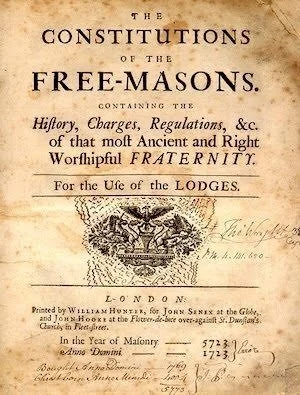
Anderson’s Constitutions, 1723.
Freemasonry took shape in early modern Britain, but its craft traditions already claimed an ancient ancestry. This series follows those inherited legends—and the Egyptian priests, mystery initiates and crusading knights later added to them—to ask what the past helped the fraternity become.
Begin with Article 1: Where Did Freemasonry Come From?
A fraternity with more than one beginning
Ask where Freemasonry came from, and the answer depends on what you are tracing.
The building craft has a medieval history. Its surviving documents include practical regulations and the manuscripts known as the Old Charges, which combined obligations of conduct with legendary accounts of masonry’s origins.
Scottish lodge records and William Schaw’s statutes of 1598 and 1599 reveal organized bodies of working masons. Seventeenth-century evidence shows the admission of men outside the building trade, restricted recognition practices and developing ceremonies.
Grand Lodge government came later. The conventional London foundation date is 1717, although the retrospective account of that beginning remains contested. By the early 1720s, the organization’s public presence becomes clearer, and Anderson’s Constitutions appeared in 1723.
These are connected developments, not one event with a single birthday.
They also complicate a familiar account of the fraternity’s legends. Freemasonry did not first become a modern gentlemen’s society and only afterward go looking for ancient ancestors.
The craft already possessed them.
The ancient past was there early
The Old Charges placed masonry within a distinguished history of knowledge, geometry, sacred building and royal patronage.
Different manuscripts told different versions. The Regius poem included Euclid in Egypt and an assembly under King Athelstan. The Cooke manuscript supplied a more expansive account involving the children of Lamech, the preservation of knowledge and Solomon’s Temple.
These narratives do not establish that an institution descended continuously from biblical builders or ancient geometers.
They do establish that people associated with the craft used a remote past to explain the importance of their work.
Anderson inherited that practice. His Constitutions enlarged it into a printed history reaching from Adam through sacred and classical antiquity to the modern fraternity.
Later writers did not begin with an empty page. They extended an existing habit of ancestry.
Egypt became more than a home of geometry: it became a school of guarded wisdom and initiation. Ancient mysteries supplied comparisons for ritual experience. Crusading knights offered chivalric obligation and stories of survival. Esoteric interpreters found fragments of a universal hidden tradition.
This series asks how those connections were made—and why they remained compelling.
What the series is asking
The central question is not simply whether Freemasonry’s ancient origin stories are true.
It is what kind of connection each story claims.
A resemblance between ceremonies is not the same as borrowing. Borrowing from an ancient text is not the same as inheriting an ancient institution. A modern revival can be historically important without being an unbroken survival.
Those distinctions allow two kinds of history to be studied together:
The development of lodges, membership, ritual and governing institutions.
The stories through which people explained, dignified, transformed or attacked the fraternity.
The second is not a substitute for the first. It is part of the history that needs explaining.
Throughout the series, three questions guide the discussion:
What can the surviving evidence establish?
What did a proposed ancestry offer the people who adopted it?
When did interpretation or symbolic inheritance become a claim of institutional descent?
Why the distinction matters
A Masonic hall decorated in an Egyptian style demonstrates a real adoption of Egyptian imagery. It does not establish descent from an Egyptian priesthood.
A modern Templar ceremony demonstrates a chivalric association. It does not prove that medieval knights secretly transmitted their organization through the intervening centuries.
Neither observation makes the later tradition meaningless.
Symbols can shape conduct. Ceremonies can give membership emotional force. Historical narratives can authorize rules, support institutions and help members understand their obligations.
The difficulty begins when those effects are offered as evidence that the proposed genealogy must be true.
This series takes symbolic meaning seriously while keeping historical claims open to examination.
Choose a starting point
Read in order for the full argument, or begin with the subject that brought you here.
New to Freemasonry, or skeptical of grand origin stories? Start with Article 1: Where Did Freemasonry Come From?.
Interested in how institutions write their pasts? Continue to Article 3, then read the synthesis in Article 8.
Drawn to sacred architecture and symbols? Begin with Solomon’s Temple and ancient Egypt.
Curious about initiation? Read Article 5 on the ancient mysteries.
Here for knights, secret wisdom or conspiracy claims? Turn to Article 6 on the Templars and Article 7 on the occult reputation.
The articles
1. Where Did Freemasonry Come From?
A building craft, a system of lodges, developing ceremonies and Grand Lodge government did not begin together. This opening article separates those histories, examines the evidence before 1717 and explains why ancient ancestry already belonged to the craft’s medieval written traditions.
2. Why Solomon’s Temple Matters to Freemasonry
A biblical building became a setting for later ritual and moral instruction. Follow the difference between the scriptural craftsman Hiram and the Masonic drama—and discover why the Temple’s symbolic importance does not establish institutional descent.
3. How Freemasonry Wrote Its Ancient History
Anderson’s Constitutions placed an expansive history before the fraternity’s charges and regulations. This article follows the movement from manuscript craft legends to an approved printed narrative, asking how ancestry helped explain identity and authority.
4. Why Freemasons Looked to Ancient Egypt
Egypt already appeared in craft legends as a home of geometry. Later readers found much more: Hermetic wisdom, mysterious writing, priestly education and imagined initiation beneath a pyramid. Follow those interpretations into Viennese Masonic culture, The Magic Flute and Egyptian revival architecture.
5. Did Freemasonry Descend From the Ancient Mysteries?
Eleusis, Isis and Mithras belonged to distinct traditions, not one ancient institution. This article examines why Masonic writers compared their ceremonies with ancient initiation—and separates analogy, influence, revival and descent.
6. The Templars, Chivalry, and the Masonic Imagination
Ramsay’s Crusader narrative was not an explicit Templar genealogy. Follow the development of the Strict Observance, the reconsideration of succession at Wilhelmsbad and the survival of chivalric symbolism after claims of medieval continuity lost credibility.
7. Who Gave Freemasonry Its Occult Reputation?
There was no single author. Esoteric Masons, magical societies, Lévi, Pike, popular writers and hostile fabricators contributed different things. This article distinguishes genuine organizational connections from symbolic readings, retrospective origin theories and invented accusations.
8. Why Freemasonry Keeps Acquiring Ancient Ancestors
The concluding essay brings the cases together. It proposes five ways ancestral stories gained appeal and authority, from adaptable building symbols to repetition in print, while keeping the inherited medieval legends in view.
What “More Light” means here
The title draws on Masonic language associating light with knowledge and understanding.
Here, it names a historical purpose: to distinguish evidence from interpretation without stripping the interpretations of their significance.
The series does not promise the recovery of a concealed ancient doctrine. It asks how claims about such doctrines arose, who circulated them and what happened when people accepted them.
A history worth understanding
Freemasonry’s documented development is not an embarrassment to be repaired with a more impressive ancestry.
Nor are its ancient stories irrelevant because their genealogies cannot be demonstrated.
The craft’s medieval legends, Anderson’s printed history, Egyptian reconstructions, chivalric systems and esoteric readings all belong to the fraternity’s history. They belong in different ways.
The useful approach is to examine the connections rather than assume them.
Who first made a claim? What sources were available? What did later writers add? Does the evidence show continuity, borrowing, revival—or a meaningful resemblance?
Those questions make the subject more interesting, not less.
Begin the series: Where Did Freemasonry Come From?
Endnote
Image: John Pine, frontispiece to James Anderson, The Constitutions of the Free-Masons (London, 1723). Montagu presents the constitutional scroll and compasses to Wharton; Desaguliers stands at the far right. Source: Grand Lodge of British Columbia and Yukon, via Wikimedia Commons. Public domain.
Suggested background reading
David Stevenson, The Origins of Freemasonry: Scotland’s Century, 1590–1710 (Cambridge University Press, 1988). Scottish lodge organization, ritual and intellectual culture.
Margaret C. Jacob, Living the Enlightenment: Freemasonry and Politics in Eighteenth-Century Europe (Oxford University Press, 1991). Lodges within the social and political history of the Enlightenment.
Peter Partner, The Murdered Magicians: The Templars and Their Myth (Oxford University Press, 1982). The medieval order and its later legendary afterlife.
Henrik Bogdan, “Freemasonry and Western Esotericism”, in Henrik Bogdan and Jan A. M. Snoek, editors, Handbook of Freemasonry (Brill, 2014), pp. 277–305. A focused treatment of the fraternity’s varied esoteric connections.
Andrew Prescott and Susan Mitchell Sommers, “Searching for the Apple Tree: Revisiting the Earliest Years of Organized English Freemasonry” (2018). A challenge to the conventional account of Grand Lodge’s foundation in 1717.

