The Chariot Within
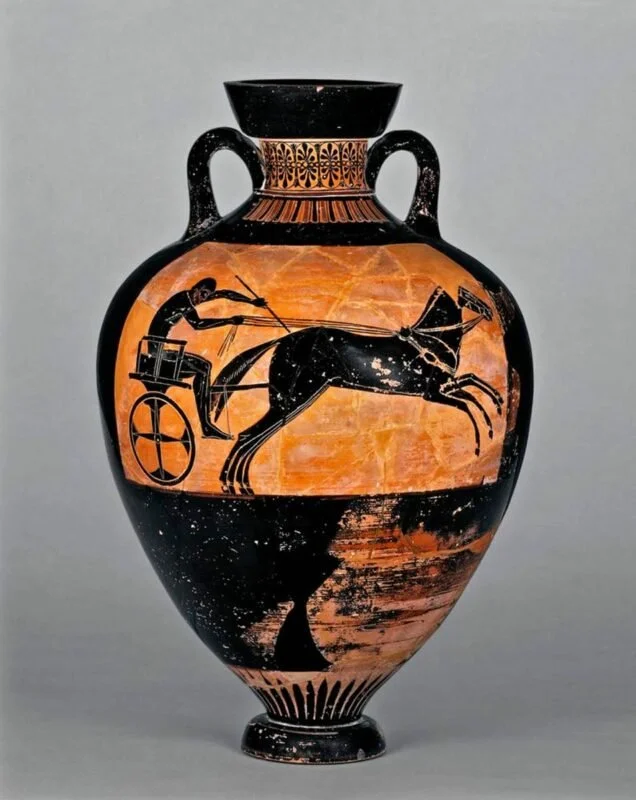
Panathenaic Amphora, 500-480 BCE, via the British Museum, London
Plato, Desire, and the Education of the Soul
Plato’s famous winged chariot is not a diagram of repression. It is a demanding picture of human freedom: the task of teaching reason, courage, desire, and love to move toward the same horizon.
Plato’s chariot is not a car.
It has no steering wheel, no brakes, no cup holder, and no reliable warranty. It is a winged vehicle drawn by two horses that do not always agree on the destination. The charioteer has the unenviable task of guiding them upward toward beauty, truth, and the divine while one horse responds to discipline and the other appears prepared to gallop after whatever happens to be attractive at the moment.
In other words, Plato has provided an unusually accurate picture of a human being.
The image appears in the Phaedrus, where Socrates describes the soul as a winged chariot. The charioteer represents reason. One horse is noble, orderly, courageous, and responsive to shame and honor. The other is unruly, appetitive, self-willed, and difficult to govern. The soul follows the gods toward the intelligible realm, struggles to behold truth, loses its wings when it fails to maintain order, and enters embodied life.1
The myth is not about killing the inferior horse. It is about the difficult education of desire. Plato does not ask us to become less alive. He asks whether the different powers within us can be taught to move toward a common good.
That makes the chariot one of the finest ancient images of moral formation.
It also makes it a natural companion to the Masonic concern with self-knowledge, discipline, education, the liberal arts, and the construction of an inward life equal to the symbols one has received.
What the Chariot Series means
The Charioteer completes the philosophical movement already begun in the Heracles, Ulysses, Jason, and Cave essays.
| Series | Central image | Primary question |
|---|---|---|
| Hercules: Heracles Within | Wilderness and Labors | What must be conquered within the self? |
| Ulysses: The Long Way Home | Sea, cave, and Ithaca | How does the soul navigate illusion and return to order? |
| Jason: The Golden Fleece Within | Ship, fellowship, and prize | How does a person become worthy of success and responsibility? |
| Plato: The Chariot Within | Charioteer and two horses | How are reason, desire, courage, beauty, and love educated into harmony? |
The ancient source base is especially strong. Plato’s Phaedrus supplies the myth itself, while Hermias of Alexandria’s surviving commentary is the only complete Neoplatonic commentary on the dialogue. Hermias reads the dialogue as an exploration of the soul, its immortality, its divine relation, its fall into embodied life, and its possible ascent through beauty, love, and philosophy.[1][5][5]
The series will not claim that the Phaedrus is a disguised Masonic degree. It is not. The value lies in philosophical comparison. Both Platonic education and Masonic symbolic instruction ask whether a human being can learn to govern himself, direct his powers rightly, and become more adequate to truth, beauty, fellowship, and duty.
The chariot is not merely a mythic object.
It is the soul under instruction.