Music in the Lodge
Harmony as moral education
A fellowship is not made harmonious by eliminating difference. It becomes harmonious when different voices learn their relation to a shared measure.
A lodge does not need to become an orchestra to learn from music.
Though, in fairness, some meetings would benefit from a conductor.
The point is not that every Mason should sing, read music, or acquire a lyre. The point is that music offers one of the clearest images of fellowship.
A note by itself is limited.
A chord requires difference.
A melody requires movement.
A rhythm requires measure.
A performance requires listening.
Harmony is not the absence of difference.
It is the achievement of relation.
The distinct voices of a fellowship
A lodge gathers different people.
Some are quiet. Some are talkative. Some are practical. Some are philosophical. Some are new. Some have been present for decades. Some are gifted ritualists. Some are gifted workers. Some know history. Some know how to welcome. Some can organize. Some can repair. Some can teach. Some are still trying to find the coffee.
The purpose is not to erase these differences.
The purpose is to place them in relation to a common work.
A fellowship becomes dissonant when private needs become louder than the shared measure.
One person must always be heard.
One grievance must always be revisited.
One office becomes more important than the institution.
One tradition becomes a weapon rather than a gift.
One innovation becomes a test of loyalty.
One conflict overwhelms the larger work.
This is not harmony.
It is a room full of instruments tuning forever.
Orpheus and the Sirens
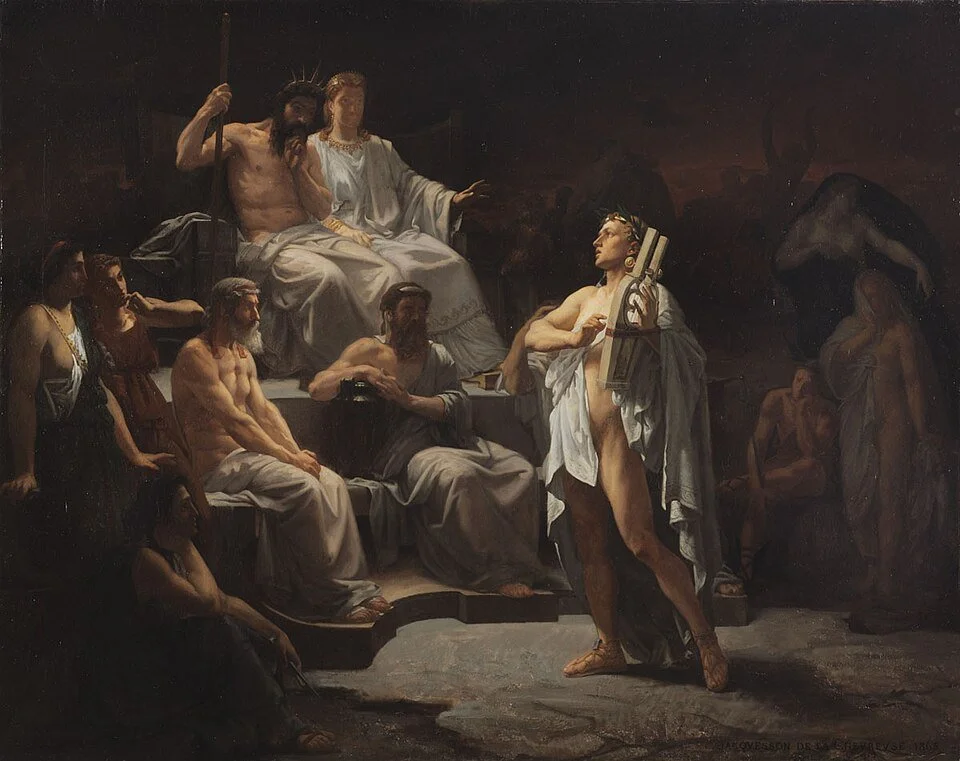
Orpheus’ encounter with the Sirens gives us a powerful contrast.
The Sirens sing beautifully, but their beauty isolates. Each listener becomes absorbed by private desire. The ship’s shared purpose dissolves. The sailors forget where they are going.
Orpheus sings differently.
His music preserves relation. It helps the Argonauts remain a crew. It counters the song that would turn each man inward toward his own fascination.
This is a useful image for every institution.
Some speech is Siren speech.
It flatters.
It inflames.
It gives the listener the pleasure of being right, offended, superior, or uniquely perceptive.
It makes the group less capable of common work.
Other speech is Orphic.
It does not erase difficulty. It gives difficulty a form in which people can continue moving together.
It reminds a group of its larger purpose.
It creates enough order for distinct people to act as a fellowship.
The ritual measure
Ritual, at its best, can provide this common measure.
It slows the individual down.
It gives words that do not belong to one person’s private mood.
It places each participant within a pattern of relation.
It reminds the group that its work is larger than any one personality.
But ritual alone is not harmony.
The words must become habits.
The symbols must influence conduct.
The fellowship must learn how to listen, correct, forgive, teach, serve, and remember.
A beautiful ritual performed by people who cannot treat one another with dignity is like a fine instrument played badly.
The object is not at fault.
The relation is.
The ethical role of harmony
Harmony should not be confused with avoidance of disagreement.
A chord contains tension.
A good musical piece may include dissonance, conflict, sorrow, and force. What makes it music rather than noise is that these elements are held within form.
A healthy lodge can contain disagreement.
It can debate.
It can correct.
It can change.
It can remember.
It can face difficult truths.
But it must do these things within a shared commitment to dignity, truth, charity, and the common good.
The aim is not to make everyone sound the same.
The aim is to ensure that no one’s private noise becomes the whole song.
Orpheus teaches that a fellowship needs more than strength.
It needs a common measure.
Harmony is not the absence of difference.
It is the achievement of relation.
Endnotes and further reading
Plato, Republic Book III, on music, education, rhythm, harmony, and character.
Apollonius Rhodius, Argonautica, on Orpheus’ role in the Argonautic fellowship and his countering of the Sirens.[3]
Aristotle, Politics Book VIII, on music and education.
Related reading: “The Argo Is Not a Solo Project” and “The Friend Who Will Not Applaud at the Wrong Time.”