The Quadrivium and the Recovery of Order
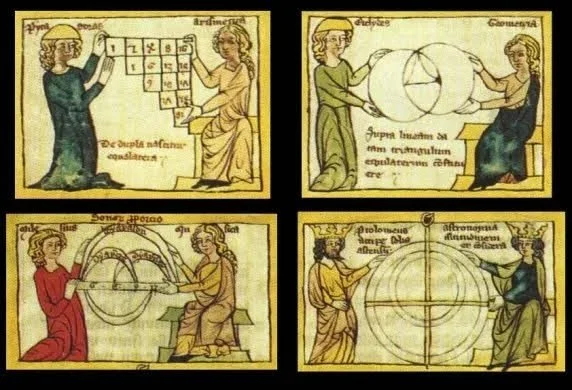
Number, proportion, harmony, and measure train the mind to encounter realities that do not bend to opinion. The quadrivium reminds us that freedom requires contact with order beyond ourselves.
The modern imagination often treats the quadrivium as a museum piece.
Arithmetic, geometry, music, and astronomy can sound like relics from an educational world too old to guide a technological society. If they are remembered at all, they are often treated as quaint stages in the prehistory of specialized knowledge. But in the older tradition, these arts were not curiosities. They formed the mind’s relation to order.[1]
That purpose remains intelligible. And necessary.
Where the trivium disciplines language and reasoning, the quadrivium disciplines perception of pattern, measure, relation, and harmony. It teaches the mind that reality possesses intelligible structure not created by whim. Number is not persuaded. Proportion is not intimidated. Harmony is not altered by preference. The stars do not consult our moods.
This is spiritually useful.
A culture dominated by self-expression easily forgets that freedom depends in part on submission to what is not oneself. The disciplined mind must learn to recognize forms of order it did not invent. Otherwise, thought contracts into appetite and education shrinks into technique. The self becomes the measure of everything precisely when it has become least capable of measuring well.
The quadrivium interrupts that illusion.
Arithmetic trains the mind in discrete intelligibility. Geometry directs it toward form and relation in space. Music, in the classical sense, concerns proportion and harmony apprehended through number and pattern as much as through performance.[2] Astronomy turns attention toward lawful motion and cosmic order. Together, these arts cultivate intellectual humility before a reality that is structured whether or not we feel like acknowledging it.
That humility is liberating.
It frees a man from confinement within the merely immediate. He begins to see that truth is not exhausted by utility, and that some of the most important acts of knowing consist in beholding order rather than manipulating outcomes. This is one reason older educational traditions treated the mathematical arts as formative of the soul, not merely preparatory for engineering.
Masonry has its own symbolic affinity with this vision.
Its language is full of measure, proportion, structure, form, and right relation. The working tools themselves testify that making is not arbitrary. Stones are not fitted by enthusiasm alone. Construction requires standard, limit, and intelligible design. A lodge attentive to its own symbolic inheritance should recognize in the quadrivium a companion discipline: an education in order against chaos, proportion against distortion, and permanence against fashionable improvisation.
This matters more than it may first appear.
Many contemporary minds are overstimulated but underordered. They move quickly among impressions yet struggle to dwell with structure. They are rich in reaction and poor in proportion. They can access vast amounts of information while losing the sense that some realities must be contemplated patiently if they are to be known at all.
The quadrivium counters this restlessness.
It requires patience before necessity. It invites the mind to discover instead of invent, to receive instead of project. Such habits are not anti-modern. They are antidotes to one of modernity’s constant temptations: the belief that the real is whatever can be immediately used, displayed, or redesigned.
The deeper lesson is moral as well as intellectual.
A person formed by measure becomes less vulnerable to exaggeration. A person formed by proportion becomes less vulnerable to frenzy. A person formed by harmony becomes less attracted to shrillness and rupture. A person formed by order becomes less willing to live by improvisation alone.
These are not mathematical virtues in the narrow sense. They are human ones.
To say this is not to romanticize the past or pretend that every student must become a medieval cosmologist. The point is more basic. The quadrivial arts represent a posture of mind: one that seeks intelligible order and allows itself to be shaped by it. In an age suspicious of limit and impatient with contemplation, that posture is quietly radical.
A Mason should understand why.
Self-construction is impossible without standard. Formation requires more than sincerity. It requires encounter with measures not of one’s own making. The man who refuses all exterior order in the name of autonomy will not become freer. He will become captive to whatever disorder he happens to prefer.
The quadrivium offers a better freedom.
Not freedom from form, but freedom through form. Not emancipation from reality, but apprenticeship to it.
And where such apprenticeship is neglected, both culture and character begin to lose their shape.
Endnotes
[1] On the quadrivium in the classical and medieval liberal arts tradition, see Hugh of St. Victor, Didascalicon, and standard histories of liberal education.
[2] “Music” in the quadrivium refers not merely to performance but to numerical proportion, relation, and harmony.
Brief Bibliography
Hugh of St. Victor, Didascalicon
Boethius, Fundamentals of Music
Josef Pieper, Leisure: the Basis of Culture
Stratford Caldecott, Beauty for Truth’s Sake