Why Masons Talk in Stones, Tools, and Symbols: A Personal Introduction
The first time I really noticed the square and compasses, it wasn’t in a lodge room. It was on a weathered headstone in a Queens cemetery, half-hidden by ivy, next to a name I didn’t recognize. I knew it meant “Mason,” but I didn’t know what that meant. Years later, sitting in a lodge room for the first time, I learned that the square isn’t just a stonemason’s tool—it’s a reminder to “square my actions” with everyone I meet. The compasses, I was told, are about boundaries: knowing where my freedoms end and my responsibilities begin.
None of that was whispered in a dark room. It’s written on Grand Lodge websites, in public books, and in plain view on buildings all over the world. What was transformative wasn’t the information—it was realizing I was expected to live it.
I’m a Freemason who leans into the observant and symbolic style of lodge work: the kind that takes its time with ritual, sits with the symbols, and asks what they demand of us in ordinary life. On this site, I’ll write about Masonic symbols the way I try to understand them: honestly, conversationally, and without giving away anything that belongs inside the lodge.
This page is your starting point: what Masonic symbols are, why we use them, what various Grand Lodges, famous Masons, and thinkers have said about them, and how symbolic thinking itself works. It’s written for three kinds of readers:
Outsiders who are curious (or wary) and want a clear, no-nonsense explanation.
Men considering joining who want to know what they’re actually stepping into.
Brethren who might see their own experience reflected—or gently challenged—in how I describe it.
What Masonic Symbols Are (and What They’re Not)
At its simplest, Masonic symbolism is the use of stonemasons’ tools, architecture, and moral images to teach ethical lessons. The square, compasses, level, plumb, trowel, rough and perfect ashlar—these are not secret codes. They are working tools turned into moral teachers.[1][2][3]
As one Masonic lodge puts it:
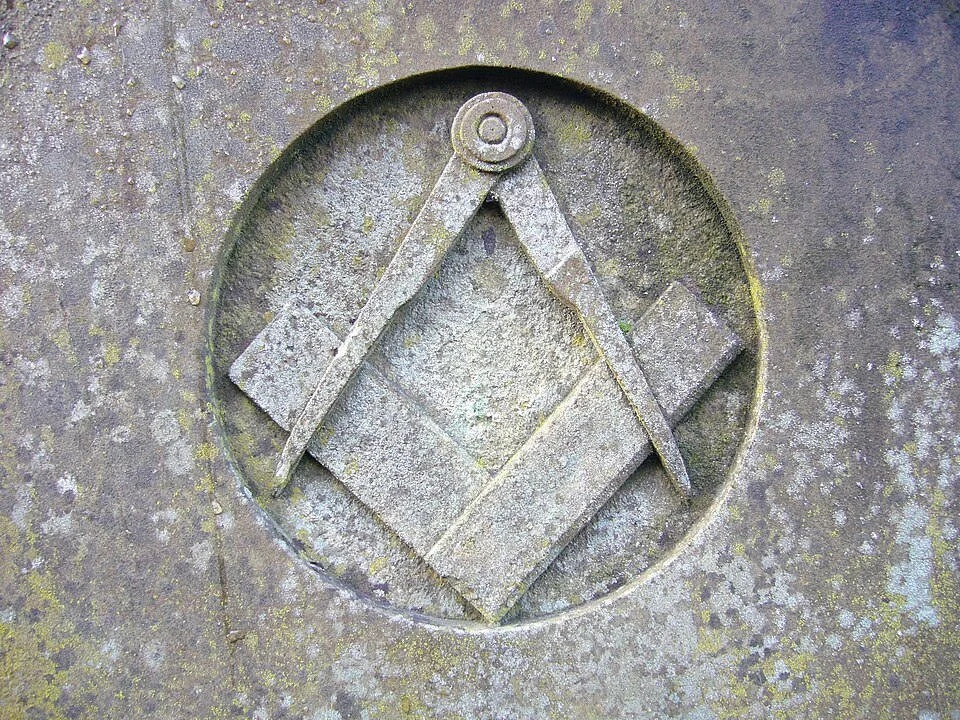
Masonic cornerstone, Great Falls, Montana.
“Symbols do not conceal the meaning of Freemasonry; they reveal it. Symbols do not obscure the teachings; they make them perfectly clear.”[4]
That’s the key. In Freemasonry, symbols are not meant to hide truth from outsiders; they are meant to make truth memorable and actionable for those who work with them.
What Grand Lodges Publicly Say
Across Regular (observant) Freemasonry, Grand Lodges are remarkably consistent in how they describe the core symbols:
Grand Lodge of Ohio explains the working tools this way:
Square: “Ensure they are right and just in their actions.”
Level: Teaches equality and unity in diversity.
Plumb: Symbol of rectitude of conduct and integrity of life.[2]
Freemason.org (California) lists the most common symbols and their public meanings:
Square and Compass: Morality and boundaries.
Apron: A badge of a Mason, linked to the work garments of operative masons, now a symbol of innocence and participation.
Trowel: Spreading the “cement of brotherly love.”[3]
The Square Magazine and other Masonic publications describe the Square and Compasses as “the single most identifiable symbol of Freemasonry,” derived from the tools of medieval stonemasons and representing the way Masonic teachings “work to build better men.”[1]
On the letter G in the center of the square and compasses, public sources agree on at least this: it stands for Geometry, the science that underpins stonemasonry and speculative Masonry. Many Masons also associate it with God (the Grand Architect), but that is often presented as a common personal interpretation rather than a fixed dogma.[3][5]
In short, if you visit most Regular Grand Lodge websites, you will find the same basic set of symbols explained in much the same way. That’s not an accident; it’s by design.
Why Symbols at All? The Purpose of Symbols in Freemasonry
Freemasonry could, in theory, hand out pamphlets with bullet points: “Be honest. Be fair. Be charitable.” It doesn’t, because symbols do something that bullet points can’t.
1. Symbols Make Ideas Memorable
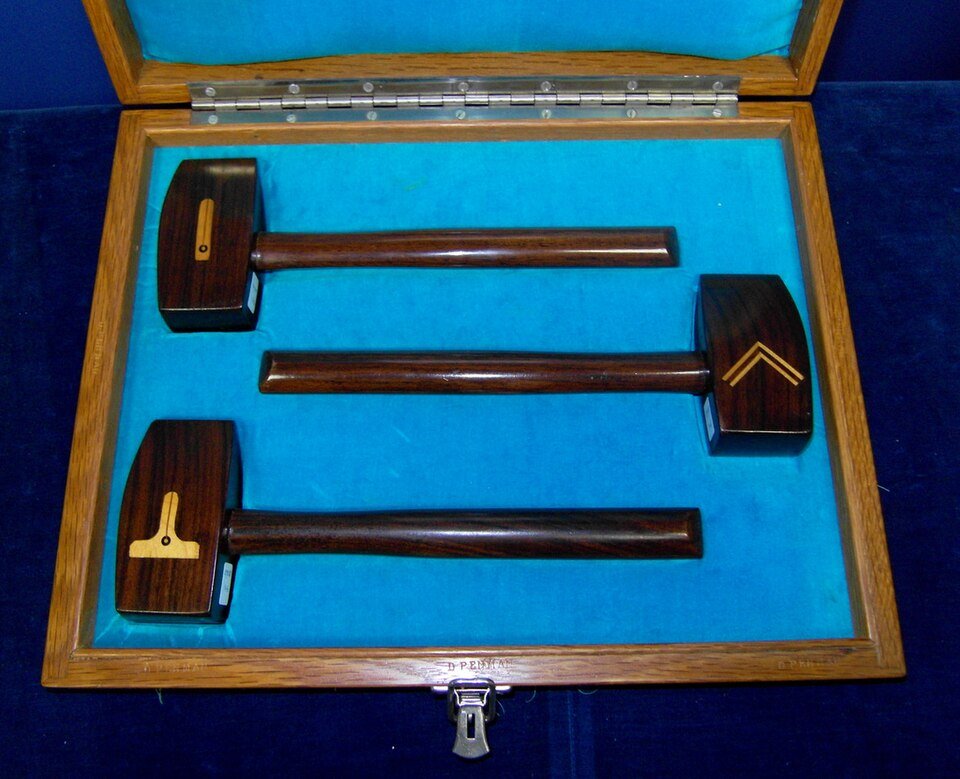
Lodge master's and wardens' gavels.
A slogan is forgettable. A symbol sticks.
“Be moral” is abstract.
“Use the square to square your actions” is concrete, visual, and repeatable.
As one Masonic writer notes, the emblem of the square and compasses, often with the point within a circle, “encapsulates the relationship between the Great Architect and creation, mapping our individual lives on the circumference.” That’s a poetic way of saying: the symbol gives you a mental map you can carry with you.[6]
2. Symbols Work on More Than One Level
A good symbol is never exhausted by a single explanation. The rough ashlar (the unpolished stone) can mean:
The individual Mason at the start of his journey.
Humanity in its imperfect state.
The parts of ourselves we still need to work on.
You can return to the same symbol years later and find new meaning in it. That’s intentional. As one Masonic commentator puts it:
“These symbols and the hidden meanings they convey cannot be communicated to everyone at once. They are, by their nature, hidden… a secret is an experience you live through, and not merely information you receive.”
That doesn’t mean the symbols are “secret” in the conspiracy sense. It means their full force is experiential, not just informational.
3. Symbols Create a Shared Language
When Masons talk about “meeting on the level and parting on the square,” they’re using a shorthand that carries a whole worldview: equality, fairness, integrity. That shared language helps create a sense of belonging without requiring uniformity of thought. You and I might apply the square differently in our lives, but we both know what it’s pointing at.[3][5]
What Famous Masons and Thinkers Have Said About Masonic Symbols
Freemasonry has always attracted men of letters, science, and public life. Some of them wrote explicitly about Masonic symbols; others embodied the symbolic approach in their work.
Masonic Authors and Leaders
Albert G. Mackey, one of the most influential Masonic writers, treated symbolism as central to the Craft. In his Encyclopedia of Freemasonry, he argues that Masonic symbolism is the primary method by which the order teaches moral and philosophical truths. (His works are widely cited in Masonic education and are available in many public-domain editions.)
Albert Pike, in Morals and Dogma (a Scottish Rite text), goes deep into symbolic and philosophical interpretation. Pike is controversial in some circles, but even his critics acknowledge that he took Masonic symbolism seriously as a system of thought, not just decoration.
Rudyard Kipling, a Mason and master storyteller, wove Masonic symbols and themes into stories like “The Man Who Would Be King” and “In the Rukh.” He doesn’t lecture about symbols; he lets them work through narrative, which is itself a very Masonic move.
Mark Twain (often debated as to whether he was formally initiated, but deeply engaged with Masonic themes in his milieu) used fraternal and symbolic language to critique society. Whether or not he was a Mason, his work shows how symbolic thinking can be used to question power and pretense.
Non-Masonic Thinkers on Symbolism
Even thinkers outside Freemasonry have commented on the power of symbols in ways that resonate with Masonic practice:
Carl Jung wrote extensively on symbols as expressions of the unconscious and as tools for individuation. He didn’t write about Masonic symbols per se, but his idea that symbols mediate between conscious and unconscious mind aligns closely with how Masons use symbols to work on character.
Joseph Campbell, in The Hero with a Thousand Faces and other works, described how myths and symbols carry universal patterns. Masonic ritual and symbolism fit neatly into this framework: a symbolic journey through degrees, trials, and transformations.
C.S. Lewis and J.R.R. Tolkien, though not Masons, understood the power of symbolic narrative. Lewis wrote about “true myth” and the way stories can convey truths that plain propositions cannot. That’s essentially what Masonic symbolism attempts: truth embodied in image and action.
These voices don’t define what Masonic symbols “must” mean, but they help explain why symbols work the way they do in a fraternity like ours.
Symbolic Thinking: How to Read a Masonic Symbol
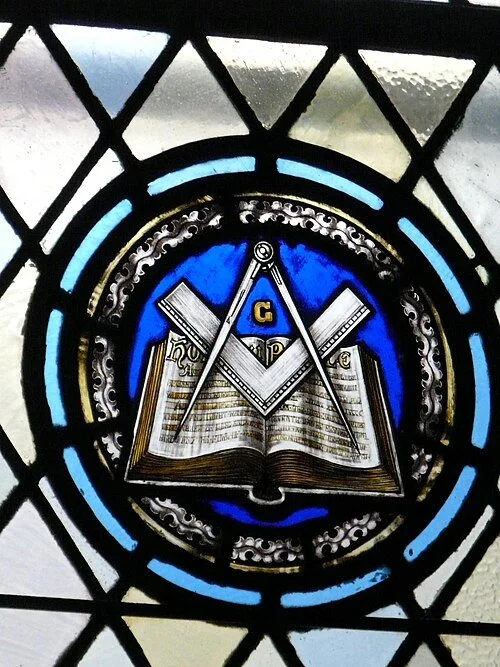
Square and compasses, stained-glass window.
If you’re not used to symbolic thinking, it can feel vague or mystical. It doesn’t have to be. Here’s a simple way to approach a Masonic symbol:
1. Start With the Tool’s Original Use
Ask: What did this tool do for a stonemason?
- Square: Checked that corners were true, that stones fit together properly.
- Level: Ensured a surface was horizontal, that things were even.
- Plumb: Verified that a wall was vertical, straight up and down.
- Trowel: Spread mortar to bind stones together.
- Compasses: Drew circles, set boundaries, laid out proportions.13
2. Ask: What Moral Lesson Does That Suggest?
Then ask: If this tool were about character instead of stone, what would it measure?
- Square → Morality, fairness, “squaring your actions” with others.2
- Level → Equality; “meeting on the level” regardless of outside status.
- Plumb → Integrity, uprightness, justice in how you live.2
- Trowel → Spreading brotherly love to unite people instead of dividing them.3
- Compasses → Boundaries, self-restraint, keeping passions within due bounds.5
3. Bring It Into Your Own Life
Finally: Where does this apply right now?
- “Where am I cutting corners instead of using the square?”
- “Am I treating this person as an equal, or am I letting status get in the way?”
- “Is my life ‘plumb’ in this situation, or am I leaning toward convenience?”
- “Am I using my trowel to build bridges or walls?”
- “Where do I need to draw a compass line and say, ‘This far, no further’?”
That’s symbolic thinking in practice: not vague mysticism, but concrete moral reflection using a shared image.
A Few Core Masonic Symbols, Briefly
Here are the symbols I’ll return to often on this site, all of which are publicly explained by Grand Lodges and Masonic authors:13
Square and Compasses (with or without the G)
Level and Plumb
- Level = equality, “meeting on the level.”
- Plumb = uprightness, integrity, rectitude of conduct.2
Rough and Perfect Ashlar
- Rough = the unpolished person we start as.
- Perfect = the person we’re trying to become through moral work.3
Trowel
- Spreading the cement of brotherly love to unite the fraternity.3
Apron
- A badge of a Mason, historically linked to operative masons’ work garments, now a symbol of innocence and participation.3
Pillars (often seen in Masonic art and architecture)
- Publicly associated with strength and establishment, often linked to the two great pillars at the entrance of King Solomon’s Temple.
All-Seeing Eye / Eye of Providence
- Often associated with Freemasonry in popular culture; present in Masonic art, but not exclusively Masonic. Many conspiracy claims (e.g., about the Great Seal) are historically dubious.3
I won’t use these symbols as secret signals or claim they give Masons special powers. I’ll use them the way our public literature does: as moral images to think with.
What I Won’t Write About (and Why)
I want to be explicit about limits, because trust matters.
As a Mason, I’ve taken obligations not to reveal certain things—not because they’re scandalous, but because they’re meant to be experienced in lodge, not explained on a website. Those include:
- Modes of recognition (grips, signs, tokens).
- Passwords or “secret words.”
- Detailed ritual sequences and exact wording of obligations.
- Internal lodge layouts or officer stations in ways that reveal ritual work.[8]
A good rule I follow: If a symbol and its moral meaning are explained on official Grand Lodge websites or in public Masonic books, I can discuss it. If it’s clearly part of the “secrets” we’re obligated to conceal, I won’t.[8]
That doesn’t make Masonry mysterious in a sinister way. It just means that some parts of the work are like a play: you can read the synopsis, but the impact comes from being in the room when it’s performed.
How I’ll Write About Symbols on This Site
Going forward, when I write about a Masonic symbol, I’ll usually:
Start with a story or image – how I encountered the symbol in real life.
Give the public meaning – what any Grand Lodge website would say about it.13
Offer my personal take – where I struggle with it, where it challenges me.
Speak to three audiences:
- Outsiders: “This is what it actually means, minus the myths.”
- Men considering joining: “This is the kind of inner work you’ll be doing.”
- Brethren: “Here’s how I’m trying to live it; how about you?”
Close with an invitation – to ask questions, read more, or visit a lodge’s public site.
If you’re a Mason reading this and you disagree with my take on a symbol, that’s fine. Part of working with symbols is that they’re never fully exhausted by one person’s interpretation. If you’re not a Mason, I hope this gives you a clear, honest picture of what we’re doing when we talk about squares, compasses, levels, and stones.
Where to Go From Here
This page is the foundation for a larger series on Freemasonry: its history, symbols, members, and legacy. From here, you might:
- Read the overview of what Freemasonry is (and isn’t), including Anderson’s 1723 Constitutions, the fundamental principles, and how observant/symbolic lodge work fits in.
- Dive into individual symbol articles (square and compasses, level and plumb, rough and perfect ashlar, etc.).
- Explore pieces on Masonic history, notable Masons, and how lodges actually function.
If you’re curious, skeptical, or already in the Craft, my hope is that this site treats symbols the way they deserve: not as decorations, not as secrets to be hoarded, but as tools for thinking and living.
Selected Public Sources Mentioned
- Grand Lodge of Ohio: “Masonic Working Tools,” “What is the Masonic Cipher?”2
- Freemason.org (California): “Freemasonry Symbols”3
- The Square Magazine: articles on 1723 Constitutions and Masonic structure
- General Masonic resources on Square and Compasses, symbolism, and public meanings15
- Discussions on what may be publicly disclosed about Masonry[8]
Sources
Author’s note:
I write as an individual Freemason, historian, and researcher. This article reflects my personal research and interpretation and does not represent an official statement of Advance Service Mizpah Lodge No. 586, the Grand Lodge of New York, or any other Masonic organization.
Images
Stone Carved Square & Compasses - Public domain (Nabokov), via Wikimedia Commons.
Gavel Image - © Chelm261, CC BY-SA 3.0, via Wikimedia Commons.
Stained Glass Window with Square & Compasses - © Robert Adamski, CC BY-SA 4.0, via Wikimedia Commons.
1 Masonic Symbols in America: A 250th Anniversary Reflection https://www.freemason.com/masonic-symbols-american-founding-blog/
2 Masonic Working Tools - Freemasonry - Grand Lodge of Ohio https://www.freemason.com/masonic-working-tools/
3 Freemasonry Symbols - Masons of California https://freemason.org/freemasonry-symbols/
4 Symbolism in Freemasonry - Sam P Cochran Masonic Lodge https://www.sampcochran1335.org/symbolism-in-freemasonry.html
5 Learn About Freemasonry Symbols - Freemason blog https://blog.freemason.org/2026/06/21/freemasonry-symbols/
6 Decoding the Square and Compasses https://www.thesquaremagazine.com/mag/article/202109decoding-the-square-and-compasses/
7 The Meaning Behind 15 Common Masonic Symbols - George H Lilley https://www.ghlilley.com.au/blogs/news/freemason-symbols
[8] What are we allowed to discuss openly about Masonry? - Reddit https://www.reddit.com/r/freemasonry/comments/uj1lrl/what_are_we_allowed_to_discuss_openly_about/