Freemasonry: A Reader’s Guide
Understand the fraternity, explore its symbols, and follow its history in Queens
Freemasonry appears throughout this website in two connected ways: as a tradition of symbols and moral reflection, and as a historical institution whose members built lodges, meeting places, and communities.
This guide helps you explore both. Begin with the introductory articles, follow a subject that interests you, or turn directly to the people and places of Queens.
No prior knowledge is required. You can read each article on its own; the suggested order simply gives you a useful path through the collection.
On this page: Start Here · Symbols & Self-Improvement · Lodges, People & Buildings · Where to Go Next
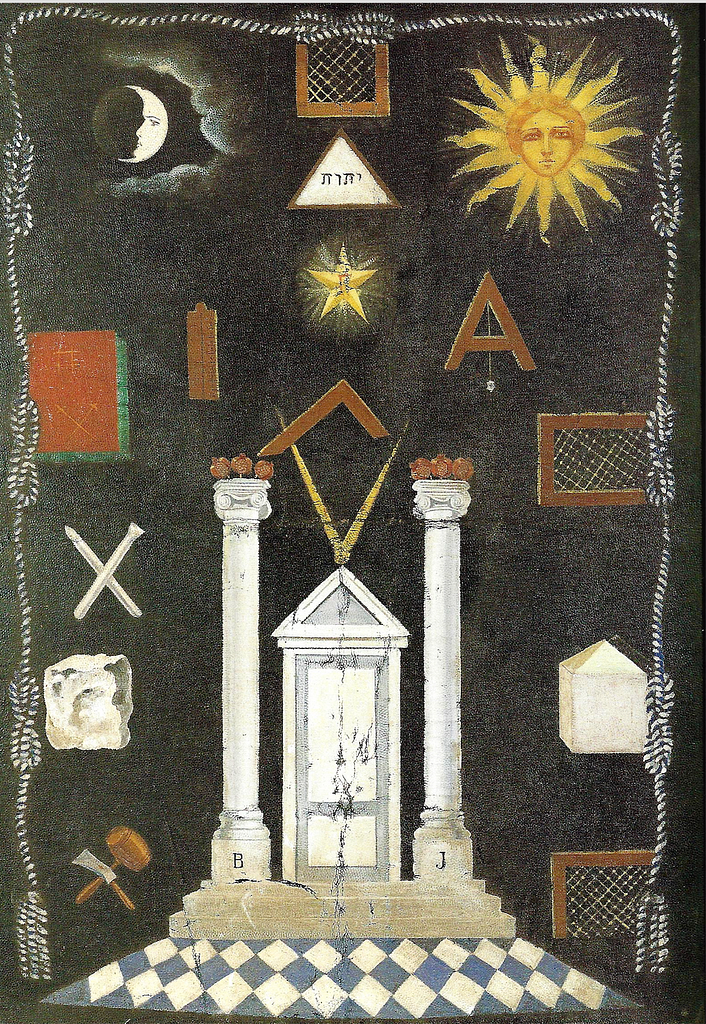
Square and compasses on a German Masonic carpet, c. 1760. Deutsches Freimaurermuseum, Bayreuth, via Wikimedia Commons.

Start here: foundations
Read these in order for an introduction that moves from the larger idea of Freemasonry to particular symbols and the lodge room itself.
What is Freemasonry? Why does it teach through stones, tools, and symbols? And what separates the pursuit of understanding from the pursuit of a title?
These three pairs of essays offer a starting point for exploring the Craft as an institution, a symbolic language, and a discipline of character. Follow the reading order below, beginning with Part 1 of each pair before continuing to Part 2.
1. What Freemasonry Is
Begin with the foundations: the fraternity’s historical framework, the symbolic lodge, and the relationship between ritual, education, and moral formation.
Part 1 — What Freemasonry Is: From Anderson’s Constitutions to the Symbolic and Observant Lodge
Part 2 — What Freemasonry Is: Ritual, Symbol, and Moral Formation
2. Why Masons Talk in Stones, Tools, and Symbols
Continue into the language of the Craft. These essays move from a personal introduction to Masonic symbolism toward the relationship between working tools and inner work.
Part 1 — Why Masons Talk in Stones, Tools, and Symbols: A Personal Introduction
Part 2 — Why Masons Talk in Stones, Tools, and Symbols: From Working Tools to Inner Work
3. Some Men Want Light. Some Just Want a Title.
Then consider the difference between seeking understanding and seeking recognition. These essays connect Mackey’s three classes of Masons with questions of office, ambition, and the inward life.
Part 1 — Some Men Want Light. Some Just Want a Title: Mackey’s Three Classes of Masons
Part 2 — Some Men Want Light. Some Just Want a Title: Office, Ambition, and the Inward Life
More Light: Freemasonry and the Ancient Past
Where did Freemasonry come from — and why do its stories so often lead back to Solomon’s Temple, ancient Egypt, the mystery religions, or the Knights Templar?
More Light explores the relationship between Freemasonry’s documented history and the older traditions through which people have interpreted it. The series asks how origin stories develop, what ancient symbols can mean, and why historical descent and symbolic resemblance are different questions.
Begin with More Light: An Introduction to the Series, then follow the reading path below. You can also choose an individual essay by subject.
Read the Series in Order
Where Did Freemasonry Come From?
Start with the question of historical origins before considering claims about a more distant past.Why Solomon’s Temple Matters to Freemasonry
Explore the Temple’s place in Masonic symbolism and the questions its importance raises about history and meaning.How Freemasonry Wrote Its Ancient History
Turn to Anderson’s Constitutions and the telling of Freemasonry’s ancient past.Why Freemasons Looked to Ancient Egypt
Consider Egypt’s appeal within the Masonic imagination and the distinction between inspiration and ancestry.Did Freemasonry Descend From the Ancient Mysteries?
Examine a recurring question about initiation, ancient religion, and the evidence needed to establish continuity.The Templars, Chivalry, and the Masonic Imagination
Follow the series into the relationship between medieval knighthood, chivalric ideals, and Masonic storytelling.Who Gave Freemasonry Its Occult Reputation?
Explore how Freemasonry came to be associated with occult traditions and interpretations.Why Freemasonry Keeps Acquiring Ancient Ancestors
Finish with the larger question: why do claims of ancient ancestry remain so compelling?
Where to Go Next
Continue with Masonic Symbols to explore the language of tools, stones, and symbolic teaching.
For a related study of ritual materials and their interpretation, explore Corn, Wine, and Oil.
Where to Go Next
After these introductions, explore individual symbols and their related questions:
Symbols and self-improvement
Interested less in dates and buildings than in what these ideas ask of a person? Continue here.
Time, attention, and useful habits
The Benjamin Franklin collection offers a practical route into questions of learning, reflection, and the use of time.
Start with:
Benjamin Franklin, Journaling, Time, and Self-Education
Then explore:
The Twenty-Four-Inch Gauge, Benjamin Franklin, and the Problem of Time
Benjamin Franklin’s Daily Routine: Journaling, Virtue Tracking, and Self-Improvement
Benjamin Franklin, Commonplace Books, and the Discipline of Keeping Useful Notes
Benjamin Franklin’s Self-Education and the Discipline of Learning for Yourself
Masonic Symbols & Symbolic Thinking
A stone, a pair of pillars, a working tool, a carefully arranged room: why use these things to explore questions about human character?
This series considers how Freemasonry brings ideas into contact with objects, actions, places, and relationships. It moves from the rough and perfect ashlars and the two pillars to the larger questions of ritual, secrecy, brotherhood, initiation, and moral responsibility.
The concern throughout is not simply what a symbol means, but how thinking with it might change what we notice—and what we do.
Visit the series introduction and reading guide
Begin with the Foundations
What Freemasonry Is: Ritual, Symbol, and Moral Formation — Begin with the relationship between the fraternity, its practices, and its concern with the work of character.
Why Masons Talk in Stones, Tools, and Symbols: From Working Tools to Inner Work — Consider why the objects and language of building offer ways to examine human conduct.
Some Men Want Light. Some Just Want a Title: Office, Ambition, and the Inward Life — Examine the difference between seeking recognition and undertaking the work that recognition is supposed to represent.
Think with Objects and Spaces
The Two Pillars — Explore strength, establishment, and the questions raised by an architectural symbol.
Rough and Perfect Ashlar: The Masonic Work of Self-Improvement — Consider what the image of shaping a stone can teach about character—and where the comparison reaches its limits.
The Working Tools — Follow the movement from practical tools to questions of moral effort, judgment, and daily conduct.
Why the Lodge Room Is Laid Out Like a Map of the Mind — Consider how an arranged space can become a setting for attention, reflection, and instruction.
From Symbolic Thought to Shared Practice
Why Secrecy Is Not the Same as Wisdom — Distinguish having access to something private from understanding something well.
Why Ritual Works Even When You Don’t Fully Understand It — Explore the relationship between participation, repetition, and understanding.
Why Brotherhood Is Harder Than Friendship — Ask what fellowship requires when personal affection and agreement are not enough.
Why Symbols Say Things Plain Language Cannot — Consider what an object, image, or enacted experience can bring to a question that a definition leaves unfinished.
Why Initiation Is About Transformation, Not Information — Examine the difference between receiving an explanation and undertaking a change in how one lives.
Why Moral Architecture Is More Than a Metaphor — Bring the series together through the relationship between individual character and the structures people build and sustain together.
How to Read These Essays
Read in order for the full progression, or begin with the question that interests you most.
Throughout the series, keep three questions in view: What does this symbol ask us to notice? Where does the interpretation help, and where might it mislead? What difference would the idea make outside the lodge?
Ambition and the inward life
For a more searching question — whether recognition and responsibility are the same thing — read:
Some Men Want Light. Some Just Want a Title: Office, Ambition, and the Inward Life
For the wider philosophical collection, continue to the Ideas & Symbols Guide.
Freemasonry in Queens: lodges, people, and buildings
To explore Freemasonry as local history, choose one of these entrances.
Follow the institutions
The History of Masonic Lodges in Queens
Begin with the larger collection, then follow individual lodge histories.
Follow the buildings
Masonic Buildings in Queens: Temples, Lodge Rooms, and Lost Meeting Places
Explore the physical settings of fraternal life, including places whose original purpose may no longer be apparent.
Follow the people
Enter the collection through individual lives and their connections to the borough.
Where to go next
Choose the Queens History Guide to explore the neighborhoods surrounding these institutions.
Choose the Ideas & Symbols Guide to continue into philosophy, classical stories, and the liberal arts.
Browse All Articles to explore the wider collection.