The Golden Fleece Within
Jason, the Argonauts, and the Hard Work of Becoming Worthy
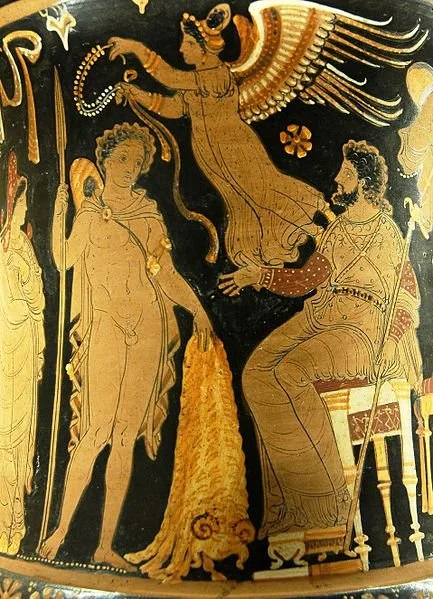
Jason’s quest is usually remembered as a voyage for treasure. But the Argonautica is stranger and more unsettling than that. It is a story about the young leader who needs help, the fellowship that carries him forward, the sacred intelligence of Orpheus, the danger of desire, and the question no Golden Fleece can answer: what becomes of a man after he gets what he came for?
Jason gathers the greatest heroes of Greece, sails beyond the known world, passes through the Clashing Rocks, survives hostile kings, yokes fire-breathing bulls, obtains the Golden Fleece, and returns with the aid of Medea.
This should make him one of the simplest heroes in mythology.
It does not.
Jason is not Heracles. He does not solve every problem with a club, a lion skin, and a cheerful indifference to workplace safety. He is not Ulysses either. He does not survive by cunning alone. Jason succeeds through fellowship, persuasion, inherited obligation, divine help, and—most troublingly—the dangerous intelligence and love of Medea.
The Argonautic voyage is not a clean story of heroic victory. It is a study in formation. What makes a leader? What does a fellowship owe its members? Can achievement be called noble if it is won at another person’s moral cost? What happens when a man gains the Fleece but loses the inner authority required to wear it?
These are old questions.
They have aged better than Jason.
The voyage behind the voyage
The principal surviving Greek epic of Jason’s expedition is the Argonautica of Apollonius Rhodius, composed in the third century BCE. It is the only fully surviving Hellenistic epic and a poem unusually attentive to uncertainty, emotional disturbance, dependence, counsel, divided motives, and the fragility of human cooperation. Jason is its leader, but he is never allowed to become a simple monument of heroic self-sufficiency.[1][2]
That makes him useful.
Heracles dramatizes the conquest of disorder through labor. Ulysses dramatizes the soul’s long navigation through illusion, distraction, and return. Jason dramatizes something more social and more unsettling: how a person becomes—or fails to become—worthy of leadership, fellowship, success, and obligation.
| Classical cycle | Central question | Philosophical emphasis |
|---|---|---|
| Hercules: Heracles Within | What must be conquered within the self? | Labor, courage, service, self-command |
| Odyseus: The Long Way Home | How does the soul return through a world of illusion and change? | Discernment, education, temptation, return |
| Jason: The Golden Fleece Within | How does a person become worthy of leadership and success? | Fellowship, counsel, desire, obligation, moral debt |
Jason’s Fleece is therefore more than an object of adventure. It is a visible prize that cannot confer the inward virtues needed to deserve it.
A man may obtain the Fleece.
He may still fail the test.
A necessary guardrail
This series is a philosophical reading of the Argonautic tradition. It is not a claim that Apollonius wrote a secret Neoplatonic initiation manual, nor that Jason’s voyage is an ancient Masonic ritual in disguise.
No surviving ancient Platonic or Neoplatonic commentary provides a fixed, canonical “Jason equals the soul” interpretation comparable to Porphyry’s reading of Homer’s Cave of the Nymphs. The articles instead draw on the Argonautica, Pindar, Euripides, Apollodorus, Roman and later reception, and Greek moral philosophy to ask what the story makes possible for a modern reader.[2]
Freemasonry enters as a secondary philosophical companion: not as a claim of historical descent, but as a tradition concerned with fellowship, symbolic education, moral responsibility, leadership, service, and the difference between outward advancement and inward attainment.
The comparison is useful precisely because it is restrained.
The series
Before the Fleece: Jason and the Burden of an Inherited Task
A throne is stolen, a young man is sent on an impossible mission, and maturity begins with work he did not choose.
The Argo Is Not a Solo Project: Fellowship, Skill, and the Making of a Crew
Jason leads men stronger and more famous than himself. The Argo teaches that no worthy undertaking is completed by private brilliance alone.
The Clashing Rocks: Why Every Serious Journey Requires a Test of Judgment
Courage without judgment is merely speed on the way to a collision.
Medea’s Fire: Desire, Knowledge, and the Price of the Golden Fleece
Jason’s greatest achievement depends on Medea. The Fleece therefore carries a moral debt.
The Golden Fleece Is Not the Prize You Think It Is
External success cannot make a person just, faithful, wise, or worthy.
The Argo After the Voyage: What Fellowship Is For
The final measure of a fellowship is not what it acquires together, but what its members become when the voyage is over.