Rhetoric and the Responsible Tongue
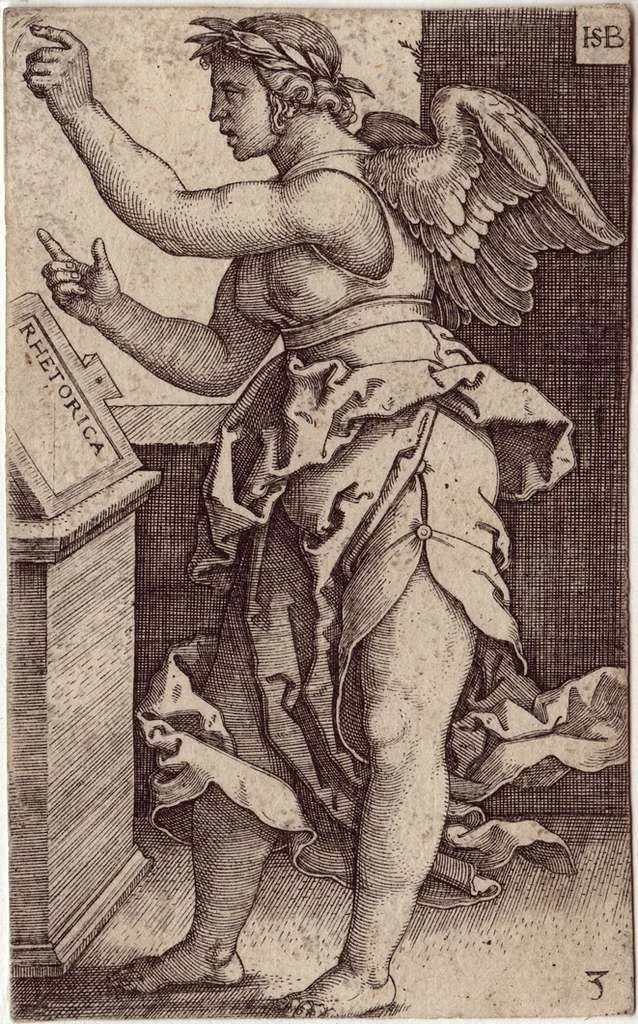
Rhetoric is often blamed for manipulation. Properly understood, it is the discipline that teaches a person how persuasion works, how it can be abused, and how speech may still be used honorably in the service of truth.
Rhetoric is one of those words that usually arrives already accused.
To call something rhetorical is often to dismiss it as inflated, insincere, or manipulative. The suspicion is understandable. Speech is one of the easiest tools for vanity and one of the quickest instruments of social control. Yet the answer to bad rhetoric is not the abandonment of rhetoric. It is its recovery.
Human beings are moved by words.
They always will be.
The question is not whether persuasion exists, but whether it will be practiced consciously and ethically or crudely and irresponsibly. The older liberal tradition treated rhetoric as an essential art because free persons must speak, deliberate, instruct, encourage, correct, and defend what is true in public as well as private.[1]
Silence alone cannot sustain a civilization.
Neither can sincerity without skill.
Rhetoric, rightly taught, does three things.
First, it trains a person to express thought clearly and fittingly. Not every truth should be stated in the same tone, to the same audience, or in the same form. Fitness matters. One must learn proportion, timing, emphasis, and arrangement.
Second, rhetoric trains a person to recognize persuasion in others. It reveals how cadence, image, repetition, framing, and selective emphasis can move an audience before any argument has been examined. This does not make persuasion illegitimate. It makes the hearer less naïve.
Third, rhetoric teaches responsibility. Words can heal, steady, reconcile, and illuminate. They can also inflame, flatter, degrade, and dissolve judgment. A person who knows how language moves others incurs a corresponding duty not to use that knowledge corruptly.
That point should resonate deeply with Masons.
Freemasonry is a verbal and symbolic culture. Its teachings are carried not only in emblems and forms but in spoken instruction, charges, obligations, and conversation among brethren. A lodge depends, in part, on whether its speech habits are truthful and proportioned. If rhetoric within it becomes careless, grandiose, or merely performative, the institution may retain its forms while losing its seriousness.
This is not a minor danger.
Much of modern public life rewards exactly the vices rhetoric ought to discipline. Speech is often prized for immediacy rather than accuracy, force rather than fitness, emotional effect rather than truthfulness. The goal is to dominate attention, display identity, or produce reaction. Under such pressures, one can become eloquent without becoming responsible.
That is not mastery.
It is verbal power without moral form.
Classical rhetoric aimed higher. In the best account of the tradition, the good speaker was not simply effective. He was formed enough to aim persuasion toward the good of the hearer and the integrity of the matter at hand.[2] This ideal was never perfectly realized, but it remains sound. Speech divorced from character becomes technique. Character without cultivated speech becomes inarticulate when truth most needs defense.
The responsible tongue requires both.
This also clarifies why rhetoric belongs after grammar and logic in the older order. One first learns what words mean. Then one learns how claims hang together. Only then does one learn how to move minds well. If rhetoric is detached from those prior disciplines, it easily degenerates into polished manipulation. If joined to them, it becomes one of the arts of civic and moral usefulness.
A Mason, no less than any other citizen, needs this usefulness. He should be able to speak without exaggeration, to encourage without sentimentality, to correct without humiliation, and to defend principle without theatrical heat. He should also be able to detect when speech — his own or others’ — is doing too much with too little truth beneath it.
That ability is increasingly rare.
And because it is rare, it is needed.
The crowd is often governed rhetorically long before it is governed politically. It is prepared by language: by stories, labels, rhythms, resentments, and simplifications repeated until they begin to feel like reality itself. A person trained in rhetoric is not automatically immune. But he is better equipped to ask what is happening to him as he listens.
Why this tone?
Why this framing?
Why this appeal now?
What is being stirred, and to what end?
Those questions do not destroy eloquence.
They rescue it from misuse.
The highest purpose of rhetoric is not to help one win at speaking. It is to make speech answerable to truth, proportion, and the good of those who hear it. That standard is demanding. It requires more than cleverness and more than sincerity. It requires formation.
So does Masonry.
So does citizenship.
So does friendship.
The tongue will always be powerful.
The question is whether it has learned obedience.
Endnotes
[1] On rhetoric in the classical tradition, see Aristotle, Rhetoric, and Cicero’s reflections on eloquence and civic life.
[2] For the classical ideal of rhetoric joined to moral seriousness, see Cicero, De Oratore, and Quintilian, Institutio Oratoria.
Brief Bibliography
Aristotle, Rhetoric
Cicero, De Oratore
Quintilian, Institutio Oratoria
Hugh of St. Victor, Didascalicon