Aeneas Below the Earth
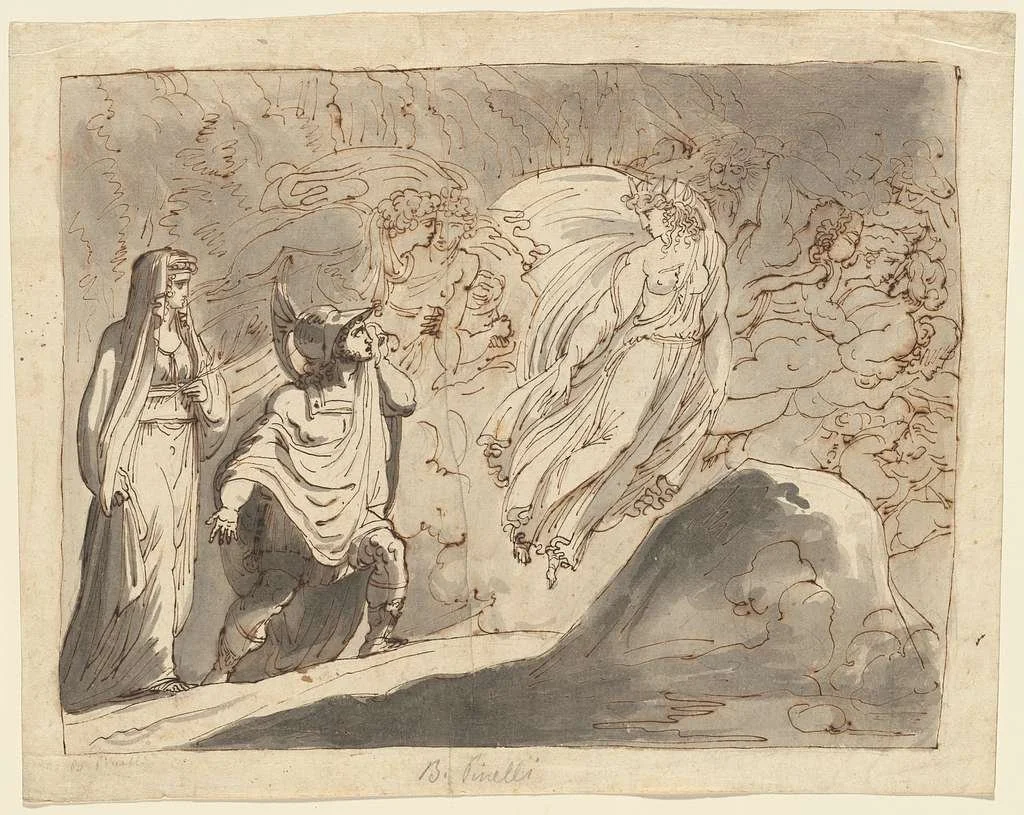
Duty, Memory, and the Roman Soul
Aeneas descends to the underworld not to escape responsibility, but to understand it. In the world below, he encounters loss, unfinished grief, moral consequence, his father Anchises, and a vision of the future. He returns to the living carrying a burden heavier than prophecy: the duty to build a world for people who do not yet exist.
Aeneas goes to the underworld for an answer.
Not a complete answer, unfortunately. Ancient literature is not generally in the business of giving its heroes a clear five-point plan, a relaxing weekend, and a modestly improved outlook.
He goes because he has lost nearly everything.
Troy has fallen. His wife Creusa has vanished in the burning city. His father Anchises has died. His people have wandered across the Mediterranean. He has left Dido in Carthage, and she has died. He has been told that he must found a future city in Italy, though this future appears to require more grief, war, compromise, endurance, and delayed gratification than any sensible person would request.
Aeneas descends to the underworld in Book VI of Virgil’s Aeneid to meet Anchises and learn what his mission means.
What he finds is not private consolation.
He finds a moral archive.
The dead remember. The unjust are judged. The prematurely dead wait at the threshold. The betrayed remain wounded. Great heroes are still marked by what they suffered and did. Future Romans wait to enter life. The past is not gone. It is gathered below the earth, where every simplified story becomes complicated again.
Aeneas returns with a vision of Rome.
But the city is not built.
That is the point.
The future is not a reward for having a vision. It is a responsibility placed upon the living by those who came before and those who have not yet arrived.
The series question
Once a person has worked on himself, what does he owe to the world that will exist after him?
This is the Roman question.
Heracles teaches the conquest of disorder. Ulysses teaches return. Jason teaches fellowship and the moral cost of achievement. Plato teaches the education of desire and the formation of judgment. Psyche learns love. Lucius learns humility. Daedalus learns that craft must answer to wisdom. Prometheus teaches that forethought can be bound and freed. Orpheus teaches how to carry grief forward.
Aeneas asks what all of this is for.
It is for the city.
Not merely the physical city, though buildings matter. Not merely the state, though institutions matter. The city is the world of shared obligation: family, memory, law, architecture, civic life, public service, inherited duties, future generations, and the difficult work of making a home for people who do not yet know they will need one.
Historical guardrail
The Aeneid is a Roman epic written by Virgil in the age of Augustus. It is political, poetic, religious, philosophical, and morally ambiguous. It should not be reduced to imperial propaganda, though it certainly engages Roman power and the Augustan world. Nor should Aeneas be treated as a simple Stoic sage, a perfect founder, or a Masonic figure in Roman clothing.
The series draws on:
Virgil’s Aeneid, especially Book VI.
Roman pietas: duty toward gods, family, community, ancestors, and future.
Stoic and Platonic ideas of moral order, fate, soul, and public obligation.
The late-antique commentary tradition of Servius.
Careful Masonic comparisons involving service, civic stewardship, memory, builders, institutions, and the work of future-oriented charity.
The Masonic comparison is philosophical, not genealogical. No claim is being made that Virgil wrote a proto-Masonic degree. The comparison rests on a shared concern with what men build, preserve, transmit, and owe.
The series
Aeneas must prepare before descent. Symbolic knowledge does not bypass duty.
The dead preserve the costs, wounds, and consequences that the living prefer to simplify.
Aeneas’ mission may be necessary. It does not make him innocent of the pain left behind.
The future city becomes a duty placed upon the living by both ancestors and descendants.
Roman duty is not passive compliance. It is the discipline of carrying what must not be abandoned.
Aeneas returns from revelation to unfinished labor. Vision matters only if it becomes building.