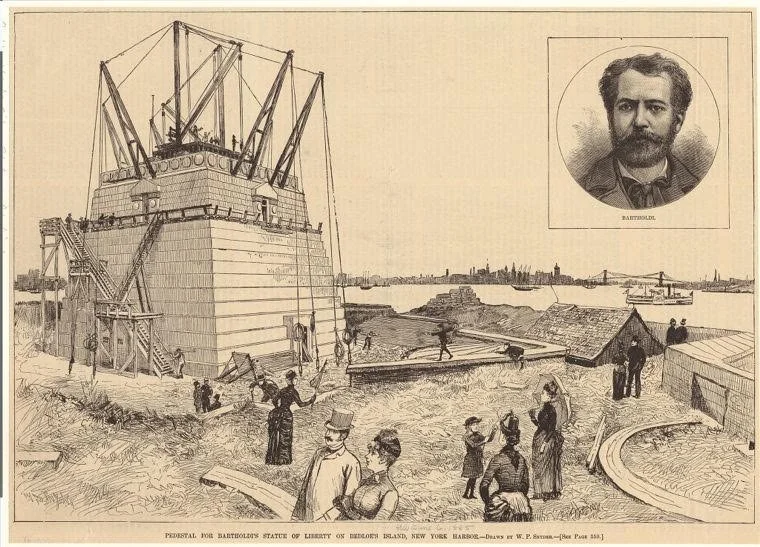
Construction of the Statue of Liberty pedestal, with poured concrete interior walls and granite facing, New York Harbor.
In the summer of 1871, a correspondent for the English weekly The Freemason stood in the rain in Albany, taking notes. The Grand Lodge of New York was laying the cornerstone of the new State Capitol, and the weather had other plans. His report ran in the issue of July 22, and it ends with a line any outdoor event planner will recognize: umbrellas “were soon seen vanishing in every direction.”
Before that, he had written down a great deal. A sealed copper box of memorials went into the stone, and the Grand Secretary read out its contents. Three grand officers, each identified with a working tool—the square, the level, the plumb—applied those tools to the stone and reported it true. The Grand Master spread mortar, struck three blows with a mallet, and declared the stone properly laid.
Then came the part this series is about. Three officers carried forward the corn, the wine, and the oil. The Deputy Grand Master scattered the corn with a prayer that the land’s nourishment might abound. The Senior Grand Warden poured the wine, asking protection for the workmen and refreshment and peace for the country. The Junior Grand Warden poured the oil, asking union, harmony, and love. The ceremony closed with a proclamation that the stone had been found square, level, and plumb, and laid according to the old customs.
One more detail matters. The correspondent says he was invited to join the Masons’ ranks for the day and declined, preferring to stand with the press. A rite that comes with an open invitation and a reporter is not a rite hidden from view.
What the stone establishes
Let’s be strict about what [that report](Making sure youre not a bot!
Making sure youre not a bot!
gives us. It is documented fact, in a printed source of the period, and it is more than most symbol-hunters ever get.
We know the occasion—a state capitol—the officiating body—the Grand Lodge of New York—and the people named—the Grand Master and the building’s architect. We know the three materials were carried by three different officers, used in a fixed order, and each paired with its own spoken blessing. We know the blessings were framed in terms of land, labor, and public welfare, and that they addressed a Deity in generic terms.
What the report does not give us is just as clear. It doesn’t say why these three materials and not others. It doesn’t say what any Grand Lodge officer privately understood by them. It tells us nothing about what happens in a lodge room, and it can’t say whether the same words were used in Albany the year before or in Ohio the year after. A reporter in the rain recorded the rite as performed. He did not record its philosophy.
One caution on the text itself: the digitized version I read is machine-transcribed and contains errors. I have paraphrased rather than reproduced it, and anyone quoting it should check the page image.
Why a lodge was standing in a parade
It is fair to ask why a fraternal society took a leading role in what was often a civic event.
The best-documented answer is simple: someone asked. When the American committee building the pedestal for the Statue of Liberty needed a ceremony in 1884, its chairman, Evarts, contacted the Grand Lodge of New York and requested a Masonic ceremony “appropriate to the occasion.” The same source says the ceremony went ahead on August 5 in a downpour, with Grand Master William A. Brodie laying the stone. The [New York Masonic Library](The Statue of Liberty Centennial Records (AR1996.4) – Chancellor Robert R Livingston Masonic Library
The Statue of Liberty Centennial Records (AR1996.4) – Chancellor Robert R Livingston Masonic Library
records that Masons re-enacted the ceremony on its hundredth anniversary in 1984. A popular introduction to Freemasonry says the Masons perform this rite “upon request,” giving their heritage as builders as the reason. That is a common explanation, but it is a general one, and I haven’t traced it to a primary source.
The model for American civic cornerstones is usually traced to September 18, 1793. George Washington laid the cornerstone of the U.S. Capitol, and the [Senate’s own historical account](U.S. Senate: 404 Error Page
U.S. Senate: 404 Error Page 404 Error Page
says he placed an inscribed silver plate under it. A [Scottish Rite Journal item](What major D.C. cornerstones were laid by Masons? | Scottish Rite of Freemasonry, S.J., U.S.A.
What major D.C. cornerstones were laid by Masons? | Scottish Rite of Freemasonry, S.J., U.S.A.
lists the participating lodges and says Joseph Clark of the Grand Lodge of Maryland acted as Grand Master pro tempore. The Architect of the Capitol describes a parade beforehand and celebration and feasting afterward. The stone itself has a footnote worthy of a mystery novel: it has never been found, and a 1991 search with a metal detector came up empty.
Here is a useful fact for anyone tempted to treat these rites as arcane. In 1793, 1871, and 1884, the ceremony drew its audience and its legitimacy from civic occasions. The rite was shaped for onlookers.
Public, private, and the vocabulary in between
That brings us to privacy, where careless writing does the most damage. Several different things get called “secret,” and they are not the same.
A publicly performed ceremony is one done before an audience, as in the three examples above. An officially published explanation is something a Grand Lodge itself puts in print. Archival material is old documents, minutes, and newspaper reports. A third-party publication is anything printed by someone other than the institution, whatever it claims to be. Current jurisdictional rules are what a given Grand Lodge allows its members to say or print today, and these vary. And there are personal interpretations, including mine.
On what Masonry says about itself, I have only partial evidence. A leaflet attributed to the Grand Lodge of New York, posted on a document-sharing site, states that Masons have private modes of recognition and ceremonies for some meetings, but that the fraternity is not otherwise secret. Its provenance needs checking before anyone relies on it. A 1939 bulletin from the Masonic Service Association, archived online, makes the older and better-known point that Freemasonry is a society with secrets, not a secret society, and that what a grand lodge prints cannot be secret from anyone. Those two statements agree, and neither is a rule for every jurisdiction.
For working purposes, here is my own vocabulary—these are my definitions, not an official taxonomy:
- Discretion is declining to broadcast what you know.
- Confidentiality is a promise about specific information.
- Institutional privacy is an organization’s control over its own meetings and records.
- Ritual secrecy is the withholding of particular forms of recognition and instruction.
A cornerstone ceremony, performed in public, lives mostly outside all four.
But there is a trap on the other side. Public ceremonies do not make every associated text public. Printed versions of cornerstone and dedication rituals do circulate on third-party websites, and some are identified with a particular Grand Lodge. Their wording is not identical to the 1871 Albany report or to each other. That is itself a lesson: the formulas moved and changed across jurisdictions and decades. I am treating them as evidence that variation existed, not as authority for any jurisdiction today, and I’m not reproducing them. Being online doesn’t make a text authorized, and a Grand Lodge’s current rules on printing ritual are a matter for that Grand Lodge. I could not find a New York statement on this, so I won’t invent one.
Two readings of one pour
Here is where the evidence stops and interpretation begins, and I will signal the turn.
In 1871 Albany, the blessings attached to the materials were about the land, the workmen, and the public: nourishment for the country, protection and refreshment for those building, harmony among the people. Those are the words spoken.
Compare a recent news report of a cornerstone ceremony at a fire station in York, Nebraska. The reporter wrote that the corn, wine, and oil represent the three stages of life—youth, adulthood, old age—and the physical, mental, and spiritual aspects of a person. I can’t tell from the page whether that was the Grand Lodge’s own explanation or the reporter’s summary, and the article is undated in the version I found.
Read together, the two accounts suggest something modest. The materials stay stable, and the explanations attached to them can drift: one account stays close to community and labor, the other reaches for a human life cycle. That doesn’t make either wrong. It does mean the ceremony alone can’t tell us which reading, if either, is “the” meaning. Anyone claiming that a pour on a stone settles the question is claiming more than the pour can bear.
What intellectual honesty asks for
It asks for three ledgers, and the discipline of not mixing them.
- Documented fact goes in one: the date, the materials, the order, the printed words.
- Attributed interpretation goes in another: this report says, this guide says, this reporter wrote.
- Present-day reflection, which is where most of this series will live, goes in the third and gets labeled when it arrives.
It also asks for two refusals. One is mystification, the habit of treating every gap in the record as a vault. The other is the debunker’s reflex, the assumption that a reserved institution must be hiding something grand or something silly. A private ceremony and a public one can sit in the same organization without either explaining the other. And a writer who is honest about partial knowledge is still allowed to be curious.
What the pour leaves behind
On a rainy July day in 1871, someone poured wine on granite that was already wet. The Albany crowd got the sequence, the officers, and a blessing for each material. They did not get a theory, and the Grand Lodge did not hand one out.
What they did get was three ordinary goods, each carried by a different pair of hands, each with its own request. Somebody grew that grain. Somebody pressed that wine and refined that oil, and somebody carried each of them across a muddy construction site. Before these materials are symbols, they are goods with a supply chain. The next article starts in the field.
Source notes
Image source: Pedestal for Bartholdi’s Statue of Liberty on Bedlow’s Island, New York Harbor, The New York Public Library Digital Collections, https://digitalcollections.nypl.org/items/73d92030-c55b-012f-bdcb-58d385a7bc34?canvasIndex=0.
Albany ceremony, 1871
[The Freemason (London), July 22, 1871, p. 3, “Grand Masonic Ceremonies at Albany”](Making sure youre not a bot!
Making sure youre not a bot!
via Masonic Periodicals Online, Museum of Freemasonry.
Source for the sealed box, the three tools and reports, the Grand Master’s declaration, the order of corn, wine, and oil, the officers carrying them, the paraphrased blessings, the correspondent’s declined invitation, the rain, and the one quotation. The report also names the architect, Thomas Fuller, and the Grand Master, J. H. Anthon.
U.S. Capitol, 1793
- [U.S. Senate, “George Washington Lays the Cornerstone of the Capitol”](U.S. Senate: 404 Error Page
U.S. Senate: 404 Error Page 404 Error Page
Source for the silver plate, lost stone, and 1991 search.
- Architect of the Capitol, “Capitol Cornerstone Ceremony, 1793”. Source for the parade and feasting.
- [Scottish Rite Journal, July/August 2008](What major D.C. cornerstones were laid by Masons? | Scottish Rite of Freemasonry, S.J., U.S.A.
What major D.C. cornerstones were laid by Masons? | Scottish Rite of Freemasonry, S.J., U.S.A.
via ScottishRite.org. Source for the participating lodges and Joseph Clark’s role as Grand Master pro tempore.
Statue of Liberty, 1884
- [National Park Service, Statue of Liberty National Monument, “Construction of the Pedestal”](Park History Program (U.S. National Park Service)
Park History Program (U.S. National Park Service) The Park History Program administers multiple agency programs, conducts historic research, provides resources about the history of the National Park Service, and supports National Park Service staff with work relating to the Agencys history and miss
Source for the August 5, 1884, date and Brodie’s role.
- Masonic Service Association, Short Talk Bulletin, August 1984, via the Skirret archive. Source for Evarts’s request and the rain.
- [New York Masonic Library, Statue of Liberty Centennial Records finding aid](The Statue of Liberty Centennial Records (AR1996.4) – Chancellor Robert R Livingston Masonic Library
The Statue of Liberty Centennial Records (AR1996.4) – Chancellor Robert R Livingston Masonic Library
Source for the 1984 re-enactment.
Privacy and secrecy
- Masonic Service Association, Short Talk Bulletin, July 1939, via the Skirret archive. Date taken from the archive URL.
- Leaflet attributed to the Grand Lodge of New York, uploaded to Issuu. Its attribution and provenance remain unverified; it is not treated here as an authenticated statement of current Grand Lodge policy.
“Upon request”
Freemasonry For Dummies excerpt, “The Public Ceremonies of the Freemasons”, Dummies.com.
Popular reference; cited only for the general explanation.
Nebraska example
York News-Times, “Freemasons hold cornerstone ceremony at new fire station”.
The version consulted is undated. The article does not establish whether its symbolic explanation came from the Grand Lodge or from the reporter’s summary.
Continue the Corn, Wine and Oil Series
This is the first article in the Corn, Wine and Oil series. Continue with a closer look at corn, grain, and nourishment, then follow the companion essays on wine and oil.
Next article: Corn in Masonic Ritual: Grain and Nourishment →
Series introduction and complete reading list: Corn, Wine and Oil
