The Two Caves and the Work of Light
Plato, Porphyry, Thomas Taylor, and the daily labor of seeing clearly
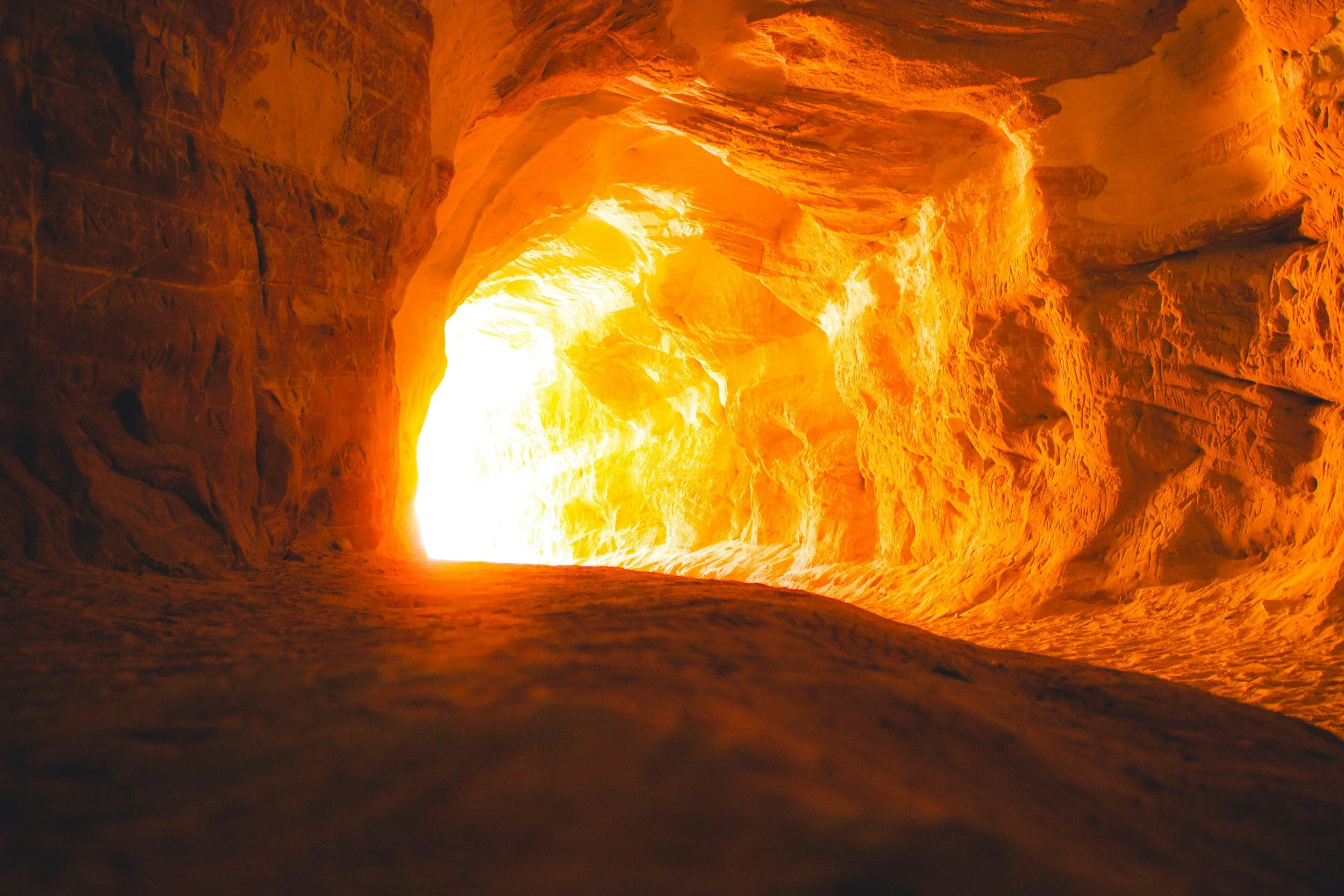
Plato’s prisoners mistake shadows for reality. Porphyry’s souls enter a cave of water, weaving, sweetness, and forgetting. Thomas Taylor sends Ulysses across the stormy sea between them. Together, these ancient images offer a demanding philosophy of self-work: turn the soul, learn to read the world, and carry better sight into ordinary life.
There are two famous caves in the classical imagination, and neither is the sort of place where a flashlight would settle the matter.
Plato’s cave is full of prisoners watching shadows and congratulating themselves on being well informed. Porphyry’s cave is full of water, bees, stone looms, hidden gates, and souls entering the complications of mortal life. Thomas Taylor, reading Porphyry through the old Platonic tradition, turns the whole Mediterranean into a third cave: a stormy world in which the soul must learn not to confuse its voyage with its destination.
The caves are not identical. That is what makes their conversation useful.
Plato asks why human beings mistake appearances for reality. Porphyry asks why souls become entangled in the world of change at all. Taylor asks how a soul, once tangled up in the business of living, manages to find its way home.
Together, they offer a philosophy that is much less abstract than it first appears. Most of the work of becoming wiser is not acquiring more opinions. It is learning what not to mistake for light.
The cave of shadows
In Book VII of the Republic, Plato asks us to imagine human beings confined from childhood in an underground dwelling. Their legs and necks are chained. They cannot turn around. Behind them burns a fire. Between the fire and the prisoners, other people carry objects whose shadows appear on the wall before the captives.
The prisoners see the shadows. They hear sounds. They give names to what they see. Since this is all they have ever known, the shadows become reality.
It is a cruel image, but not an exotic one.
We all have a wall. We all have shadows. They may be inherited opinions, resentments polished over time, anxieties dressed up as prudence, fashionable slogans, political loyalties, family myths, professional vanity, or the perpetual need to be thought right by people we do not particularly admire.
The shadows are often convincing. That is their chief occupational hazard.
Plato’s point is not that ordinary sight is evil, or that the physical world is somehow a fraud. The problem is that the prisoners have never learned to distinguish appearance from reality, report from knowledge, repetition from truth, or confidence from understanding. They have been trained by circumstance to look in one direction and then mistake their enforced angle of vision for the whole of existence.
Plato explicitly frames the story as an account of “education and lack of education.” The cure is not stuffing information into an empty head. The capacity to know, he says, is already present in the soul. Education is the art of turning that capacity toward what it ought to see.1
That is a more uncomfortable definition of education than the modern version. It means that learning is not simply adding shelves to the mind. It is rotating the entire building.
The hallucinations of misunderstanding
The prisoners in Plato’s cave are not fools. They are simply imprisoned by what they have always taken for granted.
This matters because misunderstanding seldom arrives wearing a paper hat marked ERROR. More often it appears as common sense. It arrives with references. It may have been taught by a respected parent, rewarded by a workplace, reinforced by friends, or repeated so often that questioning it feels almost rude.
A person can be highly informed and still live among shadows. He may know dates, statistics, quotations, passwords, headlines, and the complete biography of every person who has annoyed him. Yet if he has never asked what governs his judgments, his knowledge may be only a more elaborate kind of wall decoration.
The shadows are especially powerful when they flatter us.
We are remarkably inventive creatures. We can turn fear into “being realistic,” envy into “having standards,” indifference into “protecting our peace,” vanity into “leadership,” and laziness into a carefully worded theory of authenticity. The human mind is not merely a lamp. It is also, under certain conditions, a capable theatrical company with a generous budget for scenery.
The work of self-knowledge begins when a man suspects that the story he tells himself may contain a few stage effects.
That suspicion is not despair. It is the beginning of freedom.
The sun is not a brighter shadow
Plato’s prisoner is released. At first, he suffers.
He cannot look at the fire behind him. He cannot immediately recognize the objects that produced the shadows he had taken for reality. When he is dragged upward out of the cave, the sunlight blinds him. He sees poorly. He is confused. He would rather return to what is familiar.
This detail is one of Plato’s best. The first encounter with a deeper truth is not necessarily pleasant. It may be disorienting.
A person discovers that a cherished belief is inadequate. A historical account he trusted has serious omissions. A personal grievance turns out to have been sustained by selective memory. A title, position, achievement, or ritual proficiency that once seemed substantial begins to look like an external sign rather than an inward attainment.
This does not feel like light. It feels like eye strain.
But Plato insists that the soul must gradually become able to see: first reflections, then objects, then the heavens, and finally the sun itself. The sun represents the Good—the source that makes truth intelligible and gives knowledge its power. It is not simply a feeling of uplift. It is not an attractive mood, a private certainty, or the warm glow that comes from discovering that one was right all along.
The sun is not a brighter shadow.
The Good is that by which reality becomes more visible, even when what becomes visible is inconvenient. A person has moved toward the light not when he has acquired a more impressive vocabulary, but when he becomes less easily deceived by appearance—especially his own appearance to himself.1
This is why the language of “light” is so demanding. It cannot mean merely receiving a secret, learning a phrase, obtaining a degree, or being told that one belongs to a select company of enlightened people. A man may possess every symbol of illumination and still use them to decorate a very dark room.
The test is practical: does the light make him more truthful, more patient, more just, more teachable, and less governed by vanity, appetite, resentment, or fear?
If not, the candle may be real, but it has not yet been put to work.
Porphyry’s other cave
Several centuries after Plato, the Neoplatonist Porphyry took up a different cave: the cave of the Nymphs in Book XIII of Homer’s Odyssey.
Homer describes it with suspicious precision. Near the harbor of Phorcys in Ithaca stands an olive tree. Beneath it lies a dark yet pleasant cavern sacred to the Naiad Nymphs. It contains stone bowls, stone jars, bees and honey, purple cloth being woven on stone looms, flowing water, and two gates. The northern gate is open to human beings. The southern gate belongs to immortals.
Most readers see scenery.
Porphyry saw an argument.
Why, he asks, does Homer give us so many strange details? Why should nymphs weave purple garments on stone looms? Why do bees store honey in stone vessels? Why are there two entrances? Why does one lead downward for human beings and the other upward toward the immortal?
Porphyry’s answer is that the cave is not merely a cave. It is an image of the cosmos, the visible world of generation, change, embodiment, pleasure, and return.2
The contrast with Plato is essential.
Plato’s cave is a prison of misdirected perception. Its prisoners look at shadows and need to turn around.
Porphyry’s cave is the world into which the soul descends. It is not simply a prison to be cursed. It is beautiful and dark, ordered and dangerous, full of forms and full of forgetfulness. It is a place of experience, testing, formation, and possible return.
A person in Plato’s cave needs to ask: “Am I seeing what is real?”
A person in Porphyry’s cave needs to ask: “Have I forgotten what I am?”
These are not the same question. Most of us need both.
Water, garments, and honey
Porphyry reads Homer’s details as images of the soul’s embodied condition.
The flowing water signifies the unstable, changing character of the material world. A cave, being dark, stony, moist, and enclosed, can image the cosmos in its material aspect. It is “pleasant” because the world is adorned by form, beauty, and order; it is obscure because its deeper material basis is shifting, hidden, and not self-explanatory.2
The stone looms on which the Nymphs weave purple garments become symbols of bodily formation. Flesh is woven around bones as garments are woven around a frame. Purple suggests blood. The body is, in one sense, a garment with which the soul is clothed.
This is not an invitation to hate the body. Porphyry is describing condition, not issuing a complaint to the manufacturer. The body is the means through which we act, suffer, learn, love, work, speak, build, remember, and serve. But it becomes a problem when we take the garment for the wearer, or confuse bodily pleasure and pain with the full measure of what is good and evil.
The honey is still more interesting.
Honey is sweet, nourishing, preservative, and—by Porphyry’s symbolic logic—connected with the pleasures that draw souls toward generation. It is a fine image for embodied life. Life gives real sweetness. That is why it holds us. The danger is not sweetness itself. The danger is becoming drunk on it, as if pleasant sensation were the whole purpose of existence.2
This is a lesson that needs no ancient Greek vocabulary.
A good meal is good. Friendship is good. Music is good. Work completed well is good. The sight of a child learning something new is good. So are rest, laughter, beauty, and the satisfactory silence that follows the repair of a thing that had been making a noise for three weeks.
But none of these, by themselves, can tell us who we are or what we are for.
Honey is not home.
The two gates of the soul
Porphyry places great importance on the cave’s two gates.
The northern gate, he says, signifies the descent of souls into generation. The southern gate signifies the ascent of souls toward the divine. His explanation depends on ancient cosmology, including the signs of Cancer and Capricorn, lunar and solar symbolism, and the old religious geography of north and south. The astronomy need not be modern science in order to reveal the philosophical structure beneath it.2
The structure is this:
- The soul enters a world of body, time, sensation, appetite, chance, necessity, and social life.
- It becomes involved in changing things.
- It risks mistaking this involvement for its entire identity.
- Yet it possesses the possibility of turning, purifying, remembering, and returning toward what is more stable, intelligible, and divine.
The gates are not geographical directions for a weekend excursion. They are images of two movements in a human life.
We descend whenever we allow immediate appetite, fear, status, resentment, or distraction to govern us. We descend when we accept an inherited opinion without examining it. We descend when we permit an office, title, injury, income, reputation, or desire to tell us the whole truth about ourselves.
We ascend whenever we recover proportion.
We ascend when we see that pain is not identical with evil, and pleasure is not identical with good. We ascend when we distinguish admiration from worth, information from wisdom, and success from character. We ascend when we discover that an outward symbol must point beyond itself—or it becomes another shadow on Plato’s wall.
This is not an escape from daily life. It is a way of becoming more responsible within it.
Ulysses and the stormy sea
Thomas Taylor, the English Platonist, translator, and tireless excavator of late antique philosophy, took Porphyry’s cave and placed it within the whole Odyssey.
Taylor’s 1823 Select Works of Porphyry included Porphyry’s On the Cave of the Nymphs and an appendix of Taylor’s own: “An Explanation of the Allegory of the Wanderings of Ulysses.” Taylor begins from an observation Porphyry preserves from Numenius: Ulysses is an image of the person who passes “in a regular manner over the stormy sea of generation,” and at last reaches a place where storms and seas are unknown.3
For Taylor, the sea is the sensible life: changeable, dangerous, magnificent, disorienting, and never fully under human control. Ulysses is the rational soul attempting to cross it without becoming permanently lost.
This is a useful development because it turns the cave into a journey.
Plato gives us prisoners who must turn around. Porphyry gives us souls entering and leaving a cosmic cave. Taylor gives us a man on a ship, meeting one temptation after another.
The Sirens become the knowledge that flatters us but destroys our direction. Circe becomes the power of appetite to make rational creatures live like animals. Calypso becomes the comfort that asks us to abandon purpose. The Cyclops becomes force without justice, sight without insight. Ithaca becomes not merely an island, but the recovery of order in the soul’s own household.
Taylor’s interpretation is not a lost secret key handed down from Homer. It is a later Platonist synthesis, imaginative and sometimes daring, built from Porphyry and the long history of philosophical Homeric reading. It should be read as Taylor’s interpretation, not casually attributed to Homer or Porphyry. But it asks a genuinely ancient question:
How does a person live in the world without calling the world, in all its temporary conditions, his final home?
The answer is navigation.
The work is not to leave every island. The work is to recognize which islands are traps.
The Middle Chamber of the mind
This is where the comparison becomes useful for a Mason, provided we keep our historical feet on the ground.
There is no need to claim that Masonic ritual descends directly from Plato’s cave, Porphyry’s Ithacan symbolism, or Thomas Taylor’s reading of Homer. It does not need that claim. The philosophical resemblance is meaningful enough.
The lodge, and especially the Second Degree’s concern with the liberal arts and sciences, offers a symbolic education in attention, proportion, order, and self-command. It asks a candidate to see that knowledge is not an ornament. It is a discipline.
Grammar trains precision in language. Rhetoric trains the responsible power of speech. Logic trains discrimination between an argument and an assertion wearing a necktie. Arithmetic and geometry train the mind in number, relation, measure, and form. Music reveals order in harmony. Astronomy turns the attention beyond immediate appetite and provincial self-importance.
Plato would recognize the general purpose. Education is the turning of the soul toward what is more real. It is not merely the storage of facts.
Porphyry would recognize another part of the work. The visible world is full of signs. Architecture, tools, numbers, forms, paths, pillars, lights, and thresholds can become occasions for reflection. The symbol is not valuable because it conceals an exotic secret. It is valuable because it calls the mind beyond the object toward an invisible order.
Taylor would add that no one completes this education in a single room. The work continues on the sea.
The lodge may give a man symbols. His daily life decides whether he can read them.
The work is on Tuesday
The danger in all talk of enlightenment is that it begins to float several feet above the ground.
A man reads Plato, feels briefly superior to people who have not read Plato, and returns to his ordinary habits without having turned anything except a page.
This is not the ascent.
Plato’s liberated prisoner must return to the cave. He does not go upward merely to enjoy a private view. He returns to live among those still bound by shadows, though the return is difficult and his eyes no longer adjust easily to the darkness.
Porphyry’s soul does not learn the way upward merely to despise the world. The cave is the place in which the soul must learn what it is, what it serves, and what it must not confuse with itself.
Taylor’s Ulysses does not remain forever with Calypso, among the Phaeacians, or at sea. He returns to Ithaca. Then the real work begins: restoring a household, keeping promises, recognizing what has been damaged, reestablishing justice, and living as if the voyage has taught him something.
This is where philosophy earns its keep.
The work of light is how a person speaks when anger would make cruelty easier. It is how he behaves when no one is giving applause. It is whether he can tell the truth when it costs him a small advantage. It is whether he learns from correction rather than treating correction as a personal attack by the universe.
It is whether he can enter a room without needing to become its sun.
The cave is not defeated by giving a speech about the sun. It is defeated, a little at a time, when a person carries better sight into the work of ordinary life.
The true source of light
The deepest connection among Plato, Porphyry, and Taylor is not escape. It is reorientation.
Plato says: turn the soul from shadows toward the Good.
Porphyry says: remember that the cave of the world is a place of descent and possible return.
Taylor says: navigate the stormy sea of life without mistaking the sea for your homeland.
The three images together offer a mature account of self-work.
We do not become wiser by denying the body, rejecting pleasure, despising ordinary life, or congratulating ourselves for having discovered symbolism. We become wiser by learning proportion. We recognize that the things of the world are real, but not final; valuable, but not ultimate; necessary, but not sovereign.
The true source of light is not the ego’s wish to be admired as enlightened. It is the Good: that toward which reason, virtue, justice, beauty, and truthful action all point.
A Mason may call this pursuit Light. A Platonist may call it the Good. A religious person may call it God. A moral realist may call it truth. The language differs; the work remains recognizably similar.
It is difficult work.
That is probably how we know it is real.
Endnotes and further reading
- Plato, Republic VII, 514a–521b. Plato introduces the Cave as an image of “our nature in its education and its lack of education”; at 518c–d he describes education as the turning of the soul’s existing capacity for knowledge toward what is.1
- For an accessible scholarly overview of Plato’s Cave and its direct explanation within the Republic, see the Open Book Publishers discussion of Book VII.4
- Porphyry, On the Cave of the Nymphs in the Thirteenth Book of the Odyssey, on Homer, Odyssey 13.102–112. Porphyry treats the cave as an image of the world, the soul’s descent into generation, and the possibility of ascent.2
- Porphyry explains the cave as “pleasant and obscure”: beautiful through the ordering power of form, dark through its connection with material flux. He interprets the stone looms and purple web as images of bodily formation and the body as a garment of the soul.2
- On the two gates, Porphyry associates the northern gate with souls descending into generation and the southern gate with souls ascending toward the divine or immortal.2
- Thomas Taylor, trans., Select Works of Porphyry (London, 1823), including On the Cave of the Nymphs and Taylor’s appendix, “An Explanation of the Allegory of the Wanderings of Ulysses.” Taylor explicitly develops Porphyry’s preserved reference to Numenius and Ulysses’ passage through the “stormy sea of generation.”3
- Robert Lamberton, trans., Porphyry: On the Cave of the Nymphs (Station Hill Press, 1983), remains the best starting modern English edition, with introduction and notes.5
- K. Nilüfer Akçay, Porphyry’s On the Cave of the Nymphs in Its Intellectual Context (Leiden: Brill, 2019), is the leading modern monograph on Porphyry’s allegory, its philosophical sources, and its account of soul, world, and return.7
- M. J. Edwards, “Porphyry’s ‘Cave of the Nymphs’ and the Gnostic Controversy,” Hermes 124 (1996): 88–100. This is useful for distinguishing Porphyry’s symbolic and difficult cosmos from a simplistic rejection of the material world.9
- Robert Lamberton, Homer the Theologian: Neoplatonist Allegorical Reading and the Growth of the Epic Tradition (University of California Press), provides essential background for understanding how late antique Platonists read Homer as a philosophical and theological poet.10
Sources
1 The Dialogues of Plato — Translation by David Horan https://www.platonicfoundation.org/translation/republic/
2 Porphyry, On the Cave of the Nymphs (1917) English ... https://www.tertullian.org/fathers/porphyry_cave_of_nymphs_02_translation.htm
3 Select works of Porphyry - Project Gutenberg https://www.gutenberg.org/files/77014/77014-h/77014-h.htm
4 Plato's 'Republic' - 11. The Allegory of the Cave https://books.openbookpublishers.com/10.11647/obp.0229/ch11.xhtml
5 Porphyry on the Cave of the Nymphs 9780930794712 ... https://dokumen.pub/porphyry-on-the-cave-of-the-nymphs-9780930794712-0930794710-9780930794729-0930794729.html
6 On the cave of the nymphs / Porphyry ; translation and ... https://search.library.berkeley.edu/discovery/fulldisplay/alma991006317649706532/01UCS_BER:UCB
7 K. Nilüfer Akçay, Porphyry's On the Cave of the Nymphs ... https://philpapers.org/rec/AKAP_T-2
8 Porphyry's On the Cave of the Nymphs in its Intellectual ... https://brill.com/display/title/55622?language=en
9 Porphyry's 'Cave of the Nymphs' and the Gnostic Controversy https://www.jstor.org/stable/4477120
10 Porphyry’s On the Cave of the Nymphs in its Intellectual Context 9789004408272, 9004408274 - DOKUMEN.PUB https://dokumen.pub/porphyrys-on-the-cave-of-the-nymphs-in-its-intellectual-context-9789004408272-9004408274.html
11 Nilüfer Akçay on Porphyry's On the Cave of the Nymphs https://shwep.net/podcast/nilufer-akcay-on-porphyrys-on-the-cave-of-the-nymphs/
12 Thomas Taylor (Neoplatonist) https://en.wikipedia.org/wiki/Thomas_Taylor_(Neoplatonist)
13 The Republic Book 7: Parts 1 & 2 Summary & Analysis https://www.sparknotes.com/philosophy/republic/section7/
14 Plato's Republic Book VII, translated by Paul Shorey https://theconnectedcorpus.pubpub.org/pub/xrhfkclz
15 Escaping the Cave | Plato's Republic, Book VII https://jaredhenderson.substack.com/p/escaping-the-cave-platos-republic
16 Porphyry's 'On the cave of the nymphs' in its intellectual ... https://bmcr.brynmawr.edu/2020/2020.04.05/
17 Wandering Rocks and Ulysses https://www.collectionscanada.gc.ca/obj/thesescanada/vol2/002/MR28560.PDF?oclc_number=463757748
18 Plato The Allegory of the Cave (Republic, Book Seven) https://web.sbu.edu/theology/bychkov/plato%20republic%207.pdf
19 Chapter 4 The Path towards the Immortality of the Soul in https://brill.com/display/book/9789004408272/BP000005.xml?language=en
20 Wanderings of Ulysses - Christian Platonism - WordPress.com https://catholicgnosis.wordpress.com/tag/wanderings-of-ulysses/
21 (PDF) The Soul-Turning Metaphor in Plato's Republic Book 7 https://www.academia.edu/43763855/The_Soul_Turning_Metaphor_in_Platos_Republic_Book_7
22 Porphyry, the Cave of the Nymphs, and the Mysteries of ... https://www.academia.edu/92367215/Porphyry_the_Cave_of_the_Nymphs_and_the_Mysteries_of_Mithras
23 Allegory of the Cave in Plato's Republic | PDF https://www.scribd.com/document/942723797/Plato-s-Republic-Book-7-Summary
[24] Thomas Taylor | The Theosophical Library https://theosophylib.com/tt/