Advance Service Mizpah Lodge No. 586: A Living Inheritance of Six New York Lodges
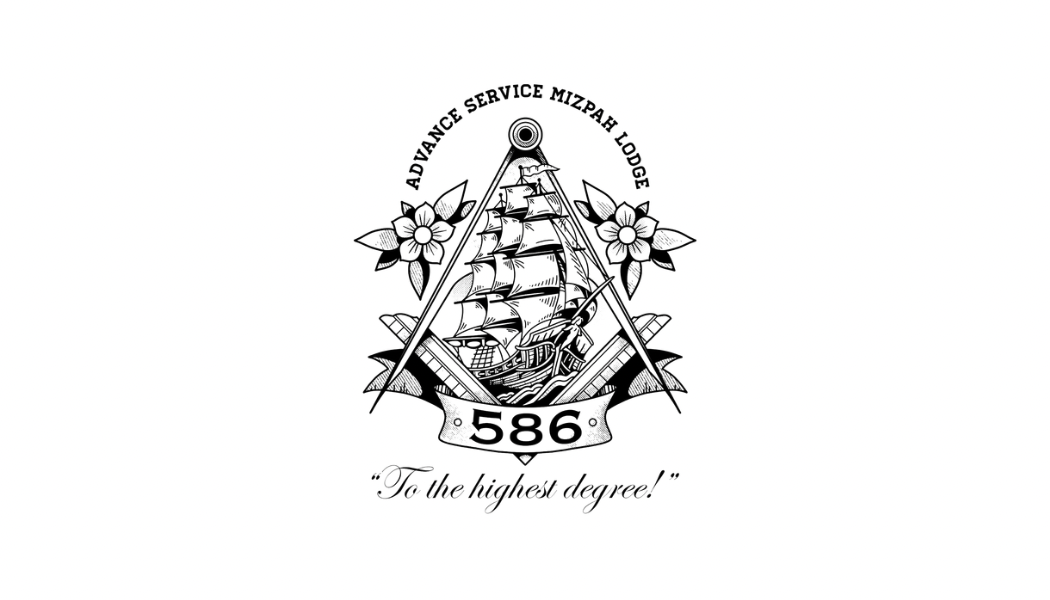
Seal of Advance Service Mizpah Lodge No.586, designed by Pon DeCaro.
From Manhattan and Hunter’s Point to Astoria, Elmhurst, and Flushing, the history of one lodge preserves the story of six.
Advance Service Mizpah Lodge No. 586 is not simply a Masonic lodge in Astoria. It is the living heir to six earlier lodges founded in Manhattan and Queens between 1856 and 1923, each shaped by its own neighborhood, generation, and moment in the city’s development.
That layered inheritance gives the lodge an unusual place in local history. Its lineage passes through mid-nineteenth-century Manhattan, the industrial waterfront at Hunter’s Point, village-era Newtown, growing Astoria, urbanizing Elmhurst, and twentieth-century Flushing. The modern lodge name preserves part of that journey. Advance, Service, and Mizpah are not decorative survivals. They are fragments of a longer institutional memory, while the number 586 carries forward the identity of Island City Lodge, chartered just after the Civil War.
Today the lodge meets at the Advance Masonic Temple in Astoria, but its story belongs to a far broader map of New York life.
Six lodges, one inheritance
The present lodge descends from six earlier bodies:- City Lodge No. 408, Manhattan, chartered 1856
- Island City Lodge No. 586, Hunter’s Point, chartered 1865
- Advance Lodge No. 635, Astoria, chartered 1867
- Mizpah Lodge No. 738, Newtown, later Elmhurst, chartered 1873
- Geba Lodge No. 954, Elmhurst, instituted 1919
- Service Lodge No. 1009, Flushing, chartered 19231
Taken together, they reflect the changing geography of New York itself. Some belonged to neighborhoods still half-rural or only beginning to urbanize. Others arose in already established districts with strong civic and commercial life. Over time, those separate histories were joined through a series of consolidations that preserved names, traditions, records, and memory within a single continuing lodge.
City Lodge and the public culture of nineteenth-century Manhattan
City Lodge No. 408 belonged to the highly visible ceremonial world of nineteenth-century Manhattan. Its members operated in a civic environment in which fraternal identity was often expressed in public dinners, charitable entertainments, memorial observances, and formal gatherings reported in the metropolitan press.One vivid example came in February 1870, when City Lodge organized a grand Masonic ball at the Academy of Music to benefit distressed Master Masons in Cuba. Contemporary newspaper accounts described a crowded and brilliant event, complete with distinguished guests, music, elaborate decoration, and a strong charitable purpose. It was a reminder that Masonic life in that period could be as public as it was private, and that ritual fraternity often moved in step with the social and philanthropic culture of the city.1
City Lodge remained part of that larger Manhattan world until 1973, when it consolidated with Service Lodge No. 1009. Its separate administrative existence ended, but its institutional memory continued forward in the line that eventually became Advance Service Mizpah Lodge No. 586.1
Island City Lodge and the rough beginnings of Hunter’s Point
Island City Lodge No. 586 began in 1865 at Hunter’s Point, when the western edge of Queens was still a place of ferries, railroad activity, workshops, muddy streets, and fast-changing industrial growth.Its founders first met near the foot of Borden Avenue in the old ferry house and resolved to organize a lodge if a charter could be secured. Early meetings took place in simple quarters, including ferry-house rooms and rented work spaces. Those beginnings were modest, but they were also characteristic of the period: local institutions often emerged before neighborhoods acquired the substantial buildings and civic polish later generations would take for granted.1
Island City Lodge grew with the district around it. In 1906 it erected a temple on Jackson Avenue near Anable Avenue, a major step that signaled both stability and ambition. The building served not only Masonic purposes but at times broader civic uses as well, reflecting the central role fraternal institutions could play in local public life.1
The number 586 remains in the modern lodge title, a direct and visible link to those post-Civil War origins at Hunter’s Point.
Mizpah Lodge and the continuity of old Newtown
Mizpah Lodge No. 738 was chartered in 1873 in Newtown, the old Queens village later known as Elmhurst. Its creation answered a practical need. Local Masons had been traveling to other communities to attend lodge, and a Newtown body gave the neighborhood an institution of its own.[1][0]Its first communication was held in the law office of Garret J. Garretson, its first Master, before the lodge moved into rooms on Broadway. Island City Lodge assisted the new body by presenting a Holy Bible, Square, and Compasses, establishing an early connection between two lodges whose histories would later be joined more formally.1
As the old village gave way to a more urban Elmhurst, Mizpah Lodge carried a sense of continuity. It preserved not only fraternal routine but also local memory, linking newer Queens streetscapes to an older civic geography rooted in Newtown’s long past.
In 1976, Mizpah Lodge consolidated with Island City Lodge No. 586 to form Island City Mizpah Lodge No. 586, combining Island City’s number with Mizpah’s historic name.1
Advance Lodge and Astoria’s institutional life
Advance Lodge No. 635 was chartered in Astoria in 1867. Its name drew on the Arctic brig Advance, associated with the expeditions of Dr. Elisha Kent Kane, and conveyed the period’s admiration for endurance, movement, and purposeful effort.Astoria in those years retained something of a village atmosphere, even as it was being pulled more closely into the life of greater New York. Within that setting, Advance Lodge became a durable local institution. Like many successful lodges, it met ordinary practical needs as well as symbolic ones: fellowship, mutual aid, routine governance, charitable work, and the steady maintenance of a community.1
Its early history included the usual challenges of rented quarters, household expenses, and the search for permanence. Yet Advance endured long enough to establish one of the most important surviving Masonic buildings in Queens. In 1915 the lodge laid the cornerstone of a new temple on Grand Avenue, now 30th Avenue, near Crescent Street, in a major public ceremony involving Grand Lodge officers, marching Masons, music, and neighborhood attention. The following year the lodge entered the building at 21-14 30th Avenue, where its successors still meet.1
That temple is more than a lodge hall. It is the chief physical vessel of the six-lodge inheritance preserved today.
Geba Lodge and twentieth-century Elmhurst
Geba Lodge No. 954 was instituted in Elmhurst in 1919, by which time Queens had become a fully urban borough marked by transit growth, residential expansion, commercial development, and rising social complexity.The lodge’s membership reflected that world. Men associated with Geba Lodge included psychologist David Wechsler, psychiatrist Dr. Dudley D. Shoenfeld, amusement entrepreneur Bernard Berkley, and comedian Don Rickles, who was raised there in 1953.1 Their presence suggests the diversity of the borough’s social fabric and the continuing importance of fraternal institutions as places where professional, commercial, and neighborhood lives intersected.
In 1982, Geba Lodge consolidated with Service City Lodge No. 1009 to form Service City Geba Lodge No. 1009.1
Service Lodge and the ethic of useful work
Service Lodge No. 1009 was chartered in Flushing in 1923. Its very name expressed a principle that ran through much of twentieth-century lodge culture: practical service, not merely ceremonial identity.Its history included support for hospitals, camps, veterans, youth work, Masonic philanthropy, and the quieter forms of relief that often define fraternal life more accurately than public display. Like many active lodges, it also built its internal culture through dinners, lectures, family events, reunions, and joint communications that made fraternity a lived experience rather than an abstract ideal.1
In 1973, Service Lodge consolidated with City Lodge No. 408 to form Service City Lodge No. 1009, bringing together a newer Queens lodge and a much older Manhattan one.1
Consolidation as preservation
The path to the present lodge was shaped by five major consolidations:- 1973: City Lodge No. 408 and Service Lodge No. 1009 consolidated as Service City Lodge No. 1009
- 1976: Island City Lodge No. 586 and Mizpah Lodge No. 738 consolidated as Island City Mizpah Lodge No. 586
- 1982: Geba Lodge No. 954 and Service City Lodge No. 1009 consolidated as Service City Geba Lodge No. 1009
- 1993: Advance Lodge No. 635 and Island City Mizpah Lodge No. 586 consolidated as Advance Island City Mizpah Lodge No. 586
- 2018: Advance Island City Mizpah Lodge No. 586 and Service City Geba Lodge No. 1009 consolidated as Advance Service Mizpah Lodge No. 5861
Consolidation is often misunderstood as a simple sign of decline. In historical terms, it can also be an instrument of preservation. Institutions adapt to demographic shifts, financial pressure, changing patterns of membership, and broader transformations in neighborhood life. When they consolidate successfully, they do not merely disappear. They carry names, records, customs, charitable traditions, and collective memory forward into a new form.
That is what happened here. The modern lodge preserves City Lodge’s Manhattan inheritance, Island City’s Hunter’s Point origins, Mizpah’s Newtown continuity, Advance’s Astoria home, Geba’s twentieth-century urban breadth, and Service’s ethic of practical relief.
A Queens institution with a larger map
Advance Service Mizpah Lodge No. 586 remains rooted in Astoria, but its story belongs to more than one place. It belongs to Manhattan, Hunter’s Point, Long Island City, Newtown, Elmhurst, Astoria, and Flushing. It belongs to generations of members who founded, sustained, merged, and preserved six lodges across more than a century and a half of New York history.That inheritance is not merely ceremonial. It survives in the lodge’s name, number, building, records, and continuing work. In that sense, Advance Service Mizpah Lodge No. 586 is not simply the end result of several consolidations. It is a living archive of local history, carried forward by institution, memory, and use.1
End Notes
Author’s note:
I write as an individual Freemason, historian, and researcher. This article reflects my personal research and interpretation and does not represent an official statement of Advance Service Mizpah Lodge No. 586, the Grand Lodge of New York, or any other Masonic organization.
Image:
Created by and from the collection of Bro. Pon DeCaro
Literary:
1 Charter dates, lodge numbers, and consolidation dates are drawn from the records and proceedings of the Grand Lodge of the State of New York. Additional historical detail is based on lodge histories, anniversary newspaper publications, newspaper coverage, temple and building records, and related local historical materials concerning City Lodge No. 408, Island City Lodge No. 586, Advance Lodge No. 635, Mizpah Lodge No. 738, Geba Lodge No. 954, and Service Lodge No. 1009. For a fuller research note, see Full Sources for Advance Service Mizpah Lodge No. 586.