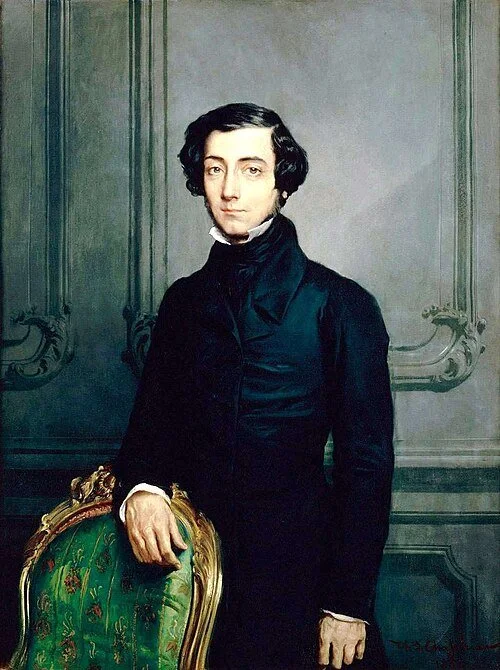
Tocqueville and the Soft Despotism of the Crowd
Tyranny does not always arrive with chains. Sometimes it comes as social pressure, managed opinion, and the quiet fear of standing apart from everyone else.
When people imagine oppression, they usually imagine force.
They picture censorship backed by police, decrees backed by prison, rulers who command obedience openly and punish dissent directly. Such things exist, and they matter. But Alexis de Tocqueville saw another danger growing within democratic life: a form of domination that operates less by terror than by social pressure, dependency, and the gradual weakening of independent judgment.[1]
Its power lies partly in its softness.
Tocqueville understood that democracy carries genuine goods. It broadens participation, undermines inherited privilege, and draws attention to the dignity of ordinary persons. But it also creates characteristic temptations. One of them is conformity. When formal hierarchies weaken, public opinion can become more powerful, not less. A man may no longer fear a king. He may instead fear isolation.
That fear can govern him very effectively.
The democratic crowd does not need to imprison every dissenter. Often it is enough to make dissent costly in reputation, belonging, and comfort. A person who departs from prevailing opinion may not be physically restrained. He may simply be treated as ridiculous, suspect, disloyal, or unclean. The result can be a wide and anxious obedience maintained largely from within.
Tocqueville worried that this condition would produce smaller souls.
Not necessarily cruel souls.
Not necessarily unintelligent souls.
But souls less practiced in standing alone.
This concern remains strikingly modern. Much contemporary pressure is not imposed by a single authority. It is diffused through institutions, networks, professions, and social expectations. People learn what may be said, what must be signaled, what cannot be questioned, and what forms of hesitation will be treated as guilt. Many comply not because they have been persuaded, but because resistance seems exhausting.
That is one path to soft despotism.
Tocqueville also feared a second development: the growth of a paternal administrative order that relieves people of responsibility while making them more dependent.[2] Such power need not appear openly vicious. It may present itself as helpful, managerial, and benevolent. It aims not to break wills dramatically, but to spare people the trouble of using them. Citizens become easier to direct precisely because they are gradually habituated to supervision and relieved of difficult judgment.
The danger, then, is not only external control.
It is internal atrophy.
Here the Masonic relevance is plain. Masonry assumes that a man ought to become capable of self-government. Its symbolic labor is not directed toward passivity but toward formation. A brotherhood of men unable to resist social pressure or administrative tutelage will preserve forms of fraternity while losing much of its substance. Fellowship becomes shallow when inward independence collapses.
The liberal arts exist, in part, to prevent that collapse.
Grammar teaches a man to examine the language by which opinion is enforced. Logic teaches him to test the arguments beneath approved conclusions. Rhetoric teaches him to recognize the emotional management of public speech. The quadrivial arts accustom the mind to order beyond fashion. Together, they make it harder for a person to be carried entirely by consensus.
That does not make him quarrelsome.
It makes him less absorbable.
Tocqueville’s analysis also explains why loneliness has such political significance. The isolated person is easier to manage, yet mass society often produces just such isolation. Traditional bonds weaken. Intermediate institutions thin out. People become simultaneously crowded and alone. In that condition, centralized narratives and social cues gain force because the individual lacks the smaller loyalties and communities that might otherwise steady him.
This is one reason lodges matter when they are healthy.
A lodge can serve as one of those intermediate places where men practice deliberation, continuity, and moral seriousness outside both the state and the market. But this happens only if it refuses to become another mechanism of easy conformity. Brotherhood must strengthen persons, not flatten them.
Tocqueville’s warning, then, is not a call to permanent defiance. It is a call to preserve the conditions under which freedom remains possible. Those conditions include local association, responsible citizenship, religious seriousness, and habits of independent thought. They also include the courage to bear disapproval without immediate collapse.
That courage is increasingly necessary.
The crowd is persuasive because it offers relief. It spares a person the burden of thinking too carefully or standing too distinctly. It lets him borrow confidence from numbers. But what it gives in reassurance it often takes in stature.
Tocqueville saw the trade clearly.
Comfort can become a political narcotic.
Equality can drift into sameness.
Protection can become tutelage.
A free society therefore requires more than rights and procedures. It requires citizens who have learned not to surrender themselves too cheaply. For Masons and non-Masons alike, that remains an exacting standard.
It is also one worth defending.
Because a man who cannot stand somewhat apart will not stand for very much at all.
Endnotes
[1] Alexis de Tocqueville, Democracy in America, especially the sections on the tyranny of the majority and public opinion.
[2] Tocqueville’s account of “soft despotism” appears in Volume II of Democracy in America, where he describes an immense tutelary power that reduces citizens to timid dependence.
Brief Bibliography
Alexis de Tocqueville, Democracy in America
Pierre Manent, Tocqueville and the Nature of Democracy
Harvey C. Mansfield and Delba Winthrop, trans., Democracy in America
Robert Nisbet, The Quest for Community