The Work Behind the Symbols
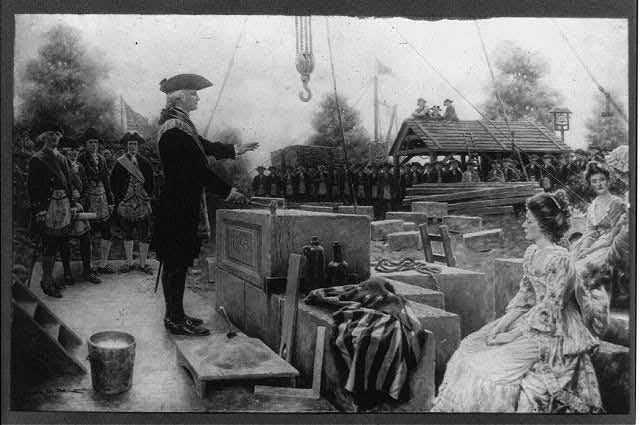
George Washington Lays the U.S. Capitol Cornerstone (painting, 1793), by Clyde DeLand; Library of Congress.
Grain, wine, and oil were useful goods before they became subjects of interpretation. Someone had to grow them, process them, store them, carry them, and worry about them.
Start with a loaf, a cup, and a lamp
None of them began as a symbol. The loaf began with a field and a season of weather. The cup depended on a vineyard, a harvest, and a fermentation that could go well or spoil. The lamp needed oil, and the oil needed fruit, a press, and someone to fill the reservoir. Each passed through hands and vessels before it reached the household. Each could fail along the way.
This series begins there. It treats corn — grain, in the older English sense — wine, and oil as real goods first, and only then asks what happens when they enter ceremony, scripture, and philosophical reflection.
The governing proposal is simple: part of their symbolic force comes from their attachment to ordinary experience. Hunger, pleasure, upkeep, labor, dependence, and the fear of running short give the reader somewhere to begin. A loaf needs little explaining in a household that has waited for one.
That is an argument about how symbols may work, not a demonstrated account of why every tradition chose them.
Freemasonry is one of the places these materials turn up. Corn, wine, and oil appear in publicly performed Masonic cornerstone ceremonies, and the series takes that evidence seriously. It asks what a report establishes, what an institution has published, and what remains unverified.
But the Masonic material is one thread among several. The essays follow the goods through agriculture, trade, and biblical texts, compare them with distinct Qur’anic images of provision, and consider what alchemical writing can — and cannot — contribute to a modern reading. The threads stay separate. Similarity does not mean that traditions say the same thing, and resemblance does not prove borrowing.
Nor does the series claim to decode anything. There is no hidden formula at the bottom of it. What it offers is a way of looking: slower, more material, and more careful about the line between what the sources establish, what a named interpreter has said, and what the writer is proposing.
How the series moves
The eight essays follow a rough arc, from the ground up.
The first opens with a public ceremony and the limits of its evidence. The next three stay with the materials: grain, wine, and oil. Here the questions are practical. What was grown? What had to be done to it? What could go wrong? What work disappears when the finished good becomes a familiar object?
The fifth turns to scripture, where the goods appear in blessing, debt, scarcity, and obligation. The sixth takes up alchemy, a subject that invites overreading, and asks how a comparison can remain useful without becoming a claim of historical connection.
The last two step back. They ask what these goods reveal about dependence and shared life, and what habits of attention might follow from taking them seriously.
You can read straight through, and the later essays build on the earlier ones. But each piece is written to stand reasonably well alone.
For public Masonic ceremony and the limits of the evidence, begin with Article 1.
For the scriptural discussion, begin with Article 5.
For alchemy and the risks of an elegant comparison, begin with Article 6.
For the wider philosophical argument, begin with Article 7
The eight essays
1. A wet day in Albany
A correspondent stands in the rain while the Grand Lodge of New York lays the cornerstone of the new State Capitol. His 1871 report records the officers, the materials, and the blessings. It does not hand the reader a complete philosophy.
The opening essay uses that distinction to establish the series’ method: keep the performed ceremony, the published explanation, and the writer’s interpretation in separate accounts. It also asks what discretion, confidentiality, and institutional privacy mean without treating every gap in the record as a secret.
2. Ears of corn, an ephah of barley
Ruth goes out to glean “ears of corn” and comes home with barley. The word is the first problem. In the older English usage, corn means grain, not necessarily maize.
From there, the essay follows the work between a field and a loaf: harvesting, threshing, grinding, storing, and leaving something for people who do not own the land. Grain appears as nourishment, but nourishment has a history of labor and a question of access attached to it.
Read “Ears of corn, an ephah of barley”
3. A crop that makes its own decisions
Wine begins with sugar and yeast, not with a meaning waiting to be poured out. The essay follows fermentation into the places wine occupies in scripture, hospitality, and public cornerstone ceremony.
The cup brings pleasure and risk into the same view. Refreshment does not erase the need for restraint, and fellowship does not require anyone to drink. The question is not simply whether a good is enjoyable, but what form lets the enjoyment remain a good.
Read “A crop that makes its own decisions”
4. The lamp, the wick, and the person who forgot
Oil brings the quieter work into view. A lamp stays lit because someone fills it. A finished building continues because someone maintains it.
The essay keeps lamp fuel, food, medicinal use, and anointing apart before considering the readings attached to them. Joy, peace, and comfort appear in published ceremonial accounts, but the writer’s further question is about continuity: who has been doing the unnoticed work, and what has been quietly running down?
Read “The lamp, the wick, and the person who forgot”
5. A loan, and what it was charged in
Nehemiah hears an outcry over grain, loans, mortgaged property, and children taken into servitude. The three goods have entered an account, not an emblem.
The essay follows grain, wine, and oil through biblical passages about blessing, tithes, failed harvests, prices, and restitution, then compares those arrangements with wider Qur’anic lists of provision. The texts are read in their own settings. What emerges is not one fixed meaning, but a set of goods around which a community’s duties and failures gather.
Read “A loan, and what it was charged in”
6. Readings, Not Equations: Alchemy, Transformation, and the Risk of Overinterpretation
Three goods, three alchemical principles, one tempting table. The comparison is easy to make. Demonstrating what it means is another matter.
This essay examines alchemy through particular texts, authors, and later readings rather than treating it as a master key. It asks what a transformation-minded comparison helps us notice about processing, separation, waiting, and labor—and what disappears when the materials become entries in a scheme.
Read “Readings, Not Equations”
7. After the Symbols: Receiving the Ordinary with Measure
The last essay returns to the kitchen. The oil has run out, the bread has gone hard, and the spare bulb was never replaced.
Here, “measure” receives a working definition: giving a good its due. The conclusion is not a code concealed inside three materials. It is a set of questions about supply, pleasure, maintenance, and the people at the table. Symbols may help someone pay attention. They do not do the paying on anyone’s behalf.
Read “After the Symbols: Receiving the Ordinary with Measure”
Back to the table
You do not need to take part in a ceremony or adopt one tradition’s beliefs to begin with the material questions. Look a little longer at something you already handle: the bread, the bottle, the lamp, the shelf someone stocked before you arrived.
Look at what went into it, who did the work, and what would happen if the supply stopped. Notice what you take for granted and what you save for a good occasion.
The symbols are old. The attention is available this evening, and it starts with whatever is on the table.
Endnote:
Photographic reproduction of “George Washington Lays Cornerstone of U.S. Capitol” (painting), 1793; Clyde O. DeLand. George Washington Lays Cornerstone of U.S. Capitol, Library of Congress. U.S. Copyright Office (G60836). http://www.loc.gov/ (accessed Oct. 25, 2026).
Start reading: Corn, Wine and Oil in Masonic Cornerstone Ceremonies →
