Geba Lodge and the Making of Modern Queens
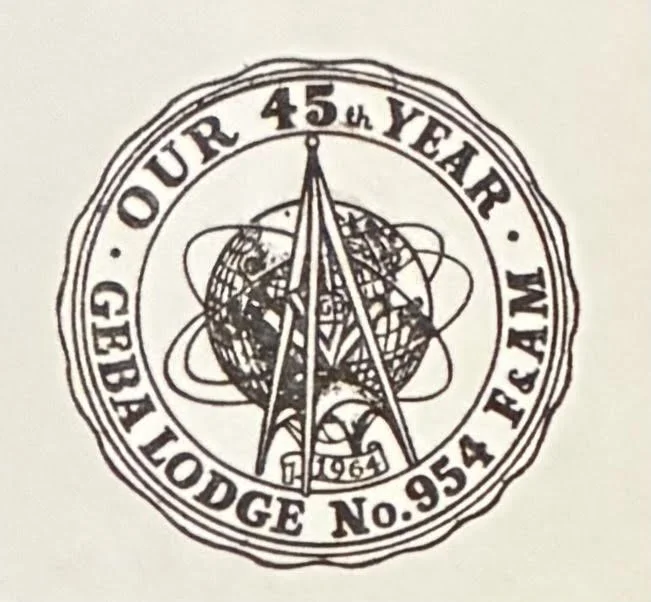
Official seal of Geba Lodge No.954, Jackson Heights, Queens
How an Elmhurst Lodge Connected Neighborhood Life, Professional Ambition, Popular Culture, and Public Service
Geba Lodge No. 954 was born in the final months of the First World War. Its members included merchants, physicians, psychologists, attorneys, tradesmen, entertainers, and civic-minded neighbors—men whose lives reveal the changing character of twentieth-century Queens.
In October 1918, the First World War had not yet ended.^1 Influenza was sweeping through New York.^2 Queens was growing at a pace that would have been difficult to imagine only a generation earlier.^3 Farms, village streets, and old local boundaries were giving way to apartment houses, commercial corridors, new transit connections, and communities formed by newcomers from across the city and around the world.^4
In that unsettled season, a group of Masons in Elmhurst established Geba Lodge No. 954.
^5The lodge’s name may be less familiar today than those of its older Queens predecessors, but its history offers one of the clearest portraits of modern Queens.^6 Geba brought together the borough’s merchants, physicians, skilled tradesmen, lawyers, civil servants, immigrants, entertainers, and professionals.^7 In time, its members would include men whose influence reached far beyond the lodge room: psychologist David Wechsler, forensic psychiatrist Dudley D. Shoenfeld, Fairyland co-founder Bernard Berkley, and comedian Don Rickles.^8
Their stories were very different.^9 Together, they reveal what a Queens lodge could be: a neighborhood institution where the ordinary and extraordinary met on equal terms.^10
A Lodge in Wartime Elmhurst
Geba Lodge began under dispensation in October 1918, as the war neared its end.^11 It was formally instituted in 1919, when Deputy Grand Master Robert H. Robinson and Grand Lodge officers took part in its ceremony of constitution.^12 Samuel A. Lando, of Corona, became its first Master.^13
The lodge entered a Queens that had already changed dramatically since the founding of Island City Lodge in 1865, Mizpah Lodge in 1873, and Advance Lodge in 1867.^14 Elmhurst was no longer only the old Village of Newtown.^15 It was an increasingly urban community shaped by transit, commerce, immigration, new housing, and the expanding life of Greater New York.^16
Geba’s establishment reflected that transformation.^17 It was a lodge of the twentieth century: formed in a borough that was becoming more populous, more professionally diverse, and more connected to the larger economic and cultural life of the city.^18
Mizpah Lodge No. 738, itself an older Elmhurst institution, presented Geba with a Bible, Square, and Compasses.^19 The wives of Geba’s officers presented the lodge with a silk American flag.^20 These gifts connected the new body to both the continuity of Queens Masonry and the patriotic atmosphere of the immediate postwar period.^21
The lodge’s early members included men from commercial, professional, and skilled occupations.^22 Their individual lives show the variety of the community around them.^23
A Lodge of Merchants, Tradesmen, and Professionals
The early Geba roster reflected the social world of Queens in the 1910s and 1920s.^24 Men entered the lodge from the expanding middle class of the borough: shopkeepers, pharmacists, attorneys, ship officers, electricians, fixture dealers, doctors, and businessmen.^25
Some became widely known.^26 Most did not.^27
That distinction is important.^28 The history of a lodge should not be told only through celebrities.^29 Its real strength often came from men whose names appeared only in lodge minutes, local directories, funeral notices, and neighborhood records.^30 A druggist who dispensed medicines to local families, an electrician who wired new homes, a merchant who ran a small business, or a lawyer who helped a neighbor navigate a legal problem could all become part of the civic fabric of Queens.^31
Geba Lodge was made from those lives.
^32David A. Davis, for example, brought maritime experience to the lodge.^33 A Master Mason before becoming affiliated with Geba, he went on to a career in shipping and port management, including work with Grace Line, States Marine Lines, and the U.S. War Shipping Administration during the Second World War.^34
Max Hansburg represented another kind of local service.^35 As a druggist, he belonged to a generation of neighborhood pharmacists who combined professional knowledge with daily familiarity.^36 In communities before chain pharmacies and large medical systems, the local drugstore was often a place of practical advice, trust, and continuity.^37
These men were not necessarily famous, but they were precisely the sort of citizens on whom neighborhood institutions depended.^38 Geba Lodge gave them a shared setting in which occupation, background, and social standing were meant to yield to fraternity.^39
David Wechsler and the Architecture of the Mind
One of Geba Lodge’s most consequential members was David Wechsler.^40
Born in Romania in 1896, Wechsler came to the United States as a child and grew up in the immigrant world of New York.^41 He graduated from the City College of New York, earned his doctorate in psychology from Columbia University, and worked in early Army psychological testing during the First World War.^42
On April 8, 1919, Wechsler was raised to the degree of Master Mason in Geba Lodge.^43 He was among the earliest members of the newly chartered lodge.^44
His later career reshaped modern psychology.^45 At Bellevue Psychiatric Hospital, where he became Chief Psychologist in 1932, Wechsler developed a new approach to understanding intelligence.^46 Rather than relying on simple “mental age” measurements, his tests used age-based statistical norms and recognized that intellectual ability had multiple dimensions.^47
The Wechsler-Bellevue Intelligence Scale, introduced in 1939, became the foundation for the Wechsler Adult Intelligence Scale, the Wechsler Intelligence Scale for Children, and the Wechsler Preschool and Primary Scale of Intelligence.^48 These instruments became central to educational assessment, clinical psychology, neuropsychology, and forensic work across the world.^49
Wechsler’s connection to Geba Lodge is a reminder that local history can contain global consequences.^50 In 1919, he was one more young man in an Elmhurst lodge room.^51 In later decades, his work influenced how schools, hospitals, courts, and clinicians understood human ability.^52
The lodge did not make him a psychologist.^53 But it formed part of the local social world in which an immigrant scholar became a Queens brother.^54
Dudley Shoenfeld and the Science of Behavior
Dudley D. Shoenfeld represented another side of Geba Lodge’s intellectual life.^55
Born in New York City in 1893, Shoenfeld earned his medical degree in 1917 and developed an interest in psychiatry while serving as a Navy physician during the First World War.^56 He later became associated with Mount Sinai Hospital, where he served in psychiatry, taught, maintained a private psychoanalytic practice, and helped develop early mental-health services.^57
Shoenfeld was among the early builders of Geba Lodge.^58 His career later brought him national attention for his role in the Lindbergh kidnapping investigation.^59 In 1932, he studied ransom notes associated with the case and prepared a psychological profile of the writer.^60 His analysis identified characteristics that later appeared strikingly consistent with Bruno Richard Hauptmann, who was arrested in 1934.^61
His conclusions included the view that the writer was likely German, mechanically skilled, living in the Bronx, and acting alone.^62 While some of Shoenfeld’s specific psychological interpretations reflected the assumptions and language of his era, his effort to apply psychiatric reasoning to criminal investigation was an early example of what would later be called criminal profiling.^63
In 1936, Shoenfeld published The Crime and the Criminal: A Psychiatric Study of the Lindbergh Case.^64 He also participated in public discussions of juvenile delinquency, mental health, substance use, and medical jurisprudence.^65 His papers, preserved by the American Psychiatric Association, document his work on the Lindbergh case, the Mayor’s Commission on Marijuana, and other questions at the intersection of psychology, law, and public policy.^66
His career was not merely a curiosity of true-crime history.^67 It showed how the emerging disciplines of psychiatry and psychoanalysis entered public life in twentieth-century New York.^68 Through Geba Lodge, that world of professional innovation was connected to a neighborhood fraternity in Queens.^69
Bernard Berkley and the Magic of Fairyland
Geba Lodge’s history also touched the popular culture and family life of mid-century Queens.^70
Bernard Berkley, raised in Geba Lodge in 1954, was a co-owner of Fairyland Amusement Park.^71 With his business partner Al McKee, Berkley helped create one of the borough’s most beloved postwar destinations for children and families.^72
Fairyland began in 1949 and later operated near the intersection of Queens Boulevard and Woodhaven Boulevard, on land now associated with Queens Center Mall.^73 It offered rides, food, bright ticket booths, parking, and a carefully designed environment built around children’s entertainment.^74 At its height, the park attracted thousands of visitors on busy summer weekends.^75
For generations of Queens families, Fairyland was a place of small but vivid memories: carousel rides, trains, Ferris wheels, candy, bright lights, and the particular excitement of childhood outings.^76 It was commercial entertainment, certainly, but it was also part of the social geography of postwar Queens.^77
Berkley’s connection to Geba Lodge became especially visible in July 1954, when the lodge sponsored an outing for more than 100 children from the Ottilie Orphan Home, the Gustav Hartman Home for Children, and the Brooklyn Home for Children.^78 Berkley provided the park facilities and luncheon.^79 Lodge members distributed balloons, candy, toys, and fruit; some dressed as clowns to entertain the children.^80
The event embodied a central Masonic principle: relief expressed in practical action.^81 For one day, a commercial amusement park became a setting for charity, hospitality, and delight.^82
Fairyland disappeared in the late 1960s as the site was cleared for the Queens Center Mall.^83 Yet its memory remains woven into the history of Elmhurst and the stories of residents who remember it.^84 Through Berkley, Fairyland also became part of Geba Lodge’s legacy.^85
Don Rickles and the Queens Voice
Perhaps Geba Lodge’s best-known member was Donald Jay Rickles.^86
Born in Jackson Heights in 1926 to Jewish immigrant parents, Rickles attended Newtown High School and served in the United States Navy during the Second World War.^87 After his discharge, he studied acting and began the long, difficult work of making a career in entertainment.^88
He was raised in Geba Lodge in 1953.^89
Rickles would become one of the most distinctive figures in American comedy.^90 His style was confrontational, quick, unscripted, and theatrical.^91 He transformed insults into a form of audience participation, using sharp improvisation to bring ordinary spectators, Hollywood stars, politicians, and celebrities into the same comic arena.^92
His breakthrough came through nightclub work and the support of Frank Sinatra, who recognized that Rickles’ jokes worked because they combined danger, confidence, and a peculiar form of affection.^93 Rickles appeared repeatedly on The Tonight Show, became a fixture on Dean Martin’s celebrity roasts, and built a career across stand-up, television, film, and animation.^94
His screen work ranged from Run Silent, Run Deep and Kelly’s Heroes to Martin Scorsese’s Casino.^95 For later generations, he became the unmistakable voice of Mr. Potato Head in the Toy Story films.^96
Rickles’ Masonic connection should not be exaggerated into an explanation for his comic genius.^97 But it does place him within the same Queens world that produced Geba Lodge’s physicians, merchants, lawyers, and civic workers.^98 He belonged to a fraternity built on ritual, fellowship, memory, and the equality of brothers inside the lodge room—qualities that stand in fascinating contrast to the unruly public persona he perfected onstage.^99
Behind the insults was a performer who understood timing, loyalty, and the need to make an audience feel included in the act.^100
A Lodge That Reflected Queens
Geba Lodge is important not merely because it counted famous men among its members.^101 It matters because those men were not alike.^102
A psychologist who transformed intelligence testing.^103 A psychiatrist who entered the early world of forensic analysis.^104 A businessman who built a children’s amusement park.^105 A comedian who reshaped American insult comedy.^106 Alongside them were pharmacists, electricians, merchants, maritime workers, attorneys, and men whose names survive only in the records of the lodge.^107
That mixture is distinctly Queens.^108
The borough has always been made through overlapping worlds: immigrant aspiration, professional ambition, neighborhood familiarity, public service, commerce, craft, entertainment, and family memory.^109 Geba Lodge brought such worlds into a common room.^110
It was a lodge of modern Queens because it reflected the borough’s diversity of work and experience.^111
From Geba to Advance Service Mizpah
By the 1970s, Geba Lodge was meeting at Mizpah Temple in Elmhurst.^112 In 1982, it consolidated with Service City Lodge No. 1009, forming Service City Geba Lodge No. 1009.^113
That merger joined three geographic histories: City Lodge’s Manhattan tradition, Service Lodge’s Flushing culture of charity and fellowship, and Geba’s Elmhurst story of professional, commercial, and cultural life.^114
In 2018, Service City Geba Lodge united with Advance Island City Mizpah Lodge No. 586.^115 The result was Advance Service Mizpah Lodge No. 586.^116
Geba’s name does not appear in the present title, but its inheritance remains fully present.^117 It survives in the stories of its members, in the traditions it carried into consolidation, and in the wider understanding of what Queens Masonry has been.^118
A lodge is never only a roster.^119 It is a gathering place for the lives that pass through it.^120
Geba Lodge No. 954 gathered a remarkable cross-section of twentieth-century Queens.^121 In doing so, it left a legacy far larger than its original name.^122
End Notes
Author’s note:
I write as an individual Freemason, historian, and researcher. This article reflects my personal research and interpretation and does not represent an official statement of Advance Service Mizpah Lodge No. 586, the Grand Lodge of New York, or any other Masonic organization.
Image:
Author's private collection.
Literary:
Sources to come - Reasearchers please feel free to request on my contact page.