Geometry, Architecture, and Moral Proportion
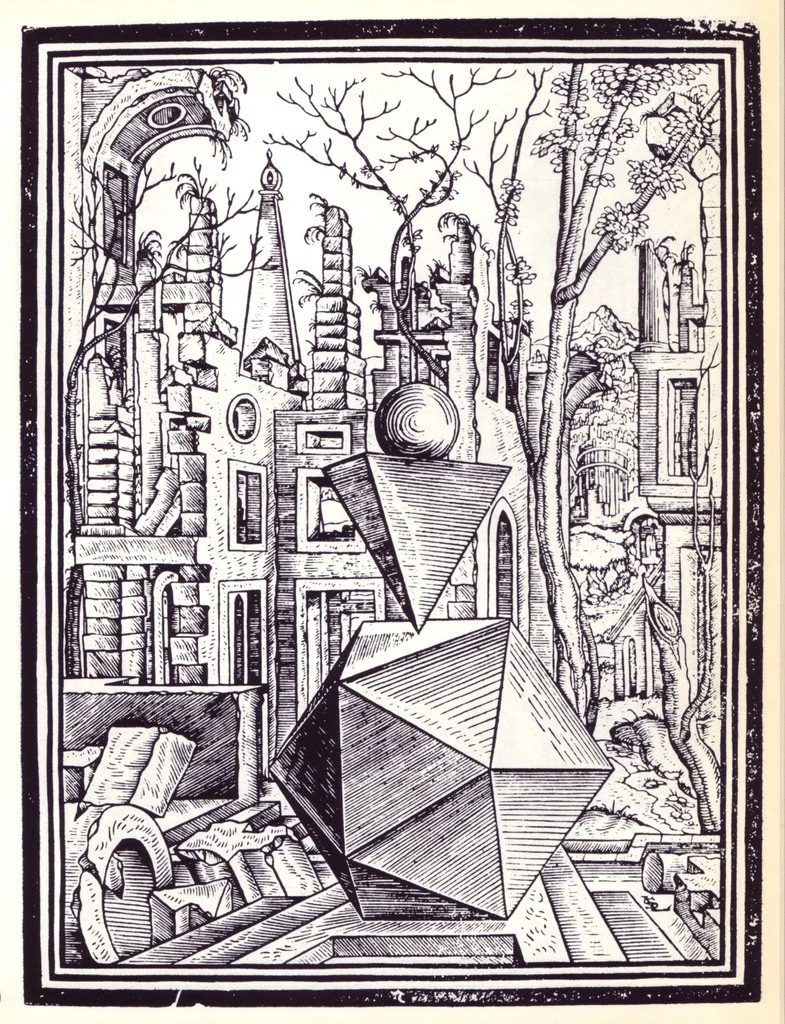
What buildings teach about the life of the soul
Geometry is not merely the art of calculation. It teaches relation, stability, balance, weight, and consequence. A building collapses when its parts are wrongly related. So can a life.
A building has no interest in our intentions.
A beam does not care that we meant well. An arch does not remain standing because we admire its symbolism. A foundation does not become stable because the architect had a compelling personal journey.
Buildings obey relation.
Weight must be carried.
Materials must be fitted.
Forces must be understood.
Measure must be respected.
This is why geometry has always been more than arithmetic with better diagrams. It teaches the mind that reality has structure. Things stand or fall according to relation.
Daedalus belongs to this world.
He understands form. He knows how to make a space confine, a wing lift, a mechanism move, a structure hold. He is a master of the built and made world.
His myth asks whether the same understanding can govern the life of the soul.
The moral meaning of proportion
Proportion is not merely visual attractiveness.
It is right relation among parts.
In a building, proportion allows the roof, walls, columns, openings, materials, and foundation to work together.
In a life, proportion allows work, rest, desire, duty, friendship, study, family, service, ambition, solitude, pleasure, and reflection to coexist without one part destroying the rest.
A life collapses for much the same reason a building does: not because one part exists, but because one part has begun carrying more weight than it was built to bear.
Work is good. Work that devours every other duty becomes destructive.
Pleasure is good. Pleasure made sovereign becomes slavery.
Ambition is good. Ambition without justice becomes predation.
Solitude is good. Solitude used to avoid love becomes isolation.
Service is good. Service without rest becomes resentment.
Study is good. Study used to avoid action becomes another form of hiding.
The moral life requires architecture.
The Labyrinth and the temple
A labyrinth and a temple are both structures.
But they order human experience differently.
The Labyrinth disorients. It makes direction difficult. It conceals exits. It traps movement inside confusion.
A temple, at its best, orients. It gives relation, direction, hierarchy, threshold, light, and a sense that the parts belong to a whole.
This contrast has obvious symbolic value.
A person may build an inward labyrinth by accumulating habits that confuse rather than clarify. Every decision becomes reactive. Every desire becomes urgent. Every grievance leads back to itself. Every conversation turns into a dead end.
Or he may build an inward temple: not a place of private superiority, but a life with clearer proportion. He knows where attention belongs. He knows what to refuse. He has room for study, work, friendship, service, rest, and honest self-examination.
The distinction is not between complexity and simplicity.
It is between confusion and order.
Geometry and the liberal arts
The Second Degree’s attention to geometry and the liberal arts has a philosophical depth often overlooked.
Geometry teaches relation.
Music teaches harmony.
Arithmetic teaches number and proportion.
Astronomy teaches scale and order.
Grammar, rhetoric, and logic teach disciplined relation in language and thought.
Together they form a school of proportion.
They train a person to see that a part is not the whole, that a line has direction, that an argument has structure, that a note has relation, that a building has load, and that a life has limits.
This is not dry knowledge.
It is moral preparation.
A person trained in proportion may be less likely to confuse temporary anger with permanent truth. He may become less easily seduced by grand slogans. He may recognize that a public triumph can conceal a private collapse. He may understand that not every problem is solved by adding more of the thing that caused it.
Geometry does not make a person good.
But it can make goodness easier to imagine as order rather than sentiment.
Queens, buildings, and moral memory
For a writer concerned with Queens history and Masonic architecture, this article can become especially local.
Every old lodge building presents a question: what did the builders think was worth making visible?
A façade may declare stability. A cornerstone may announce continuity. A lodge room may teach hierarchy, orientation, dignity, and symbolic order. A modest building may reveal community labor, mutual aid, aspiration, and the desire to create a lasting place in a changing city.
Buildings do not prove the virtue of the people who used them. A beautiful temple can house vanity. A grand room can host pettiness. A modest hall can contain extraordinary fellowship.
But architecture preserves aspiration.
It records what a community hoped to become.
That makes buildings part of moral history.
The life that stands
Daedalus knows how to build structures that hold and structures that trap.
The moral task is learning the difference.
A life should not become a maze from which the person cannot escape.
It should become a structure capable of carrying weight.
Geometry, architecture, and moral proportion all teach the same quiet truth:
The parts matter.
But relation matters more.
Endnotes and further reading
Plato, Republic VII, on geometry, mathematics, and the education of the soul.
Plato, Timaeus, on proportion, order, and the intelligibility of the cosmos.
Vitruvius, On Architecture, on proportion, order, and the responsibilities of building.
Related reading: “The Middle Chamber of the Mind” and “Beauty That Teaches Instead of Flatters.”