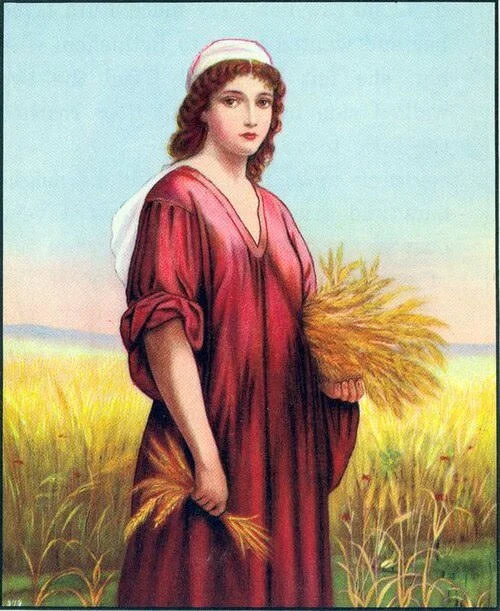
Ruth collecting grain, illustration by O. A. Stemler and Bess Bruce Cleaveland, 1927
Ruth the Moabite goes out to a field to pick up what the reapers leave behind. In the King James Version she asks to glean “ears of corn.” By evening she has beaten out what she gathered, and the same translation gives the tally: about an ephah of barley. The chapter ends with her still gleaning through the barley harvest and then the wheat harvest.
So the King James text says corn where the story itself says barley and wheat. Nobody in it is holding maize. A nineteenth-century Bible dictionary states flatly that Indian corn was unknown in Bible times, and that is as good a place as any to begin. Corn is a word that changes with the map.
A word that follows the local crop
The American Heritage Dictionary gives the short history. English “corn” once meant any rounded grain or seed, and in practice it named whatever grain a region grew most. In England that was usually wheat. In Scotland it was oats. When English speakers met maize in the sixteenth century they borrowed a Spanish word for it, and by the seventeenth they were calling it Indian corn. North Americans eventually dropped the first word, and the shortened form took over the continent. Merriam-Webster still lists the older British sense: the main cereal crop of a region.
Anyone reading British sources has to adjust. The Corn Laws, in force from 1815 to 1846, were tariffs on imported grain, and the grain in question was chiefly wheat.
Masonic writers know the problem. A 1930 Short Talk Bulletin from the Masonic Service Association says outright, “The corn of the Bible is not the corn we know today.” A 2021 piece in California Freemason glosses ceremonial corn as barley or wheat in early history. A page on the Phoenix Masonry site calls corn in the rituals a synonym for grain or wheat. Those are Masonic sources describing Masonic usage, and I can’t say they speak for every jurisdiction.
What about Albany, where Article 1 began? The 1871 report says the Deputy Grand Master scattered corn. It doesn’t say which grain. For this series, then, a working rule: grain when I mean the substance, “corn” when I am quoting or naming the ceremonial word.
The long way to a loaf
A handful of grain looks like a finished thing. It is close to the opposite. Somebody sowed it into land that might or might not get rain, and somebody cut it. Then comes the part that never makes the pictures. Threshing separates the grain from stalk and husk. Winnowing, in its oldest form, means tossing the mixture into a breeze so the chaff blows off, which means that on a windless day you wait. One reference history says that before mechanization in the late eighteenth century, about a quarter of farm labor went to threshing alone.
Then comes grinding. The Penn Museum’s page on Canaan and ancient Israel says that in the Bronze and Iron Ages bread was the staple, that people ate roughly 330 to 440 pounds of wheat and barley a year, and that cereals supplied half or more of an individual’s calories. The grain was ground by hand on a basalt quern, a slow job that left grit in the bread and, over the years, wore teeth down.
A modern essay on hand-grinding maize for masa estimates about five hours a day to feed a family of five, and concludes that one adult in five had to spend their time making the staple. That is one writer’s estimate, about a different grain, but the order of magnitude is the point. A paper on grinding in ancient Egypt argues that the work was associated with women and carried little prestige. The people doing some of the heaviest daily labor in the chain were often those with the least say over the rest of it.
Even then the grain isn’t safe. An FAO project in Ethiopia reports average post-harvest losses of cereals and pulses at 25 to 35 percent. A peer-reviewed study using household surveys in the same country found farmers reporting storage losses averaging 4 percent of the grain they stored and 2 percent of their harvest. These numbers aren’t measuring the same thing, and I wouldn’t pick one. What both show is that part of a harvest gets lost between field and table, and that experts disagree about how much.
The scale of the dependence is easier to state. FAO figures, as reported in the trade press, say wheat, rice, and maize together supply more than 40 percent of the world’s dietary energy. A great many people are living on this chain, and it has to hold every year.
Seasonality sharpens the point. A cereal harvest comes in a short window, and everything eaten until the next one has to be carried through from that window. Ruth’s gleaning runs through the barley harvest into the wheat harvest, weeks of work in the same fields. Joseph’s storehouses in Genesis 41 are the same problem at national scale: a surplus held over from the good years to cover the bad. Read this way, patience is a practical skill before it is a virtue. You wait for the crop, you wait out the weather, and you ration what you have until you know what the next season will bring.
Leaving something in the field
The law in Leviticus 19:9–10 tells a landowner not to reap to the very corners of the field and not to gather the gleanings, and to leave them for the poor and the stranger. Deuteronomy 24 adds the forgotten sheaf: if you miss one, don’t go back for it. The rabbinic tradition, in the Mishnah tractate Peah, extends this into five agricultural gifts to the poor, among them the corner of the field, the gleanings, and the forgotten sheaves. That is the text, plus a tradition that interprets it.
What follows is my reading. The law writes dependence into the harvest itself. The edge of the field belongs, in effect, to someone who doesn’t own it.
The law is not a cure for hunger, and Ruth’s story doesn’t pretend it is. She has to be in the field all day. Naomi tells her to stay close to Boaz’s young women, because in another field she might be harmed. The right to glean fed a foreign widow and exposed her in the same afternoon. Hunger in this story is just hunger. Nothing in the text suggests anyone was improved by it.
Genesis 41 works at the opposite scale. Joseph reads Pharaoh’s dream of thin ears devouring full ones as seven years of plenty followed by seven of famine. He proposes taking a fifth of the harvest in the good years and holding it in reserve. When the bad years come, he opens the storehouses and sells grain to the Egyptians, and people from other countries arrive to buy.
Two notes on that text. The King James Version has Joseph gathering “corn” where modern translations say grain, and Easton’s Bible Dictionary explains that the Hebrew word usually rendered corn covers grain generally, along with seeds and pulses. And the grain is sold. My reading, offered as such: the story treats plenty and famine as one problem, and its practical content is who holds the grain when the weather turns.
Corn on the stone, corn in Parliament
Return to Albany. In the 1871 report, the officer who scattered the corn asked that nourishment abound in the land. Masonic explanations of the substance run along the same line. The 1930 bulletin calls corn an emblem of nourishment and says the three materials poured at a cornerstone stand for health, prosperity, and peace. The California Freemason piece links corn with abundance and life. These are attributed glosses. They overlap without matching.
Why would so ordinary a thing end up on a foundation stone? The sources I found don’t give one answer, so here is a modest one of my own, marked as such. A rite performed in public needs materials the onlookers recognize on sight. Grain needs no explaining to a crowd. Its everyday familiarity does work that a rare or exotic substance could not: the blessing lands on something everyone present already depends on.
Not every Masonic writer stops there. W. L. Wilmshurst, in Masonic Initiation, likens the Mason himself to an ear of corn. That is an inward, esoteric reading by one author, and a later article can weigh it. Notice only what it needs before it starts: grain that somebody grew.
Now put that beside the Corn Laws, which used the same word for a different job. Britain’s tariff was built to keep grain prices high for domestic producers, and the National Archives notes that it made imports expensive even when home supplies were short. Repeal came in 1846, after poor harvests and the Irish potato blight. How much repeal changed prices is a question for economic historians; one modeling study puts the drop in food prices at about 1 percent.
I don’t need the arguments over that to make a smaller point. In the same century, corn was something poured on a foundation stone with a blessing for abundance, and something Parliament priced. The ceremony could ask for plenty while the tariff schedule was one of the things shaping what a loaf cost. A symbol of abundance can sit comfortably in a ritual while the thing itself is being rationed by price.
Holding food, knowing the work
Here the evidence ends and the argument begins, and I’ll say so.
You can own a loaf without ever meeting the chain behind it. Most of us do, most days. The loaf shows no quern, no storage bin, no corner of a field left uncut. That is the efficiency of the system and also its blindfold. Owning food and understanding the work are different possessions, and the second one can be lost without anybody noticing.
If grain is a symbol of nourishment, it is a symbol that depends on the reader knowing what it took. Detach it from cultivation, storage, sharing, and shortage, and you get a pleasant emblem that asks nothing of anyone. Reattach it, and the same handful asks several things at once: who grew it, who carried it, who ground it, and who got only what was left at the edge.
None of this requires romance. The harvest in these texts is hard and uneven, the labor often falls on the people with the least power, and some of the grain rots in storage. Abundance and fragility turn up together in every source I’ve read, and they don’t cancel.
What counts
If grain stands for nourishment, the question that remains is a plain one: what counts as nourishment? For a town, it might be the storehouse, the miller, the neighbor who leaves the corner. For a person with enough bread, the answer is harder, and it isn’t obvious that bread was ever all of it.
The next material comes with a limit already attached. Wine is also grown, pressed, and carried, and unlike grain it is a pleasure that can turn on its owner. That is Article 3.
Source notes
Image credit: O. A. Stemler and Bess Bruce Cleaveland, Ruth Collecting Grain (1927), via La Vista Church of Christ.
Meaning of “corn”
American Heritage Dictionary, “corn” and its word history. Source for the older meaning of any rounded grain; wheat in England and oats in Scotland; and the shortening of “Indian corn” in North America.
Merriam-Webster, “corn”. Source for the British sense: the primary cereal crop of a region.
Online Etymology Dictionary, “corn”. Additional word history.
Corn Laws
VoxEU, “The economic consequences of Sir Robert Peel”. Source for the Importation Act tariffs of 1815–1846, “corn” as chiefly wheat, and the approximately 1 percent food-price result—a modeling estimate.
The National Archives, “The Corn Laws”. Source for imports being expensive even when domestic supplies were short.
New World Encyclopedia, “Corn Laws”. Source for poor harvests and the Irish potato blight in 1845–1846, and for tariffs intended to support domestic prices.
Scripture and biblical reference works
Ruth 2, King James Version, via BibleServer. Source for gleaning “ears of corn,” an ephah of barley, and the barley and wheat harvests. Naomi’s caution about harm in another field comes from the ESV and NIV renderings of Ruth 2:22 on the same site.
Leviticus 19:9–10 and Deuteronomy 24:19–22, KJV text via CCEL. Source for leaving field corners, gleanings, and forgotten sheaves.
Introduction to Mishnah Peah, via Sefaria. Source for the five agricultural gifts to the poor.
Genesis 41, NIV, via BibleProject. Source for a fifth of the harvest, the opening of the storehouses, and the sale of grain.
Genesis 41:49, translation comparison. Comparison of “corn” in the KJV with modern renderings.
Easton’s Bible Dictionary, “corn,” via BibleHub. Source for the Hebrew dagan as a general term.
Smith’s Bible Dictionary, “corn,” via CCEL. Source for the statement that Indian corn was unknown in Bible times.
Work behind grain
“Threshing,” Wikipedia. Source for the estimate that threshing accounted for about one-quarter of late-eighteenth-century farm labor, and for winnowing in wind.
Penn Museum, “Bread”. Source for Bronze and Iron Age Canaan and Israel; annual consumption of 330–440 pounds of wheat and barley; cereals’ share of calories; and hand-grinding with basalt querns and resulting grit.
“The Daily Grind,” Works in Progress. Source for the hand-grinding labor and masa estimate.
Paper on grinding in ancient Egypt, Journal of Lithic Studies, University of Edinburgh. Source for the association of grinding with women and its low prestige.
FAO Ethiopia post-harvest fact sheet, via Nutrition Connect. Source for average cereal and pulse losses of 25–35 percent.
Bachewe et al. (2018), “Farmers’ grain storage and losses in Ethiopia,” AGRIS record. Source for farmers’ reported storage losses.
FAO cereal figures, as reported by Milling MEA. Source for wheat, rice, and maize supplying more than 40 percent of global dietary energy.
Masonic glosses
Masonic Service Association, Short Talk Bulletin, August 1930, “Corn, Wine and Oil”, via the Skirret archive. Source for the distinction between biblical and modern American “corn,” and the attributed meanings of nourishment, health, prosperity, and peace.
“The Portable Masonic Cornerstone Kit,” California Freemason, October 6, 2021. Source for barley or wheat in early history, and the associations with abundance and life.
Phoenix Masonry, “Masonic Wages Box”. Source for corn as a synonym for grain or wheat.
W. L. Wilmshurst, Masonic Initiation, “Wages”, via Phoenix Masonry. Source for the comparison of the Mason to an ear of corn.
Albany ceremony, 1871
The Freemason (London), July 22, 1871, p. 3, “Grand Masonic Ceremonies at Albany”, via Masonic Periodicals Online, Museum of Freemasonry.
Source for the scattering of corn and the accompanying blessing. See also the source notes in Article 1.
Continue the Corn, Wine and Oil Series
This is the second article in the Corn, Wine and Oil series. Continue from grain and nourishment to wine, refreshment, and restraint—or return to the cornerstone ceremony that opens the discussion.
Previous article: ← Corn, Wine and Oil in Masonic Cornerstone Ceremonies
Next article: Wine in Masonic Ritual: Refreshment and Restraint →
Series introduction and complete reading list: Corn, Wine and Oil
