The Labyrinth and the Wings
Daedalus, Icarus, and the Ethics of Craft
Daedalus could build almost anything: a labyrinth no prisoner could escape, wings that carried men into the sky, devices that astonished kings, and mechanisms that turned human ingenuity into something nearly divine. His tragedy is that skill can solve almost any technical problem except the moral problem of what skill is for.
Daedalus is one of the most interesting men in Greek myth because he is not primarily a king, warrior, prophet, or demigod.
He is a craftsman.
He builds.
He invents.
He solves problems.
He understands wood, wax, stone, proportion, mechanism, movement, and form. He creates the Labyrinth for King Minos. He fashions artificial wings for himself and his son, Icarus. Ancient writers credit him with statues so lifelike they seemed able to move. He is, in different versions of the myth, architect, sculptor, engineer, inventor, escape artist, and the sort of man modern people would hire to fix something and then regret asking too many questions.
Daedalus represents the wonder of human skill.
He also represents its danger.
The same intelligence that builds a palace can build a prison. The same craft that gives freedom to one person can create confinement for another. The same wings that promise liberation can carry a child beyond measure and into disaster.
That is why Daedalus and Icarus belong naturally within The Classical Art of Becoming. Their myth is not merely a warning against “flying too close to the sun,” which is often used as a cheerful way to tell young people not to aim too high.
The story is more difficult than that.
It asks:
What is the purpose of craft?
Can technical excellence exist without moral wisdom?
What does a builder owe to those who inhabit what he builds?
When does ambition become recklessness?
What is the difference between proportion and timidity?
Can a person make wings without first learning how to govern flight?
These are questions for architects, engineers, artists, historians, leaders, parents, teachers, craftsmen, Masons, and anyone who has ever built something that might outlive him.
The series question
Can human skill become wise, or will it always outrun the character of the person who possesses it?
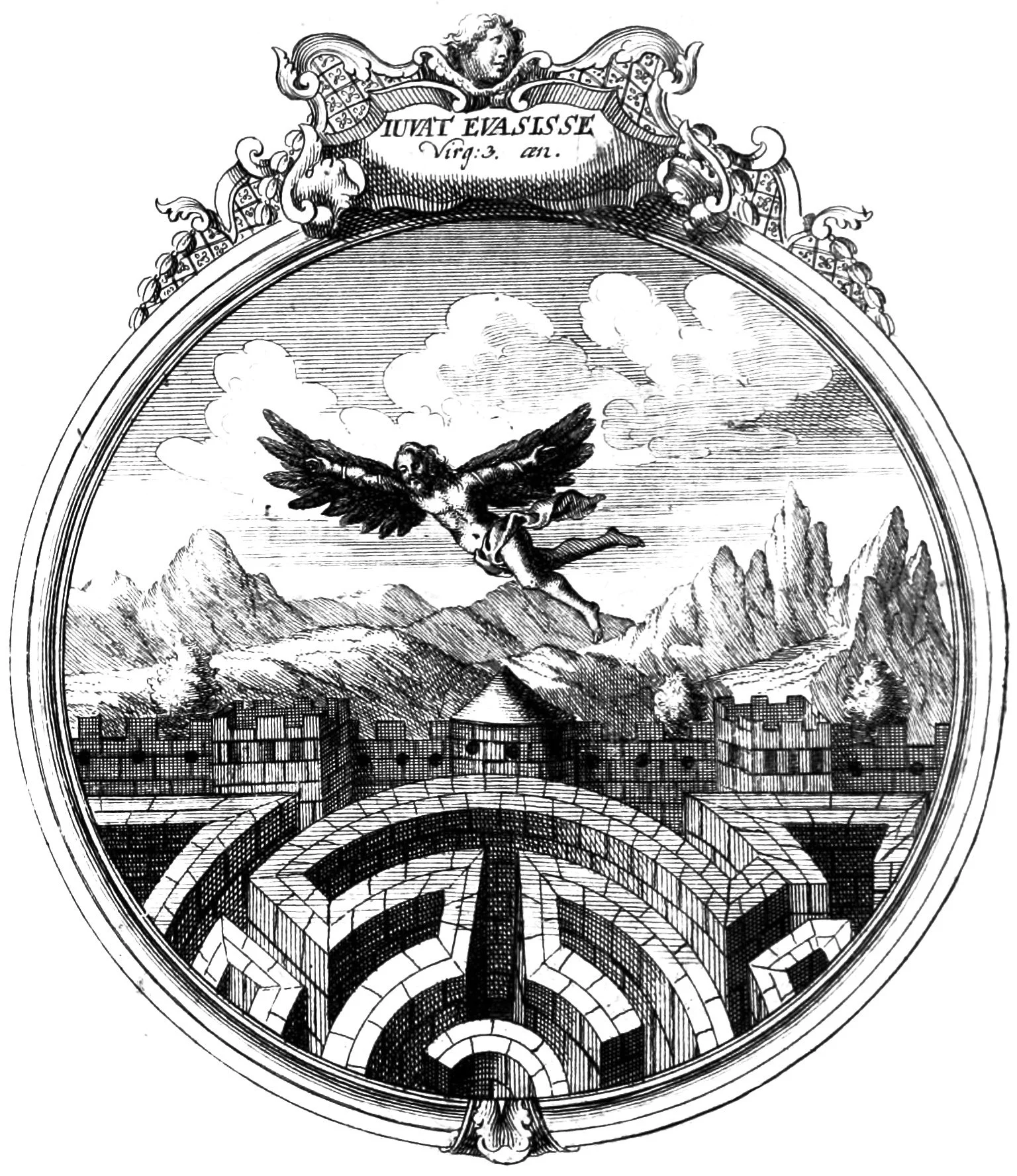
Daedalus builds the Labyrinth. Icarus flies above it. Between the two lies a complete philosophy of craft.
The Labyrinth represents skill used to confine, conceal, and solve a political problem without resolving the moral disorder beneath it.
The wings represent skill used to liberate—but liberation without measure.
The fall represents not the punishment of aspiration, but the consequence of power ungoverned by proportion.
The story is therefore an ideal bridge between your work on Masonic symbolism, the liberal arts, moral formation, historic architecture, craft, and the built environment of Queens and New York.
Historical guardrail
Daedalus and Icarus do not have a surviving ancient Neoplatonic commentary comparable to Porphyry’s On the Cave of the Nymphs or Proclus’ interpretation of Plato’s Myth of Er.
This series will therefore proceed differently from the Plato, Porphyry, and Apuleius cycles.
It will draw on:
Ancient literary accounts, especially Ovid’s Metamorphoses Book 8.
The earlier Greek mythic tradition preserved in Apollodorus, Pausanias, Diodorus, and others.
Classical ideas of measure, proportion, craft, technē, practical wisdom, and hubris.
Plato and Aristotle on knowledge, virtue, skill, and moral judgment.
A careful Masonic comparison focused on architecture, geometry, the working tools, and moral responsibility.
The series will not claim that Daedalus was a proto-Mason, that the Labyrinth is a secret ancient lodge plan, or that Icarus represents a particular degree. The myth is strong enough without these claims.
Its real value lies in the fact that every builder must eventually answer for what his building does.
The series
Daedalus solves Minos’ problem by creating a structure of perfect confinement. What does a craftsman owe to the people trapped inside his work?
Daedalus possesses extraordinary technē—craft knowledge. But craft can make a thing possible without making it good.
Icarus does not fail because he aims upward. He fails because he cannot yet understand the relation between power, freedom, risk, and proportion.
Daedalus instructs his son to fly neither too low nor too high. Aristotle’s mean is not bland compromise; it is the difficult art of finding the right measure.
Geometry is more than calculation. It teaches relation, form, balance, stability, and the consequences of placing one thing wrongly beside another.
The final question: what should a builder, leader, artist, or Mason create, preserve, repair, and refuse to make?