Tools, Ritual, and the Work of Character
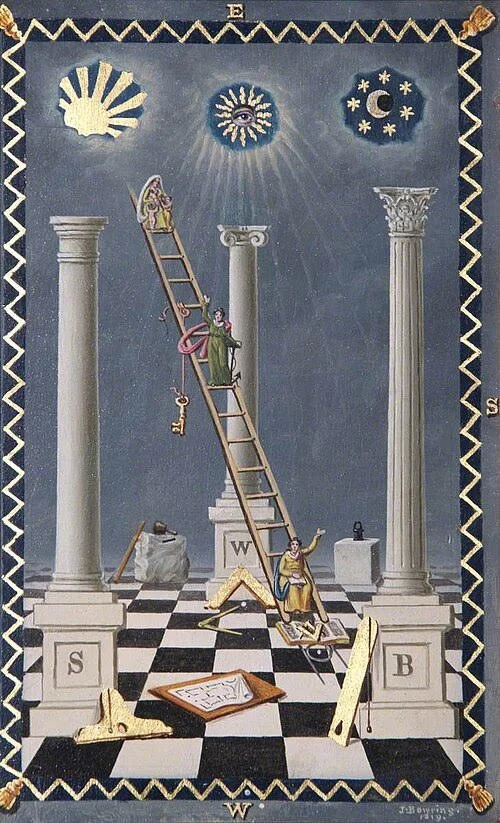
Masonic tracing board
Why would a fraternity teach moral lessons with stones, tools, pillars, and carefully arranged rooms?
It could issue a short set of instructions. Keep your promises. Deal fairly. Control your temper. Help people. Most readers would agree, and the document could be filed somewhere safe from further disturbance.
The difficulty is putting the instructions to use.
Freemasonry approaches that difficulty through objects, ceremonies, and shared practices. A tool gives an idea something visible to attach to. A ceremony makes an undertaking an occasion. A lodge brings the lesson into contact with people who may test our patience before the evening is over.
This series explores how that method works — and what we can reasonably ask of it.
Begin with Article 1: What Freemasonry Is →
A Guide for Newcomers and Experienced Masons
You do not need to be a Freemason to follow these articles. Unfamiliar terms are explained as they become useful. The aim is to make the subject intelligible, not make the reader feel that understanding depends on knowing the correct people.
If you have spent years in a lodge, familiarity brings a different difficulty. You may know the customary explanation so well that you no longer notice the question behind it.
Recognizing a square is easy. Asking whether you apply the same standard to yourself and others takes longer.
The series moves between these two tasks: explaining the symbols and examining what it means to think with them.
It distinguishes documented history, particular traditions of interpretation, and the further readings proposed here. A useful interpretation need not be ancient. An ancient interpretation need not be accepted without examination.
What Symbolic Thinking Means Here
Begin with a practical object.
A square tests an angle. From that action, we can develop a question about conduct: what standard are we using, and have we checked the result?
The comparison does not make moral judgment as certain as geometry. It gives us somewhere to begin.
That is symbolic thinking as this series uses the term. We examine an object, action, or arrangement, then consider which relationships help us understand something else.
The method requires imagination, but also limits. We should be able to explain why a reading fits. Otherwise, almost any object can be made to endorse almost any opinion.
There is no prize for discovering the greatest number of meanings in a chair.
The more useful test is whether the interpretation helps us notice a responsibility, question an assumption, or examine something we are doing.
Read the Series in Order
The full sequence begins with Freemasonry’s educational method, moves through particular symbols, and then examines the relationships and practices that give them consequences.
Each article can also be read on its own.
First: Understand the Method
What Freemasonry Is: Ritual, Symbol, and Moral Formation
Begin with the fraternity itself: its ceremonies, degrees, lodge life, and approach to character. Separate its ordinary purposes from the extraordinary reputation attached to it.
Why Masons Talk in Stones, Tools, and Symbols: From Working Tools to Inner Work
Examine how a practical object becomes something to think with—and why knowing its customary explanation is only a beginning.
Some Men Want Light. Some Just Want a Title: Office, Ambition, and the Inward Life
Consider the difference between recognition and understanding, including how office can become either an opportunity for learning or a substitute for it.
Then: Examine the Objects and the Room
The Two Pillars: Strength, Establishment, and the Architecture of Meaning
Start with the biblical pillars, Jachin and Boaz, then explore interpretations of approach, responsibility, strength, and establishment.
Rough and Perfect Ashlar: The Masonic Work of Self-Improvement
Ask what the contrast between rough and worked stone can teach about improvement — and where treating a person like building material stops being helpful.
The Working Tools: How Masonic Symbols Teach Moral Labor
Move from general intentions to particular operations: measuring time, correcting habits, testing judgments, treating people fairly, and setting limits.
Why the Lodge Room Is Laid Out Like a Map of the Mind
Read the room as an arrangement of attention and responsibility, while distinguishing this interpretation from the different layouts and practices of actual lodges.
Finally: Consider What the Forms Ask of People
Why Secrecy Is Not the Same as Wisdom
Distinguish privacy, secrecy, and silence. Ask what a boundary protects rather than assuming that restricted access proves the value of its contents.
Why Ritual Works Even When You Don’t Fully Understand It
Explore how a ceremony can affect attention, memory, or belonging before every detail is understood — and why having an effect is not the same as producing wisdom.
Why Brotherhood Is Harder Than Friendship
Examine obligations toward people whose company we did not individually choose, including the responsibilities and limits of loyalty, care, and correction.
Why Symbols Say Things Plain Language Cannot
Consider why an explanation may be accurate without replacing the object or experience it describes. Symbols and clear language have work to do together.
Why Initiation Is About Transformation, Not Information
Distinguish learning about an institution from entering an undertaking — and a change in membership from the longer work of changing conduct.
Why Moral Architecture Is More Than a Metaphor
Bring the series together through the language of building: standards, relationships, maintenance, and the difference between a satisfactory plan and something people can rely on.
Looking for a Particular Starting Point?
If you want an introduction to Freemasonry, begin with What Freemasonry Is.
If a familiar object has caught your attention, try the two pillars, the ashlars, or the working tools.
If your interest is how symbolic expression works, begin with Why Symbols Say Things Plain Language Cannot.
There is no examination at the end. You can return to the sequence when a question makes another article useful.
Beyond This Series
For the distinction between Freemasonry’s documented origins and its use of older traditions, continue with More Light: Freemasonry and the Ancient Past.
For a closer study of particular ritual materials and their interpretation, explore Corn, Wine, and Oil.
From Understanding to Use
You do not need to find a hidden explanation behind every object.
A worthwhile reading may be quite ordinary: a promise needs attention, a standard has been applied unevenly, or a responsibility has been admired without anyone undertaking it.
The symbol has helped if it makes the question clearer.
What follows is harder to put on a page.
