The Two Pillars: Strength, Established, and the Architecture of Meaning
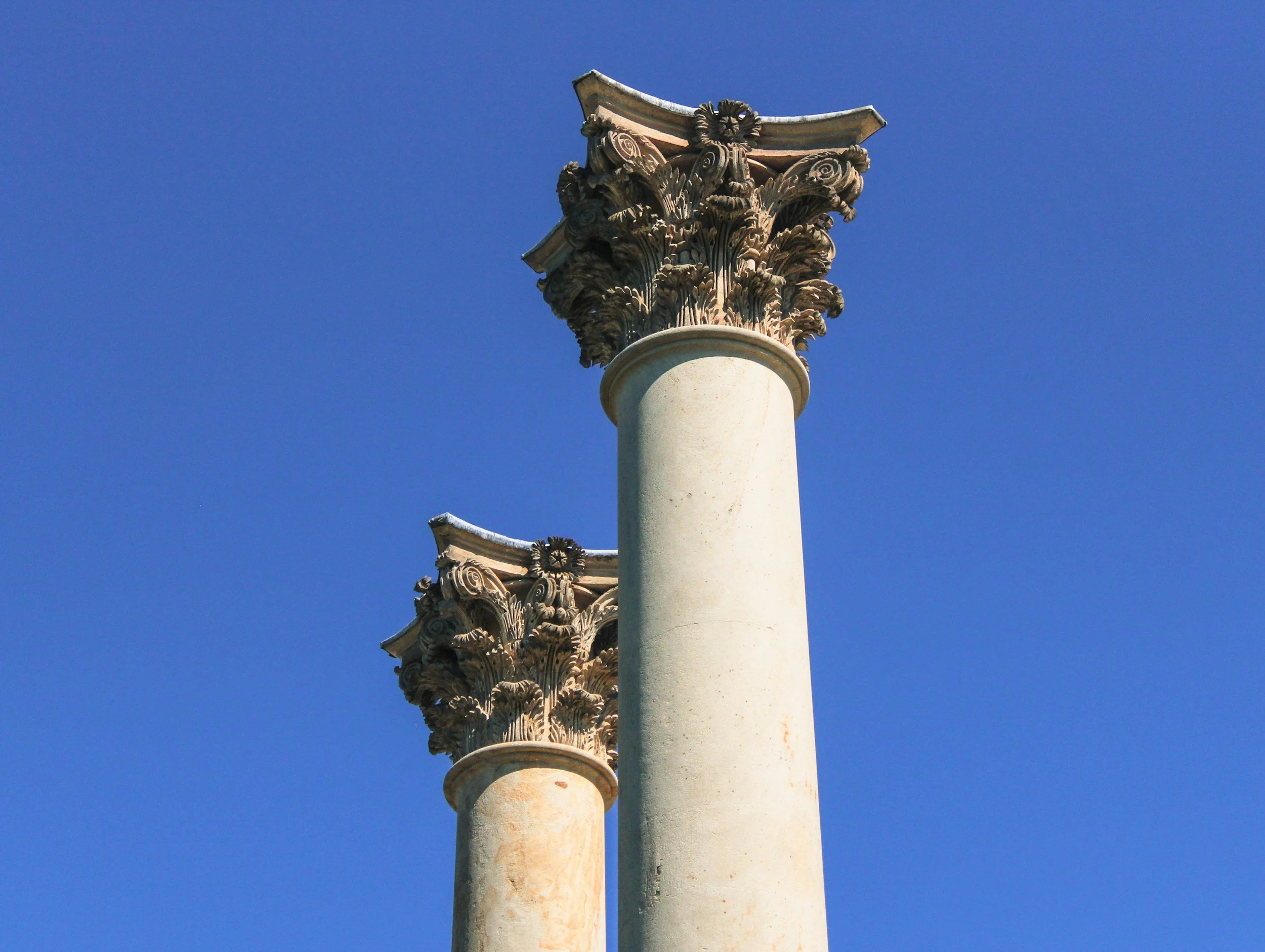
Some symbols in Freemasonry are simple the moment you see them.
The rough stone and the finished stone, for example, almost explain themselves. One suggests what is unfinished; the other suggests what has been worked on. Even if you know nothing else, the lesson is close at hand.
The two pillars are different.
They are easy to notice, but harder to read. They stand there with weight and dignity, clearly important, clearly inherited from somewhere older, and clearly meant to be more than decoration. But what exactly are they doing? Why two? Why pillars at all? And why have they remained so central in Masonic imagination?
The short answer is this: the two pillars mark an entrance into ordered space.
That is where we should begin.
A pillar is not a wall
A wall closes. A pillar supports.
That distinction matters.
When human beings want to mark something as important, they often do not block it off entirely. Instead, they frame it. A doorway, a gate, an arch, or a pair of columns says: what lies beyond this point is not nowhere. You are entering a place with structure, meaning, and expectation.
A pillar does not simply hold weight physically. Symbolically, it holds weight mentally. It tells the mind to pay attention.
That is why pillars have appeared for centuries in temples, palaces, civic buildings, memorial architecture, and ceremonial design. They suggest permanence, seriousness, threshold, and order.[1]
Freemasonry uses the two pillars in exactly this way. They mark not merely a physical setting, but a transition. To pass between them is to move, symbolically, from the ordinary world into a more disciplined one.
Not a different planet.
Not a magical realm.
Just a space where conduct, language, and attention are supposed to rise.
Why two?
Because one pillar would suggest support. Two pillars suggest passage.
A single column can stand for strength. A pair of columns creates an interval, a between. And that “between” is the important thing.
The two pillars establish a threshold.
Thresholds matter more than modern life likes to admit. We now prefer everything to be frictionless, casual, and continuous. We move from bed to inbox to entertainment to conversation with very few formal boundaries. But older cultures understood that important acts often need marked transitions.
A courthouse has steps.
A church has a nave.
A university has commencement.
A wedding has an aisle.
A nation has borders and ceremonies.
A lodge has a formal entrance into ordered symbolic space.
The threshold changes the meaning of crossing.
That is what the two pillars do. They say: you are not merely arriving. You are entering.[2]
The biblical background
In Masonic tradition, the two pillars are most commonly associated with the pillars of Solomon’s Temple, described in the Hebrew Bible, especially in 1 Kings 7 and 2 Chronicles 3.[3]
This is one of the key historical and symbolic inheritances of the Craft. Freemasonry drew heavily on temple imagery, especially the idea of sacred architecture as a language for moral order. The pillars, standing at the porch or entrance of the Temple, became part of that symbolic vocabulary.
Their names, well known in Masonic tradition, have long attracted attention and interpretation. Much has been written about their possible meanings, etymologies, and ritual function. But before getting lost in details, it is better to hold onto the broader point: these were not random pieces of masonry. They stood at the approach to a sacred and ordered structure. In symbolic terms, they marked the beginning of a serious space.
Freemasonry inherited that image and put it to work.
The lodge, in symbolic imagination, is not literally Solomon’s Temple. But it is read through temple language. And so the pillars come to represent more than architectural memory. They become emblems of entry into moral order.
Why entrance matters so much
Because most Masonic symbols are not merely about ideas. They are about transformation through passage.
That is easy to miss if you think symbols are just coded decorations. In fact, many of them are arranged to teach movement: from darkness to light, from roughness to refinement, from ignorance to understanding, from isolation to fellowship, from ordinary awareness to deliberate reflection.
The pillars fit that pattern.
They are not there simply to be admired. They imply crossing from one condition into another. The passage does not magically improve the person, of course. Freemasonry is not a machine that turns walking into virtue. But the symbolism teaches that growth begins with recognizing that some spaces, some duties, and some forms of life require intentional entry.
A man does not drift into discipline.
He enters it.
He accepts its terms.
He passes into a world in which he is meant to become more accountable.
The pillars dramatize that decision.
Stability and duality
Pillars also suggest another theme: balanced support.
Why does a structure stand? Because weight is distributed and supported. In symbolic thought, this naturally opens into the idea that human life also depends on supports. Character does not stand upright by accident. It requires foundations, principles, habits, and stabilizing forces.
A single pillar can symbolize strength, but two pillars immediately invite reflection on relation: left and right, firmness and form, power and order, energy and restraint, action and judgment. Different interpreters have drawn different pairings from them, and Freemasonry itself allows symbolic richness rather than forcing a single narrow reading.[4]
That flexibility is not confusion. It is how durable symbols work.
The pillars can suggest that serious life is not held up by one quality alone. Strength without wisdom becomes brutality. Order without vitality becomes dead form. Judgment without mercy hardens. Mercy without measure dissolves.
Two pillars imply that the good life stands through balance.
This is one reason the symbol keeps returning. It can be read architecturally, ritually, morally, and philosophically all at once.
Pillars as memory devices
Freemasonry does not use symbols only because they look impressive. It uses them because they help memory.
A man may forget a lecture about “entering moral seriousness.” He is less likely to forget a doorway framed by pillars and repeatedly explained as a threshold into ordered space. The image fixes the lesson.
This is one of the strengths of the whole Masonic method. It externalizes ideas. Instead of leaving moral instruction as pure abstraction, it gives the mind furniture. You remember the tools, the stones, the lights, the pillars, the steps, the measured arrangements of the room. These become anchors for reflection.[5]
The pillars do this especially well because they are so spatial. You do not merely think them. You imagine standing before them. That bodily sense of approach gives the symbol force.
Again, this is why ceremony matters. To move through a form is different from reading about a form. Symbols become more intelligible when they are inhabited.
Are the pillars “esoteric”?
Yes and no.
Yes, in the sense that they belong to a symbolic tradition and carry layers of inherited meaning. They are not exhausted by the sentence “columns near an entrance.” Their significance deepens within ritual, biblical reference, historical interpretation, and Masonic teaching.
But no, in the exaggerated sense often implied by modern readers who hear the word “esoteric” and assume hidden cosmic formulas.
The pillars are actually quite intelligible if you start from ordinary human experience:
important spaces are marked
entrances matter
support matters
duality often suggests balance
architecture can teach
passage changes meaning
From there, the richer layers become easier to appreciate.
This is a good rule for reading Masonic symbols generally. Start with the humanly obvious before reaching for the obscure. The tradition is usually wiser there than its more breathless interpreters.
Why architecture is such a powerful teacher
Because buildings shape behavior.
Anyone who has entered a library, a cathedral, a courtroom, or a memorial knows this. The space tells you how to move, how to speak, how loudly to breathe, what to notice, what to refrain from doing. Architecture is moral before anyone says a word.
Freemasonry understands this instinctively. It borrows from sacred and formal architecture because architecture creates seriousness without needing constant explanation. The two pillars, therefore, are not merely theological leftovers from a biblical narrative. They are instruments of orientation. They prepare the mind by shaping the sense of place.[6]
This is not trivial. Much of modern life suffers from the collapse of meaningful form. We put everything in interchangeable rooms and wonder why attention weakens. The Masonic use of architecture pushes in the opposite direction. It says that where you are matters, how you enter matters, and what frames your actions matters.
The pillars say all that silently.
The inner meaning
At some point every external symbol raises the same question: what is the inward equivalent?
If the pillars frame entry into an ordered space, what does that mean in the soul?
It means that a person must develop inner thresholds as well as outer ones.
He must know how to step out of impulse and into deliberation.
Out of noise and into attention.
Out of vanity and into humility.
Out of passivity and into responsibility.
That is the deeper lesson.
The physical or imagined pillars are useful because they point toward an inward act: the decision to treat moral life as something one enters consciously rather than something one improvises badly. A mature person develops such pillars within himself. He learns how to pause before action, how to mark seriousness, how to recognize that not every moment should be lived in the same key.
This is one reason ritual traditions endure. They train external thresholds in order to awaken internal ones.
Why the symbol survives
The two pillars survive because they gather many truths into one image.
They tell us that seriousness needs form.
That entry matters.
That order is not accidental.
That stability requires support.
That balance is wiser than one-sidedness.
That sacred or moral space should be approached, not wandered into carelessly.
And they do all this without becoming a mere lecture.
That is what good symbolism does. It preserves complexity in a memorable form. The pillars are not simple because they mean one thing. They are powerful because they mean several related things at once, while still remaining clear enough to grasp.
A pair of supports.
A framed entrance.
A threshold into order.
That is already a great deal.
So what are the two pillars?
They are not just ancient columns recalled from biblical architecture.
They are not just ornamental survivals from an older ceremonial style.
And they are not puzzle pieces for conspiracy-minded imaginations.
They are symbols of support, balance, and threshold.
They frame the entrance into ordered space.
They remind the Mason that serious life requires conscious passage from the casual to the deliberate.
And they suggest that what is worth building must be both supported and rightly approached.
In the end, the two pillars say something very old and very sane:
Do not enter important things carelessly.
That is why they stand where they do.
Endnotes
Author’s note:
I write as an individual Freemason, historian, and researcher. This article reflects my personal research and interpretation and does not represent an official statement of Advance Service Mizpah Lodge No. 586, the Grand Lodge of New York, or any other Masonic organization.
[1] On architecture, symbolism, and the formal language of sacred and civic space, see W. Kirk MacNulty, Freemasonry: Symbols, Secrets, Significance (London: Thames & Hudson, 2006), and broader contextual works on symbolic architecture in the Western tradition.
[2] For the ceremonial and spatial dimensions of Masonic life, see John Hamill, The Craft: A History of English Freemasonry (Wellingborough: Crucible, 1986), and W. Kirk MacNulty, Freemasonry: A Journey Through Ritual and Symbol (London: Thames & Hudson, 1991).
[3] 1 Kings 7:15–22 and 2 Chronicles 3:15–17 provide the biblical description of the pillars associated with Solomon’s Temple. These passages have long informed Masonic symbolic interpretation.
[4] Albert G. Mackey, The Symbolism of Freemasonry (New York, 1882), discusses the pillars as part of the inherited symbolic structure of the Craft. As with all classic internal sources, Mackey is best read alongside modern historical scholarship.
[5] On memory, symbol, and ritualized instruction in Freemasonry, see Steven C. Bullock, Revolutionary Brotherhood: Freemasonry and the Transformation of the American Social Order, 1730–1840 (Chapel Hill: University of North Carolina Press, 1996).
[6] Margaret C. Jacob, Living the Enlightenment: Freemasonry and Politics in Eighteenth-Century Europe (Oxford University Press, 1991), is useful for understanding how formal spaces, reason, order, and sociability were linked in Masonic culture. See also Jessica Harland-Jacobs, Builders of Empire: Freemasons and British Imperialism, 1717–1927 (Chapel Hill: University of North Carolina Press, 2007).