Benjamin Franklin’s Daily Routine: Journaling, Virtue Tracking, and Self-Improvement
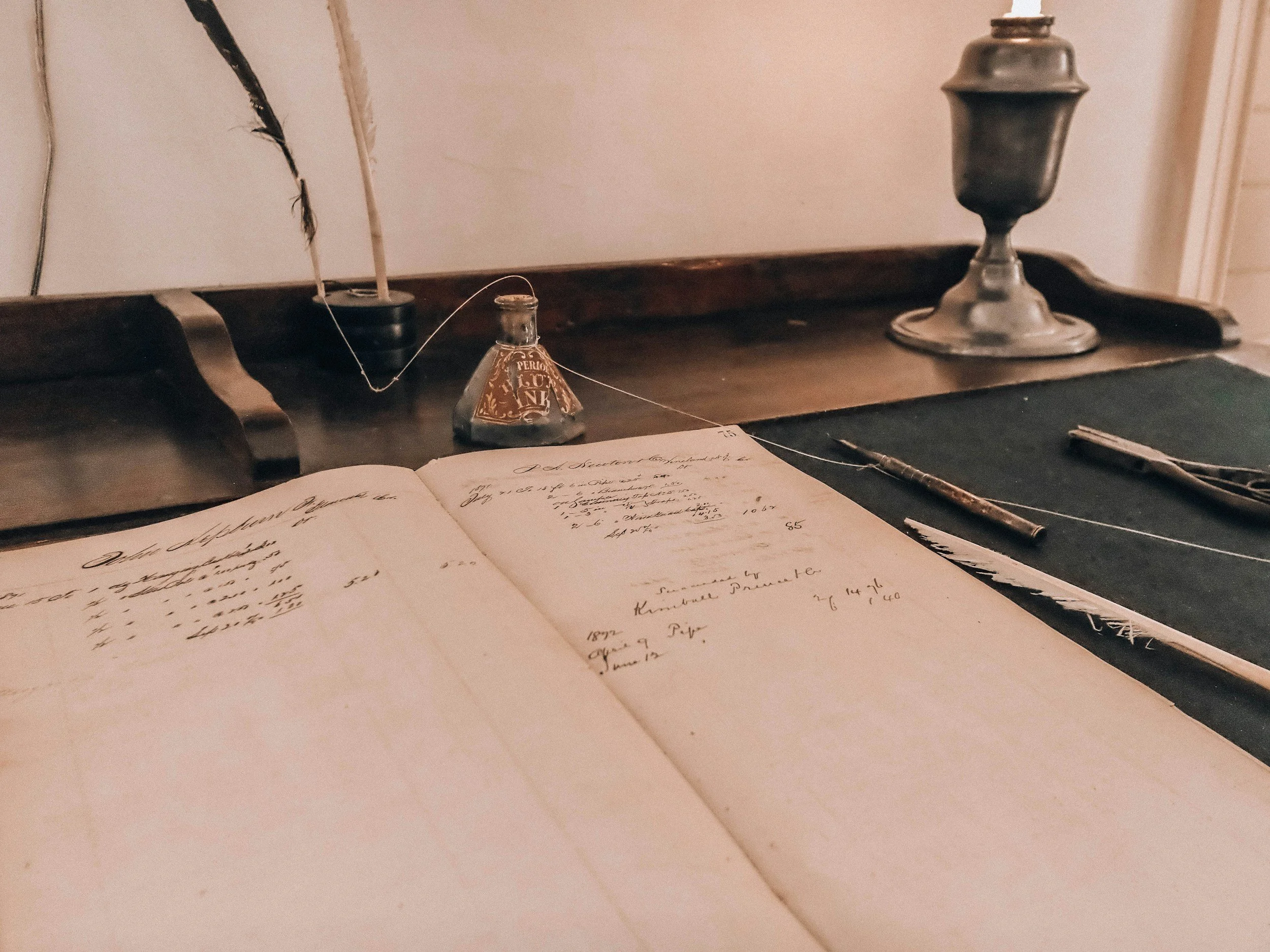
Benjamin Franklin’s self-improvement system was built on a schedule, a notebook, and a set of clear questions. His daily routine and virtue tracking still offer a practical model for journaling, order, and self-education.
Benjamin Franklin’s Daily Routine: Journaling, Virtue Tracking, and Self-Improvement
Benjamin Franklin did not wait to feel improved. He built a system.[1]
That system was not mysterious. It involved a schedule, a notebook, a set of virtues, and the repeated willingness to compare intention with action. What makes Franklin interesting is not that he wanted to become better. Nearly everyone says that. What makes him worth revisiting is that he tried to make improvement visible.
In Part II of his Autobiography, Franklin lays out a daily routine that organized his hours and anchored them with two short questions: “What good shall I do this day?” and “What good have I done to-day?”[1] Those questions gave the day both direction and review. One looked forward. The other looked back.
That pairing is stronger than most modern advice because it does not confuse planning with performance. Franklin wanted both.
Franklin’s Daily Schedule
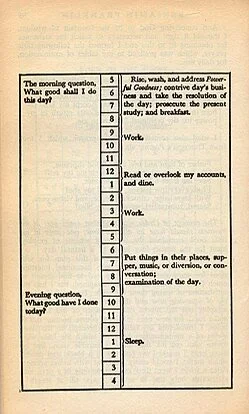
Benjamin Franklin's daily schedule
Franklin’s schedule was simple, but it was deliberate.[1] He assigned uses to his hours rather than leaving them to accident. That alone marks a serious difference between wishing to use time well and actually trying to do it.
He also understood that time management was not separate from moral life. The way a person spends his hours gradually becomes the way he spends his mind. Habits are not just repeated actions. They are repeated allocations of attention.
For Franklin, the schedule was a framework for conduct.
The Thirteen Virtues
Franklin is famous for his list of thirteen virtues, but the real interest lies in what he did with them.[1] He did not merely admire them. He tracked them.
He kept a small book in which he marked his faults against the virtues he was trying to practice. This gave self-improvement a record. Instead of trusting mood or memory, he created a system of inspection.
That distinction matters. A person can admire discipline without practicing it. Franklin tried to turn ideals into visible habits.
Among the virtues, Order is especially relevant to modern readers. Franklin defined it this way: “Let all your things have their places; let each part of your business have its time.”[2] This is practical language, not inspirational language. It links space, time, and conduct in one sentence.
Why Virtue Tracking Still Matters
The modern world has developed countless ways to monitor health, finances, sleep, and productivity. Franklin’s notebook reminds us that older forms of tracking were often aimed at character.
This can sound severe until you notice how modest the method really is. Franklin was not claiming perfection. In fact, he openly admitted that Order was difficult for him to maintain.[1] The notebook was not there to flatter him. It was there to show him where he failed.
That is part of its usefulness.
A written record resists the kind of editing memory performs on our behalf. It does not easily confuse almost with done, or good intentions with good results. The page does not remember kindly. It remembers plainly.
Journaling as Self-Examination
Much contemporary journaling is presented as expression, release, or reflection. Franklin’s example points to another use: examination.[1]
A journal can ask:
What did I intend? What did I do? Where did I fall short? What pattern is repeating? What should I correct tomorrow?
These are not grand questions, but they are effective ones. They reduce vagueness. They make self-improvement less theatrical and more concrete.
Franklin’s genius was not intensity. It was repeatability.
Why Franklin Still Holds Up
Franklin’s method still holds up because it does not depend on inspiration. It depends on recurrence.
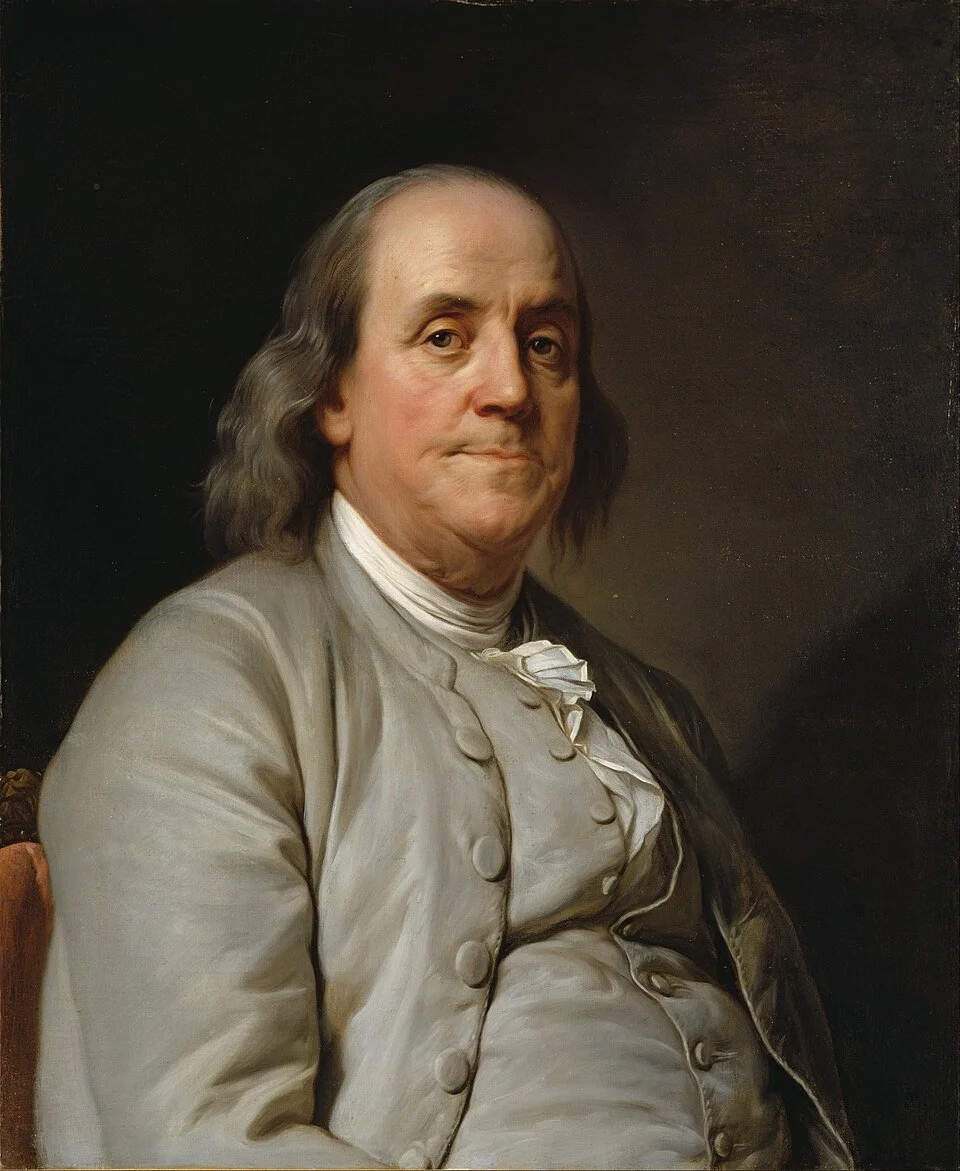
Benjamin Franklin, after Joseph-Siffred Duplessis, c. 1778–1783, National Portrait Gallery, London.
You ask the questions.
You keep the record.
You review the day.
You make an adjustment.
Then you begin again.
There is very little glamour in this. That is one reason it remains believable.
A life is not improved in theory. It is improved in the use of days. Franklin understood that. His schedule, his virtues, and his notebook all reflect the same conviction: that a person improves by examining conduct honestly and making correction possible.[1]
This is a plain method, but a serious one. And because it is plain, it still works.
Notes
Images:
Benjamin Franklin's Schedule, photograph of Franklin's daily schedule. The Atlantic, "Picture of the Day: Benjamin Franklin's Daily Schedule," 2011. Public domain via Wikimedia Commons.
Benjamin Franklin, after Joseph-Siffred Duplessis (1725–1802), oil on canvas, c. 1778–1783. National Portrait Gallery, London, NPG 327. Public domain via Wikimedia Commons.
Literary:
- [1] Benjamin Franklin, Autobiography, Part II, for Franklin’s daily schedule, his morning and evening questions, his thirteen virtues, his virtue-tracking notebook, and his reflections on self-improvement by method.
- [2] Franklin’s definition of Order appears in Part II of the Autobiography: “Let all your things have their places; let each part of your business have its time.”