Benjamin Franklin, Journaling, Time, and Self-Education
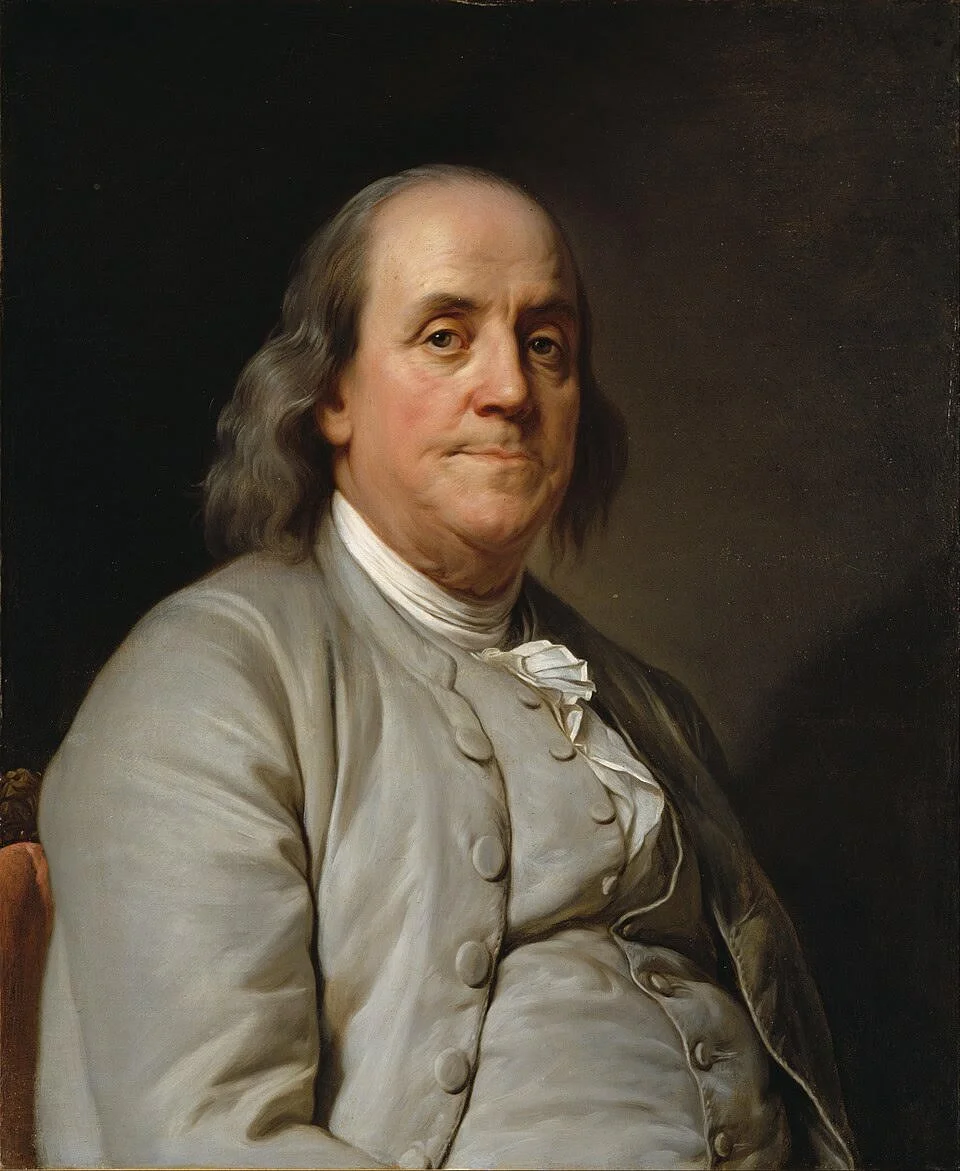
Benjamin Franklin, after Joseph-Siffred Duplessis, c. 1778–1783, National Portrait Gallery, London.
Benjamin Franklin’s habits of scheduling, journaling, note-keeping, and self-examination still offer a practical model for anyone trying to read, work, and live more deliberately.
Benjamin Franklin, Journaling, Time, and Self-Education
Benjamin Franklin remains interesting not because he supplied generations with quotable sayings, but because he worked by method. He tried to improve himself through schedule, written review, disciplined reading, and repeated correction.[1]
Taken one at a time, these habits can seem minor. Together, they form a practical philosophy. A life gains shape when time is measured, conduct is examined, and useful knowledge is preserved in writing.
Franklin’s Daily Routine
In Part II of his Autobiography, Franklin gives a daily schedule organized around two questions: “What good shall I do this day?” and “What good have I done to-day?”[1] Those questions are simple, but they do different work. One sets intention. The other tests performance.
That pairing helps explain why Franklin still feels modern. He did not mistake planning for accomplishment. He wanted both.
Journaling as Self-Examination
Franklin also kept records as part of his effort to improve himself.[1] His notebook was not merely a place for private thoughts. It was a tool for inspection.
That remains one of the most useful functions of writing. A journal can make the day visible. It can show what was intended, what was delayed, what failed, and what keeps recurring. It reduces the distance between what a person imagines about his conduct and what actually happened.
The Thirteen Virtues and Order
Franklin’s thirteen virtues are widely known, but the important point is that he tracked them.[1] He tried to make moral effort visible. Among them, Order remains especially relevant: “Let all your things have their places; let each part of your business have its time.”[2]
That is not decorative advice. It joins physical arrangement and time management in a single principle. Space should be ordered. Time should be ordered. Disorder in one usually leaks into the other.
Reading, Notes, and Self-Education
Franklin’s life also illustrates a larger discipline of self-education. He read deliberately, imitated strong prose, and learned by working actively with what he read.[1] Whether one calls this commonplacing, excerpting, or note-keeping, the principle is the same: what matters should not be left entirely to memory.
Reading becomes more useful when it leaves a mark. A note, a summary, a copied passage, or a written reflection gives knowledge a better chance of surviving and being put to use later.
A Practical Model That Still Works
Franklin’s method still holds up because it is plain:
- assign a use to time
- write down intentions
- review results honestly
- preserve useful ideas
- make correction possible
There is nothing glamorous about this. That is part of its strength.
A good day, like a good education, is rarely produced by accident. Franklin’s habits suggest that a more deliberate life is built through recurring acts of attention: schedule, notebook, review, and revision.[1]
End Notes
Image:
Benjamin Franklin, after Joseph-Siffred Duplessis (1725–1802), oil on canvas, c. 1778–1783. National Portrait Gallery, London, NPG 327. Public domain via Wikimedia Commons.
Literary:
[1] Benjamin Franklin, Autobiography, Part II, for Franklin’s daily schedule, morning and evening questions, virtue-tracking method, and larger approach to self-improvement by habit.
[2] Franklin’s definition of Order appears in Part II of the Autobiography: “Let all your things have their places; let each part of your business have its time.”
Related Reading
- The Twenty-Four-Inch Gauge, Benjamin Franklin, and the Problem of Time
- Benjamin Franklin’s Self-Education and the Discipline of Learning for Yourself
- Benjamin Franklin’s Daily Routine: Journaling, Virtue Tracking, and Self-Improvement
- Benjamin Franklin, Commonplace Books, and the Discipline of Keeping Useful Notes