Part 1 of 13 in Masonic Symbols & Symbolic Thinking
Next: Why Masons Talk in Stones, Tools, and Symbols →
People hear “Freemasonry” and think of secrets, old buildings, or men who supposedly run the world. An ordinary lodge meeting, with its minutes, bills, and discussion of building repairs, presents a rather different picture. The distance between the reputation and the agenda can be considerable.
But the agenda does not explain the whole thing either. Plenty of organizations have bills. Few put on aprons and use the tools of stonemasons to discuss how a person ought to live.
What is that about?
Freemasonry is a fraternal tradition that teaches through ceremonies, symbols, and shared practices. Its subjects include honesty, self-restraint, charity, responsibility, and fellowship. None is a startling discovery. The difficulty has never been getting people to agree that honesty is desirable. It is getting them to remain honest when dishonesty would be convenient.
Masonry approaches that difficulty by giving familiar principles a setting, an image, and something to do.
This article concerns chiefly the male Craft tradition familiar in New York and in jurisdictions such as the United Grand Lodge of England. Women’s and mixed-gender Masonic organizations also exist. Requirements and practices vary, so an account of one tradition should not be mistaken for a description of every organization using the name.
Why Teach With Tools?
Suppose someone tells you to behave fairly. You understand the instruction. You may even approve of it. Neither response guarantees that you will remember it during an argument.
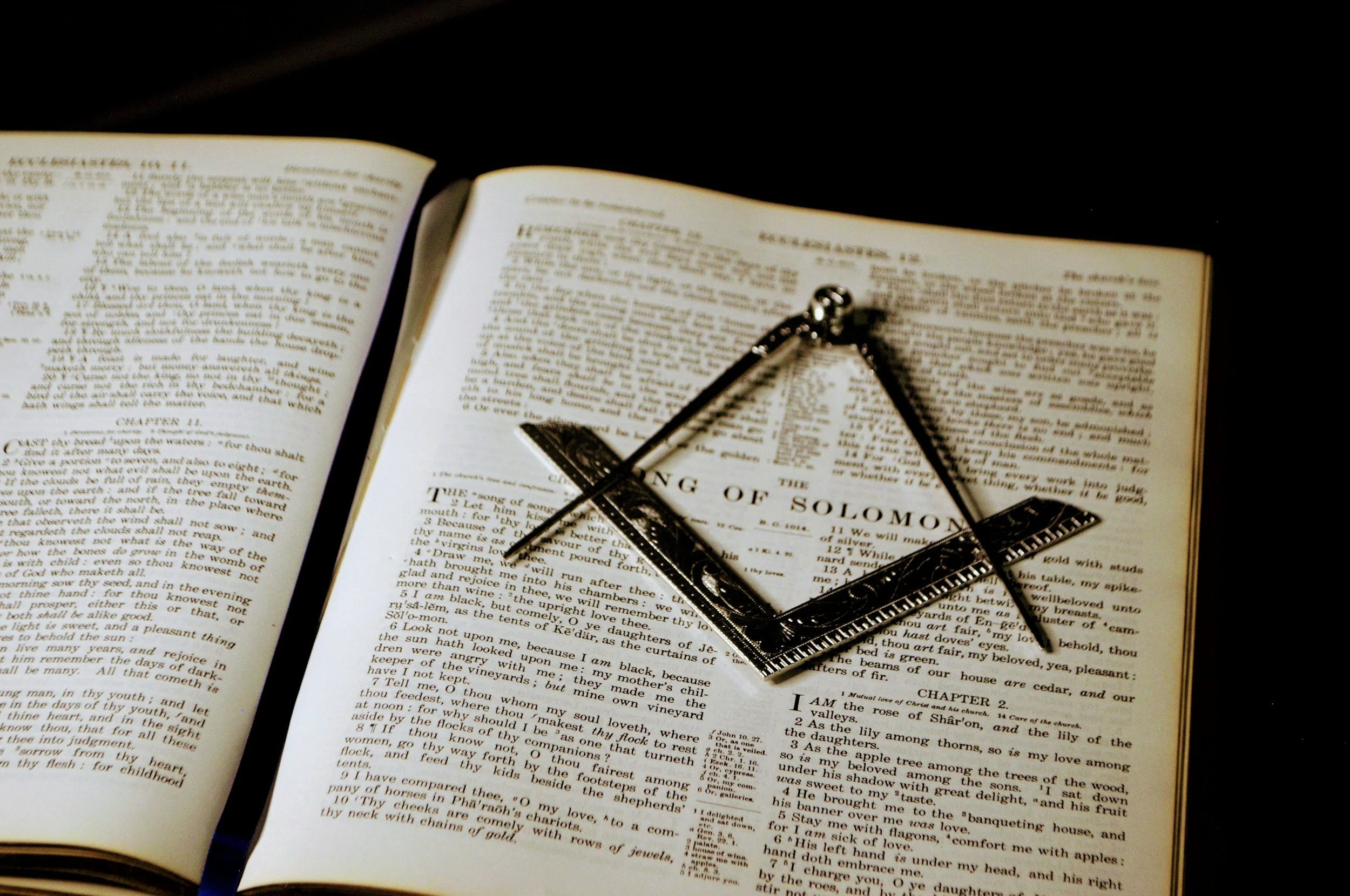
Now consider a square.
A builder uses it to check an angle. The square does not care whether the builder is tired, important, or quite certain that the work looks right. It supplies a standard against which the work can be examined.
That practical use makes another use possible. In Masonic teaching, the square becomes a reminder to examine conduct. Have you dealt fairly with someone? Have you made an exception for yourself that you would condemn in another person?
The tool has not acquired mysterious powers. It has acquired a second job.
Much of Masonic symbolism works this way. A useful object becomes the starting point for a question about human behavior. The question is easier to remember because it has something visible attached to it.
This is hardly peculiar to Freemasonry. We use images whenever plain statements seem insufficient. We speak of carrying a burden, losing our bearings, or drawing a line. No one usually asks where the line is kept.
Masonry gives this ordinary human habit a more deliberate structure. It gathers objects, stories, movements, and words into ceremonies that members encounter together.
Whether those encounters improve anyone is another question. A man can recognize every tool in the room and remain difficult to work with.
From Building in Stone to Building a Life
The connection with stonemasonry is more than a convenient choice of imagery, although its history is not as tidy as some accounts suggest.
Modern Freemasonry developed in relation to the organizations and traditions of working masons. Scottish lodge records, craft regulations, and the admission of members who were not practicing stonemasons provide important evidence. Historians continue to examine how these developments contributed to the fraternity that emerged in the seventeenth and eighteenth centuries.[1]
It is useful to distinguish two terms.
Operative masonry is the practical business of building in stone. Speculative Masonry uses the language of that business to consider questions about conduct and character.
The distinction is easier than the terminology makes it sound. One concerns what you do to the stone. The other concerns what the work might teach you about yourself.
A stone taken from a quarry is not necessarily ready for its intended place. It requires examination and preparation. That supplies an image of improvement through effort.
But an image is not a complete theory of human nature. People are not blocks of limestone, and a good education should not consist of knocking everyone into the same shape. The comparison becomes useful when we ask where it fits and where it stops.
What needs correcting? What are we preparing ourselves to do? How does our individual work affect the people who must live alongside us?
The building vocabulary gives those questions a common setting. It does not relieve us of the trouble of answering them.
What Happens in a Lodge?
A lodge is a local body of Freemasons. The word is also used for its meeting room or building, which can cause mild confusion until the context sorts it out.
Members conduct business, elect officers, admit and instruct candidates, perform ceremonies, support charitable work, and spend time together. Someone must keep the accounts. Someone must record the minutes. Tradition does not exempt an institution from administration.
What distinguishes the lodge is the way this ordinary organizational life sits alongside ceremonial instruction.
The room is arranged deliberately. Officers occupy particular places. Members follow established forms of speech and movement. These arrangements ask people to pay attention to how they enter, speak, listen, and act.
There is an educational possibility here. A setting can make us more conscious of behavior we ordinarily perform without thinking. Anyone who has lowered their voice on entering a library has experienced a modest example.
But the setting can only do so much. A solemn room does not make its occupants wise. It may simply make their mistakes more audible.
The value depends on whether members carry the attention encouraged by the ceremony into the less orderly situations outside it.
Is Freemasonry a Religion?
In the tradition discussed here, Freemasonry does not present itself as a religion or a replacement for one. It does not offer salvation, administer sacraments, or require members to adopt a common denominational theology. The United Grand Lodge of England states this distinction in its public explanations.[2]
The confusion is understandable. Masonic ceremonies may include prayer, scriptural references, and language about God. Jurisdictions such as New York and UGLE require candidates to affirm belief in a Supreme Being.
Those are religious elements. They should not be explained away merely because they complicate a short definition. But their presence does not, by itself, establish that Freemasonry functions as a religion.
The intended arrangement is that members retain their own religious commitments while meeting under shared obligations. Anderson’s Constitutions of 1723 described Masonry as a “Center of Union” among people who might otherwise have remained apart.[3]
That is an aspiration, not a certificate proving that every lodge has always practiced tolerance.
Restrictions on sectarian religious and political disputes serve a related purpose. People do not have to agree about everything to work together. They do have to resist turning every meeting into a final settlement of everything.
What Is Actually Private?
Freemasonry preserves private ceremonies and traditional modes of recognition. Its existence, however, is not concealed.
Its buildings can be conspicuous. Members often identify themselves publicly. Books and archives contain extensive information about its organization, history, symbolism, and charitable activity. Accounts and exposures of its ceremonies have circulated for centuries.[4]
Calling it simply “a secret society” therefore tells us less than it appears to. We still need to ask what is private, where, and for what purpose.
Some privacy concerns ceremonial details. Some concerns recognition between members. Some belongs to the ordinary confidences of membership. The boundaries differ between jurisdictions and periods.
One reason for preserving a ceremony concerns the experience of taking part.
Reading an account of an initiation is not the same as undergoing it, any more than reading the order of service tells you what it felt like to attend a particular wedding. The words matter, but so do anticipation, setting, participation, and the people involved.
This does not prove that secrecy produces wisdom. It does not. A closed door is an architectural feature, not an intellectual achievement.
At most, privacy may help preserve the conditions for an experience. What a person understands from that experience remains open to examination.
What Are the Three Degrees?
Craft Freemasonry is organized around three degrees:
Entered Apprentice.
Fellow Craft.
Master Mason.
These are stages of initiation and instruction. Other Masonic bodies offer additional degrees and ceremonies, but they should not be imagined as parts of a single worldwide promotion ladder.[5]
A Craft degree introduces obligations, images, and moral themes through a structured ceremony. The candidate participates rather than merely receives an explanation.
Why proceed in stages? Because an idea can mean something different after a person has acquired the experience needed to consider it. Education often works this way. Giving someone all the answers on the first morning is an efficient method of distributing paper, but not necessarily of producing understanding.
Degrees also bring a familiar institutional danger. People can become interested in acquiring the distinction rather than learning what it asks of them.
Freemasonry did not invent that difficulty. It shares it with universities, professions, public service, and most other places where titles are available.
The useful question is what changes after the ceremony. Has a member acquired another designation, or another responsibility? Ideally, both. The designation is easier to check.
What Does Freemasonry Teach?
The answer is less exotic than its reputation might lead us to expect.
Masonic instruction concerns honesty, restraint, fidelity, charity, duty, fellowship, mortality, and the effort required to improve. These ideas are not uniquely Masonic. The fraternity has no exclusive claim on decent conduct.
Its distinctive feature is the method by which it presents them.
Take the rough stone. It offers a readily understood picture of something unfinished that requires work. Yet merely repeating “the stone represents the self” does not get us very far. We have identified the comparison. We have not examined ourselves.
The next question is less comfortable: what, specifically, requires attention?
Perhaps it is a habit of speaking before listening. Perhaps it is vanity disguised as conscientious leadership. Perhaps it is the conviction that other people’s faults require correction while our own require an explanation.
A symbol becomes useful when it helps bring such things into view.
It can also become an ornament attached to an opinion we already hold. That is one reason symbolic thinking requires discipline. Finding a possible interpretation is not the same as establishing that it is traditional, historically supported, or helpful.
Throughout this series, I will distinguish those questions. What a symbol has meant in a particular source is one matter. What we can reasonably learn from it now is another. Both are worth investigating, provided we do not quietly exchange one for the other.
How Old Is Freemasonry?
Modern Freemasonry is not known to descend in an unbroken institutional line from ancient Egypt, biblical Jerusalem, or the classical mystery religions.
Its documented development belongs to a much later setting. Earlier lodges and records, particularly in Scotland, help explain its emergence. The formation of the first Grand Lodge in London in 1717 is the conventional milestone in the history of organized Grand Lodge Freemasonry, not the first appearance of every practice later associated with it.[1][6]
The fraternity nevertheless draws on older stories and images. Building traditions, biblical narratives, architectural forms, and moral teaching supply much of its vocabulary.
There is no contradiction here. A modern institution can use an ancient story.
The trouble begins when the age of the story is treated as the age of the institution. A lodge’s interest in Solomon’s Temple does not establish that the lodge descends from Solomon’s builders. That would require evidence of a different kind.
Freemasonry does not need a pedigree stretching back to Atlantis to deserve historical attention. Its documented history is complicated enough.
For a fuller examination of this distinction, see More Light: Freemasonry and the Ancient Past.
Why Has It Attracted Suspicion?
Private ceremonies, selective membership, unusual symbols, and socially influential members make a promising mixture for anyone inclined to suspect hidden arrangements.
But opposition to Freemasonry has not been one continuous argument. It has included religious objections, political fears, concerns about favoritism, organized anti-Masonic movements, and conspiracy theories.[7]
These need to be kept separate.
A theological objection is not the same as an allegation of corruption. Evidence that a particular Mason behaved improperly is not evidence that every lodge belongs to a hidden government. Equally, the absurdity of a conspiracy theory does not excuse a real abuse.
Freemasonry has existed within societies marked by prejudice, exclusion, conflict, and unequal power. It has sometimes reflected those conditions. Its ideals should be studied alongside its conduct, not used to conceal it.
That is ordinary historical work. We ask what happened, what evidence survives, and which explanation best accounts for it.
It is slower than discovering that a symbol on a building explains world affairs. It is also more likely to tell us something true.
Why Do People Stay?
There is no single reason.
Some members value friendship. Others come through family connections, historical curiosity, charitable work, ceremony, or an interest in study. A member may arrive for one reason and remain for another.
The possibility that interests me here is a community in which self-examination has a recurring place.
It is easy to intend to become more patient, generous, or disciplined. It is harder to remember the intention after an irritating day. A regular meeting, a familiar ceremony, or an obligation spoken aloud can bring it back.
The fellowship matters too. Our picture of ourselves benefits from occasional contact with people who have met us.
None of this happens automatically. A lodge may preserve its ceremonies carefully while neglecting their implications. It may speak warmly about brotherhood and make a newcomer feel thoroughly unwelcome.
The existence of a good method does not prove that it is being used well. Sometimes the method is precisely what allows us to recognize the failure.
A Way of Thinking About How to Live
Freemasonry gives its members a shared language of objects, ceremonies, stories, and obligations through which to examine conduct.
That is a more modest claim than saying it possesses a secret explanation of the universe. It is also a more demanding one. A hidden explanation can be admired. Conduct has to survive contact with other people.
A square can remind a person to deal fairly. A rough stone can prompt an examination of habits. An arranged room can encourage attention to the relationship between individual action and a shared undertaking.
But the square cannot conduct the examination. The stone cannot correct the habit. The room cannot make its occupants considerate.
Those jobs remain ours.
The next article begins with the objects themselves: why stones and tools are such persistent teachers, and how a practical instrument becomes something we can think with.
Continue the Series
Next: Why Masons Talk in Stones, Tools, and Symbols: From Working Tools to Inner Work →
Sources and Further Reading
These works provide historical background and institutional explanations. The discussion of symbolic education is the author’s interpretation, not a claim that every jurisdiction or member understands Freemasonry identically.
David Stevenson, The Origins of Freemasonry: Scotland’s Century, 1590–1710 (Cambridge University Press, 1988); Douglas Knoop and G. P. Jones, The Genesis of Freemasonry (Manchester University Press, 1947).
United Grand Lodge of England, Aims and Relationships of the Craft, and its public explanations of Freemasonry’s relationship to religion. Requirements and formulations vary between jurisdictions.
James Anderson, The Constitutions of the Free-Masons (London, 1723), especially Charge I, “Concerning God and Religion,” and Charge VI, concerning behavior.
Jessica L. Harland-Jacobs, Builders of Empire: Freemasons and British Imperialism, 1717–1927 (University of North Carolina Press, 2007); Steven C. Bullock, Revolutionary Brotherhood: Freemasonry and the Transformation of the American Social Order, 1730–1840 (University of North Carolina Press, 1996).
Knoop and Jones, The Genesis of Freemasonry; Robert Freke Gould, A Concise History of Freemasonry (1903). These provide historical background rather than a single account of every present-day jurisdiction.
Margaret C. Jacob, The Origins of Freemasonry: Facts and Fictions (University of Pennsylvania Press, 2007); United Grand Lodge of England, History of Freemasonry.
Bullock, Revolutionary Brotherhood; Paul Goodman, Towards a Christian Republic: Antimasonry and the Great Transition in New England, 1826–1836 (Oxford University Press, 1988); Jacob, The Origins of Freemasonry: Facts and Fictions.
For an institutional account of women’s Freemasonry, see the United Grand Lodge of England’s Women Freemasons
page.
Return to Masonic Symbols & Symbolic Thinking: the complete series →
Complete This Two-Part Introduction
This is Part 2 of “What Freemasonry Is.” Read it alongside the first essay to connect the fraternity’s historical framework with its use of ritual, symbols, and education. Continue into the companion introductions on symbolic language and the difference between seeking understanding and seeking recognition.
Previous: Part 1 — What Freemasonry Is: From Anderson’s Constitutions to the Symbolic and Observant Lodge
Explore the Freemasonry Reader’s Guide
Related Articles
- Why Masons Talk in Stones, Tools, and Symbols: From Working Tools to Inner Work — Continue into the relationship between symbolic instruction and personal reflection.
- Rough and Perfect Ashlar: The Masonic Work of Self-Improvement — Explore a specific symbol through the continuing work of character.
- The Lodge Mind — Consider a companion discussion of the shared atmosphere members create within a Lodge.
