Why Masons Talk in Stones, Tools, and Symbols: From Working Tools to Inner Work
If Freemasonry wanted to teach in the fastest possible way, it would hand you a list.
Be honest. Keep your word. Control yourself. Help others. Take life seriously. Improve your character.
That would be clear. It would also be forgettable.
Freemasonry does something older and, in some ways, smarter. Instead of teaching mainly through abstract statements, it teaches through objects, images, actions, and repeated forms. It talks about stones, tools, pillars, temples, light, geometry, and measured space. To a modern person, this can seem indirect, even theatrical. Why not just say what you mean?
Because people rarely live by statements alone. We live by pictures, habits, stories, gestures, rooms, and rituals that give ideas weight. Freemasonry talks in symbols because symbols are one of the oldest ways human beings learn to connect thought with conduct.
That is the simple answer.
Start with a hammer, not a theory
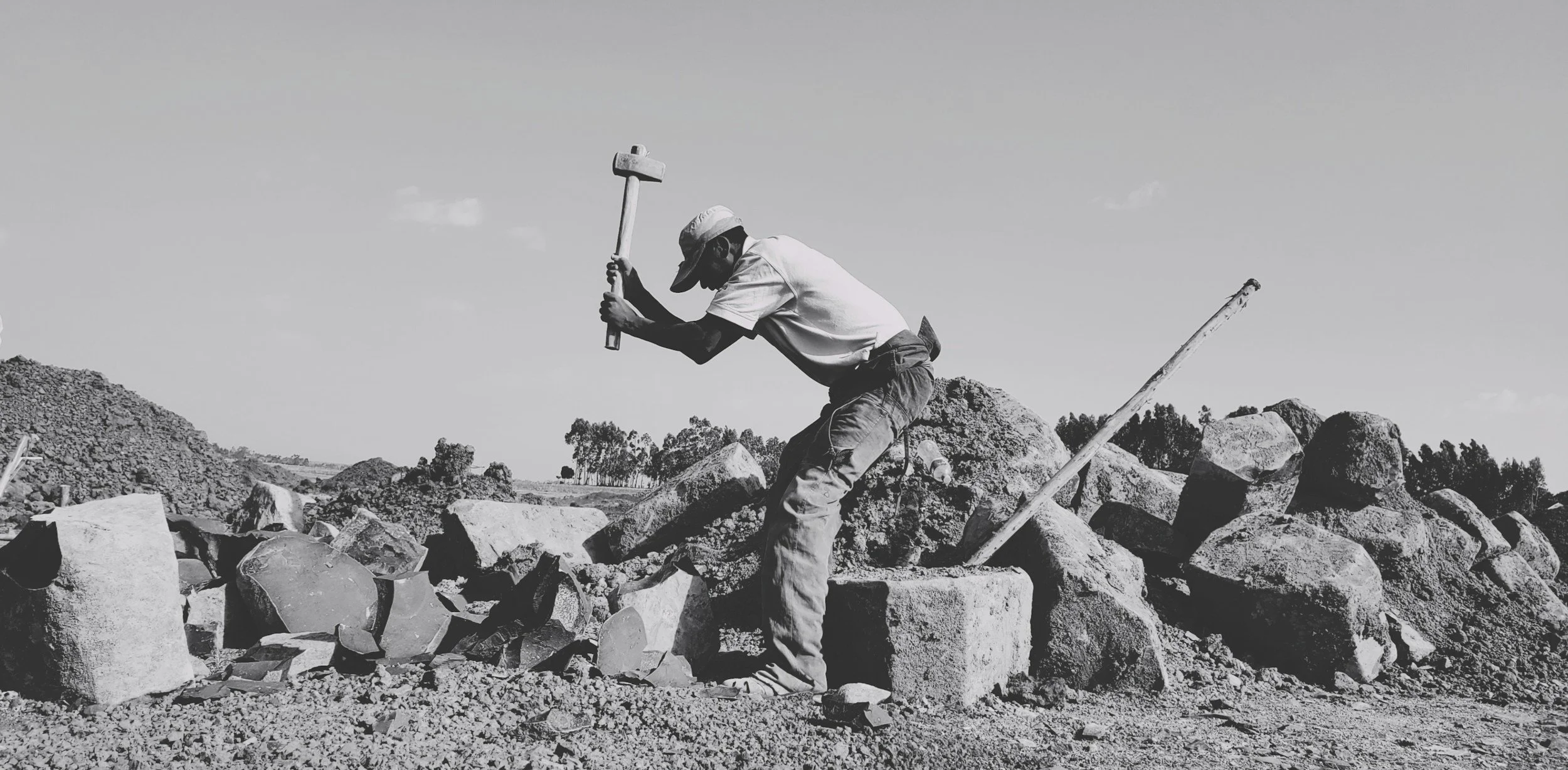
Imagine trying to teach a child the difference between “careless” and “careful.” You could define the words. Or you could hand the child something breakable and show, through action, what care looks like.
The second lesson usually lands harder.
Freemasonry works like that. It assumes moral truth becomes more memorable when attached to things. A tool can carry an idea. A stone can become an image of the self. A line, a circle, or an angle can become a way of thinking about limit, balance, order, or judgment.
This is not strange. It is normal human culture.
A wedding ring is just metal, yet it carries fidelity. A courtroom robe is just fabric, yet it carries authority. A national flag is just cloth, yet people salute it, protect it, and sometimes die for it. The physical object matters because meaning has been placed into it.
Freemasonry uses tools and building language in exactly this way. A tool is never only a tool. It becomes a lesson.[1]
Why builders’ language?
Because modern Freemasonry inherited the vocabulary of the stonemason’s craft and transformed it into a symbolic method.
That is one of the most important things to understand.
The tradition arose out of a world in which actual masons built in stone, used specialized tools, and passed along knowledge through ordered systems of instruction. Over time, the practical craft became a symbolic one. The language stayed, but the work changed. The Mason was no longer only asked to build walls. He was asked to think about building a life.[2]
This shift from operative to speculative Masonry explains a great deal.
A square can represent upright conduct.
A level can suggest equality.
A plumb can suggest rectitude.
A rough stone can stand for the unfinished self.
A finished stone can suggest discipline and refinement.
A temple can stand for order, aspiration, and sacred seriousness.
Once the language of building is transferred into moral life, the whole system begins to make sense. The point is not nostalgia for medieval construction. The point is that building is a powerful way to think.
Lives, like buildings, require foundation, measure, correction, patience, and design.
Why not just say the lesson directly?
Sometimes Freemasonry does say the lesson directly. But it prefers not to stop there.
Why?
Because direct statements often stay on the surface. Most people can say, “I should be more disciplined,” without becoming more disciplined. The sentence is easy. The transformation is hard.
Symbols help because they slow the mind down. They resist instant consumption. They make you return to an idea rather than merely receiving it once.
Take the rough and perfect ashlar, two of the most famous Masonic images. One is the stone in its unworked state. The other is the stone after shaping and refinement. You can explain the meaning in a sentence: the human being begins imperfect and must be improved through labor and discipline.
But once that idea is attached to stone, it becomes harder to forget. You can see it. You can hold the image in your mind. You begin to think of moral effort not as vague sincerity but as work done against resistance.
That is a better lesson.
Freemasonry talks in symbols because symbols make moral truths stick.
Symbols compress thought
A good symbol does the work of many paragraphs.
Take a key. In ordinary life it opens a door. Symbolically it can mean access, trust, permission, responsibility, secrecy, stewardship, or initiation. The object is simple. The meaning expands.
Masonic symbols work the same way. They compress layers of thought into a visible form.[3]
The square is not only fairness. It is rightness, honesty, measure, and moral alignment.
The compasses are not only a drafting instrument. They suggest boundary, restraint, proportion, and control.
The pillars are not only decorative forms. They suggest threshold, establishment, support, and entrance into ordered space.
Light is not only brightness. It suggests knowledge, awakening, understanding, and moral clarity.
This compression is one reason symbolic traditions endure. They allow a community to carry deep ideas without reducing them to slogans.
A slogan is consumed once.
A symbol can be revisited for years.
Symbols teach by participation
There is another reason Freemasonry uses symbols: because it is not trying only to inform the intellect. It is trying to form the person.
That requires participation.
When a lesson is embedded in ritual, gesture, spatial arrangement, and repeated language, the learner does not stand outside it as a detached observer. He undergoes it. He inhabits a sequence. He encounters the symbol in a setting designed to sharpen attention.
This is hard for modern culture to appreciate because we are trained to treat information as the highest form of knowledge. If you can look something up online, you assume you possess it. But information and formation are not the same thing.
You can read a definition of courage and still be cowardly.
You can explain temperance and still lack self-command.
You can memorize Masonic symbolism and remain untouched by it.
Freemasonry uses symbols because symbols, especially in ceremonial form, ask more of the whole person than explanation alone does.[4]
They enlist memory.
They engage imagination.
They shape expectation.
They create atmosphere.
They bind teaching to experience.
That is why the method persists.
Why tools in particular?
Tools are perfect moral objects because they connect intention with work.
A tool is not merely decorative. It exists to act on the world. That makes it an ideal symbolic bridge between principle and conduct.
A ruler measures.
A plumb corrects.
A level tests.
A hammer strikes.
A chisel shapes.
Compasses limit and define.
These are not just visual aids. They are moral metaphors with force because they arise from action.
This matters. Freemasonry is not mainly interested in moral opinion. It is interested in moral practice. Tools suggest that self-improvement is not a mood. It is labor. It requires effort applied in the right way, with the right instruments, toward the right end.
In other words, Masonic symbolism is practical before it is mystical.
That point is often missed by both critics and admirers. Critics sometimes imagine Masonry as a fog of esoteric gestures. Admirers sometimes overinflate it into cosmic occultism. But much of its power lies in its simplicity. It keeps returning to the stubborn truth that a life, like a structure, must be worked on.
Why stone?
Because stone resists.
That sounds almost too obvious, but it matters. If Freemasonry had built its symbolic world around sand or smoke, the moral lesson would collapse. Stone is solid, difficult, weight-bearing, and slow to shape. It is exactly the right material for thinking about character.
Human beings do not become better by wishing.
They become better by effort against resistance.
Stone makes that visible.
A rough stone is not useless. It is unformed.
A finished stone is not miraculous. It is worked.
This gives Masonry one of its strongest recurring insights: moral life is constructive. It requires shaping, testing, correction, and patience. There is friction in it. That friction is not failure. It is the condition of growth.
The building metaphor survives because it tells the truth about human development in a way mere sentiment does not.
Why so much geometry?
Because geometry is the study of relation, measure, order, and form.
Even before one gets into specifically Masonic meanings, geometry has always carried philosophical weight. It suggests that the world is not chaos. Things can be proportioned. Lines can be drawn rightly. Forms can be arranged intelligibly. Disorder can be answered with measure.[5]
Freemasonry takes that old intuition and moralizes it. Geometry becomes more than mathematics. It becomes a way of imagining disciplined life.
To live well is not just to feel deeply. It is to bring proportion into one’s conduct.
To judge well is to measure rightly.
To act well is to know where limits belong.
To build well is to understand relation, placement, sequence, and design.
This is why geometry appears so naturally in Masonic symbolism. It gives visible structure to the idea that goodness is not random.
Why symbols instead of dogma?
Because Freemasonry is built to gather men of different theological, political, and personal backgrounds without requiring uniformity on every question.
Dogma narrows quickly. Symbolism can unify more broadly.
A symbol allows people to share a structure of reflection without demanding that every inner thought be identical. Two men can stand before the same emblem and draw overlapping but not identical insights from it. That flexibility is not a bug. It is part of the design.
Of course, symbols can also become vague if handled lazily. Freemasonry avoids that, at its best, by placing symbols inside ritual, commentary, and tradition. The symbol is not left entirely loose. It is guided, interpreted, and revisited in a shared framework.[6]
So Masonic symbolism is not a free-for-all.
It is disciplined openness.
That is one reason it has lasted.
Why all this still matters
A modern reader may still ask: why preserve this old symbolic language at all? Why not replace it with plain contemporary language and keep only the ethical message?
Because the medium is part of the message.
If you strip away the symbols, tools, architecture, and ceremonial forms, you do not merely simplify Freemasonry. You turn it into something else. You reduce a lived symbolic tradition into a lecture series on decent behavior.
And decent behavior, however important, is not memorable enough on its own to sustain a fraternity across generations.
Symbols matter because they carry memory.
They connect present members to past ones.
They preserve a vocabulary of moral labor.
They remind people that self-improvement is not improvised from scratch each morning.
It is handed down, practiced, and renewed in forms older than oneself.
That is a rare thing in modern life.
We live in an age that mistrusts inherited form. Freemasonry survives partly because it insists that not everything old is empty, and not everything symbolic is obscure. Some truths need to be handled indirectly because indirect teaching reaches parts of us that direct instruction leaves untouched.
So why do Masons talk in stones, tools, and symbols?
Because symbols teach better than slogans.
Because tools connect ideas to action.
Because stone makes effort visible.
Because geometry gives form to order.
Because inherited images carry memory.
Because ritual helps turn information into formation.
And because a human being is not improved only by being told what is true, but by learning to see truth embodied in the world.
Freemasonry talks in stones, tools, and symbols because it believes a life must be built, not merely described.
That is the method.
And once you understand the method, the rest of the tradition becomes much easier to read.
Endnotes
Author’s note:
I write as an individual Freemason, historian, and researcher. This article reflects my personal research and interpretation and does not represent an official statement of Advance Service Mizpah Lodge No. 586, the Grand Lodge of New York, or any other Masonic organization.
[1] Albert G. Mackey, The Symbolism of Freemasonry (New York, 1882), a classic internal treatment of how Masonic objects function as moral emblems; for historical caution and context, see David Stevenson, The Origins of Freemasonry: Scotland’s Century, 1590–1710 (Cambridge: Cambridge University Press, 1988).
[2] Douglas Knoop and G. P. Jones, The Genesis of Freemasonry (Manchester: Manchester University Press, 1947); Stevenson, The Origins of Freemasonry; Andrew Prescott on the Old Charges tradition and the transition from operative to speculative forms.
[3] On symbol and ritual in Masonic culture, see W. Kirk MacNulty, Freemasonry: Symbols, Secrets, Significance (Thames & Hudson, 2006), and John Hamill, The Craft: A History of English Freemasonry (Crucible, 1986).
[4] For ritual, sociability, and formation in historical context, see Steven C. Bullock, Revolutionary Brotherhood: Freemasonry and the Transformation of the American Social Order, 1730–1840 (Chapel Hill: University of North Carolina Press, 1996); Jessica Harland-Jacobs, Builders of Empire: Freemasons and British Imperialism, 1717–1927 (Chapel Hill: University of North Carolina Press, 2007).
[5] Margaret C. Jacob, Living the Enlightenment: Freemasonry and Politics in Eighteenth-Century Europe (Oxford University Press, 1991), especially on order, reason, and sociability; see also Robin L. Carr, Freemasonry and the Enlightenment: Architecture, Symbols, and Thought for broader thematic context where available in your working bibliography.
[6] James Anderson, The Constitutions of the Free-Masons (1723), for the early normative framework of the Craft; John Hamill, The Craft; and United Grand Lodge of England, public educational materials on symbolism, ritual, and the aims of Freemasonry.