Why the Lodge Room Is Laid Out Like a Map of the Mind
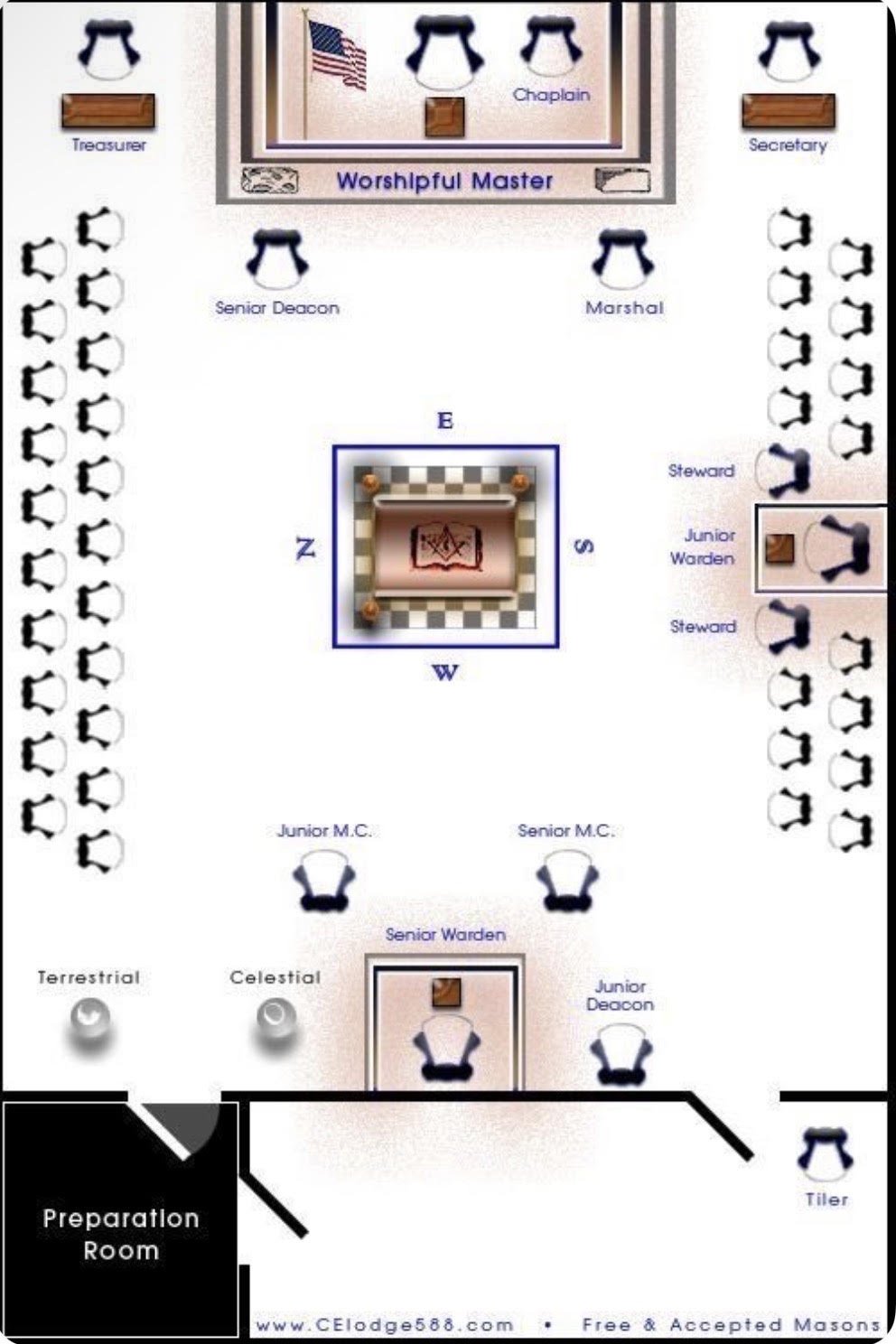
Typical lodge room, Carpenter Emanuel Lodge No. 588, GLNY.
At first glance, a lodge room can look like a formal meeting space with old furniture and unusual choreography.
Chairs in fixed stations. An altar placed with intention. Lights arranged meaningfully. Officers seated where they are supposed to be seated, not wherever convenience suggests. Movement that is not random. Orientation that matters even when the building itself does not literally face the corresponding compass points.
To a casual observer, this may seem ceremonial in the weak sense of the word: traditional, theatrical, old-fashioned, perhaps a little overarranged.
But that is not the right way to read it.
A lodge room is arranged the way a diagram is arranged. It is a teaching instrument. It is less like a living room and more like a map.
And not just a map of a building. A map of moral and mental order.
That is why the layout matters.
A room can teach
Modern people tend to underestimate space.
We think ideas live in books, speeches, and screens. But human beings have always learned from arrangement. We are shaped by where things are, what faces what, what stands at the center, what is elevated, what is approached, what must be crossed, where authority sits, where silence gathers.
A courtroom teaches before the judge speaks.
A church teaches before the sermon begins.
A classroom teaches before the lesson starts.
A memorial teaches before a single plaque is read.
The room tells you what kind of attention is expected.
Freemasonry understands this deeply. It does not leave instruction floating in abstraction. It places instruction in space. The lodge room becomes a moral geometry, an arrangement of positions and relations meant to train perception.[1]
This is why you should not ask only, “What happens in the room?” You should also ask, “Why is the room itself saying what it says?”
The first lesson: order is not optional
Nothing significant in a lodge room is casually placed.
That is the first and perhaps most important lesson.
The stations are fixed.
The movement is regulated.
The symbols occupy meaningful positions.
The room is not laid out according to whim, interior decorating taste, or whoever arrived first.
This immediately communicates something fundamental: serious things require order.
That may sound obvious, but it is actually a rebuke to a great deal of modern life. We like spontaneity because it feels free. And spontaneity does have its place. But no craft, no science, no court, no liturgy, no military formation, and no durable institution can survive on spontaneity alone.
Form is what makes sustained meaning possible.
A lodge room teaches that by embodiment. It says: if you want moral and intellectual labor to happen, you must enter a space where things are not random. The physical order of the room becomes an outer analogue of the inner order the Mason is supposed to cultivate.[2]
In that sense, the room is already making a psychological demand. It is asking the mind to straighten itself.
Why orientation matters
One of the striking things about lodge rooms is that they are symbolically oriented. Even if a particular building is not literally aligned to the compass in perfect architectural fact, the room is still understood in terms of East, West, and the other cardinal directions.
Why preserve that symbolic geography?
Because orientation gives meaning to position.
A room with mere chairs is one thing.
A room in which stations have directional significance is another.
Direction turns placement into language.
The East, in Masonic symbolism, is especially important because it is associated with light, beginning, and the source from which the day is understood to rise. This is not difficult to grasp. Human beings have always treated the rising of light as a natural emblem of awakening, knowledge, and ordered commencement.[3]
So when authority or instruction is symbolically linked to the East, the point is not primitive astronomy. The point is intelligible arrangement. The room aligns governance and illumination. It says, in effect, that guidance ought to come from the place associated with dawning light.
This is what makes the room more than a meeting hall. Its geography is moralized.
The center matters because the center always matters
Most rooms do not have a true symbolic center. They have empty floor space.
A lodge room is different. The center is charged.
This matters because what a culture places at the center reveals what it takes most seriously. In some spaces the center is entertainment. In others it is power. In others it is sacrifice, instruction, memory, or law.
In mainstream Masonic lodge arrangements, the altar and the Volume of Sacred Law occupy central importance.[4] Whatever local variations exist, the broader symbolic point remains clear: the room is organized around a standard higher than any one individual present.
That is a profound statement.
It means no officer is the center.
No personality is the center.
No ego is the center.
Not even the lodge as a social club is the center.
The center belongs to principle, obligation, and moral reference beyond private preference.
In psychological terms, this is exactly right. A disordered soul is one in which appetite, vanity, fear, or impulse occupies the center. An ordered soul places the self in relation to something higher and more stable.
The lodge room teaches that spatially before it teaches it verbally.
Fixed stations, fixed functions
Why are officers placed where they are placed? Why are functions assigned to stations rather than treated as interchangeable?
Because Masonic instruction assumes that role and relation matter.
This is not merely bureaucracy in regalia. It is dramatized order. Each station signifies a duty, and each duty belongs within a structure. The room therefore becomes a visible model of differentiated responsibility.
That is a lesson the modern world badly needs.
We speak often of equality, and rightly. But equality does not eliminate role. A healthy system requires both common dignity and distinct responsibilities. Not everyone does the same thing. Not everyone speaks at the same time. Not everyone bears the same charge in the same moment.
The lodge room embodies this without, ideally, turning it into domination. Offices are functional before they are prestigious. Or at least they are supposed to be.
That is crucial.
The room says: order is not chaos plus titles. Order means that responsibilities are distributed, recognized, and coordinated. This is true in architecture, in institutions, and in the soul. Different powers and obligations must be rightly situated if the whole is to stand.[5]
Circumambulation and movement
Another feature often noticed in lodge work is that movement through the room is not arbitrary. There are proper paths, proper sequences, proper ways of proceeding.
Why should movement matter?
Because movement teaches process.
If the room were only a static arrangement of symbols, it would already be meaningful. But the addition of regulated movement turns the room into something dynamic. It becomes a stage for enacted transition. You do not merely stand in a symbolic world. You move through it.
This is essential to Masonic pedagogy.
Freemasonry does not simply say that life has stages, duties, thresholds, disciplines, and ordered relations. It makes men rehearse these through bodily action. Movement through arranged space becomes a way of impressing moral sequence on the imagination.[6]
The body learns before the intellect finishes explaining.
That is one reason ritual can teach so effectively. It does not rely on argument alone. It organizes gesture, direction, timing, and place so that meaning is experienced as passage.
The perimeter and the center
Many lodge rooms are arranged so that members sit around the sides while central symbolic features remain visually and ceremonially prominent. Even at the simplest practical level, this helps visibility. But symbolically it does more than that.
It teaches relation to the common center.
Instead of dispersing attention into clusters, the room gathers attention inward. Members are not merely there as isolated spectators. They are arranged as participants in an ordered whole oriented toward shared work.[7]
That is important because one of Freemasonry’s constant themes is that the individual must locate himself within a structure larger than private appetite.
The room enacts that theme.
You sit somewhere particular.
You face something common.
You do not define the room around yourself.
You enter a room already speaking.
Again, that is exactly how moral life works. Reality is not centered on each person’s passing mood. We enter into orders we did not invent.
Sacred geometry, if handled soberly
The California page you mentioned uses the phrase “sacred geometry,” and that phrase can be either helpful or unbearable depending on how it is used.
Used badly, it becomes a fog machine. People start speaking as if every angle in a lodge room contains hidden cosmic frequencies detectable only by internet initiates and men who own too many velvet bookshelves.
Used soberly, the phrase points to something simpler and more solid: proportion, orientation, and measured relation matter because they reflect the idea that truth is not chaos.[8]
That is enough.
Freemasonry has long cherished geometry not because geometry is spooky, but because geometry is intelligible order. It shows that form can be known, that relation can be measured, that structure can be apprehended by disciplined intelligence. A lodge room arranged according to symbolic relations therefore becomes an enacted tribute to the idea that moral life too must be measured and ordered.
So yes, one may speak of sacred geometry, provided one means geometry in service of seriousness, not geometry as theatrical mystification.
The room as an inner diagram
Now we come to the heart of it.
Why call the lodge room a map of the mind?
Because its outer order mirrors the kind of inner order Freemasonry wants to produce.
Think of the elements we have already considered:
orientation toward light
a stable center beyond ego
distinct faculties or functions in rightful relation
measured movement rather than impulse
thresholds and stations
common participation in an ordered whole
This is not only architecture. It is psychology.
A well-ordered person also has a center.
He also needs right orientation.
He must assign proper place to judgment, desire, conscience, speech, discipline, and action.
He must learn not to move inwardly at random.
He must know when he is entering serious territory.
He must submit passing impulses to enduring standards.
The lodge room externalizes all this.
It is as if Freemasonry says: since the inner life is difficult to see directly, we will build a visible model of order and let you move within it until you begin to recognize what such order might mean within yourself.
That is a remarkably intelligent method.
Why this works better than lectures alone
Suppose someone gave a talk called “The Importance of Internal Moral Structure.”
It might be a good talk. It might even be a memorable talk. But it would remain conceptual.
Now imagine instead that a person repeatedly enters a formal room in which every station, movement, orientation, and central object reinforces the reality of ordered relation. Over time, the arrangement itself begins to think for him. Or at least to help him think.
This is one of the oldest educational techniques in the world. Build the lesson into the environment.
Religious traditions do it.
Military institutions do it.
Monastic communities do it.
Courts and universities do it.
Freemasonry does it too.[9]
The room is not an accessory to the teaching. It is part of the teaching.
The danger of not noticing the room
The trouble with any repeated form is that familiarity can make it invisible.
A man can sit in a symbolically ordered room for years and cease to see that it is ordered at all. The stations become furniture. The central objects become fixtures. The movements become routine. What was meant to awaken thought sinks into habit.
This is always the danger in ritual life.
But the cure is not to abolish form. The cure is to recover attention. The room still speaks if one learns to look at it again.
Ask simple questions.
Why there?
Why centered?
Why elevated?
Why approached in this way?
Why this direction?
Why this station?
Why this sequence?
The more seriously you ask, the less accidental the room appears.
And once you see the room clearly, it becomes much harder to think of Freemasonry as merely a club with costumes. Clubs do not usually build moral cosmologies into seating plans.
So why is the lodge room laid out like a map of the mind?
Because Freemasonry teaches through space as well as speech.
The room is arranged to embody order, orientation, hierarchy of function, centrality of principle, and meaningful movement. It is a visible pattern meant to train invisible habits. It externalizes the kind of inward architecture a Mason is meant to build within himself.
Its geography is moral.
Its center is psychological.
Its stations are instructional.
Its order is aspirational.
The lodge room says, without words, that a human being should not live as a pile of impulses in a random enclosure.
He should become a chamber properly arranged:
oriented toward light,
governed by principle,
disciplined in movement,
and fitted for serious work.
That is why the room looks the way it does.
It is not just where the teaching happens.
It is part of the teaching.
Endnotes
Image
Image credit: “Typical lodge room,” Carpenter Emanuel Lodge No. 588, Grand Lodge of New York (GLNY), accessed via Contact Us – Carpenter Emanuel Lodge #588
Literary
[1] W. Kirk MacNulty, Freemasonry: Symbols, Secrets, Significance (London: Thames & Hudson, 2006), especially on symbolic space, ritual arrangement, and the pedagogical function of lodge symbolism.
[2] John Hamill, The Craft: A History of English Freemasonry (Wellingborough: Crucible, 1986), for institutional and symbolic context regarding lodge arrangement and formal order.
[3] Margaret C. Jacob, Living the Enlightenment: Freemasonry and Politics in Eighteenth-Century Europe (Oxford University Press, 1991), for the broader cultural significance of light, order, and rational symbolism in Masonic thought.
[4] California Freemasonry, “Lodge Room,” https://freemason.org/lodge-room, useful for mainstream descriptive orientation to lodge-room symbolism and arrangement; see also standard Grand Lodge educational materials in your jurisdiction.
[5] Albert G. Mackey, The Symbolism of Freemasonry (New York, 1882), for classic internal symbolic interpretations of stations, directions, and lodge arrangements; best read critically and alongside modern scholarship.
[6] W. Kirk MacNulty, Freemasonry: A Journey Through Ritual and Symbol (London: Thames & Hudson, 1991), on ritual movement and symbolic progression in Masonic instruction.
[7] Steven C. Bullock, Revolutionary Brotherhood: Freemasonry and the Transformation of the American Social Order, 1730–1840 (Chapel Hill: University of North Carolina Press, 1996), for the social and spatial dimensions of Masonic fellowship and ordered participation.
[8] On geometry, symbolism, and form in Masonic thought, see MacNulty, Freemasonry: Symbols, Secrets, Significance; and for historical background on the esteem for geometry in Masonic culture, Douglas Knoop and G. P. Jones, The Genesis of Freemasonry (Manchester: Manchester University Press, 1947).
[9] For ritualized environments as formative spaces in early modern and Enlightenment associational culture, see Jessica Harland-Jacobs, Builders of Empire: Freemasons and British Imperialism, 1717–1927 (Chapel Hill: University of North Carolina Press, 2007), and Jacob, Living the Enlightenment.