What Freemasonry Is: From Anderson’s Constitutions to the Symbolic and Observant Lodge
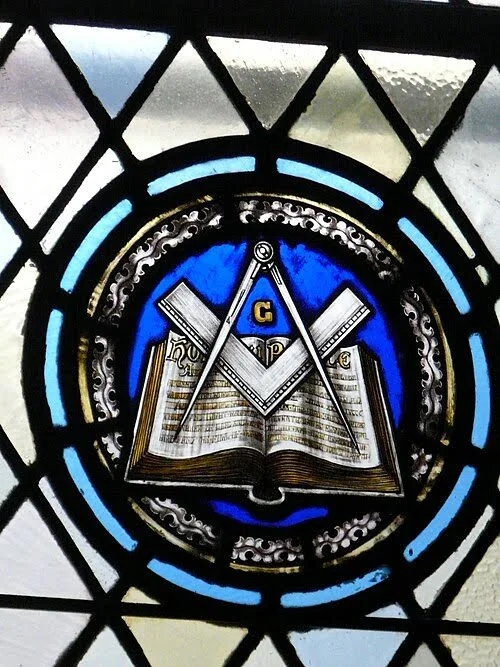
Square and compasses, stained-glass window.
Few institutions are as widely recognized by name and as poorly understood as Freemasonry. It has been praised as a school of virtue, dismissed as a relic, romanticized as a secret society, and blamed for nearly everything by those who have never crossed the threshold of a lodge room.
The truth is simpler and more interesting. Freemasonry is not a political cabal, not a religion, not merely a charitable club, and not simply a social fraternity. At its heart, it is a system of moral and symbolic formation: a fraternity that uses ritual, allegory, and inherited forms to shape character, cultivate brotherhood, and orient men toward a life of virtue.
Anderson’s Constitutions and Modern Masonry
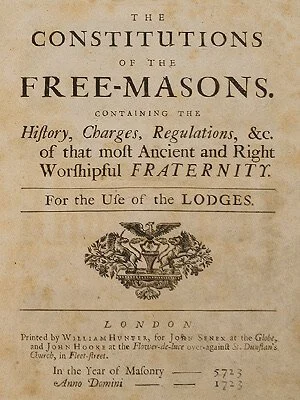
James Anderson, Anderson’s Constitutions, 1723.
To understand Freemasonry as most modern Masons understand it, one must begin with James Anderson’s Constitutions of the Free-Masons of 1723. Anderson did not invent Masonry, but his work became one of the key texts in defining the fraternity in its modern form.
The Constitutions presented Freemasonry as a moral society under God, binding men together across divisions that would otherwise separate them. Its most famous language describes Masonry as a “Center of Union,” a place where men may meet in friendship without surrendering the claims of conscience. That ideal remains central to the Craft’s self-understanding.
More Than a Social or Service Organization
Freemasonry shares some features with other fraternities, charitable bodies, and civic associations, but it is not reducible to any of them. Its distinctive feature is that it is initiatic and symbolic.
Men are not simply enrolled; they are initiated through degrees. They do not merely hear lectures; they undergo ritual experiences. They do not merely join a club; they enter a structured moral drama in which architecture, Solomon’s Temple, and the builder’s tools become instruments of ethical instruction and self-knowledge.
That is also why Masonry cannot be defined simply as a service organization. Charity matters deeply within the tradition, but it is an effect of Masonry, not its essence. A lodge is first a school of virtue and brotherhood operating through symbol and ceremony.
The Craft and Its Symbols
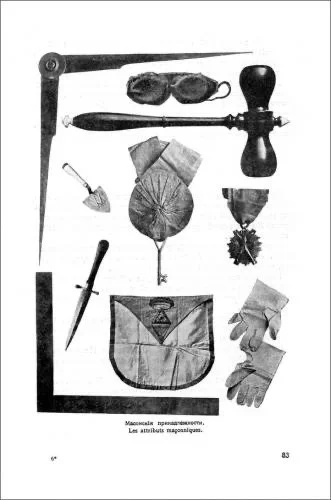
Image of historical Masonic Tools
Masons often call the fraternity “the Craft,” a word that suggests discipline, inheritance, skill, and making. Freemasonry treats the human person as unfinished material capable of refinement through reflection, moral effort, and disciplined fraternity.
Its symbols — the rough and perfect ashlar, the square, compasses, plumb, level, and trowel — are not decorative relics. They are moral instruments. Their purpose is not antiquarian nostalgia but the use of the builder’s art as a language of inner construction.
The Symbolic Lodge
In many jurisdictions, the local lodge in which a Mason receives the first three degrees is known as the Craft Lodge, Blue Lodge, or Symbolic Lodge. These terms differ in emphasis, but they point to the same core fact: the first three degrees are the foundation and heart of Freemasonry.
They are not merely preliminary stages on the way to something more important. Within them are concentrated the great themes of Masonic life: awakening, labor, instruction, fidelity, mortality, and hope. To value the symbolic lodge is to see Masonry as an initiatic and contemplative order rather than a social calendar or administrative machine.
Observant Freemasonry
This understanding is closely related to what has come to be called observant Freemasonry. Observant Masonry is not a separate rite or governing body. It is a philosophy of lodge culture that seeks to recover the solemn, transformative, and symbolic dimensions of the Craft.
In practice, this means careful ritual, serious preparation of candidates, strong education, formal decorum, thoughtful fellowship, and the conviction that lodge should feel set apart from ordinary life. Ritual is treated with reverence because ritual itself teaches. Education is central, not optional. Fellowship matters, but it does not eclipse the deeper purpose of the lodge.
A Response to Decline in Depth
The observant impulse emerged partly in response to modern patterns in which many lodges became overly administrative, casual, or focused on fundraising and rapid degree conferral. Critics argued that Masonry had become efficient at producing members without fully initiating Masons.
Observant Masonry answers that drift by preferring depth over speed, excellence over convenience, and formation over mere participation. It does not reject charity or fellowship. It insists that both are most fully Masonic when they arise from a lodge culture centered on reverence, symbolism, and serious moral labor.
Neither Religion Nor Mere Fraternity
Freemasonry is often misdescribed in opposite ways: as “just a fraternity” or as a hidden religion. It is neither.
It is more than a fraternity because its rituals, symbols, and degrees give it a distinctive initiatic structure. But it is not a religion because it does not claim to offer salvation, administer sacraments, or replace the duties of a man’s faith. In many regular jurisdictions it requires belief in Deity while remaining non-sectarian within lodge, allowing men of different confessions to meet on shared moral ground.
The Lodge as Moral Workshop
The Craft Lodge may be understood as a symbolic workshop for the soul. The lodge room is not merely functional space. In Masonic interpretation it reflects the world, the temple, and the ordered interior life of man.
The candidate’s movement through the lodge is both literal and allegorical. He seeks light, labors, learns, confronts mortality, and is taught to measure himself against enduring standards. In that sense, the symbolic lodge is not unreal. It is a reality disclosed through signs.
A Concise Definition
Freemasonry may be defined as a voluntary initiatic fraternity that uses ritual, allegory, and the symbolism of stonemasonry to teach moral truth, cultivate brotherly love, relieve distress, and encourage the pursuit of virtue under God and the moral law.
Its principles are often summed up as brotherly love, relief, and truth. But these are not slogans. They are habits formed through repeated ritual, disciplined fellowship, serious study, and a sustained return to the symbolic center of the Craft.
Final Thought
For many Masons, the future of the fraternity depends less on publicity than on recovering confidence in what the lodge uniquely is. Freemasonry becomes most compelling not when it imitates other organizations, but when it remembers its own form: initiation, symbolism, reverence, memory, and moral labor.
To be a Mason of a symbolic and observant bent is therefore not to occupy a fringe position, but to emphasize something close to the center. It is to insist that the lodge should feel like a lodge, the ritual should carry weight, the symbols should be lived with, and the brotherhood should be deep enough to sustain genuine moral formation.
End Notes
Author’s note:
I write as an individual Freemason, historian, and researcher. This article reflects my personal research and interpretation and does not represent an official statement of Advance Service Mizpah Lodge No. 586, the Grand Lodge of New York, or any other Masonic organization.
Images:
Stained Glass Image - © Robert Adamski, licensed CC BY-SA 4.0 (https://creativecommons.org/licenses/by-sa/4.0/), via Wikimedia Commons.
James Anderson, Anderson’s Constitutions, 1723, frontispiece and title page, via Wikimedia Commons, reproduced by PICRYL, public domain.
Illustration of Masonic Tools - Wikimedia Commons, via GetArchive, “Иллюстрация из репринтного издания,” 1914–1915. Public domain.