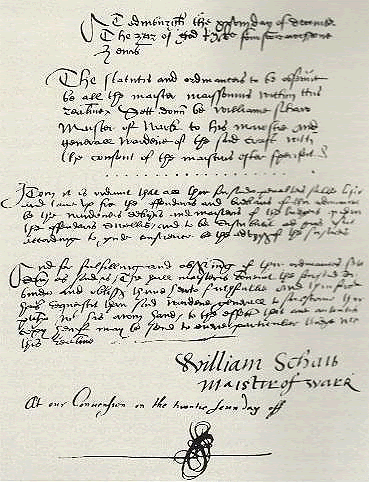
The First Schaw Statutes, 1598
More Light: Freemasonry and the Search for an Ancient Past · Article 1
Next: Why Solomon’s Temple Matters to Freemasonry
Freemasonry did not begin all at once. A building craft, an organization of lodges, a developing ritual tradition and a system of Grand Lodge government came together over time. Separating them changes the question of where the fraternity came from.
The date everyone knows
Ask when Freemasonry began and one date appears again and again: 1717.
According to the account James Anderson published in 1738, four London lodges gathered at the Goose and Gridiron alehouse near St Paul’s Cathedral on June 24, 1717. They elected Anthony Sayer as Grand Master and established the organization later remembered as the first Grand Lodge.
That remains the conventional account, including in the United Grand Lodge of England’s public history.
But its evidentiary basis needs care.
Anderson wrote more than twenty years after the supposed meeting. Historians Andrew Prescott and Susan Mitchell Sommers have challenged his narrative and argued that the decisive formation of Grand Lodge occurred in 1721.
Their study of the earliest years of organized English Freemasonry makes clear why “the traditional date” is safer than “a firmly attested founding event.”
Even if the 1717 account is accepted, it cannot answer every question about Masonic origins.
Scottish lodge records predate it by more than a century. A surviving description of initiation dates to 1696. Men who were not working stonemasons were being admitted well before the London Grand Lodge appeared.
The difficulty is asking one date to explain several developments.
“Freemasonry” can refer to a building craft, a system of lodges, a body of ceremonies and symbols, or an organization governed by Grand Lodges. Those things did not begin together.
Separating them is the first step toward understanding why a fraternity rooted in early modern Britain came to imagine itself as much older.
Builders and the places they worked
Start with the stone.
Medieval churches, castles and civic buildings required skilled masons. Large projects needed arrangements for supervising work, testing competence, organizing labor and maintaining standards.
A lodge could mean a working place or shelter associated with a building site. It should not automatically be imagined as a later fraternal meeting.
The distinction can be seen in the York Minster masons’ ordinances of 1370.
They regulated when masons should begin work, how long they could remain away for meals, how new workers should be tested and what obligations they undertook. The lodge in those rules belonged to the practical organization of construction.
Such evidence establishes a medieval setting for the craft and its regulation. It does not, by itself, demonstrate the later fraternity’s ceremonies or institutional structure.
The word “freemason” also appears in medieval records.
A prominent explanation connects it with the mason who worked freestone: stone that could be cut and dressed for fine architectural work. Other explanations have linked “free” with legal or occupational status.
The term’s history should not be used to smuggle in a fraternity of travelers enjoying universal exemption from local rules. Whatever the word’s precise development, that larger romantic picture requires evidence of its own.
A craft that already had ancestors
Another inheritance from the working craft is especially important to this series: the Old Charges.
These manuscripts combined rules of conduct with accounts of masonry’s origins. The late medieval Regius poem and Cooke manuscript are among the earliest surviving witnesses, followed by many later versions.
They did not all tell the same story.
The Regius poem presents Euclid in Egypt and includes a tradition about King Athelstan. The Cooke manuscript offers a more expansive account involving the children of Lamech, the preservation of knowledge, Euclid, Solomon’s Temple and the establishment of the craft in England.
Later copies rearranged and developed the material.
These are not reliable records of what happened in biblical antiquity or at Athelstan’s court. They are evidence that people associated with the craft explained its present through a distinguished past.
That point changes the chronology of the legends.
Ancient ancestry was not simply added by eighteenth-century gentlemen to an institution that previously had none. It was already embedded in the craft’s written traditions.
Geometry, sacred building and royal patronage gave practical rules a larger setting. A mason’s obligations could be presented as part of an honorable inheritance rather than merely the requirements of a particular employer.
Scotland writes it down
Scotland supplies an unusually substantial body of early lodge evidence.
In 1598, William Schaw, Master of Works to James VI, issued regulations for the masons under his authority. A second set followed in 1599.
The Schaw Statutes addressed apprenticeship, supervision, discipline, admission and record-keeping. Their provisions show organized craft institutions with defined responsibilities.
The Lodge of Edinburgh’s surviving minutes begin in 1599.
Those records are valuable precisely because they concern actual people conducting ordinary business. They preserve admissions, disputes, regulations and decisions—not merely a later story about what a lodge must once have been.
They also complicate a simple division between working masons and gentlemen.
John Boswell of Auchinleck attended an Edinburgh lodge meeting on June 8, 1600, leaving his signature and mark. He was a landed gentleman, but his exact status at that meeting is uncertain. The record does not describe an initiation, and it should not be made to do so.
A clearer case follows in 1641.
Robert Moray, serving with the Scottish army in northern England, was admitted at Newcastle on May 20 by members of the Edinburgh lodge. He was not a working stonemason.
By the seventeenth century, Scottish references also identify a “Mason Word,” associated with restricted knowledge and recognition.
These records establish that lodge organization, obligations, recognition practices and participation beyond the building trade existed before Grand Lodge government.
They do not establish that the entire later ritual system was already present.
What Scotland explains—and what it does not
David Stevenson’s The Origins of Freemasonry: Scotland’s Century, 1590–1710, published in 1988, gave these Scottish developments a central place.
His argument connected Schaw’s reforms with a wider intellectual setting, including architectural interests, symbolism and the arts of memory.
That is more than a story of craftsmen gradually being replaced by gentlemen. It asks how practical organization and contemporary intellectual culture could interact within lodges.
The strength and reach of particular parts of that interpretation remain matters for discussion. The surviving Scottish evidence nevertheless makes one conclusion unavoidable: the history cannot begin with a London meeting in 1717.
Nor should Scotland become a new shortcut that erases uncertainty elsewhere.
The emergence of modern Freemasonry involved related but not identical developments in different places. The records are uneven, and a continuous local archive is not available for every proposed connection.
Gentlemen at the lodge door
England’s evidence is thinner, but it contains important landmarks.
Elias Ashmole recorded that he was made a Freemason at Warrington on October 16, 1646, alongside Colonel Henry Mainwaring. He later recorded participation in a London lodge meeting.
Ashmole was an antiquary with interests extending far beyond the building trade. His membership demonstrates the admission of such a person; it does not establish that the lodge taught all the subjects that interested him.
In 1686, Robert Plot supplied another valuable account.
His Natural History of Staffordshire described the admission of men into a “Society of Freemasons,” including people of high social standing.
Plot reported meetings called lodges, the communication of secret signs, obligations of assistance and a manuscript containing the craft’s history and rules.
He was not an uncritical admirer. He challenged the historical claims in that manuscript and expressed suspicion about undisclosed practices.
His account is therefore useful in two ways. It describes customs circulating before the Grand Lodge era, and it shows that Masonic legendary history already attracted criticism.
The terms “accepted” and “speculative” are often used when discussing participation beyond the working trade. They should not conceal variation in local practice or imply that every such member joined for the same reason.
Sociability, professional connections, religious and intellectual interests, and the attraction of private ceremony are possibilities to investigate—not motives recoverable for every individual.
Ceremonies appear on paper
By the end of the seventeenth century, the evidence becomes more specific about ceremony.
The Edinburgh Register House manuscript, dated 1696, is generally identified as the earliest surviving detailed description of Masonic initiation. Related texts followed around 1700.
They include obligations, signs, words and catechetical questions. They distinguish an apprentice admission from further instruction associated with the fellow craft or master.
That terminology should not be confused with the later three-degree system. In these early materials, “master” and “fellow craft” do not necessarily identify separate ceremonies in the modern arrangement.
Solomon’s Temple is already present. A question in the 1696 catechism places the first lodge in its porch.
What is absent is the developed Hiram murder-and-recovery narrative familiar from the later Master Mason’s degree.
That narrative appears in printed form in Samuel Prichard’s Masonry Dissected, published in 1730, with ceremonies arranged in three degrees.
The publication date does not tell us the exact year the story was devised. It tells us that the narrative and this ritual arrangement were in circulation by then.
The evidence therefore supports development, not a single moment of invention. Elements were preserved, rearranged and elaborated, and the surviving documents catch only parts of that process.
Continue this subject in “Why Solomon’s Temple Matters to Freemasonry.”
London takes the stage
The early London Grand Lodge gave Freemasonry another kind of organization.
Whether its decisive beginning is placed in 1717 or 1721, its growing public presence in the early 1720s is much clearer than the details of the traditional founding meeting.
Aristocratic leadership, printed regulations and the publication of the Constitutions helped establish a governing framework above the individual lodge.
That development did not immediately create one universally accepted Masonic system.
The Grand Lodge of Ireland is documented by 1725. Scotland established its Grand Lodge in 1736. In England, a rival Grand Lodge formed in 1751 and became known as the “Antients,” distinguishing itself from the earlier body it called the “Moderns.”
The two English organizations united on December 27, 1813.
The United Grand Lodge of England’s chronology records those institutional landmarks.
Grand Lodge Freemasonry was therefore not just a decision made once. It developed through expansion, rivalry, recognition and negotiation over authority and practice.
A constitution with Adam at the beginning
Anderson’s Constitutions of the Free-Masons appeared in 1723.
It combined a historical narrative, charges and regulations, along with other material intended for the fraternity’s use. George Payne’s earlier work on the General Regulations and John Theophilus Desaguliers’s dedication also belonged to the institutional publication.
The first charge spoke of “that Religion in which all Men agree,” leaving particular opinions to individuals.
That formulation sought common ground, but it was not unrestricted religious inclusivity. The same passage excluded the “stupid Atheist” and “irreligious Libertine.” Its boundaries should be read alongside its expansive language.
The history began with Adam and carried geometry and architecture through sacred and classical antiquity to Britain.
An accessible edition of Benjamin Franklin’s 1734 reprint preserves the text.
The new governing organization did not invent a taste for ancient ancestry. It inherited the craft’s legendary past and gave that past an ambitious printed form.
The relationship between the building arts and the modern fraternity became so expansive that ancient architects could appear as participants in one continuous Masonic history.
That was a historical claim made by the institution. It was not the documentary demonstration of an unbroken institution.
Explore the publication in “How Freemasonry Wrote Its Ancient History.”
Four developments, not one birthday
Set the strands side by side.
Working masonry has a documented medieval history.
Scottish lodge organization is recorded particularly clearly from the late sixteenth century.
Initiatory practices are described before 1700 and develop further in the early eighteenth century.
Grand Lodge government emerges in London in the early eighteenth century and spreads through institutions that did not always agree.
These are not sealed compartments. Work, obligation, ceremony, membership and government interacted.
But separating them prevents a familiar mistake: assuming that the date attached to one development must be the beginning of everything else.
It also changes how the ancient claims should be understood.
The Old Charges already gave the craft a distinguished past before the London Grand Lodge. Anderson expanded that inheritance. Later writers proposed additional relationships with Egypt, mystery cults and chivalric orders.
The surviving evidence does not establish descent from Solomon’s builders. It does establish that later people used Solomon’s building to explain and dignify their own work.
That distinction is the starting point for the series.
Freemasonry’s ancestors matter historically—not only when they can be demonstrated as institutional predecessors, but also when the claims reveal what people wanted the fraternity to mean.
Continue the series
Where Did Freemasonry Come From? — You are here.
Back to the series introduction
Sources and further reading
Image: The First Schaw Statutes, December 28, 1598, bound in the First Minute Book of the Lodge of Edinburgh (Mary’s Chapel) No. 1. Original manuscript owned by the Lodge of Edinburgh (Mary’s Chapel) No. 1, under the Grand Lodge of Scotland. Digital reproduction accessed via The Square Magazine.
Early records and texts
York Minster masons’ ordinances of 1370, modernized transcription.
The Cooke manuscript, transcription and translation, with older editorial commentary.
The First Schaw Statutes of 1598, with discussion and links to the second statutes.
Robert Plot, extracts from The Natural History of Staffordshire (1686), especially chapter VIII, sections 85–88.
Samuel Prichard, Masonry Dissected (1730), online transcription.
James Anderson, The Constitutions of the Free-Masons (1723). Electronic edition of Franklin’s 1734 reprint.
Douglas Knoop, G. P. Jones and Douglas Hamer, The Early Masonic Catechisms, second edition revised by Harry Carr (Manchester University Press, 1963). Library catalogue record.
Historical studies
David Stevenson, The Origins of Freemasonry: Scotland’s Century, 1590–1710 (Cambridge University Press, 1988).
Andrew Prescott and Susan Mitchell Sommers, “Searching for the Apple Tree: Revisiting the Earliest Years of Organized English Freemasonry” (2018). A challenge to the conventional 1717 founding narrative.
Harry Carr, “Pillars and Globes, Columns and Candlesticks”: early ritual evidence, including the Temple references in the 1696 manuscript.
United Grand Lodge of England, “History of Freemasonry”. An institutional chronology retaining the traditional 1717 foundation date.
