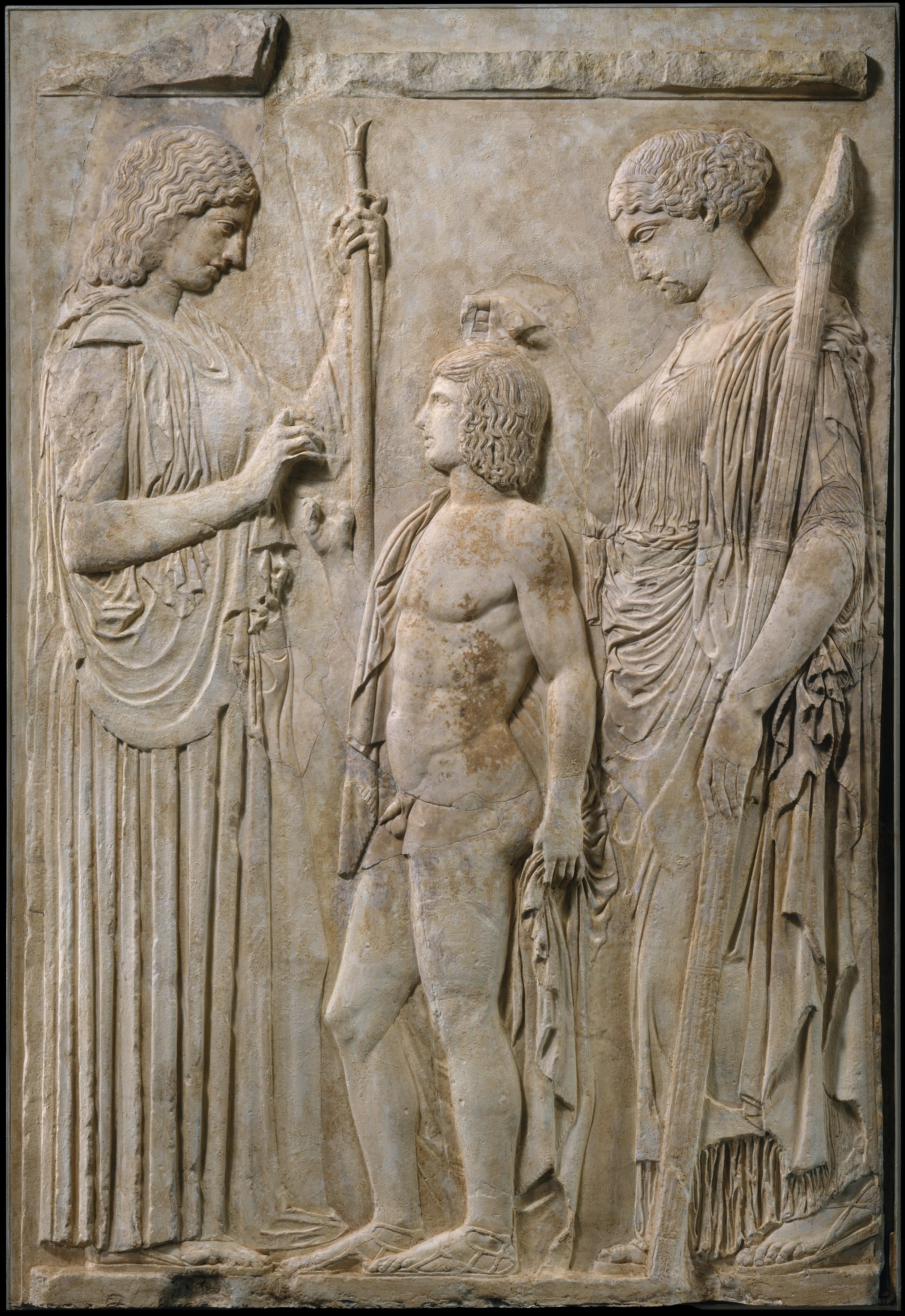
Great Eleusinian Relief: Roman fragments set into a cast of the Greek original. The Metropolitan Museum of Art.
More Light: Freemasonry and the Search for an Ancient Past · Article 5
For more than two centuries, Masonic writers have heard an echo in the lodge room of Eleusis, Isis and Mithras. The echo tells us more securely about how later readers understood initiation than about where Freemasonry came from.
A drama with a hole in the middle
In 1730, a London publication called Masonry Dissected, issued under the name Samuel Prichard, claimed to reveal what happened when a man was made a Mason.
Its ceremonies were arranged in three degrees: Entered Apprentice, Fellow Craft and Master Mason. That makes it an important witness to a developing system, not proof that every lodge already worked the same ceremonies in the same way.
The Master’s degree centered on a story. Hiram, the master builder of Solomon’s Temple, is killed after refusing demands for the Master’s Word. His body is concealed, sought and recovered. The catechism connects that recovery with the question of how the participant was raised.
This is the beginning of the comparison.
A ceremony organized around secrecy, loss and a dramatic encounter with death offered later readers something that could be placed beside accounts of ancient initiation. But “raised” must be handled carefully. Prichard describes the recovery and raising of a body; he does not say that Hiram returns to ordinary life. Resurrection and regeneration are interpretations that require their own explanation.
Readers had ancient language available for making those interpretations.
In De Legibus II.36, Cicero praised the mysteries associated with Athens for teaching people not only how to live with greater happiness but how to die with better hope.
Apuleius ended The Golden Ass with the initiation of Lucius into the cult of Isis. Book XI describes initiation in the language of a voluntary death and renewed life, while withholding a complete account of the ceremony.
Such passages made the comparison attractive. They did not establish a connection between an ancient sanctuary and a modern lodge.
What “the mysteries” were—and were not
The Eleusinian Mysteries, associated with Demeter and Persephone, formed part of a religious festival with public activities and restricted rites. Initiates were bound to secrecy about what they experienced.
Important features of the ceremonies remain uncertain. Yet “almost nobody wrote anything down” is too simple a description of the evidence. Literary references, inscriptions, buildings, images and polemical accounts preserve information of different kinds. The difficulty is deciding what each can reliably establish.
Nor was Eleusis the headquarters of a single ancient mystery institution.
Dionysiac initiations, the worship of Isis in the Greek and Roman world, and the Roman cult of Mithras belonged to different traditions. They varied in their gods, membership, organization, settings and promises.
Mithraic communities, for example, worshipped in distinctive shrines often arranged to evoke caves. A seven-grade system is attested by Jerome’s Letter 107 and by archaeological evidence, including the floor mosaic in the Mithraeum of Felicissimus at Ostia.
That does not mean every member everywhere necessarily completed the same seven-stage course. The extent and function of the grades remain matters of interpretation.
The relationship between Roman Mithras and Iranian Mithra also requires care. Iranian connections are real, but the Roman cult should not be treated as a straightforward transplantation of an unchanged Persian religion.
Walter Burkert’s Ancient Mystery Cults offers a comparative study of several traditions without turning them into one institution.
Later writers often did the opposite. “The Mysteries” became a single school of hidden wisdom, supposedly recognizable beneath different divine names.
That simplification was useful to an origin theory. A lineage was easier to imagine when antiquity appeared to possess one trunk.
Four ways to be connected
Four different claims need to be separated.
Analogy: two ceremonies share features, such as secrecy, staged admission or imagery of darkness and light.
Influence: later people encounter an earlier tradition through texts, images or scholarship and adapt material from it.
Revival: people deliberately construct a modern practice that claims to recover or renew an ancient one.
Institutional descent: an organization continues through a demonstrable chain of transmission.
These are not interchangeable.
An analogy can be genuine without proving influence. Influence can occur through a book without institutional continuity. A revival can be historically consequential while remaining a modern creation.
Cagliostro’s Egyptian Masonry of the 1780s belongs to that last kind of history: a modern system presenting itself through an ancient Egyptian identity.
The strongest claim is institutional descent. The surviving evidence does not establish an unbroken chain from the ancient mystery cults to Freemasonry.
Much of the confusion begins when writers move between categories without announcing the change. A resemblance is noticed, borrowing is presumed, and a genealogy is declared.
Hutchinson: a sacred interpretation
William Hutchinson, an attorney and Mason associated with Barnard Castle, published The Spirit of Masonry in 1775.
His lectures treated Masonry as a system of moral and religious instruction. Ancient ceremonies helped him explain what he believed Masonic practices meant.
His relationship with antiquity was more assertive than a comparison between distant cousins. Hutchinson accepted ancient sources for elements of Masonic ceremony while maintaining a larger account of sacred origins.
At the same time, his interpretations were explicitly Christian. He did not merely describe an ancient religion that had somehow survived unchanged. He read Masonic symbolism through his own religious commitments.
That distinction matters when using the book.
A widely available online transcription of The Spirit of Masonry reproduces a later edition edited by George Oliver. It includes Oliver’s introductory dissertation and editorial apparatus. Those additions should not automatically be attributed to Hutchinson’s first edition.
For this article, the safest conclusion is also the most useful: Hutchinson helped make comparison with ancient rites a vehicle for explaining Masonry’s sacred and moral significance.
That is evidence about eighteenth-century interpretation. It is not proof that the ceremonies traveled intact from an ancient cult.
Warburton and the learned mysteries
The larger intellectual setting helped.
William Warburton’s The Divine Legation of Moses Demonstrated, whose first two parts appeared in 1738 and 1741, made the ancient mysteries part of a wide-ranging argument about religion, government and revelation.
Warburton distinguished public religious forms from teachings reserved for initiates. His account helped make the mysteries appear to be institutions with an intellectual and moral purpose, rather than merely strange survivals of pagan worship.
Such interpretations offered later Masonic writers a prestigious comparison. Secrecy could protect serious instruction. Initiation could prepare a person for truths not communicated in the same way to everyone.
But the resemblance between two writers’ arguments does not, by itself, prove that one directly borrowed from the other. Hutchinson should not be described as dependent on Warburton without identifying the relevant passages and distinguishing the original text from later editorial notes.
The broader point requires less speculation: eighteenth-century readers encountered the ancient mysteries through modern arguments as well as through ancient evidence.
Their “Eleusis” was already an interpreted Eleusis.
A continental version of the comparison
The mysteries also entered Masonic discussion beyond Britain.
Versions of Andrew Michael Ramsay’s discourse associated with 1737 explicitly compare the fraternity with the festivals of Ceres at Eleusis, Minerva at Athens and Isis in Egypt.
The passage presents ancient celebrations as gatherings of initiates and contrasts an imagined original purity with later pagan excess. It is a revealing claim of kinship, not evidence that Ramsay had discovered an ancient chain of lodges.
The text survives in different versions, and its circumstances of delivery require care. It is better to say that the comparison appears in the discourse tradition than to reconstruct a particular spoken occasion too confidently.
In Vienna, the inquiry became more systematic.
Ignaz von Born’s 1784 essay on the Egyptian mysteries appeared in the Journal für Freymaurer. The lodge circle around Born treated ancient initiation as a subject worthy of sustained investigation.
Jan Assmann’s study of Egyptian mysteries and secret societies places that work within the intellectual setting of Mozart’s The Magic Flute.
The opera’s Egyptian temples and trials of initiation demonstrate the imaginative productivity of the comparison. They do not show that its authors were recovering a lost ancient ceremony.
Oliver turns the arrow around
George Oliver pushed the argument in a different direction.
An Anglican clergyman and prolific nineteenth-century Masonic author, Oliver believed that a sacred form of Masonry reached back to humanity’s beginnings.
In his scheme, “pure” or “primitive” Masonry continued through the biblical patriarchs. Pagan mysteries represented altered or corrupted forms of that original tradition: the “spurious Freemasonry” of antiquity.
His The History of Initiation, first published in 1829, is a particularly relevant work for this comparative project. Later editions and discussions developed the argument further.
Notice what the theory does.
It accepts similarities between Masonry and ancient mysteries, but reverses the direction of descent. Instead of Masonry being a late survival of pagan initiation, pagan initiation becomes a damaged reflection of an older Masonic truth.
This is not a minor variation. It shows that the likeness itself did not determine the genealogy.
The same resemblance could support opposite histories, depending on what the writer already believed about religious truth and the fraternity’s origins.
Oliver’s writings are therefore valuable evidence for the construction of Masonic ancestry. Their claims about antiquity still require independent support.
Pike’s library of initiation
Albert Pike’s Morals and Dogma of the Ancient and Accepted Scottish Rite of Freemasonry appeared in 1871.
Written for the Scottish Rite’s Southern Jurisdiction in the United States, it interprets the degrees through an enormous range of religious, philosophical and symbolic material.
Its account of antiquity was not produced entirely from independent readings of ancient sources. Pike compiled, translated and adapted passages from numerous later writers.
Éliphas Lévi was one important source, but not the only one. Pike also drew upon other religious and philosophical syntheses. Arturo de Hoyos’s 2011 annotated edition identifies and contextualizes extensive portions of that borrowed material.
The Southern Jurisdiction’s review of the annotated edition describes its work of supplying sources, explanations and corrections.
This does not make Pike’s book unimportant. It changes the historical question to ask of it.
Rather than reading every parallel as proof of ancient transmission, a reader can ask how Pike assembled a vocabulary through which Scottish Rite degrees acquired a universal religious and philosophical setting.
The resulting work belongs to nineteenth-century intellectual history as much as to the history of the fraternity.
It should not be treated as the authoritative teaching of every Masonic jurisdiction or degree system.
Paine finds a different ancestor
Thomas Paine offered another origin theory.
His essay “On the Origin of Freemasonry” first appeared posthumously in New York in 1810, with passages omitted. An 1818 publication helped circulate a fuller text.
Paine’s proposed ancestry ran through the Druids.
He argued that Masonry preserved remnants of ancient solar religion. Sun imagery, lodge orientation, clothing and festival dates became clues from which he reconstructed the supposed descent.
His conclusion differed sharply from the Christian histories of Hutchinson and Oliver. His method nevertheless shared their weakness: perceived similarities did more work than documentary connections.
Paine is also useful because he quoted Masonic writers while challenging their explanations. His essay shows that the same published traditions could be rearranged to support a substantially different religious argument.
The origin story did not simply emerge from the evidence. It reflected what the interpreter thought the evidence ought to mean.
The appetite for comparison
Comparative antiquity made such arguments attractive.
Translations, travel, archaeological discoveries and expanding scholarship placed more cultures within reach of European readers. Ancient rites could be assembled into broad patterns of religion and initiation.
James George Frazer’s The Golden Bough, first published in 1890 and greatly expanded afterward, gave influential form to one such pattern: gods whose death and return were associated with fertility and renewal.
That chronology matters. Frazer did not create the eighteenth-century Masonic comparison with the mysteries. His work belonged to a later comparative climate in which similar methods of assembling parallels became exceptionally influential.
The category of “dying and rising gods” was subsequently challenged.
Jonathan Z. Smith’s 1987 encyclopedia article under that title questioned the evidence and the grouping of unlike traditions. Later scholarship has continued the debate rather than simply replacing one universal verdict with another.
The discussion in Bryn Mawr Classical Review identifies both the force of Smith’s criticism and subsequent attempts to reconsider particular cases.
The lesson is methodological. A pattern can help organize comparison, but it must not erase differences or supply a missing history of transmission.
What the resemblance can—and cannot—carry
Ancient mystery traditions are known through uneven evidence.
Some testimony comes from participants or sympathetic observers. Some comes from outsiders, including Christian critics with polemical purposes. Archaeology can confirm settings and practices without necessarily revealing what participants believed an experience meant.
A novel such as Apuleius’s is especially suggestive, but it is still a literary work. Its account cannot automatically be treated as a complete ritual transcript.
Nor does secrecy mean that historians can say nothing. It means that claims must be proportionate to the evidence.
Freemasonry presents a different documentary sequence: late medieval craft texts, early modern lodge records, regulations, ritual manuscripts and printed publications.
The Scottish evidence examined by David Stevenson places recognizable lodge organization and developments in initiation within a late sixteenth- and seventeenth-century setting. Prichard’s 1730 exposure then supplies a printed account of the three degrees and the Hiram narrative.
Those sources do not establish an institutional connection with Eleusis, Isis or Mithras.
They also do not reveal every step in the formation of Masonic ritual. The absence of a complete developmental history should not be disguised as certainty about a single inventor or source.
But a gap in one history is not evidence for a preferred alternative.
The comparison with ancient mysteries becomes securely visible as something Masonic writers made: an interpretation, an argument and sometimes a source of material for further invention.
Why initiation seems to produce ancestors
The power of the comparison may lie partly in experience.
That is an interpretation of its appeal, not a universal psychological law.
Initiation can make membership feel different from an ordinary administrative act. Preparation, obligation, movement, restricted knowledge and a structured change of status can give admission unusual emotional force.
Ancient accounts supplied language for that force: purification, enlightenment, passage through darkness, renewed life and hope in the face of death.
A Mason could use such language to describe what his ceremony meant without possessing evidence that it descended from an ancient cult.
Later readers sometimes took another step. An experience that felt ancient came to require an ancient genealogy.
The resulting kinship could be persuasive from inside the ritual while remaining unproved as institutional history.
This is why dismissing the comparison as “only interpretation” misses something important. Interpretation helped people understand their membership and helped writers give the fraternity a place within a much larger account of human aspiration.
Its historical consequence was real even when its genealogy was not demonstrated.
A relationship without a chain
The ancient mysteries were not one institution waiting to become Freemasonry.
They were distinct traditions, known through different bodies of evidence. The surviving record does not provide an unbroken institutional chain from their sanctuaries to early modern lodges.
What can be documented is another relationship: later readers encountering ancient accounts, recognizing suggestive similarities and using them to explain or develop modern practices.
That relationship includes scholarship and speculation, borrowing and revival, religious conviction and literary imagination.
It answers the series question from a different angle. Freemasonry reached toward the ancient world not only for prestigious ancestors, but also for a language large enough to describe initiation.
The mysteries offered that language. They gave Masonic writers ways to discuss secrecy, transformation and mortality—and an imagined past in which those experiences had happened before.
That makes them important to the history of Masonic self-understanding. It does not make them proven founders of the fraternity.
Sources and further reading
Image: Ten marble fragments of the Great Eleusinian Relief, Roman, Early Imperial, Augustan period, ca. 27 BCE–14 CE. Marble fragments set into a cast of the Greek original. The Metropolitan Museum of Art, Rogers Fund, 1914, object no. 14.130.9. Source: The Metropolitan Museum of Art. Public domain; Open Access.
Early Masonic and related texts
Samuel Prichard, Masonry Dissected (London, 1730), online transcription.
William Hutchinson, The Spirit of Masonry, in Moral and Elucidatory Lectures (1775).
William Hutchinson, later edition edited by George Oliver, online transcription. Oliver’s introduction and notes must be distinguished from Hutchinson’s own text.
William Warburton, The Divine Legation of Moses Demonstrated, first two parts published 1738–1741.
Andrew Michael Ramsay, discourse associated with 1737: text and discussion. Versions differ; claims about a particular delivery require care.
George Oliver, The History of Initiation (first published 1829). For the “pure” and “spurious” framework, see the historical discussion in “The Ancient Mysteries”. This is evidence for Masonic origin theories, not independent confirmation of them.
Albert Pike, Morals and Dogma of the Ancient and Accepted Scottish Rite of Freemasonry (1871); annotated edition edited by Arturo de Hoyos (2011). See the Southern Jurisdiction’s review and excerpts.
Thomas Paine, “On the Origin of Freemasonry”; first published posthumously in 1810, with omissions; fuller publication in 1818.
Ancient evidence
Cicero, De Legibus, Book II, section 36: the Eleusinian mysteries, life and hope in death.
Apuleius, Metamorphoses, or The Golden Ass, Book XI: the initiation of Lucius into the cult of Isis.
Sarolta A. Takács, “Initiations and Mysteries in Apuleius’ Metamorphoses”: analysis of the novel’s initiation language.
The Roman Cult of Mithras: collection of literary and archaeological material, including evidence for initiatory grades. Translated ancient testimony should be distinguished from the site’s modern synthesis.
Modern scholarship
Walter Burkert, Ancient Mystery Cults (Harvard University Press, 1987; later paperback edition).
Hugh Bowden, Mystery Cults of the Ancient World (Princeton University Press, 2010).
Marvin W. Meyer, editor, The Ancient Mysteries: A Sourcebook: Sacred Texts of the Mystery Religions of the Ancient Mediterranean World (Harper & Row, 1987).
David Stevenson, The Origins of Freemasonry: Scotland’s Century, 1590–1710 (Cambridge University Press, 1988).
Jan Assmann, “Egyptian Mysteries and Secret Societies in the Age of Enlightenment: A ‘Mnemo-Historical’ Study”.
Jonathan Z. Smith, “Dying and Rising Gods,” The Encyclopedia of Religion, volume 4 (1987), pp. 521–527; and Drudgery Divine (1990), chapter 4. For discussion of the subsequent debate, see Bryn Mawr Classical Review.
Jett B. Conner, “Thomas Paine, Deism, and the Masonic Fraternity”, Journal of the American Revolution (2016).
