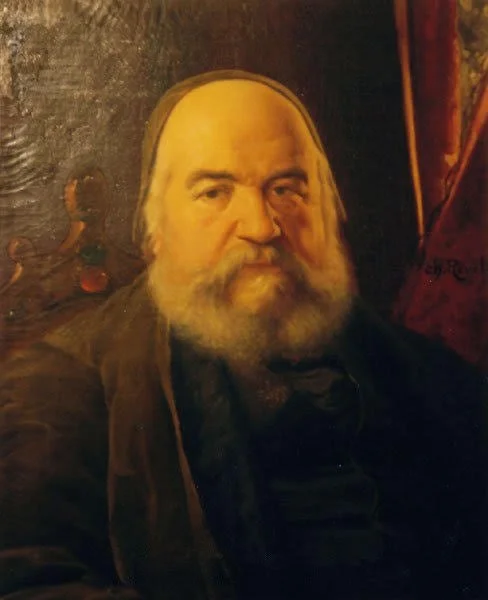
Éliphas Lévi, 1874. Portrait by Charles Revel. Courtesy of Wikimedia Commons.
More Light: Freemasonry and the Search for an Ancient Past · Article 7
Freemasonry’s occult reputation had no single author. Esoteric Masons, magical societies, popular writers and hostile inventors all helped build it—and they were not describing the same thing.
Two shelves
Freemasonry can appear in two different kinds of book: a history of sociability and institutions, or a compendium of magic and hidden wisdom.
Neither placement can be explained simply by declaring the other mistaken.
The early printed sources offer a useful starting point. The 1723 Constitutions combined a legendary history of architecture with charges governing conduct and regulations for the fraternity. Its religious formulation sought common ground without eliminating religious obligations or extending membership without limits.
Samuel Prichard’s Masonry Dissected, published in 1730, described signs, words, obligations and three degrees, including the drama of Hiram.
These texts do not present a program of alchemical experiment or ceremonial magic. But they are not merely the rules of a dinner club, either. Biblical history, sacred architecture, ritual instruction and restricted knowledge already gave readers substantial material to interpret.
That distinction matters.
A ceremony can be private without being magical. A symbol can invite spiritual interpretation without proving the existence of a concealed ancient doctrine. Conversely, the absence of a magical manual from an early constitutional book does not establish that every member lacked esoteric interests.
The historical question is therefore more precise than “Was Freemasonry occult?”
Which people, organizations and publications connected it with particular forms of esotericism—and what evidence supports those connections?
What “occult” means here
The word can obscure more than it explains.
Alchemy, Christian mysticism, Jewish and Christian Kabbalah, ceremonial magic and Rosicrucianism are not interchangeable. Nor is an esoteric interpretation of ritual the same thing as an accusation of devil-worship.
The University of Amsterdam describes Western esotericism as an umbrella covering several historically distinct currents, including Hermeticism, the occult sciences, theosophy and modern occultism.
Used carefully, the category helps identify relationships among traditions. Used loosely, it makes every secret ceremony look like the same practice.
This article follows several different processes: participation by people with esoteric interests, the creation of explicitly esoteric systems, the reinterpretation of symbols, and hostile claims about hidden purposes.
They sometimes reinforced one another. They should not be collapsed into one origin story.
Ashmole: a member is not a ritual program
Elias Ashmole supplies an early and frequently cited connection.
An antiquary with strong interests in alchemy and astrology, he recorded in his diary that he was made a Freemason at Warrington on October 16, 1646, alongside Colonel Henry Mainwaring.
The entry is important. Its meaning is also limited.
It establishes that Ashmole participated in a Masonic admission. It does not describe that ceremony as an alchemical initiation, identify a Hermetic curriculum or demonstrate that the lodge shared all his intellectual interests.
The argument becomes circular when his personal interests are used to define the lodge, and that supposedly Hermetic lodge is then used to explain his membership.
Frances Yates’s The Rosicrucian Enlightenment encouraged influential discussion of connections among Rosicrucianism, scientific culture and early Freemasonry. Those proposed connections remain subjects for examination, not a documented organizational genealogy.
The sound conclusion is narrower: people with esoteric interests were among those who entered Masonry. What a particular lodge taught must be established from evidence about that lodge.
When some systems became explicitly esoteric
By the later eighteenth century, the evidence becomes more direct.
Some organizations using Masonic structures or recruiting Masons taught subjects and practices that went well beyond ordinary Craft ritual.
Martinès de Pasqually’s Élus Coëns developed during the 1760s. Its teachings concerned the spiritual condition of humanity and its restoration, and its advanced practices included theurgy: ritual operations intended to establish relations with the spiritual world.
The Order of the Gold and Rosy Cross in the German lands combined alchemical and Christian esoteric teachings with an initiatory organization connected to Masonic networks. Its major late-eighteenth-century form is associated with a reorganization in 1777.
Jean-Baptiste Willermoz, who had participated in the Élus Coëns, helped shape the Rectified system through reforms associated with Lyon in 1778 and Wilhelmsbad in 1782. Its explicitly Christian framework incorporated teachings influenced by that earlier environment.
These were different projects. Theurgy was not identical to alchemy, and neither can simply be substituted for the Rectified system’s Christian spiritual teaching.
Nor were these bodies Freemasonry as a whole.
Henrik Bogdan’s “Freemasonry and Western Esotericism” examines the relationship without reducing all Masonic activity to one doctrine.
The distinction changes the argument. Esoteric associations were not merely a reputation imposed from outside. In some settings, participants deliberately made them part of their institutional work.
What cannot be assumed is that such developments reveal an unchanged occult program present in every earlier lodge.
Lévi reads the symbols
Éliphas Lévi—the pen name of Alphonse-Louis Constant—became one of the most influential interpreters of magic in the nineteenth century.
His Dogme et rituel de la haute magie appeared in two parts, in 1854 and 1856. His Histoire de la magie followed in 1860.
Lévi brought Kabbalah, ritual magic, tarot, religious imagery and secret societies into an ambitious account of hidden knowledge. Within that scheme, Masonic symbols could be treated as fragments of a wisdom their custodians did not necessarily understand.
His chronology is revealing.
He was initiated on March 14, 1861, in the Paris lodge La Rose du Parfait Silence, under the Grand Orient of France.
His major magical writings therefore preceded his lodge membership.
Accounts of his brief association describe disagreement with the lodge and disappointment with its intellectual and religious atmosphere. That experience should not be generalized into a verdict on every Mason, but it undercuts the idea that his magical synthesis was simply a report of what he learned at initiation.
His more consequential contribution was interpretive.
Masonic emblems could be placed beside Kabbalistic diagrams, Hermetic imagery and tarot correspondences. A writer could then argue that their resemblance revealed a shared doctrine.
Such a method might produce an elaborate symbolic reading. It did not, by itself, demonstrate how a particular emblem entered Masonic ritual.
Pike and the authority of a large book
Albert Pike’s Morals and Dogma appeared in 1871 for the Scottish Rite’s Southern Jurisdiction in the United States.
The book placed interpretations of Masonic degrees alongside an enormous range of religious, philosophical and symbolic material.
Pike did not reach this synthesis entirely independently of Lévi. He translated and adapted material from Lévi and drew extensively on other writers as well.
Arturo de Hoyos’s 2011 annotated edition identifies sources, explains contexts and corrects errors. The Southern Jurisdiction’s review of that edition describes the importance of this work.
That source history matters.
Pike’s book is evidence of how a nineteenth-century Masonic author assembled and interpreted learning. It is not independent confirmation of every ancient connection it proposes.
Its jurisdictional setting matters too. A work written for one Scottish Rite body should not be treated as a universal handbook for every lodge or every form of Freemasonry.
Nevertheless, it made a substantial association visible: Masonic degrees and esoteric comparative interpretation now occupied the same influential volume.
A Rosicrucian society for Masons
British organizations provided another route.
The Societas Rosicruciana in Anglia, or SRIA, dates its establishment to 1867. Robert Wentworth Little was its principal organizer.
Membership required a Master Mason in good standing. The society’s Christian identity and Rosicrucian interests gave its work a more particular character than the phrase “a secret society for Masons” would suggest.
Its subjects included Hermetic and Rosicrucian literature, Kabbalah and related forms of religious and philosophical inquiry.
The SRIA’s own account is useful for its institutional date and membership requirement. Its broader assertions about remote Rosicrucian and Masonic origins should be distinguished from those verifiable organizational facts.
Kenneth R. H. Mackenzie belonged to this wider esoteric and Masonic world. His Royal Masonic Cyclopaedia appeared in 1877.
The reference-book form gave readers a place where Masonic rites, unusual organizations and esoteric subjects could be encountered together. But Mackenzie’s exact role in the early SRIA and in the materials behind later orders has been disputed.
He should not be installed as the single architect of a movement merely because later writers found him convenient as an ancestor.
The Golden Dawn: related, not identical
In 1888, William Wynn Westcott, William Robert Woodman and Samuel Liddell Mathers established the Hermetic Order of the Golden Dawn.
All three were Freemasons and members of the SRIA. The Golden Dawn’s graded structure drew upon the Rosicrucian initiatory environment in which they worked.
The Britannica account of its formation identifies those connections and dates the first London temple, Isis-Urania, to March 1888.
The Golden Dawn was not a Masonic lodge or a degree system governed by a Grand Lodge. It admitted women and did not require its members to become Freemasons.
It was a separate organization with a curriculum that developed toward ceremonial magic.
That distinction is exactly what later accounts sometimes lost.
Some founders belonged to both worlds. Some organizational forms traveled between them. Neither fact makes the two institutions identical.
It is reasonable to see how the resemblance could contribute to public confusion. Demonstrating how widely that confusion spread, however, would require evidence from particular readers, publications and settings—not simply the observation that both organizations used initiation.
Waite: mystical interpretation and historical criticism
Arthur Edward Waite complicates any simple division between believers and skeptics.
He participated in the Golden Dawn, became a Freemason in 1901 and pursued a Christian mystical interpretation of ritual.
His The Secret Tradition in Freemasonry appeared in 1911. A New Encyclopaedia of Freemasonry followed in 1921.
Waite believed that symbolic traditions could point toward an inward restoration or return to the divine. Freemasonry, in his reading, could participate in that larger spiritual pattern.
He was also critical of careless history.
R. A. Gilbert’s “The Masonic Career of A. E. Waite”, drawing on diaries, correspondence and published works, demonstrates both aspects of his thought. Gilbert also identifies Waite’s historical errors and his sometimes extravagant judgments of other scholars.
It would therefore be too neat to say that Waite rejected every theory of transmission while offering only a harmless metaphor. He constructed a substantial “secret tradition,” even as he challenged particular origin stories.
A more concrete example shows why he matters.
In Devil-Worship in France, published in 1896, Waite investigated and rejected the supposed evidence for a Satanic organization concealed within Freemasonry.
He did so before Taxil publicly confessed the fraud.
The same writer could interpret Masonic ritual mystically and insist that a sensational claim about actual Masons was false. Those positions were not contradictory.
Hall writes before joining
Manly P. Hall’s The Secret Teachings of All Ages appeared in 1928.
Its full title announced its scope: an encyclopedic outline of Masonic, Hermetic, Qabbalistic and Rosicrucian symbolic philosophy.
Hall presented these subjects within a broad panorama of esoteric wisdom. His book is evidence of that synthetic project, not a neutral inventory of the teachings of ordinary lodges.
The chronology is decisive.
Hall was initiated in Jewel Lodge No. 374 on June 28, 1954, more than twenty-five years after the book appeared.
He subsequently became an active and honored Mason. That later membership does not retroactively make his 1928 book an account written from lodge experience.
Nor is it necessary to claim that every reader misunderstood him. The narrower point is enough: his early writing about Masonry must be evaluated on its sources and arguments, not authenticated by honors received decades later.
The suspicious audience
An occult reputation also grew through hostility.
In 1797, John Robison published Proofs of a Conspiracy. Augustin Barruel’s Mémoires pour servir à l’histoire du jacobinisme began appearing that year and continued in 1798.
Their arguments were principally about organized subversion of religion and government. They combined Freemasons, Illuminati and other groups within accounts of a revolutionary conspiracy.
That is not the same claim as ceremonial magic.
It did, however, encourage a powerful interpretive habit: the public purpose of an association might be a disguise, and an ordinary member might know nothing about its true directors.
In such a narrative, lack of knowledge could become evidence of how successfully the secret was kept.
Taxil and the invented inner order
Catholic opposition to Freemasonry had its own theological and political history.
Pope Leo XIII’s Humanum Genus, dated April 20, 1884, condemned the fraternity and associated it with naturalism, religious indifferentism and attacks on the Church’s position.
Its language placed the conflict within a struggle between the kingdoms of God and Satan. That does not make the encyclical a documentary report that Masons conducted devil-worship ceremonies.
The distinction becomes essential with Léo Taxil.
Taxil, an anticlerical writer who professed conversion to Catholicism, helped create an elaborate literature alleging a hidden Luciferian organization called Palladism.
Its supposed witnesses included Diana Vaughan, presented as a former insider. Albert Pike was assigned a leading role in the imagined hierarchy.
On April 19, 1897, Taxil publicly acknowledged his deception in Paris.
The fabricated identity and testimony of “Diana Vaughan” should be distinguished from Taxil’s claim that he had borrowed the name of a real woman who assisted him. The supposed Palladist witness was not established as a real participant in the events described.
Massimo Introvigne’s Satanism: A Social History places the episode within a longer history of Satanism and accusations of Satanism.
The lesson is not merely that somebody lied.
Taxil’s invented inner order exploited existing assumptions: secrecy concealed a second organization, ordinary members were ignorant of its purposes, and esoteric language proved that a darker religion lay underneath.
The fraud supplied fictional evidence for a story some readers were already prepared to accept.
Its reception also complicates the picture. As Gilbert documents, Waite—himself an esoteric interpreter—was among those who exposed it.
Masons who asked for records
Other Masonic writers pursued a different kind of authority.
Robert Freke Gould’s History of Freemasonry appeared during the 1880s. It belonged to the development of documentary Masonic research associated with the “authentic” school.
This approach emphasized dated texts, lodge records and the critical comparison of evidence.
It should not be idealized as perfectly free from error, nor reduced to hostility toward every spiritual interpretation. Its central contribution was a distinction between what a symbol might mean and what documents could establish about institutional history.
Those are different questions.
A person could find mystical significance in a ceremony without possessing evidence that it descended from an ancient mystery school. Conversely, disproving a legendary genealogy did not determine every possible meaning of the ritual.
Debate about these matters took place among Masons as well as between the fraternity and its critics.
How a reading becomes an origin story
Several different connections can harden into one misleading picture.
An alchemist joins a lodge. That becomes an alchemical lodge.
A later rite teaches esoteric doctrine. That becomes the original doctrine of all Masonry.
A magical order has Masonic founders. That becomes proof that Masonry itself is a magical order.
A celebrated author joins after writing about the fraternity. His earlier books become insider testimony.
A polemic invents a hidden hierarchy. The absence of corroboration becomes evidence of its secrecy.
Each step moves beyond what the underlying fact establishes.
Yet the correction should not go too far in the other direction. Explicitly esoteric Masonic systems existed. Masons helped build magical organizations. Masonic authors wrote influential interpretations of hidden wisdom.
The problem is not acknowledging those relationships. It is flattening their dates, institutions and purposes into one timeless identity.
A reputation with several authors
No single writer gave Freemasonry its occult reputation.
Some participants introduced particular teachings and practices. Others read existing ceremonies through Hermetic, Kabbalistic or mystical frameworks. Independent orders adapted initiatory forms. Popular authors assembled universal wisdom traditions. Hostile writers imagined conspiracies, and some manufactured evidence.
These processes differed in truthfulness, purpose and relationship to the fraternity.
They also explain why the question belongs in a series about ancestry.
An interpretation of a symbol can become a claim about where it came from. A modern association can be projected backward into an original design. A compelling spiritual reading can acquire the appearance of a documented genealogy.
Freemasonry’s esoteric history is real. That does not make every occult account of its origins true.
The task is to identify who made each connection, when they made it, and whether the evidence establishes participation, borrowing, interpretation—or descent.
Sources and further reading
Charles Revel, portrait of Éliphas Lévi, 1874, Wikimedia Commons, “File:Eliphas Levi 1874.jpg,” sourced from La Rose Bleue, accessed October 26, 2026,
Early Masonry and esoteric interpretation
James Anderson, The Constitutions of the Free-Masons (1723). University of Nebraska–Lincoln edition of Benjamin Franklin’s 1734 reprint.
Samuel Prichard, Masonry Dissected (1730), online transcription.
Elias Ashmole, diary entry for October 16, 1646. The entry is reproduced in the historical discussion of Ashmole; its later editorial interpretations should be distinguished from the quoted diary.
Éliphas Lévi, Dogme et rituel de la haute magie (1854–1856), and Histoire de la magie (1860).
Grand Lodge of British Columbia and Yukon, Lévi’s Masonic initiation: source excerpts and translations.
Albert Pike, Morals and Dogma (1871); annotated edition edited by Arturo de Hoyos (2011). See the Southern Jurisdiction’s review.
Kenneth R. H. Mackenzie, The Royal Masonic Cyclopaedia (1877).
A. E. Waite, The Secret Tradition in Freemasonry (1911), and A New Encyclopaedia of Freemasonry (1921).
Manly P. Hall, The Secret Teachings of All Ages (1928). For his later lodge membership, see the documented initiation dates.
Organizations and historical scholarship
Henrik Bogdan, “Freemasonry and Western Esotericism”, in Henrik Bogdan and Jan A. M. Snoek, editors, Handbook of Freemasonry (Brill, 2014), pp. 277–305.
R. A. Gilbert, “The Masonic Career of A. E. Waite”.
R. A. Gilbert, The Golden Dawn: Twilight of the Magicians (Aquarian Press, 1983).
R. A. Gilbert, A. E. Waite: Magician of Many Parts (Aquarian Press, 1987).
Societas Rosicruciana in Anglia, institutional account and membership requirement. Claims about remote origins require independent evaluation.
Encyclopaedia Britannica, “The Hermetic Order of the Golden Dawn”.
Robert Freke Gould, The History of Freemasonry, original publication during the 1880s.
Frances A. Yates, The Rosicrucian Enlightenment (1972), an influential interpretation rather than a definitive account of Masonic origins.
Opposition and the Taxil affair
John Robison, Proofs of a Conspiracy (1797).
Augustin Barruel, Mémoires pour servir à l’histoire du jacobinisme (1797–1798).
Pope Leo XIII, Humanum Genus (April 20, 1884).
A. E. Waite, Devil-Worship in France (1896), discussed in Gilbert’s study of his Masonic career.
Massimo Introvigne, Satanism: A Social History (Brill, 2016).
Grand Lodge of British Columbia and Yukon, “Léo Taxil’s Confession”, a retrospective discussion of the hoax.

