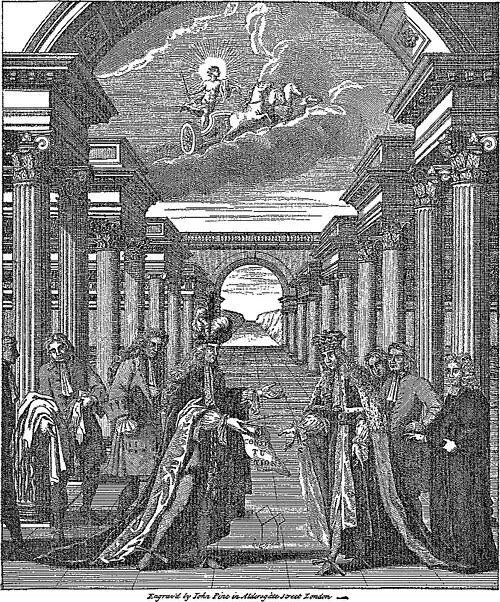
Frontispiece to Anderson’s Constitutions of the Free-Masons, engraved by John Pine, 1723.
More Light: Freemasonry and the Search for an Ancient Past · Article 3
Previous: Why Solomon’s Temple Matters to Freemasonry
Next: Why Freemasons Looked to Ancient Egypt
Institutions do not simply inherit a past. They compose one. In 1723, a London fraternity did it in print, and the result helped shape how Freemasons understood themselves for generations.
A commission, and a word on the title page
In September 1721, according to an account James Anderson published seventeen years later, the Grand Master directed him to put the old constitutions of the Masons into better order.
The Grand Master was the Duke of Montagu. Anderson was a Scottish Presbyterian minister, born and educated in Aberdeen and by then ministering in London. His later account dates the instruction to September 29 and describes the appointment of fourteen brethren to examine his manuscript in December.
Those details need a qualification. They come from Anderson’s retrospective narrative in the enlarged Constitutions of 1738, not from a surviving contemporary minute of the commission. The earlier book’s own approval statement confirms that his work underwent review, but it does not describe the process in precisely the same terms.
The book appeared early in 1723 as The Constitutions of the Free-Masons. Its title page promised the “History, Charges, Regulations, &c.” of “that most Ancient and Right Worshipful Fraternity.”
Notice the adjective.
On the conventional dating of its foundation to 1717, the London Grand Lodge was only about six years old. Yet its constitutional book announced antiquity before it announced a single rule. A recently organized governing body, claiming authority among lodges of varied age and origin, introduced itself with a pedigree.
This article asks why. It follows the movement from manuscript tradition to printed constitution and argues that the ancestral narratives were doing work: telling members what Freemasonry was, telling outsiders how to regard it, and helping explain why separate lodges belonged within a larger body.
Whether every claim about Adam, Moses and Solomon was true is part of the story, but not its center.
The stories Anderson inherited
Anderson was not starting from a blank page. He inherited a substantial manuscript tradition known to historians as the Old Charges: documents combining accounts of the craft’s origins with rules governing the conduct of masons.
Article 1 introduced these craft texts. Here the question is what a Grand Lodge did when it took them up.
The Museum of Freemasonry describes about 130 known examples, including manuscripts in Britain and overseas. Among the earliest are the Regius poem and the Cooke manuscript. Their precise dating has been debated, but both belong to the late medieval world.
Another important witness, the Grand Lodge No. 1 manuscript, bears the date December 25, 1583.
These documents do not all tell the same story.
The Regius poem begins its account of masonry with Euclid in Egypt and includes an assembly under King Athelstan. The Cooke manuscript offers a more expansive history: the children of Lamech before the Flood, the preservation of knowledge, Egypt and Euclid, Solomon’s Temple, and the craft’s eventual establishment in England.
In the Cooke account, St Alban supports the masons and establishes their charges. Later, a son of Athelstan obtains royal permission for assemblies and regulation of the craft. Other versions rearrange and develop these episodes.
That variety matters. There was an inherited store of stories, not one fixed medieval constitution waiting to be printed.
The documents were not neutral histories. Their pedigree and their rules occupied the same manuscript. An account of royal patrons and ancient assemblies could lend weight to instructions about wages, workmanship, loyalty and conduct.
Some versions also contain directions associated with administering an obligation or receiving a mason. The printed history in Anderson’s own book explicitly directs that it be read at the admission of a new brother.
The practical setting helps explain the relationship between legend and obligation. A man hearing the craft’s history could also hear why its charges deserved obedience: the craft was ancient, honorable and useful, and its rules had the sanction of distinguished patrons.
Treat the Old Charges as evidence for what their writers and users said about masonry, not as proof of events in Egypt or at Athelstan’s court.
That is exactly why they matter. They preserve an inherited habit of explaining the present through a long past, before the London Grand Lodge existed.
Anderson at the desk
What Anderson did with this material is best described by three verbs: compile, organize, narrate.
He compiled. Many episodes in his history belong to the older craft tradition: geometry, Egypt, Solomon and the English royal patrons. He did not invent the idea that masonry possessed a distinguished ancient history.
He organized. The 1723 volume brought together a historical narrative, charges governing members’ conduct, and regulations for lodges and the Grand Lodge. It also included a dedication, a procedure for constituting a new lodge, formal approval statements and songs.
Nor was every part Anderson’s independent creation.
The General Regulations were attributed to George Payne, who had compiled them during his Grand Mastership in 1720. John Theophilus Desaguliers supplied the dedication. The finished book was an institutional publication assembled from several kinds of contribution, even though Anderson’s name became attached to the whole.
And he narrated, which is where he went beyond straightforward compilation.
The history opens with Adam, who “must have had the Liberal Sciences, particularly Geometry, written on his Heart.” It moves through Noah, Moses, Solomon and the architects of Greece and Rome before reaching Britain.
Ancient figures receive the titles of the modern fraternity. Moses becomes “Grand Master Moses.” Solomon is Grand Master of the lodge at Jerusalem; Hiram, king of Tyre, is Grand Master at Tyre.
The effect is to make the offices and organization of eighteenth-century Freemasonry appear at home in sacred antiquity.
A chronology repaired—and a genealogy preserved
Anderson also reworked the inherited chronology.
The Cooke manuscript makes Euclid a pupil of Abraham in Egypt. Anderson separates their periods. His account places Euclid at Alexandria under Ptolemy, son of Lagus, after Alexander the Great.
That change already appears in the 1723 work; it was not an innovation first introduced in 1738.
The passage can be checked in the University of Nebraska–Lincoln edition of Franklin’s 1734 reprint. Anderson describes Euclid gathering scattered geometrical knowledge and arranging it into a lasting system under Ptolemy’s patronage.
The result was not simply an inherited medieval story copied carelessly. Anderson attempted to fit its materials into a more expansive chronology.
Yet repairing one chronological difficulty did not establish the larger genealogy.
The narrative still treated the history of geometry, the history of architecture and the history of the Masonic fraternity as if they formed one continuous subject.
That movement between meanings is central to the book’s method. Wherever people built impressive things, Anderson could find material for the history of Masonry.
A past shaped by contemporary taste
The story also reflected Anderson’s architectural preferences.
He admired classical architecture and celebrated what he understood as the recovery of the Roman or Augustan style in Britain. Medieval Gothic occupied a less comfortable place in that scheme.
His judgment was not that Gothic buildings had no merit. He called them “venerable, tho’ not imitable” by those with a taste for ancient architecture.
The distinction was telling. An old building could deserve respect without being the model a modern architect should follow.
The past was being arranged to support a contemporary ideal of proportion, learning and architectural refinement.
This was more than decoration around a fraternity’s rules. It helped present Freemasonry as a cultivated pursuit, connected with the liberal arts and worthy of educated and aristocratic attention.
Anderson did not simply copy a craft legend or invent one from nothing. He turned inherited material into an ambitious history of civilization, then placed the modern fraternity within it.
What antiquity bought
Why lean so hard on the distant past?
Consider what the Grand Lodge needed in the early 1720s and what an ancient pedigree could offer. These are interpretations of the book’s institutional work, not a surviving list of motives written by its authors.
Legitimacy
A recently organized Grand Lodge was asserting authority in a world where lodges and craft traditions already existed.
A history of ancient assemblies, charges and Grand Masters allowed it to represent Masonic government as inherited rather than newly invented. The modern organization could appear as the latest expression of an older order.
Dignity and rank
A fraternity that placed Solomon, princes and learned architects within its history offered more than the identity of a trade association.
Its ancestry made room for gentlemen as well as craftsmen. Participation could be presented as an honorable connection with the arts of civilization rather than simply an interest in a manual occupation.
Continuity
The narrative joined builders, rulers, scholars and gentlemen within one long account.
A new member did not have to imagine himself entering a society of recent formation. He could understand his membership as a place within a tradition that had survived changes of kingdom, language and religion.
Intellectual standing
Anderson’s history made geometry the foundation of the building arts. That association gave Masonry a place among respectable forms of knowledge.
The connection with contemporary natural philosophy was not merely rhetorical. Desaguliers was an experimental lecturer and a Fellow of the Royal Society, as well as an early Grand Master and later Deputy Grand Master.
His dedication endorsed the book explicitly. He praised Anderson for making it “a just and exact Account of Masonry” and for preserving what was ancient and authentic in the older constitutions.
The dedication itself is stronger evidence for that endorsement than a later assumption that Desaguliers must have approved every detail of Anderson’s work.
It joined scientific reputation, Masonic office and institutional history on the opening pages of the same publication.
Antiquity supplied several kinds of value at once. It could explain authority, confer dignity, connect different kinds of member and locate the fraternity within a larger history of knowledge.
A source that is also a stakeholder
Here is the awkward part for a historian. Anderson’s Constitutions is indispensable evidence, but it is not reliable evidence for every period it describes.
It is especially valuable for the early eighteenth century. Its charges, regulations, dedication and history show how those responsible for the publication wanted Freemasonry to appear: orderly, honorable, learned and ancient.
The first charge also offered a particular religious formulation. Instead of requiring adherence to a single national confession, it spoke of “that Religion in which all Men agree,” leaving particular opinions to the members themselves.
That language matters, but it should not be turned into a claim of unrestricted modern inclusivity. The same charge excluded the “stupid Atheist” and the “irreligious Libertine.” The text had boundaries as well as an expansive ambition.
As a guide to Egypt, Babylon or Athelstan’s England, the book requires a different reading.
Its ancient Grand Masters and lodges belong to an institutional genealogy assembled much later. The use of eighteenth-century titles does not demonstrate the existence of eighteenth-century organizations in antiquity.
The distinction is not between a valuable source and a worthless one. It is between the questions a source can answer.
Anderson is strong evidence for how early Grand Lodge Freemasonry represented its past. He is not, by that fact alone, evidence that the past happened as he described it.
The enlarged past of 1738
Anderson’s enlarged edition of 1738 extended the history and provided a fuller account of the early Grand Lodge.
That account preserves narratives not supplied in comparable detail by the first edition. It is also retrospective and must be checked against independent evidence wherever possible.
The story of his own commission belongs to this later account. So does his statement that valuable manuscripts had been burned in 1720 by brethren anxious that they might fall into outside hands.
The burning should not be repeated as an independently established event. It is an assertion made by Anderson.
Nor should its explanatory convenience be mistaken for proof that he invented it. The responsible distinction is narrower: the report survives, but independent corroboration has not been established in the sources used here.
The episode illustrates a recurring difficulty in institutional history. An explanation for missing records may itself survive only in the narrative whose claims those records would supposedly support.
A historian can report that explanation without treating it as a substitute for the missing evidence.
Print, repetition and the making of authority
Anderson’s book changed the form in which Masonic history circulated.
The manuscript tradition had been variable. Copyists could omit passages, alter names, rearrange episodes or reproduce the distinctive readings of an earlier exemplar. That variation is one reason historians can compare families of Old Charges.
It does not follow that manuscript copies lacked authority. A particular document could carry substantial weight for the people who possessed and used it.
Print offered a different advantage: a substantially standardized text that could be reproduced, distributed, quoted and adapted across a widening network.
The book’s authority came from more than its technology. It carried formal approval, the names of officers and lodges, and a declared purpose of use within the fraternity.
Print made that institutional endorsement portable.
The publication’s reach soon extended beyond London.
In 1730, John Pennell published an Irish version in Dublin. This was an adaptation for an Irish Masonic setting, not simply another impression of Anderson’s London edition.
In 1734, Benjamin Franklin printed the work in Philadelphia. The Museum of Freemasonry’s overview of the editions and the University of Nebraska–Lincoln identify it as the first Masonic book printed in America.
Franklin reproduced the earlier text with an additional song. Anderson’s enlarged edition followed in 1738.
Reprinting and adaptation did not prove the ancient genealogy. They made the narrative easier to encounter and repeat.
A story appearing inside an approved constitutional volume could acquire the familiarity of institutional background knowledge.
The surviving editions demonstrate circulation. They do not establish that every Mason read the book or accepted every historical claim it contained.
Authority grew through publication and institutional use, but reception was neither necessarily uniform nor beyond dispute.
An inherited frame
Once an institution possesses an expansive ancient history, later writers have a frame within which to work.
Anderson’s narrative offered a particularly accommodating one. It connected geometry, architecture, sacred history, royal patronage and learned culture across enormous stretches of time.
Later explanations of Masonic origins could draw on that broad habit of connection, even when they departed from Anderson’s particular claims.
That does not mean every later theory descended directly from his book. It means that the constitutional history helped normalize a method: explain the fraternity by locating its essential character within a remote and distinguished past.
The question was no longer only what surviving lodge records showed. It could become where else in history one might recognize the fraternity’s supposed ancestors.
The history as a constitution
The most telling feature of Anderson’s book is where the history stands: before the charges and regulations.
That placement joined identity to obligation. Before the reader encountered the detailed rules, he encountered an explanation of what the fraternity was and where it claimed to belong in human history.
The arrangement continued an older practice. The Old Charges had already placed legendary history beside practical rules. The printed book enlarged that relationship and gave it a new institutional setting.
This answers the series question from another angle. Freemasonry reached into deep time not only to explain symbols or enrich ceremonies, but also to describe and authorize itself.
The ancestral narrative was not merely an ornamental addition to an institution already complete. It participated in making a body of lodges imagine itself as a fraternity with a common identity.
What appeared in 1723 was not documentary proof of an unbroken line from Adam, Solomon or the ancient builders. It was an organized, approved and reproducible account that placed the modern fraternity at the end of a distinguished past.
Its historical claims still require evidence. Its institutional importance does not depend on those claims being true.
Freemasonry did not merely inherit an ancient history. It helped write the form in which that history would be remembered.
Sources and further reading
Image: John Pine, frontispiece to James Anderson, The Constitutions of the Free-Masons (London, 1723). The Duke of Montagu presents the constitutional scroll and compasses to the Duke of Wharton, with John Theophilus Desaguliers at the far right. Source: Grand Lodge of British Columbia and Yukon, via Wikimedia Commons. Public domain.
Primary texts and accessible editions
The Cooke manuscript: transcription and translation. The page also reproduces older commentary, which should be distinguished from the manuscript text.
James Anderson, The Constitutions of the Free-Masons (London, 1723). University of Nebraska–Lincoln electronic edition of Benjamin Franklin’s Philadelphia reprint of 1734. The Euclid passage appears on printed page 23 of that reprint; Desaguliers’s dedication begins on page 3.
James Anderson, The New Book of Constitutions (London, 1738). For the relationship among editions, see the Museum of Freemasonry’s illustrated overview.
John Pennell, The Constitutions of the Free-Masons (Dublin, 1730). Discussed in the Museum of Freemasonry’s account.
Documentary and historical studies
Andrew Prescott, “The Old Charges Revisited”, Transactions of the Lodge of Research No. 2429, Leicester (2006). Listed in the lodge’s 2005–2006 transactions.
Lionel Vibert, “Anderson’s Constitutions of 1723”, The Builder (August 1923). A detailed older critique; its conclusions about Anderson’s motives and honesty require critical reading.
Museum of Freemasonry, “Uncovering Freemasonry’s Past”: the Old Charges, surviving manuscript numbers and the discovery of another example.
Shawn E. Eyer, “Three Centuries of Anderson’s Constitutions, Part Two”, George Washington Masonic National Memorial (2023): Desaguliers and his dedication.
Broader scholarship
David Stevenson, The Origins of Freemasonry: Scotland’s Century, 1590–1710 (Cambridge University Press, 1988).
Margaret C. Jacob, Living the Enlightenment: Freemasonry and Politics in Eighteenth-Century Europe (Oxford University Press, 1991).
Margaret C. Jacob, The Origins of Freemasonry: Facts and Fictions (University of Pennsylvania Press, 2006).
Continue the series
How Freemasonry Wrote Its Ancient History — You are here.

