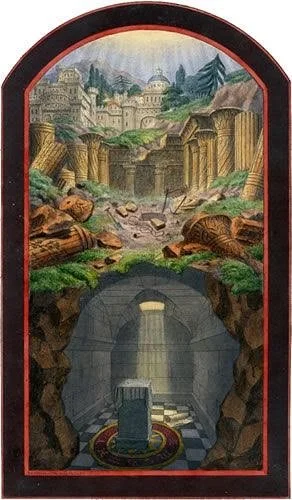
Masonic tracing board credited to John Harris. Public domain, via Wikimedia Commons.
More Light: Freemasonry and the Search for an Ancient Past · Article 8
Previous: Who Gave Freemasonry Its Occult Reputation?
Solomon’s builders, Egyptian priests, Greek initiates, crusading knights. Freemasonry has acquired one distinguished forebear after another. The pattern tells us less about a lost origin than about how institutions turn the past into meaning.
A recoverable history and an inherited habit
Start with what the documents show.
Among the oldest sources relevant to Masonic history are medieval craft texts: the Regius poem and the Cooke manuscript, followed by many later versions known collectively as the Old Charges.
They combine rules for masons with legendary accounts of the craft’s origins. Their stories differ. The Regius poem includes Euclid in Egypt and an assembly under King Athelstan. The Cooke manuscript supplies a more expansive narrative, including the preservation of knowledge before the Flood, geometry in Egypt, Solomon’s Temple and the craft’s establishment in England.
Scottish lodges were keeping records by the end of the sixteenth century. William Schaw’s statutes of 1598 and 1599 regulated their organization and conduct.
In London, a Grand Lodge emerged in the early eighteenth century. Its conventional foundation date is 1717, although the familiar account of that beginning was recorded retrospectively and remains contested.
The Constitutions of 1723 gave the developing body a printed combination of history, charges and regulations. Ritual manuscripts and publications from the same period show ceremonies taking forms that later Masons would recognize.
This history is substantial, not merely a disappointing substitute for something older. It concerns work, association, religion, knowledge and the formation of institutions.
Nor was ancient ancestry added only after the fraternity had established itself.
The surviving craft manuscripts already claimed a distinguished past. Anderson’s Constitutions extended that approach, moving from Adam through sacred and classical antiquity to the modern fraternity.
The problem is not that early Masonic traditions made no ancient claims. They did. The problem is that a claim of ancestry is not the same thing as evidence demonstrating it.
The question running through this series is therefore not simply “Who invented the first legend?”
It is why the fraternity kept acquiring additional ancestors—and why different ancestors remained useful.
The five mechanisms that follow are this series’ way of interpreting that pattern. They are not a settled scholarly classification or a claim that every Mason thought alike.
One: a building you can carry anywhere
Freemasonry inherited an unusually adaptable vocabulary.
Squares, compasses, levels, plumb-rules, stones and buildings could refer to practical work. They could also become ways of discussing conduct, character and community.
The craft legends had already enlarged the connection. Geometry and architecture joined biblical figures, ancient civilizations and working masons within a common narrative. Anderson’s history extended that narrative to the modern fraternity.
The metaphor could travel.
A temple might represent a sacred project. A prepared stone might represent a person under moral instruction. A structure assembled from separate parts might suggest an ordered community.
That portability helps explain the attraction of more than one architectural past.
Solomon’s Temple had a particularly strong place because of its biblical detail and its role in Masonic legend and ritual. Egyptian monuments offered another imposing world of geometry, sacred construction and extraordinary age.
A resemblance between buildings or symbols did not establish a connection between institutions. It did make comparison easy.
That is the first mechanism: a vocabulary formed around building could be applied to many histories, and an application could later be mistaken for an ancestry.
Two: initiation invites a pedigree
The ancient mysteries supplied a different attraction.
In De Legibus II.36, Cicero praised the Eleusinian rites for teaching people how to live more happily and die with better hope.
Apuleius described initiation into the cult of Isis through imagery of approaching death and receiving renewed life. His Golden Ass, Book XI, supplied later readers with a particularly suggestive account.
Masonic interpreters could place those passages beside ceremonies organized around obligation, restricted knowledge, loss and discovery.
The comparison did not require a surviving chain of initiators. It required experiences or descriptions that seemed alike.
Writers then arranged the similarities in different ways.
William Hutchinson interpreted Masonry through ancient religious material and his own Christian commitments. Albert Pike assembled a much broader philosophical and religious framework around Scottish Rite degrees.
George Oliver made an especially revealing move. In his account, “pure” or “primitive” Masonry was older than the pagan mysteries. The latter were altered or corrupted forms of the original tradition.
Albert G. Mackey’s later discussion of “pure” and “spurious” Masonry explicitly associates that terminology with Oliver and explains the supposed division.
The direction of descent could therefore be reversed without abandoning the resemblance.
That is evidence of the comparison’s flexibility. Similarity did not decide which institution came first; a writer’s prior account of religious history helped decide what the similarity meant.
The experiential argument also needs care.
It is reasonable to suggest that a moving initiation encourages a search for language adequate to describe it. It would be too much to claim that every candidate experiences transformation or necessarily wants an ancient pedigree.
For some interpreters, however, the mysteries supplied precisely that language: preparation, purification, enlightenment and a changed relation to mortality.
A way of describing an experience could become a proposed history of its origin.
Three: interrupted histories leave room for continuations
The Templars offered a different kind of opening.
Philip IV ordered arrests in France in 1307. Pope Clement V suppressed the order in 1312 without a definitive corporate conviction for heresy. Jacques de Molay was executed in 1314.
The consequences are documented. Property was transferred, former members survived, and in Portugal the Order of Christ became a recognized successor institution.
Those facts do not establish a concealed Masonic succession. They do show why the story could be extended imaginatively.
Karl Gotthelf von Hund’s Strict Observance supplied one such continuation. It placed modern initiates inside a supposed Templar survival directed through hidden channels and “Unknown Superiors.”
At Wilhelmsbad in 1782, institutional succession from the medieval Templars was given up, while forms of chivalric identity continued in the reformed system.
The outcome was not an instantaneous disappearance of every Templar association or the agreement of every participant. Elements survived in transformed settings.
The distinction is important. A genealogy could lose credibility while the ceremonial world built around it continued to matter.
Article 6 follows that development in detail.
Egypt offered another, different opening.
It was already present in the craft legends through Euclid and geometry. Later Masonic interpreters drew upon a much older cultural inheritance that associated Egypt with priestly learning, sacred signs and guarded wisdom.
They did not invent that reputation. They adapted it to their own questions.
Reliable reading of hieroglyphs had been lost for centuries. Champollion’s work, publicly presented in 1822, marked a decisive breakthrough rather than an instantaneous translation of every ancient text.
Before that breakthrough, scholars had monuments and ancient testimony, but lacked secure access to much of the civilization’s own written record.
That did not mean Egypt was wholly silent. Egyptian culture continued, Coptic preserved a later stage of the language, and Arabic and European scholars attempted to understand the ancient scripts.
It did mean that elaborate interpretations could be difficult to test against the inscriptions themselves.
The two cases should not be made identical.
Templar survival stories exploited a disputed institutional ending. Speculative Egypt used the prestige of a civilization whose ancient texts remained largely inaccessible.
Both allowed later people to supply connections that the available evidence did not establish.
Four: repetition can resemble corroboration
Print made ancestral narratives portable.
Anderson’s history circulated in a constitutional book. Later authors drew upon earlier Masonic publications and upon scholarship, religious speculation and imaginative literature from outside the fraternity.
Pike’s Morals and Dogma supplies a concrete example. His use of Éliphas Lévi and other writers is not merely a resemblance noticed by later critics. Sources and contexts are identified in Arturo de Hoyos’s annotated edition.
The Southern Jurisdiction’s review of that edition explains its work of supplying references, correcting errors and clarifying context.
That is a documented route through which nineteenth-century esoteric writing entered an influential Masonic interpretation.
Manly P. Hall illustrates a different problem.
The Secret Teachings of All Ages appeared in 1928. Hall was not initiated into Freemasonry until 1954. His later membership and honors cannot turn the earlier book into an account originally written from lodge experience.
Its claims must be assessed through their sources, not authenticated retrospectively by his eventual status.
Repetition can also carry fabrication.
The Taxil affair created supposed revelations about a concealed Luciferian organization within Freemasonry. Taxil publicly acknowledged his deception in 1897, but allegations associated with the affair continued to circulate.
A later citation is not necessarily independent confirmation. Several books may repeat one source; several websites may reproduce the same unsourced quotation.
This is the fourth mechanism: a chain of references can acquire the appearance of accumulated evidence even when it contains no new evidence.
Print does not automatically produce belief. It makes claims available for repetition, endorsement and eventual familiarity.
Five: privacy supports opposing interpretations
Freemasonry’s privacy has never prevented publication about its ceremonies.
“A Mason’s Examination” appeared in the Flying Post issue dated April 11–13, 1723. Prichard’s Masonry Dissected followed in 1730.
These publications do not prove that every reported detail was accurate or that every lodge worked identically. They do show that public descriptions of signs, words and ritual were available early in the Grand Lodge period.
It is therefore misleading to imagine a completely blank interior about which outsiders knew nothing.
The stronger point concerns interpretation.
A private association allows an observer to suspect that public information is incomplete. Some writers imagined a concealed school of wisdom. Others imagined hidden directors manipulating ordinary members.
Barruel and Robison’s publications beginning in 1797 developed conspiracy accounts connecting secret associations with revolutionary upheaval.
Such claims were not established merely by the existence of private meetings, obligations or shared membership.
Nor were all favorable interpretations outsider projections. Esoterically minded Masons created systems, wrote books and attached particular teachings to particular bodies.
The pressure came from several directions.
Some members sought a distinguished spiritual or chivalric ancestry. Some independent writers wanted a surviving wisdom tradition. Some opponents wanted an explanation for political and religious change.
The same institutional features could be made to support very different stories.
Article 7 examines these overlapping processes.
Different ancestors did different work
The proposed lineages were not interchangeable.
Solomon’s Temple offered sacred architecture, biblical authority and a setting for the fraternity’s central building legend.
Egypt offered extraordinary antiquity, monumental construction and a reputation for guarded wisdom.
Ancient mystery traditions supplied language for initiation, secrecy, purification and hope in the face of death.
The Templars offered chivalric obligation, religious service and a drama of suppression and survival.
These are interpretations of what the associations could accomplish. They are not an assertion that every writer deliberately manufactured a pedigree for those purposes.
Many authors believed their historical claims. Others distinguished symbolism from literal descent. Some combined careful observation with speculative conclusions.
The recurring pattern is not simply dishonesty.
It is the movement from a useful comparison to a statement about continuity—and the tendency to ask more of a resemblance than it can establish.
Why correction does not end the story
Documentary scholarship has greatly improved understanding of early Freemasonry. It has not removed every uncertainty about the fraternity’s formation.
David Stevenson’s study of Scotland located important developments around 1600 in lodge organization, ritual and intellectual culture. Margaret Jacob examined the political and social significance of eighteenth-century lodges.
Those are related but different projects. Neither should be compressed into a slogan that “records disproved symbolism.”
Stevenson’s argument itself gives serious attention to Renaissance intellectual influences. A documentary approach can investigate such influences without endorsing an ancient institutional succession.
The older “authentic” school of Masonic research likewise helped distinguish dated evidence from unsupported genealogy. Its work was consequential without being infallible.
Why, then, do ancestral claims persist?
Part of the answer may be that people are asking different questions.
A historian asks whether identifiable institutions transmitted practices through a demonstrable sequence. A participant may ask what values a ceremony represents or what larger human experiences it resembles.
A documentary correction can answer the first question without exhausting the second.
But that distinction must not become an excuse for making factual claims immune to evidence. If a writer says that an institution survived continuously from antiquity, that is a historical proposition and should be tested as one.
Meaning does not substitute for missing records.
Documentary continuity and chosen inheritance
Two kinds of statement need to be kept apart.
One says: this organization descends through identifiable institutions, people and records.
The other says: this community has chosen an earlier story, image or ideal as part of its identity.
Freemasonry offers examples of the second that can themselves be documented.
An Egyptian-style hall demonstrates an architectural adoption. A modern Templar ceremony demonstrates a chivalric association. A writer’s use of Apuleius demonstrates an encounter with an ancient text.
None automatically establishes institutional descent.
Calling such relationships “chosen inheritances” does not make them worthless. It makes their nature clearer.
A community can honor fidelity through a Templar setting without proving that medieval knights secretly organized its lodges. It can use Temple imagery without claiming that Solomon’s builders transmitted the fraternity’s constitution.
Historical precision leaves room for symbolic seriousness.
The problem begins when a chosen inheritance is presented as a discovered genealogy.
Why the ancestors keep arriving
Freemasonry keeps acquiring ancient ancestors partly because its symbolic materials are adaptable.
Tools can represent virtues. Buildings can represent communities. Initiation can invite comparison with older ceremonies. Privacy can encourage both sympathetic speculation and suspicion.
The fraternity’s inherited documents also established a precedent. An ancient pedigree was part of the way the craft described itself in manuscript long before it did so in print.
Later writers did not face an empty page. They inherited an expandable framework.
Some enlarged Egypt’s place in that framework. Others proposed mystery initiates, chivalric survivors or custodians of a universal secret doctrine.
Their purposes and standards of evidence differed, but each found material that could be made to fit.
That does not prove Freemasonry was designed in advance to receive every later interpretation. It shows what happened when an adaptable ritual culture met successive generations of readers and institutions.
The practical lesson is to examine the joints in the genealogy.
Who first made the connection? What source did that person use? Does the evidence show resemblance, borrowing, revival or continuity? Are later writers adding independent support or repeating the original claim?
Freemasonry’s documented history does not need to be enlarged into antiquity to become significant.
The ancient ancestors belong to that history too—not as proven founders, but as evidence of how people imagined the fraternity, developed its practices and argued over what it should mean.
Sources and further reading
John Harris, Masonic Tracing Board, date unknown, Wikimedia Commons, “File:Masonic Tracing Board.jpg,” sourced from Pinterest, accessed October 26, 2026, https://commons.wikimedia.org/wiki/File:Masonic_Tracing_Board.jpg.
Early records and published ritual
William Schaw, statutes of 1598 and 1599. See the First Schaw Statutes, with links to the second set.
The Regius poem and the Cooke manuscript, among the earliest surviving Old Charges. Their histories differ, and the page’s older commentary should be distinguished from the manuscript text.
James Anderson, The Constitutions of the Free-Masons (1723). University of Nebraska–Lincoln electronic edition of Benjamin Franklin’s 1734 reprint.
“A Mason’s Examination,” Flying Post, April 11–13, 1723. Discussed in “A Historical and Sociological Survey of Masonic Exposures”.
Samuel Prichard, Masonry Dissected (1730), online transcription.
Documentary history and interpretation
David Stevenson, The Origins of Freemasonry: Scotland’s Century, 1590–1710 (Cambridge University Press, 1988).
Margaret C. Jacob, Living the Enlightenment: Freemasonry and Politics in Eighteenth-Century Europe (Oxford University Press, 1991).
Robert Freke Gould, The History of Freemasonry, published during the 1880s.
Henrik Bogdan, “Freemasonry and Western Esotericism”, in Henrik Bogdan and Jan A. M. Snoek, editors, Handbook of Freemasonry (Brill, 2014), pp. 277–305.
Ancient ancestry and later readings
William Hutchinson, The Spirit of Masonry (1775).
George Oliver, The History of Initiation (first published 1829).
Albert G. Mackey, The Symbolism of Freemasonry (1869), especially the discussion of “pure” and “spurious” Masonry. This is evidence for a nineteenth-century interpretive system, not proof of its ancient genealogy.
Albert Pike, Morals and Dogma (1871). For source identification, consult the annotated edition edited by Arturo de Hoyos (2011), discussed in the Southern Jurisdiction’s review.
Éliphas Lévi, Histoire de la magie (1860).
Manly P. Hall, The Secret Teachings of All Ages (1928). His Masonic initiation occurred in 1954.
Walter Burkert, Ancient Mystery Cults (Harvard University Press, 1987).
Jan Assmann, “Egyptian Mysteries and Secret Societies in the Age of Enlightenment: A ‘Mnemo-Historical’ Study”.
British Museum, “Eureka! Finding the Key to Ancient Egypt”: Champollion’s breakthrough, its predecessors and its subsequent development.
Templar and conspiratorial afterlives
Malcolm Barber, The Trial of the Templars (Cambridge University Press, 1978; second edition, 2006).
Peter Partner, The Murdered Magicians: The Templars and Their Myth (Oxford University Press, 1982).
Roger Dachez and Jean-Marc Pétillot, Le Rite écossais rectifié (Presses Universitaires de France, 2010), especially the chapter on the Templar legend and Strict Observance.
“Chevaliers Bienfaisants de la Cité Sainte”, Dictionary of Gnosis and Western Esotericism: the Rectified system and the abandonment of Templar succession.
Augustin Barruel, Mémoires pour servir à l’histoire du jacobinisme (1797–1798).
John Robison, Proofs of a Conspiracy (1797).
Massimo Introvigne, Satanism: A Social History (Brill, 2016), including the Taxil affair.
Explore the complete series
Why Freemasonry Keeps Acquiring Ancient Ancestors — You are here.

