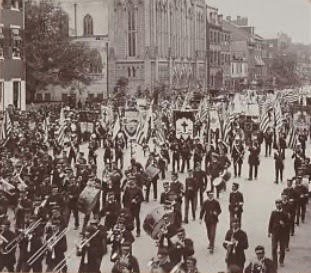
Knights Templar Conclave parade, Philadelphia, 1903. Library of Congress.
More Light: Freemasonry and the Search for an Ancient Past · Article 6
In 1307, a French king ordered the arrest of the Templars in his kingdom. In 1312, the pope suppressed their order. Centuries later, some Freemasons turned that interrupted history into an imagined lineage.
A suppression with loose ends
The Order of the Temple began around 1119 in Jerusalem, when a small group of knights undertook to protect Christian pilgrims.
Over the next two centuries, it became a military religious order with an international network of estates, fortified houses and financial operations. Its members combined religious obligations with military service. Knight brothers wore the familiar white mantle with a red cross, although not every category of member wore white.
Papal privileges gave the order substantial independence from local ecclesiastical authorities. That did not place the Templars outside political relationships with kings, whose patronage and protection remained important.
The fall of Acre in 1291 ended the principal Crusader foothold in the Holy Land. It raised difficult questions about the military orders’ future, but it did not make the Templars immediately purposeless. They continued to plan and support efforts to recover territory.
Then came the arrests.
On Friday, October 13, 1307, agents of Philip IV of France seized Templars across his kingdom. The accusations included denying Christ, abusing the cross and participating in illicit initiation practices. Confessions were obtained under coercion and torture, and some were later retracted.
Proceedings spread beyond France, but their conduct and results varied by region.
In 1312, Pope Clement V suppressed the order through the bull Vox in excelso. This was not a definitive judicial finding that the order as a whole was guilty of heresy. Political pressure, scandal and the claimed impossibility of continuing its work supplied the grounds for suppression.
In 1314, the last grand master, Jacques de Molay, was burned in Paris after retracting his confession.
Malcolm Barber’s The Trial of the Templars examines the interaction of royal policy, ecclesiastical proceedings and accusations against the order. The affair cannot be reduced securely to a single explanation such as Philip’s debts.
For this series, the important point is what happened afterward.
The order ended, but its people, property and memory did not disappear together. Much of its property was assigned to the Hospitallers, although transfers were complicated and rulers retained or redirected some assets.
Portugal offers a particularly clear example of a documented successor. The Order of Christ, established in 1319, received former Templar resources and incorporated former members. This was a recognized medieval reorganization, not evidence of a concealed Masonic succession.
A suppression leaves survivors and consequences. It can also leave room for stories about a continuation that the surviving records do not establish.
The romance was made, not recovered
The Templars’ afterlife was not one continuous movement toward admiration.
They could appear as victims, heretics, sinister possessors of secrets or exemplary knights. Later writers selected different parts of that inheritance.
Eighteenth-century Masonic interest belonged to a broader culture of historical speculation, aristocratic sociability and fascination with chivalry. It should not be explained simply as a reaction against the Enlightenment. Chivalric invention and Enlightenment ideals could coexist within the same fraternity.
The nineteenth century gave medieval romance an even wider audience.
Walter Scott’s Ivanhoe appeared in December 1819, although its title page was dated 1820. Its Templar, Brian de Bois-Guilbert, is a powerful and morally compromised figure, not a straightforward model of chivalric virtue.
Scott helped make the medieval world culturally vivid. He did not originate the Masonic Templar connection, which was already well established before his novel appeared.
The appeal was nevertheless considerable. The Templar story joined religious vows, warfare, wealth, prosecution and a disputed ending. A later reader could make loyalty under persecution its central lesson.
That interpretation was not dictated by the medieval evidence. It was one way of arranging it.
Nor was the story beyond contradiction. Historians could test particular claims against surviving documents. What made a secret-survival narrative difficult to disprove was its ability to explain the absence of evidence as the necessary result of concealment.
Ramsay and the Crusader ancestry
An important Masonic turning point came with Andrew Michael Ramsay, the Scottish-born writer known as the Chevalier Ramsay.
Versions of his discourse associated with 1736 and 1737 presented Freemasonry through a Crusader ancestry. The texts differ, and claims about exactly which version was delivered on which occasion require care.
The central argument is clear.
Ramsay described Crusaders gathering in the Holy Land and forming a fraternity across national divisions. Signs and words enabled recognition. Returning participants carried the association back to Europe, where Britain and Scotland became important guardians of the tradition.
In a familiar version of the discourse, the fraternity entered an alliance with the Knights of St John of Jerusalem—the Hospitallers.
It did not identify the Knights Templar as the ancestors of Freemasonry.
The Scottish Rite’s discussion of Ramsay’s oration makes the distinction between Ramsay’s Crusaders and the Templar theories that followed. An accessible compilation of discourse texts and commentary allows readers to examine the relevant passages, although its historical commentary includes differing dates and older interpretations.
Ramsay’s contribution was not the discovery of a medieval chain of lodges. It was the presentation of a fraternity whose ancestry included religious and military elites rather than only builders.
Even that contrast should not be pushed too far. Earlier Masonic histories had already placed kings, princes and learned patrons alongside craftsmen. Ramsay intensified the chivalric element; he did not invent prestigious ancestry from nothing.
His argument also went beyond social rank. The Crusaders became an image of international fellowship, with men from different nations united by common obligations.
The narrative joined universal fraternity to chivalric dignity.
Strict Observance and the hidden superiors
A more explicit Templar genealogy developed in the German lands around Karl Gotthelf von Hund.
Hund’s system took shape in the 1750s and became known as the Strict Observance during its later development. The often-cited date of 1751 is a useful starting point, but not every feature of the mature organization can be assigned to that year.
Its claim was more specific than Ramsay’s.
The medieval Templars had supposedly continued in concealment after their suppression. Authority had passed through hidden channels, and modern initiates could be admitted into the surviving order.
Hund said that he had received such authority in Paris in 1743. Accounts of the episode involve unidentified superiors and a mysterious knight whose identity could not be securely established.
That is a report of Hund’s claim, not confirmation that the hidden hierarchy existed.
The “Unknown Superiors” became a defining problem as well as an attraction. If authority came from concealed leaders, members could be asked to obey people whose identities and credentials they could not inspect.
The system gave its adherents a substantial institutional world. It organized provinces, assigned chivalric names and ranks, and placed lodge activity within a larger historical mission.
Roger Dachez and Jean-Marc Pétillot examine this development in “La légende templière et la Stricte Observance”, a chapter of Le Rite écossais rectifié.
The attraction should not be reduced to gullibility. Rank, ritual, fellowship and an ambitious account of the order’s purpose all helped make the system meaningful.
But meaning did not supply the missing evidence for medieval descent.
Wilhelmsbad: ancestry reconsidered
The Convent of Wilhelmsbad met in 1782, six years after Hund’s death.
Among its central questions were the origins of the order, the authority of its supposed superiors and the claim of Templar succession.
The outcome rejected the assertion that Freemasons were the institutional successors of the medieval Templars. This was not a unanimous conversion of every participant, nor did it instantly remove all Templar imagery from European Masonry.
Instead, the convention helped separate a historical claim from a continuing chivalric symbolism.
Reform also involved developments already underway, especially the work associated with Jean-Baptiste Willermoz and the Rectified system. Wilhelmsbad should not be described as the single moment when an entirely new rite sprang into existence.
The Strict Observance lost its position as a coherent organizing system. Elements of its ritual and chivalric structure survived in transformed settings.
This matters to the argument.
An organization could abandon a literal ancestry without abandoning everything that ancestry had helped create. Historical correction did not necessarily require ceremonial erasure.
Three kinds of connection
Three relationships need to be kept apart.
Symbolic adoption: a body uses Templar names, imagery or chivalric ideals without establishing descent.
An asserted lineage: a body claims continuity through a narrative whose links cannot be independently demonstrated.
Documentary continuity: records establish a succession between identifiable institutions.
The Strict Observance made the second kind of claim. The surviving evidence does not establish the third between the medieval order and Masonic Templar organizations.
Portugal’s Order of Christ illustrates why that distinction matters. A documented medieval transfer of resources and personnel is a different proposition from an eighteenth-century claim that concealed knights transmitted their authority through otherwise unrecorded channels.
None of this prevents a modern body from using Templar imagery sincerely.
A ceremony can honor courage, fidelity and Christian service without becoming a historical certificate of descent.
The Templar orders that stayed
The decline of the Strict Observance did not end Masonic Templar traditions.
In England, the official account at Mark Masons’ Hall identifies a 1778 reference in the minutes of the Chapter of Friendship at Portsmouth, where the Templar ceremony was worked as an appendant degree.
In 1791, a Grand Conclave formed under Thomas Dunckerley. The governing organization and its terminology developed further during the nineteenth century.
North American records supply another firm point.
The Grand Encampment’s historical account identifies August 28, 1769, in Boston as its earliest recorded conferral of the Order of the Temple. The national Grand Encampment was organized in 1816.
These dates establish modern Masonic activity. They do not bridge the centuries back to the medieval order.
The terminology also varies.
In the United States, Templar commanderies are commonly grouped within the York Rite. In England and Wales, the order operates under a separate Great Priory and should not simply be described as a branch of an American-style York Rite structure.
The Christian character is explicit. The English order requires candidates to be Master Masons, Royal Arch Masons and Trinitarian Christians.
Its own public description presents installation through the candidate’s symbolic journey as a pilgrim and his elevation to knighthood.
That is a modern ceremonial association with medieval defenders of Christian holy places. It does not require a claim that the medieval corporation secretly survived as a lodge.
Why the Templars made such compelling ancestors
Compare this past with the others in the series.
Solomon’s Temple supplied sacred architecture. Ancient mystery traditions offered a vocabulary of initiation. Egypt promised wisdom and extraordinary antiquity.
The Templars offered a drama of obligation under pressure.
Later interpreters could emphasize fidelity, accusation, suppression and sacrifice. They could imagine a precious inheritance preserved despite persecution.
That is an interpretation of the legend’s appeal, not proof that the medieval Templars possessed a hidden body of Masonic teaching.
Chivalry also offered an organizational language. Provinces, ranks, titles, vows and ceremonial service could structure an institution as well as decorate it.
For some eighteenth-century members, that language matched their social world. For others, it offered entry into an imagined moral aristocracy rather than a confirmation of inherited noble status.
The attraction was therefore broader than aristocrats refusing to accept craftsmen as ancestors.
A chivalric system could turn membership into a vocation: a promise to live according to an elevated standard.
An ending that invited a sequel
The Templars did not need to have founded Freemasonry to matter to it.
Their suppression made available a story in which an institution ended publicly while its obligations might be imagined to continue privately. Later writers filled that possibility with very different accounts.
The absence of a final corporate conviction did not prove innocence in every particular. The existence of surviving knights did not prove a secret succession. The possession of Templar symbols did not establish inherited Templar authority.
Those distinctions allow the later history to be taken seriously without accepting its genealogy.
The Masonic afterlife of the Templars produced real organizations, ceremonies and ideals. Its claims shaped conduct and identity even when their supposed medieval links could not be demonstrated.
That is what this case adds to the series.
Freemasons reached into the past not only to acquire age or wisdom, but also to imagine an obligation that survived defeat. The Templar legend offered honor and sacrifice—and an unfinished story to which a later fraternity could write a sequel.
Sources and further reading
Image: Magnificent display of banners in massed parade, Knights Templar Conclave, Phila, 1903. Stereograph. Library of Congress, Prints and Photographs Division, Washington, D.C. Digital reproduction no. LC-DIG-stereo-1s46201. Source: Library of Congress.
The medieval order and its suppression
Malcolm Barber, The Trial of the Templars (Cambridge University Press, 1978; second edition, 2006).
Malcolm Barber, The New Knighthood: A History of the Order of the Temple (Cambridge University Press, 1994).
Helen Nicholson, The Knights Templar: A New History (Sutton Publishing, 2001).
Encyclopaedia Britannica, “Templar”: overview of the order, its privileges and suppression.
World History Encyclopedia, “Knights Templar”: chronology and historical overview.
Masonic chivalry and Templar genealogies
Andrew Michael Ramsay, discourse texts and historical commentary. Versions associated with 1736 and 1737 should be distinguished; the surrounding compilation contains inconsistent older biographical claims.
Scottish Rite, Southern Jurisdiction, “Freemasonry Q&A: What Was Ramsay’s Oration?”.
Roger Dachez and Jean-Marc Pétillot, Le Rite écossais rectifié (Presses Universitaires de France, “Que sais-je?”, 2010), especially “La légende templière et la Stricte Observance”.
“Lessing’s Templars and the Reform of German Freemasonry”, German Life and Letters: scholarly discussion of the Templar controversy and reform.
Peter Partner, The Murdered Magicians: The Templars and Their Myth (Oxford University Press, 1982).
Modern Masonic Templar organizations
Mark Masons’ Hall, “Knights Templar”: English history, qualifications and ceremonial description.
Grand Encampment, Knights Templar, U.S.A., “Heritage”: Boston in 1769 and the formation of the national body in 1816.
Boston Commandery, historical account: local records and the development of organized Templary.
Chivalric revival and historical fiction
Walter Scott, Ivanhoe: publication history and synopsis, University of Edinburgh. Published in December 1819 with an 1820 title-page date.
Mark Girouard, The Return to Camelot: Chivalry and the English Gentleman (Yale University Press, 1981).
