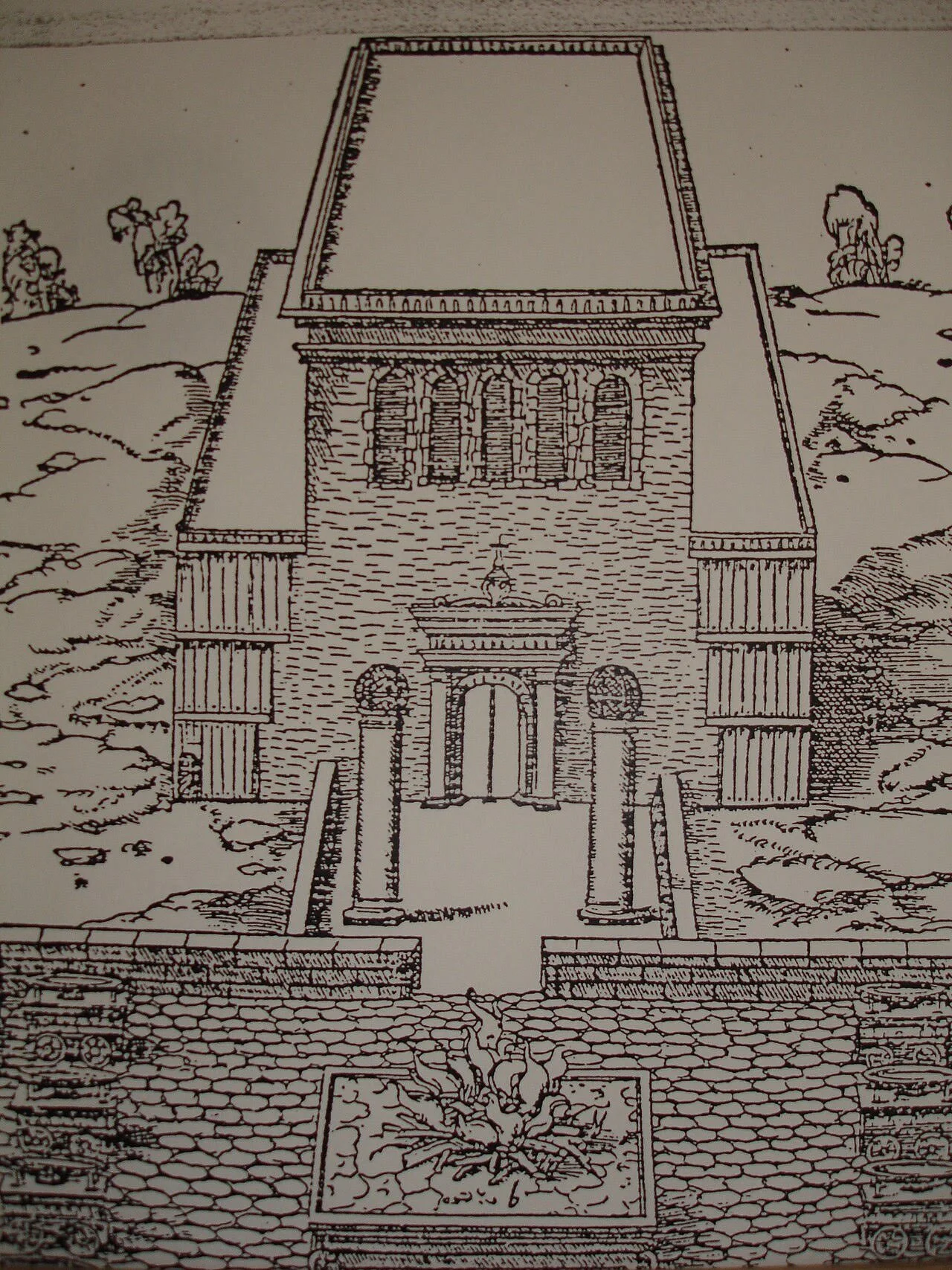
Solomon’s Temple, reconstructed in a 1546 engraving attributed to François Vatable.
More Light: Freemasonry and the Search for an Ancient Past · Article 2
A building destroyed in the sixth century BCE became the fraternity’s most productive stage set. The reason has less to do with ancestry than with what a Temple lets you say.
A story the Bible never tells
In 1730, a London pamphlet called Masonry Dissected, published under the name Samuel Prichard, claimed to expose what happened inside a lodge. For a historian, it is a gift: a dated, printed witness to early Masonic ceremonies, including an early published account of the story at the heart of the Master Mason’s degree.
That story concerns Hiram, the master builder of Solomon’s Temple, known in Masonic tradition as Hiram Abiff. In Prichard’s account, he is killed after refusing demands for the Master’s Word, and his body is subsequently sought and recovered.
Here is the odd part. The Bible does not tell that story. In 1 Kings 7, Hiram is a gifted metalworker who completes his commissions for Solomon. Chronicles describes a craftsman with a wider range of skills. Neither account supplies the murder, the burial or the recovery that became central to Masonic ritual.
The Temple was borrowed. The drama staged inside it developed later. Its recognizable printed form belongs to early eighteenth-century Freemasonry, although the surviving documents do not identify a single author or establish exactly when all its elements came together.
That gap—between a scriptural building and what Masons made of it—is the subject here. It explains why the Temple matters so much. It also explains why its importance cannot be read as evidence of descent.
What Scripture gives a builder
The Temple narrative, told in 1 Kings 5–8 and again in 2 Chronicles 2–7, reads like a building specification that happens to be sacred.
Solomon plans a house for God in Jerusalem. He makes an agreement with Hiram, king of Tyre, for timber and assistance. The text gives dimensions in cubits, lists materials, counts laborers by the tens of thousands, and describes carved cherubim, bronze fittings and an inner sanctuary.
One detail offered later readers an especially striking image. According to 1 Kings 6:7, the building stones were prepared before being brought to the site, so that no hammer, axe or iron tool was heard while the house was being built.
Two more details carried particular weight. At the porch stood a pair of bronze pillars, named Jachin and Boaz. The craftsman who made them was another Hiram—not the king of Tyre—whom Kings describes as a widow’s son, with a Tyrian father and a mother of the tribe of Naphtali.
Chronicles gives the craftsman’s mother a different tribal association, identifying her with the daughters of Dan. Its description also extends his expertise beyond bronze to work in precious metals, stone, timber and textiles. The two biblical portraits are related, but they should not be flattened into a single identical account.
Then the Temple falls. Babylonian forces destroyed it in 587/586 BCE, and later readers spent centuries imagining what had stood there.
For a craft that valued geometry, proportion and the proper dressing of stone, the biblical account offered something unusually rich: a sacred building, specified by measure, constructed by named workers under a wise patron.
A world already fascinated by the building
Masons did not discover the Temple in the 1720s. The manuscript traditions known as the Old Charges had already placed it within a legendary history of the building craft.
The distinction between manuscripts matters. The Regius poem does not tell the Solomonic Temple story. The Cooke manuscript does, presenting Solomon as confirming the craft’s charges. Later versions developed the account further. There was an inherited tradition here, but not a single unchanging medieval text.
The wider culture had its own fascination with the building. Around 1600, the Jesuit scholar and architect Juan Bautista Villalpando produced an elaborate reconstruction within the commentary on Ezekiel published with Jerónimo de Prado. Villalpando’s Temple volume appeared in 1604. His project treated sacred architecture, proportion and the origins of architectural order as closely connected subjects.
In the seventeenth century, the Jewish scholar Jacob Judah Leon also reconstructed the Temple, producing a model that became a public attraction. His model was exhibited in London as well as on the Continent. These were not merely illustrations of an ancient building: they were arguments about how Scripture could be translated into architectural form.
For readers who prized geometry and measured proportion, a Temple described in Scripture was a gift: sacred and mathematical at once.
When James Anderson wrote the history in the Grand Lodge’s Constitutions of 1723, he placed Freemasonry within this much older biblical and architectural world. His Solomon is “Grand Master” at Jerusalem; Hiram, king of Tyre, is “Grand Master” at Tyre; and Hiram Abif is “Master of Work.”
The passage makes its claim unmistakably. Anderson presents the fraternity’s history as reaching back into sacred antiquity. But a claimed pedigree and a demonstrated line of institutional descent are different things. His account shows what early eighteenth-century Masons wanted their past to mean, not an unbroken documentary chain connecting their lodges to Solomon’s workmen.
An accessible edition of Benjamin Franklin’s 1734 reprint of Anderson’s Constitutions preserves this way of telling the fraternity’s history.
Hiram Abiff, assembled in stages
Follow Hiram through the documents and you watch a figure being built.
The Masonic name Hiram Abif, also spelled Abiff, is associated with the Hebrew expressions behind two passages in Chronicles. The King James Version renders 2 Chronicles 2:13 as “of Huram my father’s,” and 2 Chronicles 4:16 as “Huram his father.” Other translations handle these expressions differently, including by using the name Huram-Abi.
“Abiff” should therefore not be treated as an ordinary surname supplied straightforwardly by the English Bible.
Anderson’s 1723 book names Hiram Abif and makes him a master of the Temple works. It does not narrate the murder-and-recovery story later printed by Prichard.
Another important witness is the Graham manuscript, dated October 24, 1726. It tells of Noah’s sons going to their father’s grave in search of a valuable secret and attempting to raise his body.
Hiram also appears elsewhere in that manuscript, praised as an inspired craftsman. But he is not the subject of its body-recovery episode.
The comparison is suggestive: death, a missing secret and the recovery of a body already appear together in an early Masonic document. It does not, by itself, prove that a Noah ceremony was directly rewritten into the Hiram ceremony. The manuscript is evidence of related narrative material, not a complete account of how one ritual became another.
By 1730, in Prichard’s pamphlet, Hiram stands at the center of the drama, and the story has an outline Masons would recognize.
What happened next shows how much room remained for development. Later eighteenth-century lectures and publications expanded the explanations attached to the Temple, its furnishings and its symbolism. William Preston’s Illustrations of Masonry, first published in 1772, became an influential part of that explanatory tradition.
Different lodges, jurisdictions and generations gave the material different emphases. “The Hiram legend” is best approached as a family of related ritual traditions rather than one timeless text.
What could the story do? It gave a lodge a way to consider fidelity under pressure, mortality, and the loss and recovery of something valuable. Those are interpretations, not a transcript of the intentions of an identifiable first author. But they help explain why a biblical craftsman could carry so much additional meaning.
His story had room in it.
Building as self-construction
The deepest thing the Temple gave Freemasonry was a double meaning. Building could be a trade, and it could also describe the formation of a person.
Scripture already offered that language. 1 Peter 2:5 calls believers “lively stones” built into a spiritual house; 1 Corinthians 3:16 describes the community as God’s temple.
Masonic teaching developed its own uses of architectural metaphor. Prichard’s 1730 text already places building tools and moral instruction within the same ceremonial world. It describes the square, level and plumb-rule, while saying that a “Gentleman-Mason” learns “Secresy, Morality and Goodfellowship.”
That is not yet the same thing as every later explanation of every working tool. It does show how readily the craft’s equipment could share a vocabulary with conduct and character.
The Temple also supplied places in which ritual action could unfold. In Prichard’s Fellow-Craft catechism, the participant describes working at the Temple, passing its pillars and reaching a middle chamber by a winding stair.
These are explicit Temple associations. Other features require more care. Prichard places the lodge master in the east, but explains that position through the rising sun—not by saying that the master occupies Solomon’s throne.
A lodge room was therefore not simply an archaeological model of Solomon’s building. It was a symbolic space in which biblical architecture, craft imagery and other explanations could overlap.
Architecture also offers a useful way to think about memory. A porch, pillars, a stair and a chamber provide distinct places around which spoken instruction can be organized. That is a reading of how the ritual works, not proof that its designers consciously adopted a particular system from the older arts of memory.
The Temple supplied identity as well. It placed the lodge’s work inside an ancient sacred project rather than an ordinary meeting room. Its biblical setting could carry meaning for readers from more than one religious tradition, although a shared scriptural reference should not be confused with equal access to membership in every place or period.
A new member did not simply enter a club. Within the ritual’s imaginative world, he took a place among the workers on a very old project.
Symbol is not pedigree
Because the Temple is everywhere in Masonic ritual, it is easy to feel that it must also stand at the beginning of Masonic institutional history.
The early Masonic histories encouraged that feeling. The Old Charges and Anderson’s Constitutions placed the fraternity inside a sweeping narrative of the building arts, reaching back through biblical antiquity.
But three things need to be kept apart:
The biblical Temple: the ancient sanctuary described in Scripture and destroyed by the Babylonians.
Masonic uses of the Temple: craft legends, historical narratives, ritual dramas and lectures documented in much later sources.
Documentary continuity: evidence demonstrating an unbroken institutional connection between the ancient builders and early modern lodges.
The first two are subjects of substantial historical evidence. The sources discussed here do not establish the third.
Nor should the date of a surviving publication be mistaken for the exact date of a story’s invention. Prichard shows that the Hiram narrative was in print by 1730. The Graham manuscript shows related narrative motifs in 1726. Together they illuminate the world in which early Masonic ritual developed; they do not reveal every step of its formation.
None of this makes the Temple a mistake.
Institutions often tell founding stories that function as charters: accounts that explain their values, justify their standing and describe the kind of community they aspire to be. Such stories can make historical claims without supplying the evidence needed to prove them.
The Masonic Temple works in that register. It says, in effect: we are people who build with order, measure and fidelity, and our work has sacred significance.
That is a statement about meaning. A historian can take it seriously without accepting it as a documented genealogy.
The building that could be rebuilt
One reason the Temple proved so adaptable was that the building itself was gone.
Its absence did not leave readers without constraints: Scripture supplied dimensions, materials, names and descriptions. But it left considerable room for reconstruction and interpretation. Villalpando and Leon filled that room with architectural models. Masonic traditions filled it with ritual action and moral instruction.
The result was not a recovered ancient ceremony. It was a later use of antiquity: a biblical building made to carry the concerns of another world.
That is the pattern this case reveals about the fraternity’s relationship with the ancient past. Antiquity could be claimed as ancestry, but it also served as raw material—adopted, ritualized and given a moral frame.
The Temple was not a demonstrated institutional ancestor. It was a stage, and the surviving early eighteenth-century texts let us watch the Masonic drama taking shape.
Sources and further reading
Image: Detail of an engraving reconstructing Solomon’s Temple, in Biblia. His accesserunt schemata Tabernaculi Mosaici, & Templi Salomonis, quae praeeunte Francisco Vatablo (Paris, 1546). Image attribution: François Vatable. Wikimedia Commons. Public domain.
Biblical texts
1 Kings 5–8: materials, labor, construction, furnishings and dedication.
1 Kings 6:7: stones prepared before arrival at the building site.
1 Kings 7:13–22: Hiram the craftsman and the pillars Jachin and Boaz.
2 Chronicles 2–4: the craftsman’s skills, parentage and work.
1 Peter 2:5 and 1 Corinthians 3:16: spiritual building and temple imagery.
Early Masonic texts and documentary studies
James Anderson, The Constitutions of the Free-Masons (London, 1723). Accessible electronic edition of Benjamin Franklin’s Philadelphia reprint of 1734.
Graham manuscript, dated October 24, 1726: transcription and discussion.
Samuel Prichard, Masonry Dissected (London, 1730), online transcription.
William Preston, Illustrations of Masonry: digitized 1772 edition.
John Acaster, “The Noah Legend and the Graham Manuscript,” Ars Quatuor Coronatorum, volume 131.
Temple reconstruction and historical context
“Isaac Newton and the Architectural Models of Solomon’s Temple”: discussion of Villalpando, Leon and the exhibition of Temple models.
University of Leeds Special Collections, “Portrait of the Tabernacle of Moses”: background on Jacob Judah Leon Templo.
Encyclopaedia Britannica, “Temple of Jerusalem”: historical overview and destruction chronology.

