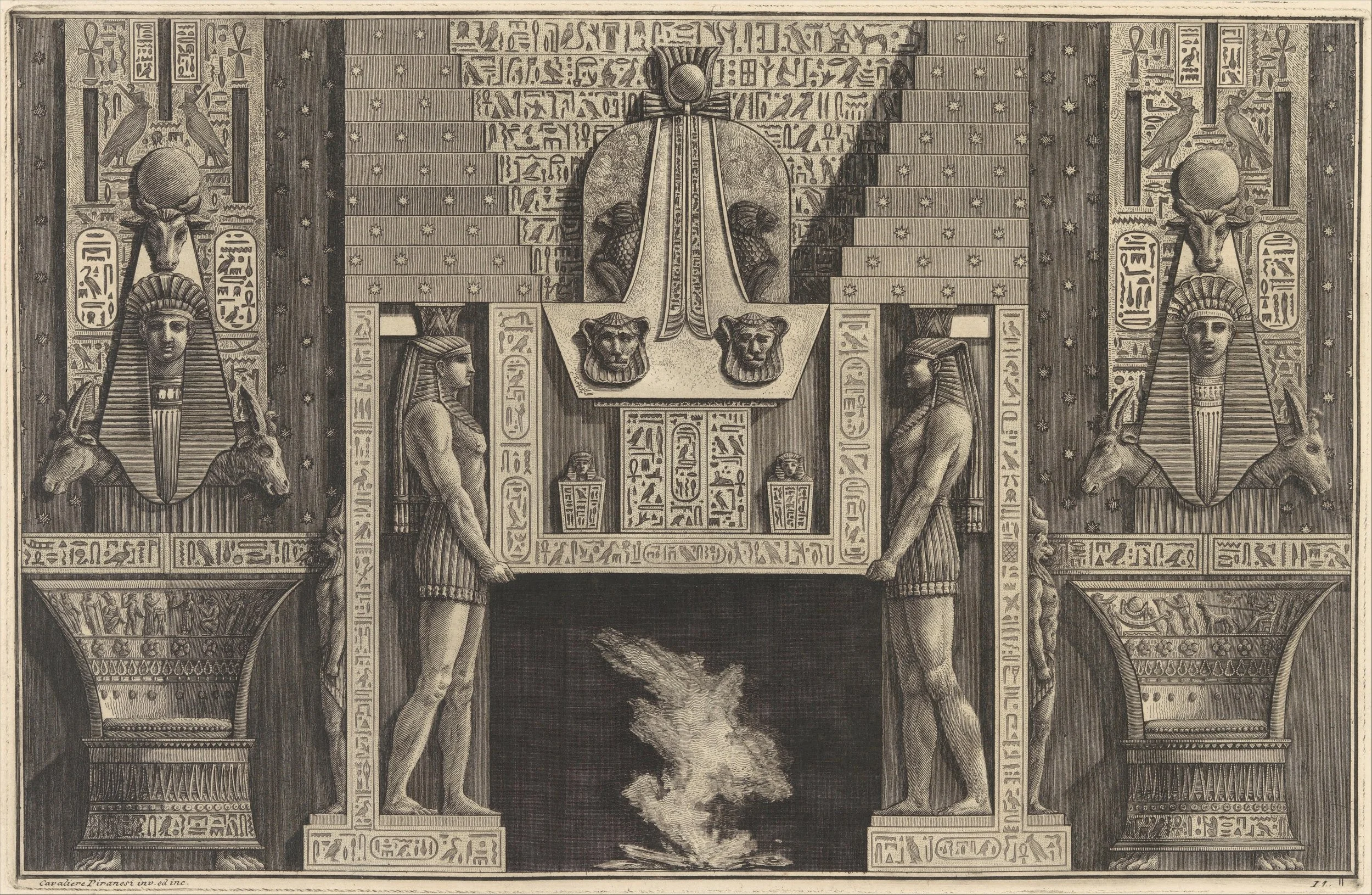
Piranesi’s Egyptian-style chimneypiece, 1769. The Metropolitan Museum of Art.
More Light: Freemasonry and the Search for an Ancient Past · Article 4
Europeans imagined a land of learned priests, hidden chambers and monuments of extraordinary age. Some Freemasons recognized a flattering image of themselves. What did they think they saw there?
Vienna, 1784
In 1784, the Viennese Journal für Freymaurer published an essay titled “Ueber die Mysterien der Aegyptier”—“Concerning the Mysteries of the Egyptians.”
Its author was Ignaz von Born, a celebrated mineralogist and the master of the lodge Zur wahren Eintracht, or True Concord. The essay appeared in the journal’s first issue under initials identifying Born and his lodge office.
The setting matters. As Hans-Wilhelm Kelling explains in his introduction to Born’s essay, Born encouraged scientific research and publication within his Masonic circle. The ancient mysteries were not merely an exotic diversion. They belonged to a larger inquiry into knowledge, religion and the improvement of society.
Born’s Egyptian priesthood belonged to a learned eighteenth-century reconstruction: an elite associated with disciplined preparation, guarded knowledge and the education of initiates. Such a picture invited comparison with a fraternity that understood its own ceremonies as a passage toward enlightenment.
Born was not an isolated enthusiast. True Concord became a center for research into ancient mysteries. Mozart belonged to a different Viennese lodge, Zur Wohltätigkeit, or Benevolence, but participated in the interconnected Masonic world in which these subjects were discussed.
The connection is more than a general resemblance. The Egyptologist Jan Assmann points to lodge records placing Mozart at lectures by Anton Kreil on “scientific Freemasonry” in April 1785. Those lectures belonged to the same inquiry into ancient mysteries.
When Mozart and Emanuel Schikaneder’s The Magic Flute premiered in 1791, its invocations of Isis and Osiris and its trials of initiation drew upon an Egyptian imaginative world familiar in those circles.
That does not make every character a portrait of a particular Mason, or every scene a transcription of lodge ritual. But Egypt was plainly available as a setting in which Enlightenment ideals could be dramatized.
Here is the puzzle this article takes up. Egypt appears in early Masonic legendary history, especially as a home of geometry and learning. What the surviving evidence does not establish is an institutional line from Egyptian priesthoods to modern lodges.
Egypt entered Freemasonry through interpretation and cultural borrowing—not through a demonstrated succession of ancient initiates.
An Egypt before Egyptology
The Egypt Born described was not the Egypt reconstructed by modern archaeology and philology. It was an inheritance assembled from ancient authors, biblical passages, Renaissance scholarship, travelers’ accounts and imaginative literature.
Greek and Roman writers supplied important materials.
Herodotus presented Egypt as the source of numerous religious practices. Plutarch interpreted the traditions of Isis and Osiris. In Book XI of The Golden Ass, Apuleius described the initiation of Lucius into the mysteries of Isis.
These works did not all describe the same period or the same religious setting. Apuleius wrote in the Roman imperial world, not in the age of the pyramid builders. Later readers nevertheless drew them together into a picture of a single ancient Egyptian wisdom.
The Egyptologist Jan Assmann’s study of Egyptian mysteries and secret societies explains how eighteenth-century writers transformed such materials into a model of initiation: passage through danger and apparent death toward knowledge, purification and a new understanding of the divine.
That model owed something to ancient texts. Its elaborate modern form also answered the concerns of the people reconstructing it.
Hermes, hieroglyphs and the promise of hidden wisdom
Another influential source was the Corpus Hermeticum, a collection of Greek philosophical and religious writings attributed to Hermes Trismegistus.
A manuscript reached Renaissance Florence in the fifteenth century, and Marsilio Ficino translated it into Latin. Hermes was widely treated as a sage of remote Egyptian antiquity. Readers placed him within accounts of primordial wisdom, sometimes before Moses and sometimes close to him in chronology.
In 1614, Isaac Casaubon challenged that ancient dating through linguistic and historical analysis. The philosophical Hermetic writings belonged to the early centuries of the Common Era, not to the remote age their Renaissance admirers had imagined.
That correction did not immediately dissolve the prestige of Egyptian wisdom. An interpretation can outlive the chronology once used to justify it.
Hieroglyphs strengthened the attraction.
Because the script could no longer be read reliably, European scholars depended heavily on ancient explanations of its signs. Some treated hieroglyphs as pictures that communicated profound ideas directly, rather than as a writing system containing phonetic elements.
The Jesuit scholar Athanasius Kircher carried this approach into enormous learned publications. His Oedipus Aegyptiacus, published in Rome in 1652–1654, interpreted hieroglyphic inscriptions through an elaborate framework of theology, symbolism and ancient wisdom.
His proposed translations were wrong. Yet his work was not simply idle fantasy: it combined extensive learning with a mistaken theory of how the script worked. His attention to Coptic also belonged to the longer history of attempts to understand Egyptian language.
The distinction is important. Modern decipherment did not emerge from a world containing no knowledge at all. It emerged through the correction and reorganization of accumulated knowledge.
Scripture supplied another point of connection. Acts 7:22 says Moses was “learned in all the wisdom of the Egyptians.”
Early modern scholars asked what that education might imply about biblical religion. Assmann’s Moses the Egyptian studies this remembered Egypt: not merely the ancient country, but the Egypt later writers constructed when thinking about religion, revelation and cultural origins.
Initiation beneath a pyramid
One of the most influential bridges between this learned Egypt and the eighteenth-century imagination was a novel.
In 1731, Jean Terrasson published Séthos, presenting it as a translation from an ancient Greek manuscript. Its fictional Egyptian prince seeks preparation for wise rule through instruction and initiation.
His journey takes him into the Great Pyramid and an imagined underground world. He passes ordeals involving fire, water and air before entering the setting of further instruction in the mysteries of Isis.
This was not a recovered ancient initiation manual. It was a modern narrative assembled from classical sources and Terrasson’s own educational ideals.
Its influence can be traced. In “The Travels of Sethos,” literary scholar Jay Macpherson follows the book through translations, scholarship, Masonic writing and theatrical adaptations.
The relationship with The Magic Flute is especially concrete. An inscription announcing the trials in Terrasson’s novel reappears in adapted form in the opera. Its elemental ordeals also helped shape the work’s Egyptian imaginative setting.
The relationship with lodge ritual requires more discrimination.
Macpherson documents symbolic trials involving water and fire in some Viennese initiations of the 1780s and considers Terrasson’s influence likely. She also identifies later Masonic writers who quoted or paraphrased Séthos directly.
Those examples support borrowing in particular settings. They do not show that all Masonic initiation came from Terrasson, much less that Terrasson preserved an authentic ceremony from pharaonic Egypt.
The distinction is the whole point. A fictional reconstruction could become material for real ceremonies without becoming evidence of an ancient institutional descent.
Egypt was already in the room
It would be misleading to say that Masons first encountered Egypt through Séthos.
The Old Charges had already placed geometry in Egypt. Anderson’s Constitutions of 1723 incorporated Egypt into a broader history of architecture and learning. A defense of Masonry published after Samuel Prichard’s 1730 exposure explicitly compared Masonic symbolic instruction with the hieroglyphs of the ancient Egyptians.
What changed was the richness and specificity of the available picture.
Egypt could now supply not just a place in the history of geometry, but a dramatic account of priestly education: guarded entrances, stages of preparation, ordeals, secrecy and enlightenment.
Masons who encountered that account could recognize features resembling their own practices. The resemblance invited a flattering question: might the lodge preserve something of those ancient mysteries?
Some writers answered yes. But recognizing a resemblance is not the same as documenting its cause.
A fashion larger than Freemasonry
The Egyptian interest also belonged to a wider European culture.
Egyptian forms appeared in architecture and decorative design before Napoleon’s expedition. Giovanni Battista Piranesi’s Diverse maniere d’adornare i cammini, published in 1769, incorporated Egyptian motifs into designs for fireplaces and interiors.
The Metropolitan Museum of Art’s Egyptian-style chimneypiece from that publication shows how freely those forms could be adapted. Piranesi combined the decorative vocabularies of several ancient cultures rather than attempting a strictly Egyptian reconstruction.
The Yale Peabody Museum places his designs within the pre-Napoleonic Egyptian revival.
Egypt could suggest antiquity, solemnity, mystery or architectural permanence. Masons were participants in that fashion, not its sole inventors.
Their particular interests made it especially useful.
What Egypt seemed to offer
Five qualities help explain the attraction. These are interpretations of the connection, not a checklist shared by every Mason.
Hieroglyphs
If Egyptian signs concealed wisdom, Masonic emblems could seem to belong to the same venerable method of instruction.
That comparison did not prove that a particular Masonic symbol descended from an Egyptian sign. It made the act of teaching through symbols appear ancient and dignified.
Priests
The Egyptian priest imagined by eighteenth-century writers was learned, disciplined and entrusted with knowledge.
For Masons who understood the lodge as a place of improvement, this could serve as an attractive model of intellectual fellowship.
Secrecy
An ancient priesthood guarding sacred knowledge could make secrecy appear reverent rather than merely exclusive.
The parallel also raised a question important to Enlightenment thinkers: could knowledge be protected and cultivated within a restricted community while benefiting society beyond it?
Monuments
Pyramids and temples made Egypt’s antiquity visible.
For a fraternity whose language drew upon building and geometry, such structures offered powerful images of skill, order and endurance.
Age
Egypt promised access to a past older than classical Greece and Rome.
Its place within biblical chronology was contested, but its reputation for extraordinary antiquity was itself a source of prestige.
None of these attractions required evidence of institutional contact. They required a compelling picture of Egypt.
After Napoleon
Napoleon’s expedition of 1798 brought another surge of European attention. The accompanying scholars and artists helped generate the vast Description de l’Égypte, with its documentation of monuments, antiquities and the contemporary country.
The expedition did not create the Egyptian revival. It enlarged and redirected an interest already well established.
A more consequential change came with decipherment.
On September 27, 1822, Jean-François Champollion publicly presented findings that marked a decisive breakthrough in reading hieroglyphs. The British Museum’s decipherment timeline also emphasizes the contributions of other researchers, including Thomas Young.
This was a breakthrough, not an instant translation of every Egyptian text. Reading the language securely required further work.
It nevertheless changed the evidentiary situation. Scholars could increasingly compare inherited interpretations with inscriptions written by ancient Egyptians themselves.
The resulting history did not substantiate an institutional succession from Egyptian priests to Masonic lodges. Egyptian religion, ritual and learning were substantial historical subjects in their own right—not incomplete versions of modern Freemasonry.
Yet decipherment did not make the symbolic Egypt disappear.
Egyptian Masonry after decipherment
Egyptian-themed Masonic systems belonged to the modern history of the fraternity.
Cagliostro promoted his Egyptian Masonry in the 1780s. Later systems included Misraïm, established in France by the Bédarride brothers in 1814–1815, and Memphis, organized by Jacques-Étienne Marconis de Nègre in 1838.
Their earlier origin stories vary. Claims of ancient or unusually early foundations should not be substituted for the later dates at which identifiable organizations can be documented.
These systems also should not be treated as interchangeable with mainstream Craft Freemasonry. They developed particular collections of degrees, teachings and claims, and their recognition differed among Masonic bodies.
The relevant historical fact is not that their Egyptian pedigrees were proved. It is that modern people created and practiced rites under Egyptian names.
Architecture supplies an equally tangible example. Philadelphia’s Masonic Temple contains an Egyptian Hall, dedicated in 1889. The Temple’s official history records its place in the building’s decorative development, while the New York Public Library preserves a menu for its opening.
The room demonstrates a real Egyptian revival within Masonic culture. It does not demonstrate that Masonry originated in ancient Egypt.
Writers who made Egypt an ancestor
Masonic authors also incorporated Egypt into larger theories of origins.
George Oliver, an English clergyman and prolific Masonic writer, published The Antiquities of Freemasonry in 1823 and The History of Initiation in 1829.
His scheme distinguished “pure” or “primitive” Masonry from “spurious” forms. The original tradition supposedly reached back to humanity’s beginnings, while ancient pagan mysteries preserved altered or corrupted versions.
The logic is revealing. In such a system, an ancient resemblance could confirm Freemasonry’s antiquity even when the ancient practice was judged inferior. Egypt became an echo of an older, supposedly purer Masonic truth.
Albert Churchward later made a more direct Egyptian-origin argument. His The Signs and Symbols of Primordial Man appeared in 1910, followed by The Arcana of Freemasonry in 1915.
Churchward treated Egyptian religion and symbolism as keys to the origins of Masonic signs and ceremonies.
These writings document a theory, not an established genealogy. The existence of an Egyptian parallel does not supply the missing chain of people, institutions and records needed to demonstrate descent.
Oliver and Churchward matter here because they show how differently Egypt could be used. For one, ancient mysteries were altered survivals of a primordial tradition. For the other, Egypt itself supplied the origin.
The desired ancestry changed shape with the argument.
Resemblance, adoption, borrowing, descent
Four different relationships need to be kept apart.
Resemblance: two traditions have features that look alike.
Symbolic adoption: a later group uses an ancient culture as a source of imagery or meaning.
Borrowing: a particular text, practice or design is adapted from an identifiable source.
Institutional descent: an organization continues through a demonstrable chain of transmission.
Masonic Egypt supplies abundant evidence for adoption. It also supplies specific instances of borrowing, including the use of Terrasson’s fictional material by later writers.
It does not supply a demonstrated institutional chain from Egyptian temple communities to early modern lodges.
The old Egyptian cult institutions declined over centuries rather than ending everywhere at once. Philae is a particularly important late case. The traditional account places the closure of its temples under Justinian in 535–537 CE, although modern scholarship emphasizes a longer, more complicated process of religious transformation.
A review of Jitse Dijkstra’s study of Philae explains why even this apparently convenient endpoint requires care.
The gulf between those communities and early modern Masonic lodges cannot be crossed by resemblance alone.
The routes visible in the evidence run through ancient literature, biblical interpretation, scholarship, fiction, travel, design and later ritual invention. That is a real history of cultural transmission. It is not the institutional succession claimed by an Egyptian pedigree.
An unread ancestor
One final correction matters to the argument.
Egypt was not literally silent until Champollion. Its monuments remained visible. Greek and Roman accounts circulated. Egyptian people and cultures continued to exist. Coptic preserved a later stage of the Egyptian language and became essential to decipherment.
What had been lost was reliable knowledge of the ancient hieroglyphic writing system.
The last known dated hieroglyphic inscription was carved at Philae in 394 CE. Champollion’s breakthrough came more than fourteen centuries later. Those dates describe a long interruption in literacy, not a precisely dated moment when every reader disappeared.
That interruption gave speculative interpretation unusual room. Readers could assign elaborate meanings to signs they could not check by reading the inscriptions themselves.
But unreadability was only part of Egypt’s attraction. Its prestige also rested on visible monuments, ancient testimony and centuries of accumulated scholarship.
Once formed, that symbolic Egypt developed a history of its own. New discoveries could challenge an origin theory without dissolving the buildings, books and ceremonies already created around it.
A symbolic ancestor
Egypt answers the series question in a particular way.
Freemasons found there an image of disciplined learning, guarded knowledge, monumental building and transformative initiation. Those qualities could enlarge the meaning of their fraternity without establishing its ancestry.
The connection was not trivial because it was constructed. It produced real scholarship, imaginative literature, ritual systems and architecture. It also contributed to the intellectual world behind one of the most famous operas ever written.
The mistake is to ask those products to prove something they do not prove.
They are evidence of how later people understood and used Egypt. They are not, by themselves, evidence that Egyptian priests founded or transmitted Freemasonry.
A symbolic ancestor can still matter. It supplies a language for aspiration and images through which a community imagines its work.
The Egyptian lineage is not a demonstrated account of where Freemasonry came from. It is a revealing account of what some Freemasons—and the culture around them—wanted the fraternity to mean.
Sources and further reading
Image: Giovanni Battista Piranesi, Chimneypiece in the Egyptian style: Giant figures supporting the lintel, flanked by chairs, from Diverse Maniere d’adornare i cammini (1769). Etching. The Metropolitan Museum of Art, Rogers Fund, transferred from the Library, object no. 41.71.1.20(20). Source: The Metropolitan Museum of Art. Public domain; Open Access.
Born, Mozart and eighteenth-century initiation
Ignaz von Born, “Ueber die Mysterien der Aegyptier,” Journal für Freymaurer (Vienna, 1784), pp. 15–132.
Hans-Wilhelm Kelling, “An Introduction to Ignaz Edler von Born and His Article ‘Concerning the Mysteries of the Egyptians’”, Religion in the Age of Enlightenment, volume 4 (2014).
Jan Assmann, “Egyptian Mysteries and Secret Societies in the Age of Enlightenment: A ‘Mnemo-Historical’ Study”, Aegyptiaca.
Jean Terrasson, Séthos (Paris, 1731).
Jay Macpherson, “The Travels of Sethos”, Lumen 23 (2004), pp. 235–254.
Ancient texts, hieroglyphs and decipherment
Herodotus, Histories, Book II; Plutarch, On Isis and Osiris; Apuleius, Metamorphoses, also known as The Golden Ass, Book XI. These belong to different historical settings and should not be treated as a single account of pharaonic initiation.
Athanasius Kircher, Oedipus Aegyptiacus (Rome, 1652–1654).
Daniel Stolzenberg, “Athanasius Kircher and the Hieroglyphic Sphinx”.
British Museum, “Egyptian Hieroglyphs: Decipherment Timeline”.
Carol Andrews, “The Decipherment of Hieroglyphs”, BBC History.
Egyptian revival and Masonic interpretations
Giovanni Battista Piranesi, Egyptian-style chimneypiece from Diverse maniere d’adornare i cammini, approximately 1769; Metropolitan Museum of Art.
Yale Peabody Museum, Piranesi and the pre-Napoleonic Egyptian revival.
George Oliver, The Antiquities of Freemasonry (1823) and The History of Initiation (1829). For his interpretive framework, see “Dr. George Oliver”, an older Masonic biographical discussion.
Albert Churchward, The Signs and Symbols of Primordial Man (1910), and The Arcana of Freemasonry (1915). These are sources for Egyptian-origin theories, not demonstrations of their validity.
Masonic Temple, Philadelphia, official building history.
New York Public Library, menu for the opening of Egyptian Hall (1889).
Broader scholarship
Jan Assmann, Moses the Egyptian: The Memory of Egypt in Western Monotheism (Harvard University Press, 1997).
Erik Hornung, The Secret Lore of Egypt: Its Impact on the West, translated by David Lorton (Cornell University Press, 2001).
Erik Iversen, The Myth of Egypt and Its Hieroglyphs in European Tradition (Gad, 1961).
James Stevens Curl, The Egyptian Revival: An Introductory Study of a Recurring Theme in the History of Taste (George Allen & Unwin, 1982).
James Stevens Curl, The Art and Architecture of Freemasonry: An Introductory Study (Batsford, 1991).
