The Argo After the Voyage
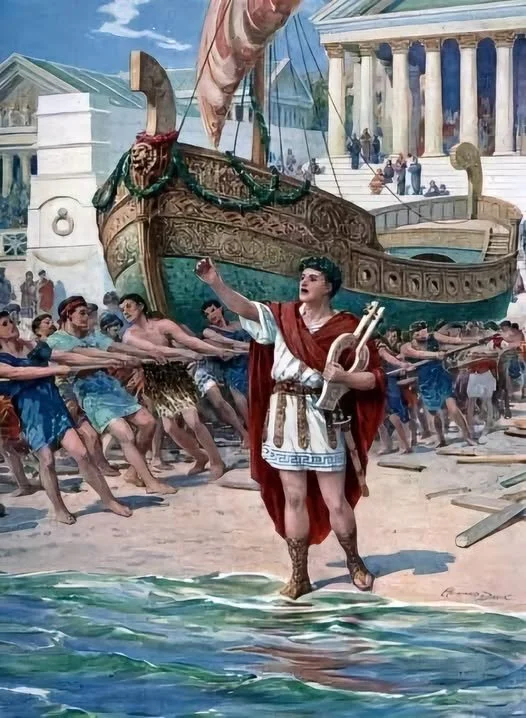
What Fellowship Is For
The Argonauts return with the Fleece, but no fellowship survives by achievement alone. The final lesson of the Argo is that the worth of a shared journey is measured by what its members become after the oars are shipped.
Every fellowship is tested by its voyage.
The difficult part is what happens after it succeeds.
During the expedition, the Argonauts have a purpose. They row, fight, argue, mourn, take counsel, sing, endure storms, bury companions, navigate strange lands, and look after one another because the Fleece lies somewhere ahead.
The destination organizes them.
But once the Fleece is taken and the Argo turns home, another question appears.
What was the fellowship for?
If it existed only to acquire an object, it ends with the object.
If it existed to form better people, create durable obligations, cultivate courage, develop judgment, and bind individual gifts into common service, then the return is not the end.
It is the beginning of the test.
A fellowship is not a crowd
The Argo contains famous names.
Fame does not automatically create fraternity.
A crowd may gather around a cause, a prize, a crisis, or a charismatic leader. It may be energetic, talented, impressive, and entirely incapable of enduring once the immediate excitement fades.
A fellowship is different.
It requires shared purpose, mutual restraint, distributed skill, memory of obligation, and a willingness to place the good of the whole above private vanity.
The Argo requires all of these.
Heracles cannot simply do everything himself. Orpheus cannot sing the ship through every obstacle. Jason cannot lead without help. The seers cannot row. The rowers cannot navigate every danger without counsel. Each member matters; no member is sufficient.
This is how serious institutions work.
A lodge, historical society, community organization, workplace, family, or civic body may have exceptional individuals. It still requires the less glamorous virtues: reliability, preparation, patience, shared labor, institutional memory, and the willingness to do necessary work without immediate recognition.
A ship with insufficient life jackets is not improved by having excellent biographies on board.
Orpheus and the common measure
Orpheus is the quiet clue to the meaning of fellowship.
He does not lead through force. He creates harmony. He gives the company a shared measure.
That is not ornamental.
A group without a shared measure is vulnerable to every passing emotion, rivalry, and distraction. Its members may be talented, but their talents collide rather than cooperate. They mistake volume for leadership and private passion for common purpose.
Orpheus’ music offers a different model.
Harmony is not uniformity. It is relation.
The strongest fellowship does not demand that every member become the same. It asks whether different gifts can be coordinated toward a good larger than private distinction.
This is why music belongs among the liberal arts. It teaches proportion in time. It teaches that tension may be resolved without being erased. It teaches that distinct voices can create something no individual voice could produce alone.
A lodge should not aim to produce identical men.
It should aim to produce men capable of harmony.
The return as judgment
Jason’s later failure forces the whole Argonautic story into a harder moral light.
Success in a great undertaking does not absolve a person from promises made along the way.
The voyage may end.
The debts do not.
The Fleece may be brought home.
The people whose labor, courage, loyalty, and sacrifice made the victory possible do not become irrelevant because the object has been secured.
This is a lesson for every fellowship.
A group that celebrates achievement but forgets obligation has misunderstood its own purpose. A lodge that enjoys its history but does not form better men has preserved a museum, not a moral tradition. A fraternity that prizes title over service will eventually become a hierarchy of decoration. An institution that does not remember who carried its burdens will produce resentment rather than loyalty.
Fellowship creates moral memory.
It teaches us that success is shared, that obligations survive applause, and that a person is not free to rewrite history merely because he has become comfortable.
The lodge and the ship
The Argo does not prefigure a Masonic lodge in any direct historical sense.
The comparison is philosophical.
Both are settings in which people with different capacities gather around a purpose larger than private preference. Both require ritual or structure, ordered responsibility, trust, skill, correction, and mutual dependence. Both can be damaged by vanity, faction, neglect, and the hunger for recognition.
And both must answer the same question:
What do we produce in the lives of those who belong to us?
Does the fellowship create better listeners?
Better workers?
More reliable friends?
More thoughtful citizens?
More capable husbands, fathers, sons, neighbors, and servants of the common good?
Does it make people more able to hold responsibility without mistaking it for entitlement?
Does it teach a man to share credit, accept correction, keep promises, and remember those who helped carry him?
If not, it may have acquired a Fleece.
It has not completed a voyage.
The ship that remains
The best fellowships leave something behind after the immediate task is done.
Not merely a photograph, a plaque, a meeting minute, a list of officers, or a story that becomes larger each time it is told.
They leave character.
They leave habits of service.
They leave a memory that makes selfishness harder to justify.
They leave younger members who have been taught not only how things are done, but why they are worth doing.
They leave a structure capable of surviving the departure of strong personalities.
They leave people more capable of returning to the ordinary world with courage, proportion, generosity, and attention.
This is the final lesson of the Argo.
A fellowship is not measured only by what it acquires together.
It is measured by what its members become after the oars are shipped.
Endnotes and further reading
Apollonius Rhodius, Argonautica Book 4, on the difficult return voyage and the continuing consequences of the expedition.
On Orpheus as an active, ordering presence in Apollonius’ Argonautic fellowship, see scholarship on his role in the epic.[5]
Euripides, Medea, for the later moral consequences of Jason’s failure to honor obligations created by the voyage.
Aristotle, Nicomachean Ethics Books VIII–IX, on friendship, shared life, virtue, and the good of another.
Plutarch, “How to Tell a Flatterer from a Friend,” on moral friendship and the dangers of self-love.[10][11]
Related reading: “The Friend Who Will Not Applaud at the Wrong Time” and “The Work Is Not Over When the Lodge Closes.”