The Fall of the Chariot
Embodiment, confusion, and the long work of philosophical recovery
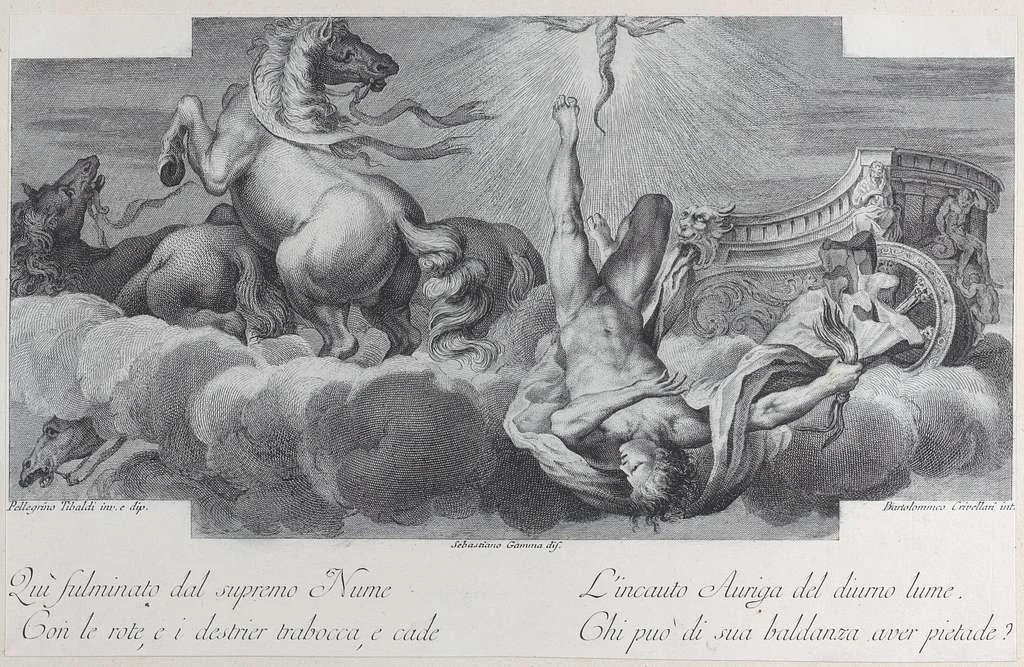
In Plato’s myth, the soul falls when its wings fail. The fall is not a punishment for having a body. It is the condition of a life in which attention is scattered, desire is divided, and the self must learn again how to rise.
Every person has experienced a version of the fall.
Not necessarily from the sky.
More often from attention.
A person begins with a clear intention and loses it in distraction. He values friendship and allows pride to harden into silence. He wants to act justly and discovers that fear has been making decisions in private. He knows what matters and spends the day serving what does not.
The fall of Plato’s chariot is not merely an ancient cosmic fairy tale.
It is the loss of inner order.
Falling into mortal life
In the Phaedrus, souls follow divine processions toward the realm beyond the heavens. They struggle to behold true reality—justice itself, temperance itself, knowledge itself. Some see more; some see less. The chariot’s imbalance eventually causes the soul to lose its wings and fall into embodied life.
This can sound severe to modern ears. It may seem as though Plato is saying that bodily life is a punishment or a mistake.
That is too simple.
The problem is not the body as such. The problem is confusion.
The embodied soul becomes vulnerable to forgetfulness, appetite, social pressure, pain, pleasure, imitation, status, fear, and the endless demands of change. It no longer sees reality with the clarity it once possessed. It must recover truth through the slow labor of education, experience, philosophical reflection, moral practice, and love rightly understood.
The fall is not “having a body.”
The fall is forgetting that the body is not the whole story.
Confusion is not destiny
A person who has become confused often begins treating confusion as identity.
“This is just who I am.”
“I have always been this way.”
“I cannot help my temper.”
“I need praise to do good work.”
“I cannot forgive.”
“I am simply not disciplined.”
“I am too busy to study, reflect, serve, or change.”
These statements often contain a grain of truth. Habit is powerful. Temperament is real. Injury leaves marks. Circumstance constrains. Bodies and histories matter.
But confusion is not destiny.
The Platonic soul can fall. It can also recover.
This is one reason Plato’s myth remains hopeful. The wings may be damaged. They are not necessarily gone forever. Beauty, wisdom, friendship, virtue, and philosophical practice can nourish their return.
The person is not asked to become someone entirely different.
He is asked to remember what he is capable of becoming.
The lower life and the higher self
Later Platonists developed this distinction with greater philosophical precision.
Plotinus, for example, speaks of higher and lower powers of soul. The lower life is involved with sensation, appetite, emotion, imagination, and embodied activity. The higher life remains oriented toward Intellect and the divine.
This does not divide a person into two unrelated beings. It describes different levels of involvement.
Part of us is caught in the day’s noise. Another part is capable of stepping back from the noise and asking whether it deserves obedience.
Part of us feels anger. Another part can judge whether anger is just.
Part of us wants immediate pleasure. Another part can ask what pleasure will cost.
Part of us fears failure. Another part can recognize that avoiding every risk is itself a form of failure.
The work of recovery is learning not to identify the whole self with the loudest part.
The daily recovery of altitude
No one regrows wings through one heroic declaration.
The recovery is daily.
It begins with attention.
What is pulling me downward?
What have I allowed to govern my mood?
What desire is masquerading as principle?
What fear is masquerading as prudence?
What resentment am I treating as insight?
What beauty have I ceased to notice?
What obligation have I postponed because I prefer the comfort of potential to the vulnerability of action?
These questions are not designed to produce self-contempt. They are designed to produce orientation.
A person who sees clearly where he has fallen has already begun to rise.
The Masonic work of recovery
The Masonic comparison is again philosophical rather than genealogical.
The work of the lodge assumes that a person is unfinished. He is not treated as worthless. He is treated as capable of form.
The rough ashlar need not be despised. It needs labor.
The tools do not condemn the worker. They provide a vocabulary for shaping conduct.
The degree does not declare the candidate complete. It places him under further obligation.
The fall of the chariot becomes, in this light, a useful image of ordinary moral life. We lose altitude whenever appetite, fear, vanity, distraction, and unexamined habit seize the reins.
We recover altitude through knowledge, reflection, service, self-command, friendship, study, and the repeated decision to turn toward what is higher.
The fall is real.
It is not final.
Endnotes and further reading
Plato, Phaedrus 248a–249d, on the soul’s fall into embodiment and the differing kinds of human life.
Plotinus, Ennead IV.8, “On the Descent of the Soul into Bodies,” on the soul’s higher and lower activities.[13][14]
Plotinus, Ennead I.1, on the layered or double life of the soul through the image of Heracles.[15][16]
Related reading: “The Two Gates of the Soul” and “The Work Is Not Over When the Lodge Closes.”