Love as a Ladder, Not a Trap
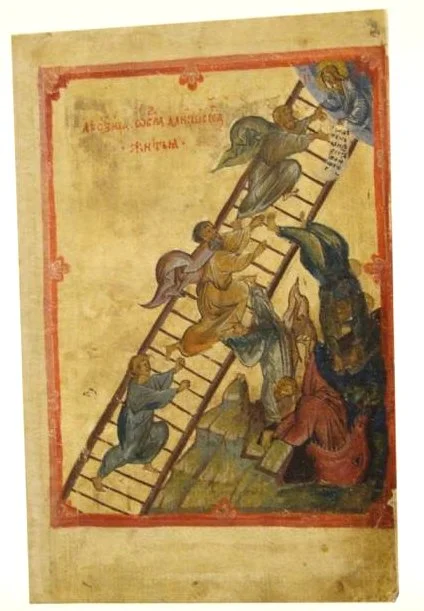
Plato, Diotima, and the education of desire
Love begins by wanting to possess what is beautiful. Plato asks whether it can become something more difficult and more generous: the desire to understand beauty, serve it, and become worthy of it.
Love is a ladder.
It is also, if approached badly, a trapdoor.
Plato knew both.
In the Phaedrus, the sight of beauty awakens the soul’s wings. Desire becomes a conflict between appetite and reverence. In the Symposium, Diotima describes a longer ascent: a lover begins with attraction to one beautiful body, learns to recognize beauty in many bodies, then in souls, laws, practices, knowledge, and finally Beauty itself.
This has sometimes been presented as though Plato disliked ordinary love and wanted everyone to become an abstract cloud of admiration.
That is not the point.
Plato is asking whether desire can be educated.
The first step: wanting what is beautiful
The beginning of love is ordinary.
A person sees someone beautiful. He is moved. He wants closeness, attention, possession, recognition, pleasure, or union. Nothing in this is surprising. It is human.
The problem begins when the lover treats the beautiful person as an object for his own use.
The lower horse in the Phaedrus wants to seize. It wants satisfaction. It wants to collapse beauty into possession.
The higher horse responds differently. It feels awe, respect, shame before what would dishonor the beloved, and a desire to become better.
The charioteer must learn which response will govern.
This is the first education of eros.
The beautiful person is not a prize. He or she is not a mirror for the lover’s vanity, a cure for loneliness, a source of prestige, or an object to be controlled.
Beauty invites reverence because it points beyond possession.
Diotima’s ladder
In the Symposium, Diotima describes the ascent of love in stages.
The lover begins by recognizing beauty in one body.
He then learns that the beauty of one body is related to beauty in many bodies.
He moves toward the beauty of souls—the moral and intellectual beauty of character.
He learns to admire beautiful practices, laws, institutions, and ways of life.
He comes to love knowledge.
Finally, he seeks Beauty itself: not merely one beautiful object, but the enduring reality by which beautiful things are beautiful.[9][10]
This is not an invitation to abandon human relationships in favor of vague abstraction.
It is an invitation to refuse reducing human relationships to appetite.
The ladder teaches that desire can become less possessive, less narrow, less vain, and more capable of recognizing what is truly worthy.
Love becomes educative when it enlarges the lover’s soul.
Love and possession
The difference between love and possession is not always obvious.
Possession says: “I need you to make me feel complete.”
Love says: “I want your good, even when it does not serve my vanity.”
Possession says: “You belong to me.”
Love says: “You are a person whose dignity places limits on my desire.”
Possession says: “Do not change.”
Love says: “May you become more fully yourself.”
Possession is frightened by freedom because freedom may leave.
Love respects freedom because without freedom, there is no person to love—only an object to hold.
This is where Plato’s ladder becomes morally demanding. It requires the lover to turn desire outward toward the good of the beloved and upward toward beauty, truth, and wisdom.
The lover is not asked to become less passionate.
He is asked to become more just.
The Masonic and ethical parallel
Freemasonry does not teach Platonic eros in any direct ritual sense. But it does value brotherly love, relief, truth, respect for human dignity, and the refinement of the self through moral obligation.
The Platonic comparison is therefore useful.
Brotherhood is not possession. Fellowship is not control. Service is not a means of making oneself appear virtuous. Love of the Craft is not merely attachment to its outward forms.
The test is whether affection becomes more generous, more disciplined, more truthful, and more useful.
A person who loves a lodge should want it to become better, not merely to praise him.
A person who loves tradition should want to understand its obligations, not merely inherit its status.
A person who loves beauty should become more attentive to justice.
The ladder of love is not a way of escaping ordinary human affection.
It is a way of making ordinary affection less selfish.
The destination of desire
The highest Platonic love is not cold.
It is intensely alive.
It is moved by beauty, truth, goodness, friendship, intellectual discovery, moral courage, and the desire to bring something worthy into the world. It creates—not always children, though that is one ancient image, but beautiful actions, institutions, thoughts, works, and lives.
The soul becomes winged not because it has stopped desiring.
It becomes winged because it has learned what deserves desire.
Desire begins by wanting to possess what is beautiful.
Education teaches it to become worthy of beauty instead.
Endnotes and further reading
Plato, Symposium 210a–212a, Diotima’s Ladder of Love.[9][10]
Plato, Phaedrus 249d–256e, on beauty, eros, recollection, and the soul’s charioteer.
Plotinus, Ennead III.5, “On Love,” for later Platonic development of eros and intelligible desire.[18]
Related reading: “Why the Soul Has Wings” and “The Black Horse Is Not the Enemy.”