The Chariot Is Not a Car
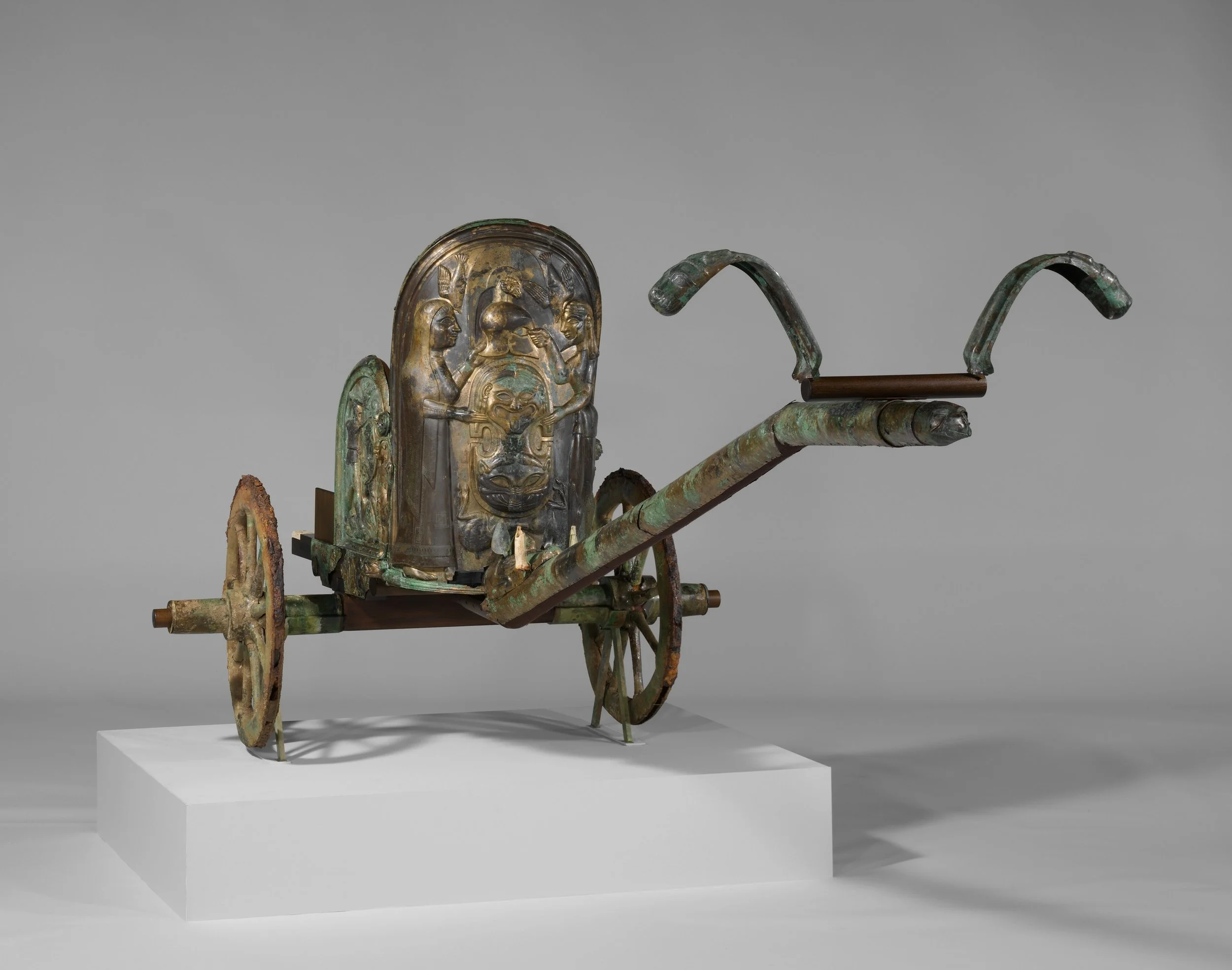
Bronze chariot inlaid with ivory, at the MET
Plato’s Map of the Human Soul
Plato’s winged chariot is not an ancient diagram of psychology in the modern sense. It is a demanding image of human life: reason holds the reins, courage pulls upward, desire pulls elsewhere, and every person must learn whether he is actually driving.
Plato’s chariot has one driver and two horses.
That is not a transportation problem.
It is a picture of what it feels like to be human.
The charioteer holds the reins. One horse is noble, obedient, dignified, and naturally drawn toward what is honorable. The other is unruly, impulsive, appetite-driven, and dangerously interested in whatever appears attractive at close range.
The chariot is winged. It belongs, by nature, to an upward movement. It follows the gods toward the heights, where souls attempt to behold true reality. But the horses do not pull evenly. The charioteer struggles. Some souls glimpse more truth than others. Some lose their wings. All eventually fall into mortal life.
This may be the most elegant explanation ever offered for why a person can sincerely want to improve himself and still eat the third cookie.
The charioteer and the two horses
The myth appears in Plato’s Phaedrus, in a dialogue ostensibly concerned with love, rhetoric, madness, beauty, and the soul. Socrates argues that the soul is immortal because it is self-moving. He then gives the chariot image to explain the soul’s structure and its journey.[1]
The charioteer represents the rational power of the soul. Reason is not merely cleverness. It is the capacity to judge, discern, direct, and recognize what is genuinely good.
The noble horse represents a higher spirited power: courage, shame before dishonor, responsiveness to beauty, aspiration, and the capacity to be moved by what is admirable.
The unruly horse represents lower appetite: hunger, lust, possessiveness, vanity, impatience, and the urge to seize what is pleasurable before asking whether it is good.
Plato’s image is not a claim that every human being has three neatly labeled compartments. Human beings are too complicated for that and have spent centuries proving it.
It is an image of conflict.
Reason may see the right path. Spirit may be willing to endure difficulty for it. Desire may still insist that a different path looks more immediately rewarding.
The charioteer’s task is not easy because the horses are not imaginary.
The divided self
Every person knows this division.
We know what we should do and do not do it.
We promise to speak carefully, then become angry.
We admire courage, then choose comfort.
We value friendship, then allow pride to keep us silent.
We say we want truth, then become suspicious of anyone who offers correction.
We want a life of purpose, then spend a great deal of it avoiding the next difficult thing.
This does not prove that human beings are hopeless hypocrites.
It proves that human beings require education.
The charioteer myth is optimistic precisely because it does not pretend the inner conflict is unreal. It assumes conflict. It asks whether the soul can be brought into harmony through discipline, beauty, reason, love, and repeated moral effort.
The question is not whether the horses will pull.
They will.
The question is whether they will pull in the same direction.
A soul with wings
The wings matter.
Plato says wings lift what is heavy upward. In the myth, the soul’s wings are nourished by beauty, wisdom, goodness, and other divine realities. They wither through their opposites: ugliness, injustice, ignorance, and disorder.
This is a powerful claim.
A person becomes spiritually lighter not by denying reality, but by learning to love what is higher in reality. Beauty, truth, justice, courage, and wisdom do not merely decorate a life. They give the soul lift.
The opposite is also true.
A life organized around appetite, distraction, resentment, vanity, and falsehood becomes heavy. It loses altitude. The soul begins to move downward, not necessarily into visible scandal, but into a gradual condition of inner disorder.
The person may appear successful. He may have a title, money, admiration, power, or a handsome office. Yet if his soul has no wings, he remains earthbound in the worst sense: confined to whatever his appetite, fear, or public image requires.
The Masonic comparison
The Masonic comparison is not one of historical descent. Plato did not write the Phaedrus as preparation for a lodge degree, and no serious reader should suggest otherwise.
But the philosophical kinship is genuine.
Freemasonry asks a man to consider whether he is governing himself. Its working tools speak of measure, uprightness, proportion, restraint, equality, and the removal of what obstructs moral form. Its degrees suggest movement, education, and the responsibility that comes with greater light.
The charioteer myth asks the same foundational question in another language:
Who holds the reins?
Is reason governing appetite?
Is courage serving justice or merely anger?
Is desire being educated toward what is worthy, or is it dragging the whole person toward the nearest satisfaction?
The chariot is not a car.
It is a life.
And most of us have been driving it longer than we have been paying attention.
Endnotes and further reading
Plato, Phaedrus 245c–257b, on the immortality of the soul and the myth of the winged chariot.
Hermias of Alexandria, Commentary on Plato’s Phaedrus, the only complete surviving Neoplatonic commentary on the dialogue.[2][3]
For an overview of Hermias’ commentary and its late-Platonic context, see the scholarly discussion of the surviving Neoplatonic tradition on the Phaedrus.[2][4]
Related reading: “The Black Horse Is Not the Enemy” and “The Middle Chamber of the Mind.”