How Maonic Symbols Teach Moral Labor
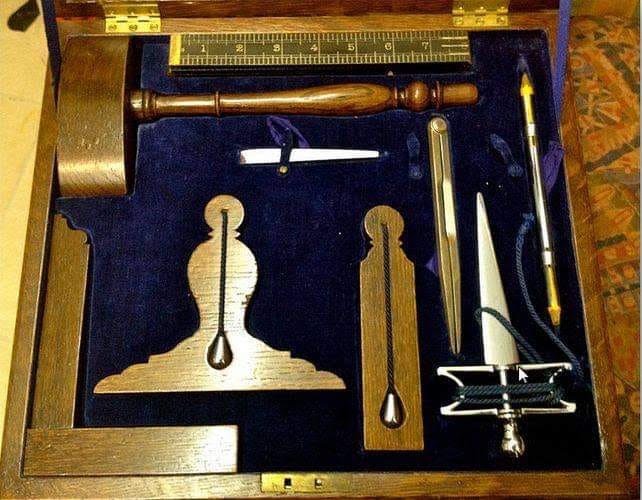
Masonic working-tool set
Part 6 of 13 in Masonic Symbols & Symbolic Thinking
← Previous: Rough and Perfect Ashlar · Next: The Lodge Room →
A tool is an awkward object to use as a decoration.
You can mount it on a wall, polish it, or place it in an impressive case. But its shape continues to suggest that somebody ought to be doing something with it.
That makes tools useful subjects for moral instruction.
It is possible to admire honesty without examining a transaction, praise restraint without exercising it, and discuss the value of time through a meeting that has exceeded every reasonable estimate.
A working tool brings the conversation back to a task.
What are you measuring? What needs correcting? How will you know whether the result is better?
The earlier articles considered why Freemasonry teaches through objects and how the ashlars present an image of improvement. Here we need to become more particular. A desire to work is not yet a method. Different difficulties require different operations.
You would not check an angle by striking it harder.
There Is More Than One Set of Working Tools
Before opening the toolbox, a qualification matters.
Masonic jurisdictions do not all assign the same tools to the same degrees. Some tools prominent in one ritual tradition are absent from another’s formal presentation. Their explanations also differ.
The chisel, for example, has a place in some traditions that it does not occupy in others. Other presentations include implements such as the trowel, pencil, or skirret.
The tools discussed here are therefore a selection from Masonic symbolic teaching, not an inventory that every lodge is expected to reproduce.
I will distinguish their practical functions, familiar moral associations, and the applications proposed in this essay. Those applications are invitations to examine conduct, not additional ritual instructions.[1]
The Gauge: What Have You Promised Your Time To?
A gauge measures. The twenty-four-inch gauge gives Masonic teaching a readily understood comparison with the hours of a day.
Its familiar moral application concerns the division of time among obligations and activities. Particular formulations vary, but the underlying question is recognizable: how are you allocating a limited resource?[1]
A useful beginning is to compare what we say deserves attention with what actually receives it.
We may consider a responsibility important while repeatedly leaving it whatever time remains. Eventually, the people depending on us notice the difference.
But this is not a lesson in assuming that everyone controls every hour.
Work schedules, illness, caregiving, and financial pressures impose real limits. A person working two jobs does not need a lecture suggesting that a better diary will create a third evening.
The practical question is what discretion remains, and what commitments can reasonably fit within it.
Before making another promise, examine the time already promised.
Rest belongs in that examination too. Exhaustion is not proof of conscientiousness, and a schedule with no room for interruption may be accurate chiefly as a description of what will go wrong.
For a fuller discussion, see The Twenty-Four-Inch Gauge, Benjamin Franklin, and the Problem of Time.
The Gavel: Stop Doing the Thing
The common gavel is associated in familiar Masonic instruction with removing the rough stone’s irregularities and, by comparison, correcting faults of conduct.[1]
The useful word here is removing.
Some improvements begin when we stop an action that repeatedly creates trouble. We stop agreeing to work we do not intend to complete. We stop repeating a story whose accuracy we have never checked. We stop using irritation as permission to speak cruelly.
That sounds less ambitious than transforming the self. It also gives us something observable to attempt.
Consider a habit of making jokes at another person’s expense. The speaker may regard it as harmless wit. The recipient may have a different understanding, particularly after the sixth performance.
The first correction need not involve an elaborate account of personality. Stop making the joke. Listen to the objection. Repair what can be repaired.
The stoneworking image should not be mistaken for an instruction to become severe with ourselves or others. Force does not establish the value of a correction.
The gavel gives us a way to think about discontinuing a fault. It does not tell us that every difficulty should be struck.
The Chisel: Find the Particular Fault
A chisel directs a cutting edge toward a particular place. In traditions where it receives a formal Masonic explanation, it can carry associations with education and cultivation.[2]
For this essay, its precision offers a useful question: have we identified the difficulty accurately?
“Be more disciplined” leaves almost everything unsettled.
“I arrive late because I begin preparing at the time I should leave” gives us a workable problem.
The same apparent fault may have different causes. Someone avoids speaking because he has not prepared. Someone else has prepared carefully but fears disagreement. Advising both to remain quiet and listen would help one more than the other.
Specificity matters.
So does the choice of response. A reminder may address forgetfulness. Practice may address a lack of skill. An apology may be required where the problem has harmed someone else.
Trying harder at the wrong correction can make a person thoroughly committed to a mistake.
This is where instruction and feedback become useful. We need not diagnose every difficulty alone, but neither must we accept an explanation merely because it is delivered confidently.
Ask what the proposed correction is meant to accomplish.
The Square: Does the Standard Apply to You?
A square checks a right angle. It does not, as is sometimes loosely said, test only a horizontal relationship. An angle can be checked in different orientations.
Its familiar Masonic associations include morality and upright conduct.[3]
The practical application I find most useful concerns consistency.
Would we accept the explanation if someone else offered it? Would the same decision look fair if we were the person disadvantaged by it?
Suppose a deadline applies to everyone except the officer who approved it. Perhaps there is a sound reason. But the reason must do more work than the officer’s importance.
Or consider a mistake. We describe our own as an understandable lapse and another person’s as evidence of character. The facts may differ. We should establish how before reaching the convenient conclusion.
The square suggests checking against a standard rather than allowing confidence to stand in for the check.
Conduct is not geometry, however. A difficult moral judgment cannot always be settled with the certainty of a right angle.
The comparison asks us to examine the standard and its application. It does not manufacture an answer.
The Level: How Do You Treat the Least Influential Person?
A level tests whether something is horizontal. In Masonic teaching, it is commonly associated with equality and shared human standing.[3]
Equality does not mean that everyone holds the same office, possesses the same knowledge, or carries the same responsibilities.
It does mean that differences of position need not become differences in the basic consideration people receive.
The test is ordinary enough. Who gets interrupted? Whose question is treated as worth answering? Who receives an explanation, and who is expected to be satisfied with an instruction?
A lodge may speak warmly about equality while arranging its attention according to prestige.
The level gives us a reason to notice.
An officer may need to make a decision. He does not thereby acquire permission to humiliate someone affected by it. A new member may need instruction without being treated as an inconvenience.
We should also distinguish the ideal from the historical record. Masonic language about fraternity and equality has existed alongside exclusions and social hierarchies. Stating the principle does not establish that an institution has practiced it consistently.[4]
That tension is a reason to examine conduct, not to retire the principle.
The Plumb: What Happens Without an Audience?
A plumb line uses a suspended weight to establish a vertical reference. Once it settles, it can help the worker test whether something is upright.
Its familiar Masonic association is rectitude of conduct.[3]
The square, level, and plumb have overlapping moral applications. We do not need to force each into a separate compartment. But we can use them to ask different questions.
Here the question concerns what remains true when social approval is removed.
Do you record a mistake when nobody else has noticed? Keep an undertaking after the person who requested it has lost influence? Deal honestly with someone unlikely to discover the difference?
These actions rarely produce much ceremony. They may not produce recognition at all.
That makes them useful places to examine integrity.
The physical comparison has a limit. Gravity supplies the plumb line’s reference; conscience does not possess equivalent infallibility. A person can feel thoroughly upright while being mistaken.
Private conviction still needs reasons, evidence, and a willingness to hear an objection.
Otherwise, “following my conscience” can become an impressive description of refusing to reconsider.
The Compasses: Where Will You Set the Limit?
Compasses draw circles, transfer measurements, and establish relationships in a drawing. Their Masonic associations commonly include the idea of keeping desires and passions within due bounds.[1]
The question is not whether desire is bad.
Ambition can sustain difficult work. Pleasure belongs in life. Anger may alert us to an injustice.
The difficulty concerns what happens when one impulse is permitted to decide everything.
A desire for recognition may begin to determine which responsibilities we accept. Anger may decide what we say before judgment has examined it. An appetite for work may consume the time we promised to other people.
The compasses provide an image of setting a boundary.
What limit would protect the obligation at risk?
Perhaps it is refusing another appointment. Perhaps it is leaving a message unanswered until anger subsides. Perhaps it is deciding that an argument does not need an audience.
Restraint is not the same as withdrawal. Setting a boundary around a harmful response can make a useful action possible.
We do not become freer merely by obeying the strongest impulse currently available.
Why One Tool Is Not Enough
Imagine an officer who keeps an excellent schedule, completes every task, and treats everyone around him badly.
The gauge has not solved the whole problem.
Or imagine someone who gives everyone a patient hearing but never makes a decision. Consideration is valuable. So is completing the work.
The tools help us distinguish operations that a general desire to improve can leave blurred.
We may need to allocate time, discontinue a habit, identify a precise difficulty, test a judgment, examine our treatment of others, keep faith without recognition, or set a limit.
More than one may be required.
Suppose you accepted responsibility for an event and then failed to prepare. Reviewing the schedule matters. So does telling the people affected. If pride encourages you to conceal the failure, the difficulty is no longer only time management.
This is the advantage of a collection of working tools. It permits a more exact question than “Am I a good person?”
What went wrong here, and what kind of work would address it?
A Small Test of Whether the Teaching Is Being Used
It is easy to discuss a tool in general terms. Application becomes clearer when attached to an occasion.
Choose something specific.
You have been postponing a promise. You regularly dismiss a colleague’s questions. You accept responsibilities too quickly and complete them resentfully.
Describe the action without improving your motives in the telling.
Then ask what the tools help you notice.
Is this a failure of allocation? A habit to discontinue? A judgment being applied unevenly? A boundary you have refused to set?
Decide on a response that can actually be attempted. Later, examine what happened.
This is a suggested exercise, not a prescribed ritual practice. It does not require turning every day into a formal inspection.
Its purpose is simply to bring the symbolism close enough to conduct that conduct can answer back.
Tools Do Not Select the Project
A final limit deserves attention.
A tool can be used skillfully toward a bad end. Accuracy does not make a dishonest plan honest. Efficiency may allow a person to complete more work that ought not to have been undertaken.
Moral labor therefore requires judgment about purpose as well as competence in method.
What are we trying to accomplish? Who will be affected? Is the standard defensible? Are we correcting a genuine fault or merely making ourselves more acceptable to someone whose approval we want?
The tools cannot relieve us of these questions.
Their usefulness lies in directing attention toward ways of working: measuring, testing, correcting, and establishing limits. We still have to consider what the work is for.
That keeps the symbolism from becoming a mechanical recipe.
A person is not a piece of stone awaiting instructions from whoever happens to hold the equipment.
Put One to Work
The working tools can be studied as historical objects, ritual emblems, and subjects of interpretation. Each approach has value.
But the moral reading eventually returns to use.
The next time a responsibility is being accepted, examine the available time. When an explanation is being offered, ask whether the same standard applies to everyone. When anger supplies an excellent sentence, consider whether it should be delivered.
There is no need to imagine the whole toolbox at once.
Find the operation the situation requires. Attempt it. Check the result.
The tool in the display case can remain beautifully polished. The work is elsewhere.
Continue the Series
Next: Why the Lodge Room Is Laid Out Like a Map of the Mind →
Sources and Further Reading
Working tools and their degree assignments vary between Masonic jurisdictions and ritual traditions. The examples below provide explanations and historical context, not a universal inventory. The practical exercises and applications in this essay are the author’s interpretation.
Public explanations of the twenty-four-inch gauge, common gavel, and compasses illustrate familiar associations with time, correction of faults, and due bounds. These associations should be checked against the authorized instruction of the jurisdiction being discussed. For a comparative discussion of the tools’ practical functions and ritual presentation, see “The Working Tools of the Craft”.
W. Kirk MacNulty, Freemasonry: A Journey Through Ritual and Symbol (Thames & Hudson, 1991), and Freemasonry: Symbols, Secrets, Significance (Thames & Hudson, 2006). Consult the specific passages and ritual context before assigning a particular explanation to the chisel or other tools.
“Square, Level, and Plumb,” Short Talk Bulletin, December 1943.
This historical Masonic educational text discusses the tools’ practical functions and moral associations. It is an example of interpretation, not a statement binding on every jurisdiction.
- Steven C. Bullock, Revolutionary Brotherhood: Freemasonry and the Transformation of the American Social Order, 1730–1840 (University of North Carolina Press, 1996); Jessica L. Harland-Jacobs, Builders of Empire: Freemasons and British Imperialism, 1717–1927 (University of North Carolina Press, 2007).
For historical background on the development of Freemasonry in relation to the building craft, see David Stevenson, The Origins of Freemasonry: Scotland’s Century, 1590–1710 (Cambridge University Press, 1988), and Douglas Knoop and G. P. Jones, The Genesis of Freemasonry (Manchester University Press, 1947).
Return to Masonic Symbols & Symbolic Thinking: the complete series →
