Queens History and Freemasonry
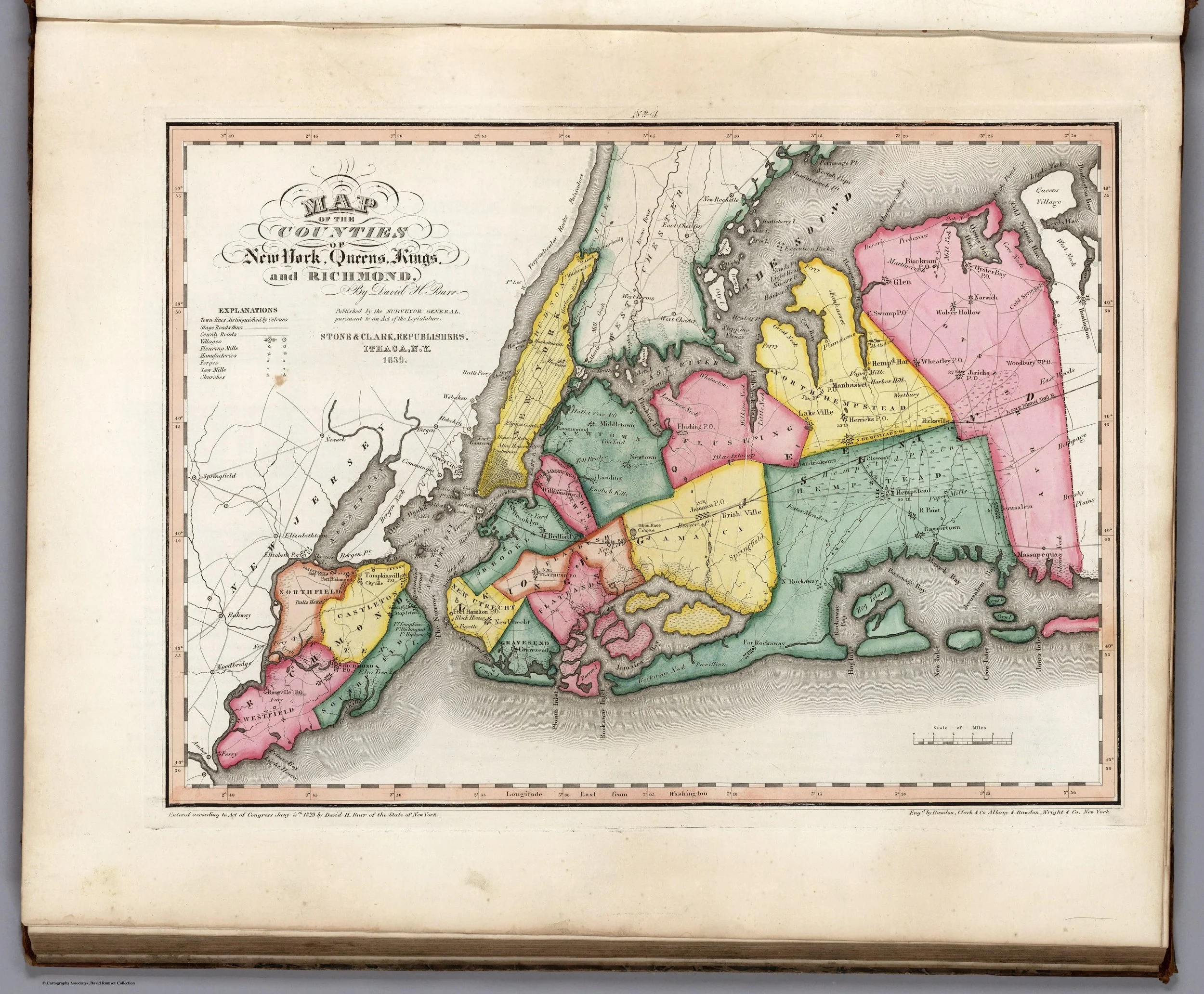
Counties of New York, Queens, Kings & Richmond, by D.H. Burr, c. 1839. David Rumsey Map Collection.[5]
Queens is often described through movement and growth. Farms gave way to streets, villages became neighborhoods, shorelines turned industrial, and older local identities were gradually absorbed into the greater life of New York City. That history is real, and it matters. But it is only part of the story.
Places are not shaped by roads, transit, industry, and real estate alone. They are also shaped by institutions. Churches, schools, clubs, charitable associations, political societies, and fraternal orders all help turn settlement into community. They preserve memory, create continuity, and give visible form to what a neighborhood believes about itself.
Freemasonry belongs to that history in Queens. Its lodges did not exist outside the borough’s development, nor did they float above it in ritual abstraction. They emerged within particular communities, met in real buildings, drew members from changing local populations, and offered a language of order, fellowship, improvement, and permanence in places often marked by rapid change.
To study Queens history and Freemasonry together, then, is not simply to list lodges or record dates. It is to look at how local life was organized through association, symbolism, and built space. It is to read the borough not only as territory, but as a landscape of institutions, ambitions, and meaning.
Queens as a Historical Landscape
Before Queens became a borough of New York City, it was a patchwork of towns, villages, shorefronts, roads, farms, and developing commercial districts. Flushing, Newtown, Astoria, Jamaica, Ravenswood, Dutch Kills, Hunter’s Point, Steinway, and Far Rockaway did not grow in identical ways. Each had its own patterns of settlement, trade, religion, labor, migration, and public life.
That uneven development matters. Institutions do not appear in empty space. They arise where communities become stable enough, connected enough, and ambitious enough to sustain them. The older local identities of Queens created the conditions in which civic and fraternal organizations could take root, endure, and adapt.
This is one reason Masonic history in Queens must be understood locally before it is understood generally. A lodge in western Queens stood in a different civic and social environment than one in an older village center or a later residential district. The borough’s Masonic story was never abstract. It was always grounded in neighborhood life.
Why Freemasonry Took Root in Queens
Freemasonry tends to flourish where a community has developed enough civic texture to support voluntary association. Lodges require more than members. They require continuity, habits of organization, formal meeting culture, and a social world that values fellowship, ritual, charity, memory, and self-improvement.
As Queens developed, it produced exactly these conditions in many places. Commercial growth, transportation networks, local leadership, and neighborhood identity all helped create an environment in which fraternal life could thrive. In that sense, the rise of lodges in Queens reflects a broader pattern in American civic history: where communities deepen, institutions multiply.
This does not mean that Freemasonry alone explains local development, nor that every growing neighborhood produces the same kinds of associations. It does mean that the presence of lodges can tell us something important about the maturation of public life. A lodge suggests a community interested in durability, formality, mutual recognition, and moral structure.
In a borough shaped by constant change, that mattered. Fraternal life offered continuity without requiring uniformity. It gave men a way to belong to something ordered and enduring even as the world around them shifted.
Lodges as Neighborhood Institutions
It is easy to imagine a lodge as something sealed off from ordinary life, a private world of ritual and symbolism existing behind closed doors. In practice, lodges were also neighborhood institutions. They drew their membership from local populations, reflected local leadership, occupied local buildings, and became part of the civic fabric of the places around them.
This is especially important in Queens, where neighborhood identity has always been strong. Lodges formed within communities already shaped by commerce, kinship, ethnicity, transportation, religion, and local custom. They did not replace those things. They joined them. Like churches, benevolent societies, civic clubs, and business associations, they helped structure the life of a place.
That local rootedness is what makes individual lodge histories more than isolated institutional records. They are pieces of neighborhood history. A lodge’s foundation, growth, movement, merger, or decline often reflects wider changes in the surrounding community. Population shifts, economic transformation, altered street life, new building patterns, and changing forms of sociability all leave their mark on fraternal institutions.
Seen this way, the Masonic history of Queens becomes inseparable from the history of Queens neighborhoods themselves.
Buildings, Halls, and Moral Architecture
Freemasonry is not only a matter of membership and ritual. It is also a matter of space. Lodge rooms, halls, and temples were places where ideas about order, discipline, fraternity, and instruction took visible form. They were never merely neutral containers.
This matters because buildings express values. A Masonic meeting place, whether grand or modest, signaled seriousness, continuity, and institutional presence. It told the surrounding neighborhood that this was a body meant to endure. In a borough where redevelopment and change have often erased earlier layers of civic life, Masonic buildings remind us that communities once invested deeply in durable forms of assembly and memory.
There is also a more symbolic dimension. Freemasonry has long used the language of building to speak about the formation of character. Stone, tools, proportion, light, orientation, and structure are not decorative afterthoughts. They belong to an older moral imagination in which architecture could teach, discipline could ennoble, and built order could reflect inner order.
That tradition helps explain why Masonic spaces mattered. They were not simply convenient meeting locations. They were environments shaped by the belief that form influences conduct, that ceremony requires setting, and that institutions should make their ideals visible.
Symbolic Thought on the Ground
If symbolism is treated only as theory, it quickly becomes thin. Its real force appears when it is embodied in habits, rooms, buildings, institutions, and communities. That is why local history matters so much to the study of Freemasonry.
Queens gives symbolic thought a concrete setting. Here, Masonic ideas were not floating abstractions. They were carried by men in particular neighborhoods, enacted in specific lodges, and housed in actual buildings. The language of tools, stone, pillars, light, geometry, and moral construction entered local life through repeated practice and institutional memory.
This is what makes Freemasonry more than an ornamental feature of borough history. It offered a way of understanding improvement, obligation, discipline, and fraternity that was both symbolic and social. Its teachings did not remain in lectures. They shaped how members understood duty, fellowship, conduct, and the meaning of institutional life.
For that reason, symbolic thought should not be separated too sharply from local development. The same borough that built streets, businesses, schools, and neighborhoods also built spaces for ritual, moral instruction, and ordered fellowship. The symbolic and the civic met on the ground.
How Masonic History Helps Explain Queens
Freemasonry does not explain Queens in full, and it should not be used to flatten the borough into a single institutional story. Queens is too large, too varied, and too complex for that. But Masonic history does help explain certain features of local development that are easy to overlook.
It highlights the importance of voluntary institutions in shaping neighborhood life. It shows how communities sought continuity amid rapid change. It reveals that local identity was built not only through commerce, politics, religion, and migration, but also through formal associations that gave people a structure for memory, fellowship, and ethical aspiration.
It also reminds us that development is not only physical. A neighborhood is not made real by streets and buildings alone. It becomes a community through institutions that help people locate themselves within a larger moral and civic world. Lodges were part of that process. They gave local life a rhythm, a setting, and a language of seriousness that belonged to the broader history of the borough.
To read Queens through its Masonic history, then, is not to indulge in mystery or exaggeration. It is to recognize that places are shaped by meanings as well as markets, by association as well as infrastructure, and by the institutions people build when they want continuity to survive change.
Explore Queens History and Freemasonry
Readers interested in this subject can explore it from several directions across the site.
Neighborhood Histories
The local history of Queens provides the essential setting for understanding how fraternal institutions developed. Neighborhood and district histories help explain why lodges emerged where they did and how they reflected the character of the places around them.
Lodge Histories
Individual lodge histories show how Freemasonry took shape in specific communities over time. These pages offer the most direct view of how membership, place, institutional continuity, and neighborhood change interacted.
Masonic Buildings and Temple History
The built history of Freemasonry in Queens deserves attention in its own right. Meeting halls, temples, and lodge spaces reveal how institutions represented themselves architecturally and how symbolic ideas were carried into local space.
Symbolism and Masonic Thought
For readers coming from the symbolic side, the broader essays on tools, light, geometry, pillars, stone, and moral construction provide the interpretive language that helps explain why Masonic institutions looked and functioned as they did.
Related Queens and Fraternal Topics
Biographical pages, broader Queens institutional history, and related fraternal traditions can deepen the picture further by showing how Freemasonry fit within a larger world of association and civic life.
Conclusion
Queens history is often told through expansion, incorporation, transportation, industry, and demographic change. All of that belongs to the story. But so do the institutions that gave those changes form and meaning.
Freemasonry was one of those institutions. Its lodges were woven into neighborhood life. Its buildings gave visible shape to continuity and aspiration. Its symbolic language offered a way of connecting personal conduct, civic seriousness, and communal memory. To follow that history across Queens is to see not only a fraternity, but a pattern of local place-making.
In that sense, Freemasonry belongs within the larger history of the borough not as a curiosity at the margins, but as part of the institutional fabric through which Queens became legible to itself.
End Notes
[5] "Map of the Counties of New York, Queens, Kings, and Richmond," by David H. Burr, in An Atlas of the State of New York ... under the superintendence of Simeon DeWitt (Ithaca, N.Y.: Stone & Clark, republished 1840; map dated 1839). From the David Rumsey Map Collection, David Rumsey Map Center, Stanford University Libraries. Accessed via: David Rumsey/ Map of The Borrough of Queens