City Lodge No. 408 history, from an 1856 charter and a lower Manhattan lodge room to the Queens lodge that carries its lineage today.
Start Here · Series Hub · Timeline · Previous Article: To Be Assigned · Next Article: To Be Assigned · Related Directory: City Lodge Members · Related Member Profiles: To Be Assigned
One February evening in 1870 it rained hard enough that the committee of City Lodge No. 408 noticed. The Academy of Music was dressed for the occasion, with four chandeliers over the stage and the lodge’s name spelled in gas jets across the back, and about a hundred couples danced anyway.
Perhaps five hundred spectators sat scattered through the house. The lodge was raising money for Master Masons in distress in Cuba, and the Tribune, which called its report “The Freemason at the Academy,” noted that the “mysterious knights” of the lodge had left their regalia at home and danced like everyone else.
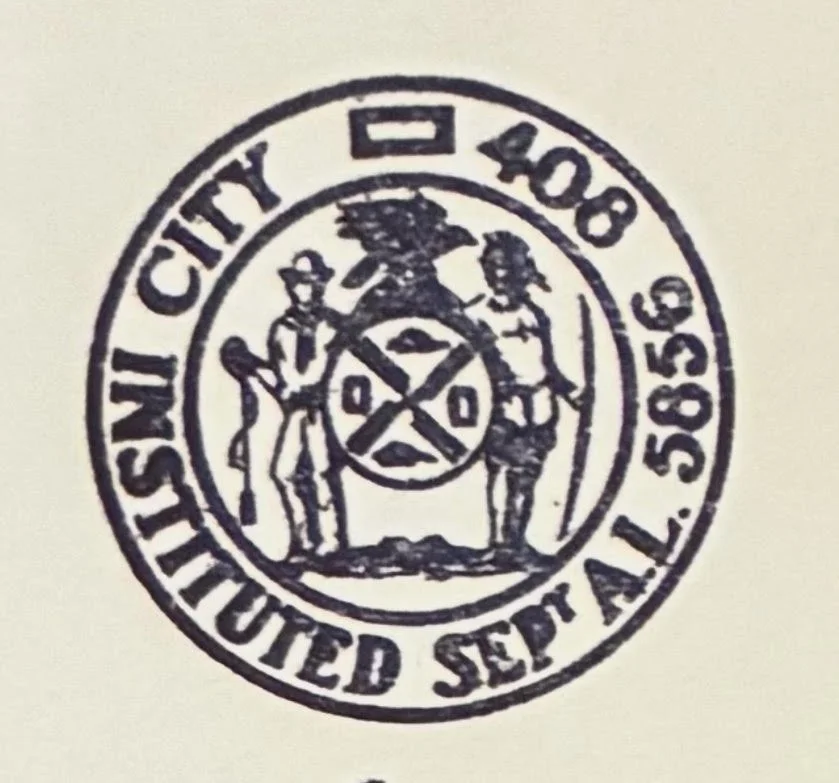
City Lodge No. 408 history begins in Manhattan, and its charter is the oldest in the family that became Advance Service Mizpah Lodge No. 586. This article follows what the clippings in hand can show of it.
Manhattan in 1856
The Grand Lodge of New York chartered City Lodge on September 1, 1856.
The sources in hand do not describe its founding or name its first members, but a 1912 New York Times item is informative. It reports that A. J. Dittenhoefer, a former judge who had just turned seventy-five, was the only living charter member, and that the lodge had been organized fifty-six years earlier.
The members gave him a silver loving cup. The clippings show him as Master in 1881 and 1883, roughly a quarter-century after the charter.
The lodge’s early notices place it in Odd Fellows’ Hall, which the notices of the day locate simply as the corner of Grand and Centre Streets. The exact address was 165–171 Grand Street.
The notices from 1866 to 1869 have it meeting there, in a room called the Corinthian Room. The neighborhood now goes by other names, Little Italy and SoHo among them (see Note 1).
In August 1863 a notice summoned the members to a funeral connected, in the part of the clipping that survives, with the battle of Gettysburg.
A Lodge That Moved
City Lodge did not stay on Grand Street.
By April 1870 its summonses give 594 Broadway as the address of its rooms. In April 1873 they name the Bleecker Building at Bleecker and Morton Streets.
In November 1873 a special communication met in the Clinton Rooms of the Masonic Temple, and in October 1874 the summons gives No. 33 Union Square.
In May 1875 the New York Herald reports a ceremony in the lodge room of the new Masonic Temple, and from then on the lodge meets in the Ionic Room there. A Times item of 1903 still has it in the Ionic Room of Masonic Hall.
The sources in hand do not explain the moves (see Note 1).
The Herald’s May 1875 item is a small social comedy. The lodge’s officers, after closing the lodge to outsiders, called on Alderman Edward Gilon, the Master of Concord Lodge, who was chatting with friends in a side room and had no idea why he was being fetched.
They escorted him into City Lodge’s room, where Grand Master Ellwood E. Thorne presented him with a testimonial making him an honorary member.
The alderman, the Herald reports, was too surprised to speak for a few minutes. A banquet at the Grand Circle Restaurant followed, and the speeches went on until dawn.
The Master was Alexander Mack, and George Newcomb was Senior Warden.
The Cuba Ball
City Lodge’s most ambitious public act in the clippings is the ball at the Academy of Music.
In December 1869 a committee of the lodge met at the Revere House on Broadway to plan it. The Herald explained the purpose. The insurrection in Cuba had left Master Masons there in extreme distress, and many members of City Lodge were themselves in Cuba in indigent circumstances.
The lodge had already had a taste of the island’s dangers. In March 1868 it had adopted resolutions mourning a young member, Charles E. Jacobs, who died at Santiago de Cuba after an illness of four days.
The ball was priced at five dollars for a gentleman and eight for a double ticket, limited to a thousand, and it came with a lottery.
The prize was a silk bedspread embroidered by hand in China, said to have cost $1,000 in gold and given by a wealthy brother. The winner could claim it from the committee’s secretary whether or not he attended.
The Herald called it the first grand Masonic ball ever held in the Academy.
The night itself was wet, and the Tribune reported that the driving rain sadly disappointed the committee.
Among the guests were Police Commissioner Mathew T. Brennan, J. W. Woodruff, a past Grand Secretary of the state, Judge Jones, the Hon. Cassius M. Clay, and a considerable number of Cubans.
The Tribune did not say how much money the ball raised.
Lodge Life
Most of what the clippings preserve of City Lodge is its funerals.
The lodge printed its summonses in the Herald and the Times, calling members to meet at their rooms and attend a brother’s burial. The notices name Masters including William I. Lloyd in the mid-1860s, Alexander Mack in the early 1870s, and D. T. Castro in 1870.
Dittenhoefer’s three years in the chair, from 1881, are better documented.
An Anniversary Turned to Mourning
On September 26, 1881, the lodge had planned a celebration of its twenty-fifth anniversary.
President Garfield had died the week before, and the lodge held a lodge of sorrow instead in the Ionic Room, which the Times says was heavily draped in mourning.
Dittenhoefer conducted the service with the Deputy Grand Master, William H. Corsa, assisting and delivered the eulogy. He said he would propose at the next meeting that Masons across the country raise a fund for a Garfield monument at Lake View Cemetery.
A Jewel for Dittenhoefer
Two years later, in June 1883, the lodge gave Dittenhoefer a jewel.
The Grand Lodge had just appointed and elected him a Commissioner of Appeals for three years, and the Grand Secretary, E. M. L. Ehlers, presented the gift for the lodge.
The Times described it with the care of a jeweler. It hung from a broad black silk ribbon and had a gold plate set in a rising sun, with a compass and gauge below, a large diamond at the rivet, and the words “Grand Lodge, New York” above.
A banquet at Bade’s on Sixth Avenue followed.
Members Beyond Manhattan
The obituaries that follow in the clippings give the lodge’s later members.
Simon Bower, a former liquor dealer born in Germany, died in Brooklyn in 1908. Frederick Hartenstein, a past master, was buried from West 140th Street in 1916. Tobias E. Raffel, a past master and the president of a machinery company, died in Brooklyn in 1920.
By the 1920s the notices have City Lodge men living in Brooklyn as well as Manhattan. In 1921 a Wor. D. O. Middlebrook of City Lodge was filling the south station in a Brooklyn degree team.
In May 1936 the lodge gave a dinner at the Hotel Astor in honor of Jacob C. Klinck, the president of the Kings County Savings Bank and the new Grand Master of Masons in New York, who was an honorary member.
A hundred and fifty members and guests attended, and the speaker called Klinck a “master of humanism.” William J. Gottlieb was Master of City Lodge.
From Manhattan to a Queens Lineage
The clippings in hand end at the Astor dinner. The next event documented in the working record is the lodge’s end as a separate body.
In 1973 City Lodge No. 408 consolidated with Service Lodge No. 1009, which had been chartered in Flushing on May 3, 1923, to form Service City Lodge No. 1009.
The Manhattan lodge lost its number, and its name survived as the middle word of a Queens lodge.
In 1982 Geba Lodge No. 954 joined, and the lodge became Service City Geba Lodge.
On January 31, 2018, Service City Geba consolidated with Advance Island City Mizpah Lodge to form Advance Service Mizpah Lodge No. 586, and the word City dropped out of the title.
The Merger History follows those consolidations. The Timeline places them alongside the charters, buildings, and moves of the other lodges in the series.
City Lodge No. 408 history ends without a ceremony in the sources in hand. Its September 1, 1856 charter date remains the oldest in the lineage, and the successor lodge now meets in Astoria.
Sources and Notes
Working list from the City Lodge source packet. Full article titles, dates, and page references remain to be completed where not supplied.
Newspaper Clippings
- New York Herald, Tribune, Sunday Mercury, Times, and other New York papers, 1863–1936.
- New York Times, September 27, 1881.
- New York Times, June 26, 1883.
- New York Times, March 28, 1912.
- Times Union, May 19, 1936.
- Brooklyn Eagle, 1888–1929.
- Brooklyn Daily Times, 1903 and 1908.
Charter and Consolidation Records
- Grand Lodge records for charter and consolidation dates.
[Before publication: complete the newspaper citations and identify the specific Grand Lodge records consulted.]
Note 1: Dates, Names, and Places
The charter date of September 1, 1856, is from Grand Lodge records. The 1881 anniversary and the 1912 Times item, which says “fifty-six years ago,” agree.
The clippings place Odd Fellows’ Hall at the corner of Grand and Centre Streets, a common way to give a location at the time. The exact address is 165–171 Grand Street.
The ball at the Academy of Music was announced for February 16, 1870. The Tribune reports it as “last evening” in a clipping dated February 16, which suggests February 15. The body therefore identifies the month without choosing between those dates.
The “new Masonic Temple” of 1875 is probably the Grand Lodge’s temple on Twenty-third Street, but the clippings do not give an address.
The notice that places a special communication in the Clinton Rooms of the Masonic Temple carries a February 1870 date on the clipping. Its text mentions a Wednesday, November 19, which fits 1873, and the lodge confirms it used those rooms in 1873.
The Gettysburg notice of August 1863 is cut off and names no one.
The jewel’s inscription is transcribed as June 25, 1888, but the Times item is dated June 26, 1883. The body follows the newspaper item’s date.
Names vary by transcription: Mack and Mauk, Gilon and Gillon, Copland and Copeland.
Service Lodge No. 1009 was chartered on May 3, 1923, per Grand Lodge records.
The sources in hand say nothing of the proceedings of the 1973 consolidation itself.
Start Here · Series Hub · Timeline · Previous Article: To Be Assigned · Next Article: To Be Assigned · Related Directory: City Lodge Members · Related Member Profiles: To Be Assigned
