How Long Island City Was Created in 1870
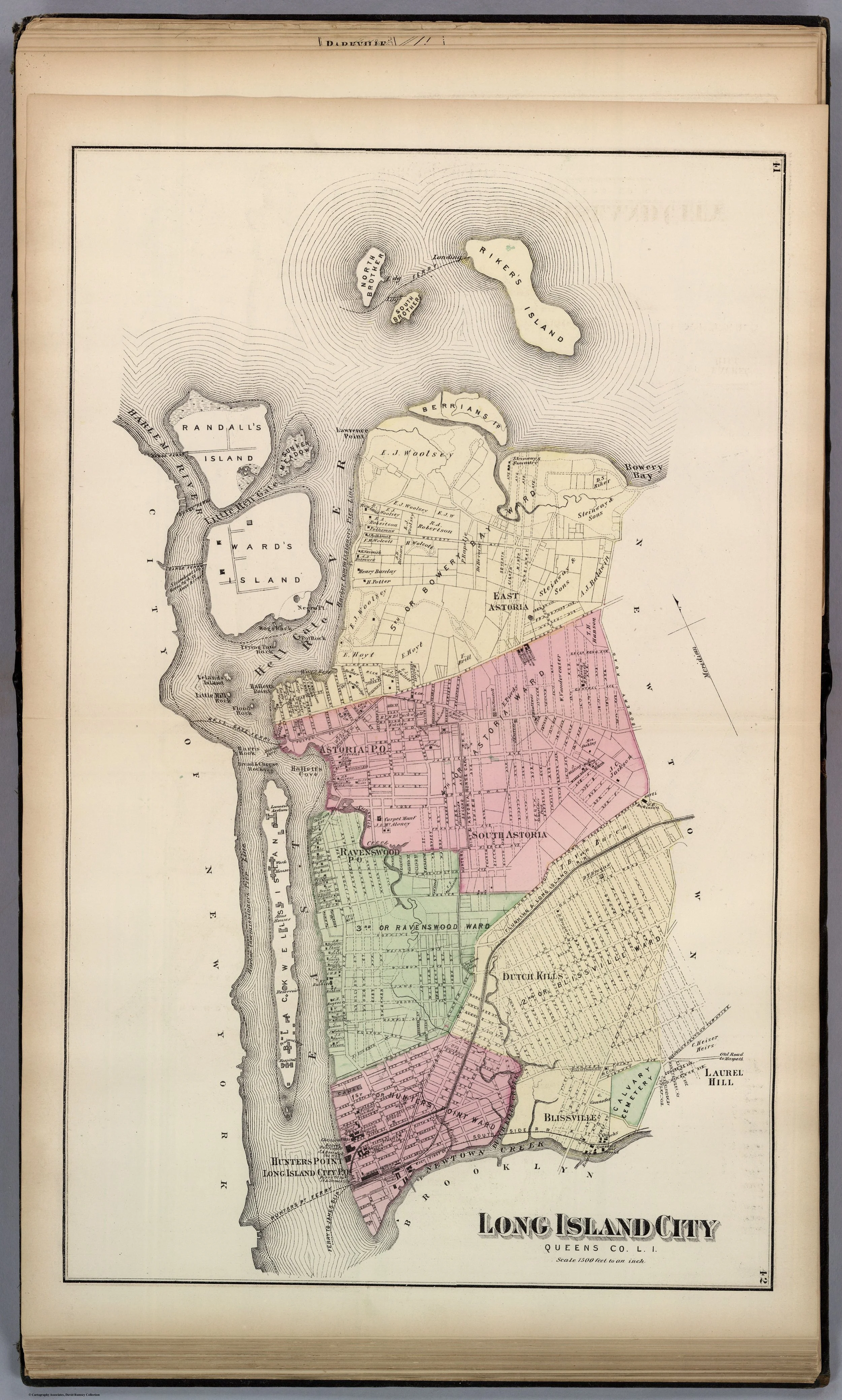
Long Island City, Queens Co., L.I., by F.W. Beers, 1873. David Rumsey Map Collection, Stanford Libraries.[4]
The Merger That Remade Western Queens
Long Island City did not begin as one place.
It was assembled from communities that had grown apart for more than two centuries: Astoria, Hunter’s Point, Ravenswood, Dutch Kills, Blissville, Middletown, Steinway, Bowery Bay, and smaller districts along the East River and Newtown Creek. Each had its own roads, landowners, churches, schools, industries, and local identity.
By the late 1860s, however, the old system could no longer manage the pressures of growth. Railroads converged at Hunter’s Point. Ferries tied western Queens directly to Manhattan. Factories crowded the waterfront. Farm roads became urban thoroughfares. The scattered settlements of the old Town of Newtown were becoming a city in everything but name.
On May 4, 1870, New York State created Long Island City.
The new municipality existed for less than three decades before its absorption into Greater New York in 1898. Yet its brief life permanently shaped the geography, transportation, and civic identity of western Queens.
Before the city: the Out Plantations
The territory that became Long Island City had long been part of the Town of Newtown.
The northwestern section of Newtown was known in colonial records as the Out Plantations. It included scattered farms, waterfront estates, creeks, roads, and small settlements extending from Newtown Creek north toward Hell Gate and Bowery Bay.[1][1]
This was not a single village. It was a landscape of distinct communities.
Astoria developed from Hallett’s Cove into a prosperous waterfront village of homes, ferries, churches, and commercial activity. Hunter’s Point became a railroad and ferry terminal. Dutch Kills remained associated with its creek, mills, and old farms. Ravenswood mixed old estates with industry. Blissville grew beside Newtown Creek. Steinway emerged as a factory village around the piano works of Steinway & Sons.[1]
For generations, the old Town of Newtown had governed these places together with the inland village and farm districts. But the arrangement made less sense as the western edge of Queens became increasingly urban.
The problem was not that the communities lacked energy. It was that they lacked a common municipal structure capable of supporting city-scale growth.
Hunter’s Point forces the issue
The strongest argument for consolidation came from Hunter’s Point.
By the 1860s, Hunter’s Point had become the western terminal of the Long Island Rail Road and a major transfer point for ferries to Manhattan. Factories, shops, railroad yards, warehouses, and new housing clustered around the old point at the mouth of Newtown Creek.[1]
But the district’s public improvements lagged far behind its commercial importance.
Kelsey described Hunter’s Point as having dirt roads that became deeply muddy, little or no public lighting, inadequate drainage, no comprehensive sewer system, and water drawn from surface pumps. The area was subject to recurring illness, including fever and ague and later typhoid outbreaks.[1]
The contradiction was impossible to ignore. Hunter’s Point had access to Manhattan, railroad connections to all of Long Island, and valuable waterfront land. Yet it lacked the basic services expected in an urban community.
The old town government of Newtown was not designed to finance or manage major sewers, waterworks, graded streets, police protection, fire service, schools, and public health in a rapidly industrializing district.
A new city government seemed increasingly necessary.
Astoria’s hesitation
Not everyone welcomed the idea.
Astoria had incorporated as a village in 1839 and had already developed many of the services that Hunter’s Point lacked. It had paved or improved roads, schools, lighting, churches, ferry connections, and a functioning village government. Its waterfront estates and residential character also set it apart from the industrial lower districts.[1]
Astoria residents had a practical concern: why should a well-established village assume the financial burden of improving Hunter’s Point, Dutch Kills, or other less-developed communities?
The resistance was understandable. Municipal consolidation often creates a tension between older, wealthier districts and rapidly growing areas that require large public investment. Astoria had already paid for many improvements. Hunter’s Point needed them.
But geography and economics pushed toward union. The communities shared roads, rail lines, waterways, markets, labor, and a future tied to Manhattan. Their separate governments increasingly seemed like relics of an earlier rural Queens.
Henry S. Anable and the city movement
The leading figure in the movement for incorporation was Henry S. Anable.
Anable represented the extensive property interests of Union College at Hunter’s Point. He was deeply involved in the development of the district’s streets, waterfront, railroad connections, and land sales. He understood that Hunter’s Point’s future depended on municipal improvements that could not be achieved through private development alone.[1]
In the fall of 1869, a group of leading citizens met in Anable’s office on Borden Avenue to discuss creating a city government. The proposal was supported by men associated with local business, real estate, transportation, and public affairs. Anable was assigned the task of drafting a charter.[1]
The local press also played an important role.
The Long Island City Star, founded in 1865 by Thomas H. Todd, had adopted the name “Long Island City” before the municipality formally existed. The paper promoted the idea that the separate settlements of western Newtown would eventually unite in a larger city. Its support helped establish the phrase in public consciousness.[1]
The name itself may have originated earlier. Kelsey credited Captain Levy Hayden, associated with a marine railway at Hunter’s Point, with suggesting that the surrounding communities would one day form a city called Long Island City. Whether or not Hayden was the first to use the phrase, the name became an expression of local ambition.[1]
The incorporation bill
The proposed city charter included Astoria, Ravenswood, Hunter’s Point, Dutch Kills, Blissville, Middletown, Bowery Bay, and related areas within the Town of Newtown.
Assemblyman Francis B. Baldwin introduced the incorporation bill in the New York Legislature. Its supporters included Henry S. Anable and other leading advocates of municipal consolidation.[1]
The measure passed the Assembly and Senate, but it still required the approval of Governor John T. Hoffman.
At the governor’s hearing, the proposal encountered opposition. Supporters and opponents appeared with counsel, petitions, and arguments. The dispute reflected the conflicting interests of the communities: some saw incorporation as essential to public improvement and economic growth; others feared higher taxes, political instability, and the transfer of local control.[1]
The supporters prevailed.
Governor Hoffman signed the bill on May 4, 1870, creating the City of Long Island City.[1]
The new city’s boundaries
The charter defined a city extending from the mouth of Newtown Creek northward and eastward through western Newtown to Bowery Bay, then west along the East River and Hell Gate shoreline.
The city was bounded:
- To the south by Newtown Creek and the Brooklyn boundary.
- To the west by the East River.
- To the north by Hell Gate and Bowery Bay.
- To the east and southeast by roads and lines connecting the Bowery Bay Road, Woodside, Calvary Cemetery, and the old Newtown boundaries.[1]
The new city was divided into five wards.
The First Ward centered on Hunter’s Point and the lower industrial waterfront. The Second Ward included much of Dutch Kills and the inland approach to Newtown Creek. The Third, Fourth, and Fifth Wards extended north through Ravenswood, Astoria, Steinway, and Bowery Bay.[1]
The boundaries were more than legal descriptions. They represented an effort to draw one civic entity across neighborhoods that had evolved independently.
The first election
Long Island City held its first election on July 5, 1870.
Abram D. Ditmars of Astoria was elected mayor. George Parsells of Ravenswood became recorder. John Horan of Hunter’s Point was elected treasurer. James Bradley of Blissville became collector. W. Paul Brown of Hunter’s Point became a justice of the peace.[1]
The first board of aldermen included representatives from every ward. The city’s government therefore embodied the merger: Astoria, Hunter’s Point, Ravenswood, Dutch Kills, Blissville, and the other communities were now represented in one municipal structure.[1]
Mayor Ditmars took office on July 15, 1870. Kelsey reported that he donated his salary to the city because of its urgent financial needs. The first city government quickly appointed officials for streets, policing, administration, and public regulation.[1]
The new municipality had been born, but it faced enormous challenges.
A city still under construction
Long Island City’s first charter was simple and limited. It created a mayor, common council, city officers, wards, and basic powers of taxation and administration. But it was not fully equipped for the demands of a rapidly growing industrial city.[1]
Within a year, the Legislature adopted a more elaborate charter. It created or expanded municipal departments, established a police commission, provided for mapping and surveying, addressed water supply, and established a board of education.[1]
The new city had to undertake work that private development and the old town government had left unfinished:
- Opening and grading streets.
- Constructing sewers.
- Developing a water supply.
- Expanding schools.
- Creating police and fire services.
- Regulating growing industries.
- Managing taxes, assessments, and bonded debt.
- Coordinating transit and waterfront development.[1]
This work was expensive and politically contentious. Long Island City’s municipal history became marked by disputes over charters, elections, taxes, public works, and political factions. Yet the city’s basic purpose remained clear: it provided a structure for transforming the old Out Plantations into an urban district.
The legacy of 1870
Long Island City lasted only twenty-eight years.
In 1898, it was absorbed into the new City of Greater New York and became part of the Borough of Queens. Its municipal government disappeared, but its neighborhoods remained. Astoria remained Astoria. Hunter’s Point remained Hunter’s Point. Dutch Kills, Ravenswood, Blissville, Steinway, Middletown, Bowery Bay, and the other local districts retained their names and identities.[1]
The city’s legacy is visible everywhere in western Queens.
Its street grid, railroad terminals, industrial zones, public institutions, ward boundaries, and transportation corridors were shaped by the era when Long Island City was an independent municipality. The city also created the political and administrative framework that prepared western Queens for incorporation into Greater New York.
The merger of 1870 was not merely a legal event. It was the moment when a collection of farms, villages, creeks, estates, rail yards, and waterfront settlements became a city.
End Notes
[4] "Long Island City, Queens Co., L.I.," by F.W. Beers, published by Beers, Comstock & Cline, 1873, in Atlas of Long Island, New York, from Recent and Actual Surveys and Records under the Superintendence of F.W. Beers (New York, 1873). From the David Rumsey Map Collection, David Rumsey Map Center, Stanford University Libraries. Accessed via: David Rumsey/ Long Island City Map