Service Lodge No. 1009 history, from a 1923 charter in Flushing to the charity dinners, fishing trips, and joint communications of a working lodge.
Start Here · Series Hub · Timeline · Previous Article: To Be Assigned · Next Article: To Be Assigned · Related Directory: Service Lodge Members · Related Member Profiles: To Be Assigned
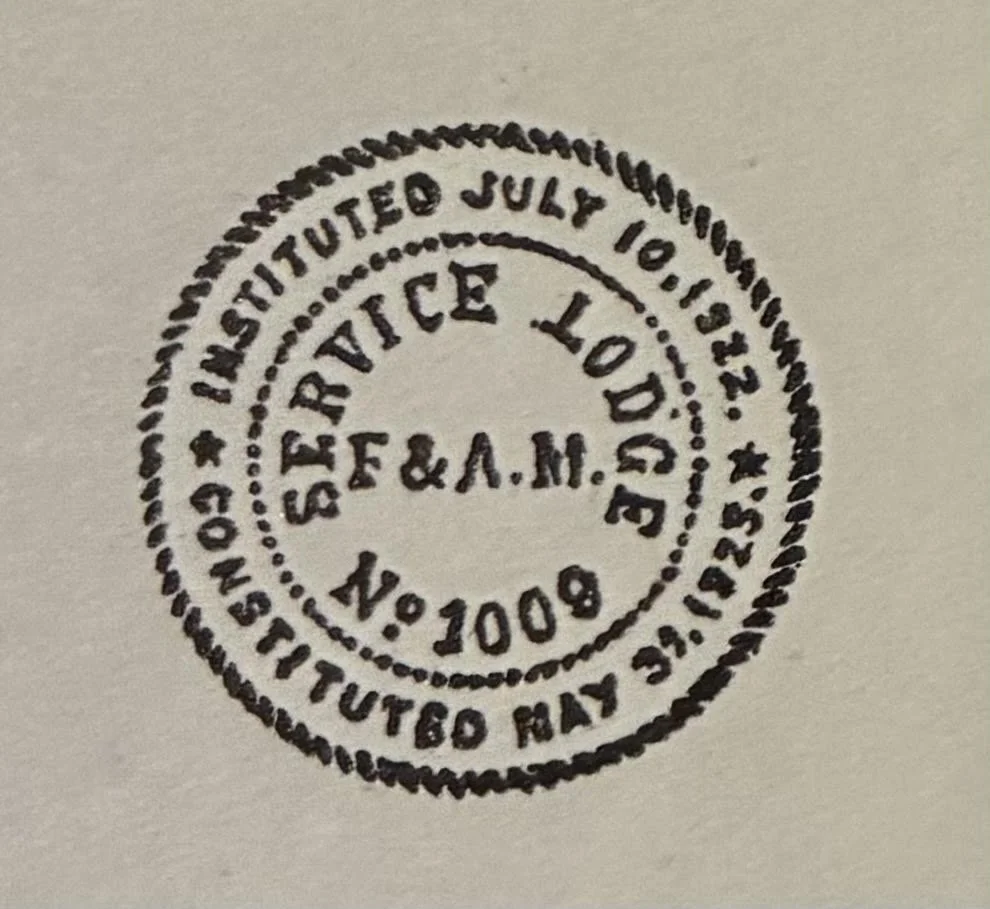
Service Lodge No. 1009 was chartered in Flushing on May 3, 1923. Its history survives largely in the bulletins of a working lodge, documents that place charitable giving beside degree work, anniversary dinners, and the occasional unsuccessful fishing trip.
In the summer of 1967 Service Lodge took its members fishing. Twenty-three signed up, and the Master’s report in the fall bulletin says that most of them were seasick.
“This certainly was not Service Lodge’s finest hour,” he wrote.
He then moved on to the evening at Yonkers Raceway, where nobody was seasick and nobody won, and to the summer bowling league, which he called the best event of all because everybody won.
Over fifty years the lodge raised money for charities, welcomed the district’s deputy grand masters, saw a past master go on to lead a new lodge in Bayside, and kept up a steady program of dinners, bowling leagues, and fishing trips. In 1973 it took in a lodge from Manhattan.
A Flushing Address and a Name Put to Work
Service Lodge was chartered in Flushing on May 3, 1923, per Grand Lodge records.
It met at the Flushing Temple at 137-70 Northern Boulevard near Union Avenue, a building built and run by Cornucopia Lodge No. 563. The notices in hand place its regular meetings there.
A 1936 Times Union item has the First Queens District’s deputy visiting the lodge at the Masonic Temple on Northern Boulevard, and a 1956 invitation gives the address.
The sources in hand do not describe the founding, name the first Master, or list the charter members. The earliest document in the packet is a list of Queens lodges from November 1929, when Service Lodge’s Master was Benjamin L. Shuter.
The name is unexplained, but the lodge’s own bulletins and journals use it freely. One Master wrote in a charity journal that the journal should become part of Service Lodge’s service to the community.
The lodge’s charity shows up in the clippings in two forms, the district’s and its own.
The district’s was the Queens Masonic Association’s annual charity ball. On November 22, 1929, the sixth ball filled the main ballroom of the Hotel Pennsylvania in Manhattan with about 2,000 people, and the lodges were assigned tiers of boxes.
Service Lodge’s Master that year, Benjamin L. Shuter, sat on the entertainment committee. The guest list included Grand Lodge officers, Justice Townsend Scudder, and Samuel A. Lando, Geba’s first Master, who was by then a grand director of ceremonies.
By 1936 the ball had moved to the Flushing Armory. The Times Union says it had been held for ten years, with the proceeds supporting a free employment bureau in Jamaica run by the Masonic lodges of Queens.
The lodge’s own giving is spelled out in a journal published for its thirtieth anniversary in 1953 under the Master, Harry H. Goebel.
The lodge had raised special funds for the Jewish Settlement House of the West Side, Camp Louemma, and the Masonic Foundation for Medical Research and Human Welfare. It gave every year to hospitals, the Federation, the United Jewish Appeal, war veterans, and the temples and synagogues of the community.
The list, and a rabbi and a cantor on the program of a 1946 joint communication, suggest ties to Flushing’s Jewish community.
In 1952 the lodge brought back a Fellowcraft team after a lapse of twenty-five years. In February of that year it joined Geba and King David Lodges in observing the two hundredth anniversary of George Washington’s initiation.
In October Raymond C. Ellis, then Deputy Grand Master, accepted honorary membership. The roll stood at 392 Master Masons, with others waiting on their degrees.
Ellis became Grand Master by 1955 and constituted Cardoza Lodge No. 1150 in Bayside on June 21 of that year, with William K. Borow, a past master of Service, presiding as the new lodge’s Master.
Brothers at the Lectern and a Collector at the Customhouse
In March 1956 the lodge held the homecoming of the First Queens District’s deputy, George J. Gross, at the Flushing Temple, under its Master, Bernard J. Manford.
In May it invited its Masonic friends to the 637th communication, held to celebrate the 175th anniversary of the Grand Lodge of the State of New York. Max S. Rosenzweig was to give a word picture of the Grand Lodge’s formation, with anecdotes.
Rosenzweig is the lodge member best documented in the packet.
A testimonial journal says he was raised in 1942, sat in the East in 1949, and served as Assistant Grand Lecturer of the district in 1958 and 1959.
He was a director of the Queens Masonic Study Club in 1953 and of the Queens Masonic Association from 1957 to 1959.
He had lived in College Point for more than fifty years, was a Scottish Rite Mason and a member of the American Lodge of Research, and was a known figure among Flushing’s merchants. In 1943 he was president of the men’s club of Temple Gates of Prayer.
He later moved to Florida, became a Shriner, and led the Empire State Club of Florida, an association of New York Masons there.
Another member, Ernest L. Chambre, belonged to a different world.
A New York consultant on U.S. Customs regulations at Leading Forwarders, Inc., on Stone Street in lower Manhattan, he was also an honorary Conservator of Customs. From 1948 he collected old Customs documents. By 1984 the collection had grown to some 23,000 items.
In August 1965 he wrote to a Brother Walker about an honor.
The mayor of Rochester had given him a citation for loyal and capable service and devotion to perpetuating American heritage, a long colored proclamation that was on exhibit at the New York Customhouse.
Customs Post No. 51 of the American Legion had sent him a color photograph of it. Its commander, John J. Coyne, wrote that the post appreciated the tremendous show he had put on at its meeting with his documents earlier in the year.
A copy of the photograph went to the Bureau of Customs in Washington.
In May 1984 the U.S. Commissioner of Customs, William von Raab, invited a small group of guests to Customs headquarters at 1301 Constitution Avenue to open an exhibit of historic documents on loan from Chambre’s collection, as the service marked its 195th anniversary.
The release describes thirty-three framed documents from pre-colonial days to the late 1800s. Among them were papers never before displayed that show trade between North and South during the Civil War.
It singles out as the most modern of them a document showing that in 1880 the Commissioner of Customs had to co-sign every expenditure over a dollar.
A Shared Calendar Through War and Peace
Service Lodge shared a building and a calendar with its neighbors.
In November 1946 four lodges held their tenth annual joint communication at the Mizpah Masonic Temple in Elmhurst: Anchor No. 729, Geba No. 954, King David No. 994, and Service No. 1009.
Their Masters were Frederick L. Zarnfaller, Bernhard Goldberger, Milton Haas, and Mitchell W. Smith.
The printed program has the lodge opening, a reception of delegations, a presentation of colors, an invocation by Rabbi Abraham Dubin, and vocal selections by Cantor Saul Kirschenbaum.
An address by Dr. Robert Brown, a missionary, on Masonry in war-torn China followed, then a collation.
A bulletin from April 1971 announces the thirty-sixth annual joint communication of Geba, Service, Brandeis, and King David Lodges, with Queens County District Attorney Thomas Mackell as the speaker.
The earliest bulletin in the packet, from February 17, 1942, is the Master’s message to the lodge in the first winter of the war.
A recent speaker had described how Masonry was being treated in the conquered countries of Europe. The Master wrote that it was a distinct indication that the Craft was threatened, and that several members had missed the address.
He announced that the Junior Warden would exemplify the first degree and urged members to bring a brother.
Two brethren, Harry Peritz and Robert Rubin, had joined the armed forces. The Master asked God to return them in good health, mind, and spirit when victory was achieved.
He then reminded the members, in capitals, that the dues were lagging and that they should send them now.
The trestle board lists five men awaiting the first degree: Martin Kaplan, Philip Schwartzman, Saul Kirschenbaum, Max S. Rosenzweig, and Philip Shapiro.
The district’s Grand Lecturer, Henry G. Meacham, was to preside over a convention at the Mizpah Temple on March 11.
The Business of Keeping a Lodge Together
The bulletins from the 1960s and early 1970s are the liveliest documents in the packet.
In September 1967 the Master reported on the summer.
Beyond the fishing trip and the raceway, the bowling league had been so successful that it was being extended through the winter as a mixed league at Whitestone Lanes, at a dollar a night per couple, with the surplus banked toward a weekend away.
W. Leonard Barend won a trophy for high game with a 232.
The Master added a few lines on his own year, which he called the busiest of his life, and thanked the officers and past masters whose example he had followed.
The 1968 bulletin by the Master, W. Edwin Rosenfeld, carries a sadder piece of business.
Over the summer the lodge had lost two past masters, Sidney Ritter and David Dinnerstein. Ritter had been Secretary for more than two and a half decades, and Rosenfeld delayed naming a successor for as long as he could.
Ritter’s widow, Ruth, then told him twice that unrecorded lodge business had piled up, correspondence was unanswered, and checks had not been deposited.
He appointed Abe Tannenbaum Acting Secretary and W. Lou Hacker Acting Treasurer.
The same bulletin announces the forty-fifth anniversary dinner dance on November 30 at a country club on Grand Central Parkway in Bellerose, in honor of R.W. Calvin Raff, the District Deputy Grand Master.
Fifteen dollars bought cocktails, a smorgasbord, a seven-course prime rib dinner, dancing, and a gift for every lady.
In April 1971 the Master thanked the officers who had honored five long-serving brethren: Sidney Leviss, Seymour Boyers, Emil Levin, Morton Greenspan, and Nathan Schobler.
A delegation from Hellenic Lodge No. 1129 had visited. Ladies Night had drawn a record crowd, too large for the hall, so that many were turned away. The Master promised a larger place next time.
He announced a combined communication of all seventeen lodges of the First Queens District on June 9 in the Holiday Inn ballroom at LaGuardia Airport, with Grand Master William R. Knapp as guest of honor.
There was also a flounder fishing trip on April 25 aboard the Corsair at Freeport for eight dollars. A Masonic blood bank was set for May 8 at the Cornucopia Masonic Temple.
A May 1972 letter invited every member to a reunion in the lodge room, to meet the brothers raised with him and the Master of his year. It also mentioned a recent rededication evening.
The Name That Stayed
In 1973 Service Lodge consolidated with City Lodge No. 408, which had been chartered in Manhattan in 1856, to form Service City Lodge No. 1009.
The older lodge’s number disappeared and Service’s stayed.
In 1982 Geba Lodge No. 954 joined, and the lodge became Service City Geba Lodge No. 1009.
On January 31, 2018, Service City Geba consolidated with Advance Island City Mizpah Lodge to form Advance Service Mizpah Lodge No. 586.
Service is the one name that survives in the title of every version of its branch, from 1923 to today.
The Merger History follows those consolidations. The Timeline places them alongside the charters, buildings, and moves of the other lodges in the series.
Service Lodge No. 1009 kept its number through the first two consolidations and left a good many of its bulletins. They show a membership that raised money, honored its own, took its chances on the sea, and kept coming back.
Sources and Notes
Working list from the Service Lodge source packet. Full bibliographic details remain to be completed where not supplied.
Newspapers
Brooklyn Eagle, November 23, 1929.
Daily News, June 12, 1955.
Times Union, November 22, 1936.
Lodge Bulletins and Journals
Service Lodge bulletins and notices, 1942–1972.
Service Lodge anniversary and testimonial journals; dates to be confirmed.
Printed invitations and programs, 1946 and 1956.
Ernest L. Chambre Documents
Ernest L. Chambre letter to Brother Walker, August 1965.
U.S. Customs press release concerning an exhibition of documents from Chambre’s collection, May 1984.
Charter and Consolidation Records
Grand Lodge records for charter and consolidation dates.
[Before publication: complete the bibliographic details, identify the specific Grand Lodge records consulted, and supply exact dates and document titles for the Chambre materials.]
Note 1: Dates, Names, Figures, and Limits of the Record
The charter date of May 3, 1923, is per Grand Lodge records, which resolves a conflict between 1923 and 1925 in earlier notes.
The Flushing Temple was built and run by Cornucopia Lodge No. 563 at 137-70 Northern Boulevard near Union Avenue.
The anniversary journal with Harry H. Goebel as Master is undated. Its mention of a lodge age of thirty years places it in 1953.
The testimonial journal for Max S. Rosenzweig is headed 1949, the year he was Master. Its text mentions his 1965–1966 Florida presidency and his move seven years earlier, placing the journal in the mid-1960s rather than 1949.
The 1946 program numbers the joint communication as the tenth, and the April 1971 bulletin calls its meeting the thirty-sixth. The counts differ by about a year.
The 1946 program misprints the Mizpah Temple’s address as 37-11 Whitney Avenue. The building’s address is 87-11 Whitney Avenue.
The 1967 bulletin does not name its author, and the 1971 bulletin is likewise unsigned.
The 1955 Daily News names Raymond C. Ellis as Grand Master, and the anniversary journal calls him Deputy Grand Master in 1952.
The 1952 Washington observance was held with Geba and King David Lodges.
The lodge’s charitable recipients and the rabbi and cantor on the 1946 program suggest ties to Flushing’s Jewish community. The sources do not explicitly characterize the lodge’s membership or religious composition.
Neither the 1965 letter from Ernest L. Chambre nor the 1984 press release about his collection of Customs documents names Service Lodge. His membership is confirmed by the lodge.
Chambre’s letter is addressed to a Brother Walker, who is not identified.
The sources in hand say nothing about the proceedings of the 1973 consolidation itself.
Start Here · Series Hub · Timeline · Previous Article: To Be Assigned · Next Article: To Be Assigned · Related Directory: Service Lodge Members · Related Member Profiles: To Be Assigned
Related Reading
City Lodge No. 408: Manhattan Roots in the Lineage of a Queens Lodge
Geba Lodge No. 954 and the Making of Modern Queens
Mizpah Masonic Temple: The Watchtower at the Center of Queens
Advance Service Mizpah Lodge No. 586: A Living Inheritance of Six New York Lodges
