Mizpah’s Watchtower in Old Newtown
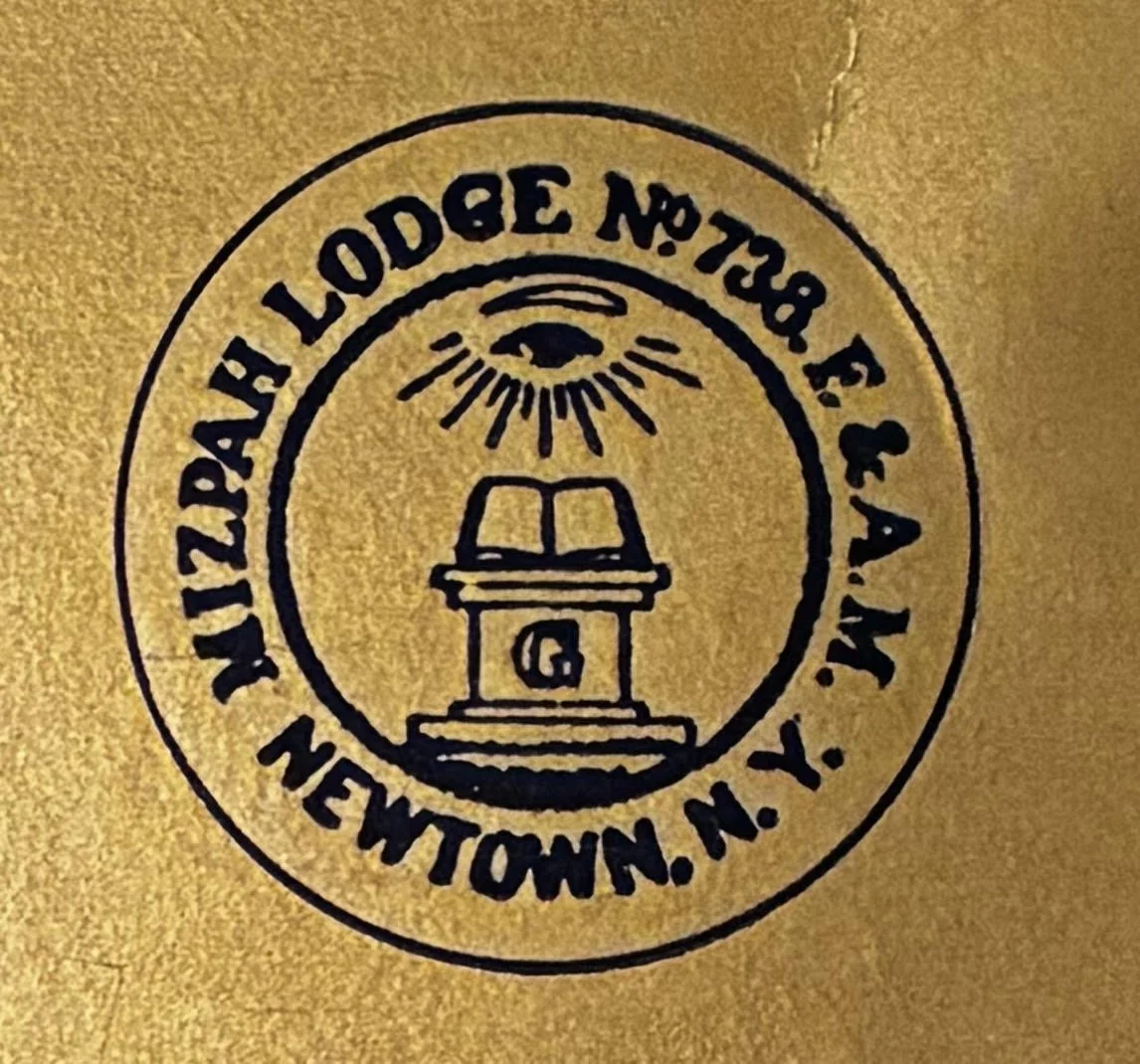
Official seal of Mizpah Lodge No.738, Elmhurst, Queens
How a Small Village Lodge Became a Guardian of Continuity in Elmhurst
Founded in 1873 when Newtown was still a village of farms, churches, and small shops, Mizpah Lodge No. 738 grew with Elmhurst—and ultimately became one of the enduring roots of Advance Service Mizpah Lodge No. 586.
The Queens Boulevard of today gives little hint of the village landscape that came before it. Traffic moves through Elmhurst in a steady current of buses, trains, storefronts, apartment buildings, schools, and families from every part of the world. Yet in 1873, this area was still known as Newtown: a farming and residential village with a small population, a handful of businesses, several churches, and a pace of life more rural than urban.^1
It had nearly everything a settled community required.
It did not have a Masonic lodge.^2
For local Masons, attending lodge meant traveling to Jamaica, Flushing, Hunter’s Point, or Astoria.^3 Those journeys were considerable in an era before automobiles, subways, and fast cross-borough travel.^4 A group of local brethren concluded that Newtown needed a lodge of its own—not only for the convenience of meetings, but for the fellowship, mutual aid, and civic presence that a lodge could provide.^5
They named it Mizpah.^6
A Name of Vigilance and Remembrance
“Mizpah” is a biblical word commonly translated as “watchtower.”^7 It evokes watchfulness, mutual responsibility, and the hope that those separated by distance will remain in one another’s care.^8
The name was well chosen for a lodge founded in a small Queens village. Mizpah Lodge would become an institution that watched over its traditions through dramatic changes in its neighborhood: from a rural community to a suburban district, then to one of the most densely built and culturally varied sections of New York City.^9
The lodge began with nine Master Masons who petitioned the Grand Lodge of the State of New York for a dispensation.^10 On February 13, 1873, Grand Master Christopher G. Fox granted permission for the formation of Mizpah Lodge.^11 Garret J. Garretson was named Master; S. Fisk Worthington, Senior Warden; and Samuel Douglass, Junior Warden.^12
Its first communication under dispensation took place on February 27, 1873, in Garretson’s law office.^13 The setting was modest, but its purpose was clear: Newtown now had the beginnings of its own Masonic home.^14
A Gift from Island City
Mizpah Lodge did not begin alone. Its founding was closely tied to Island City Lodge No. 586 of Hunter’s Point, which had helped the petitioners obtain their charter and shared its bylaws for Mizpah’s use while the new lodge worked under dispensation.^15
Within six weeks, Mizpah had secured rooms on the top floor of the Jebbens Building on Broadway.^16 The initial furnishings, supplied by charter members, cost $529.11.^17 At its first meeting in those rooms, Island City Lodge presented Mizpah with a Holy Bible, Square, and Compasses.^18
The gift was both practical and symbolic. A Masonic lodge needs tools, furniture, and ritual objects, but these items also convey continuity. The Bible remained associated with Mizpah’s important ceremonies, including installations, and generations of Masters took their obligations upon it.^19 The Square and Compasses became tangible links between the new lodge and the older Queens lodge that had assisted in its birth.^20
More than a century later, that early bond would be renewed through consolidation.^21 But in 1873, it was simply a generous act of Masonic succession: one lodge helping another find its footing.
A Charter in a Growing Village
Mizpah Lodge received its charter as No. 738 on June 27, 1873.^22 The constitutional ceremony was conducted by Right Worshipful Elwood E. Thorne, acting as Grand Master.^23 Under Garretson’s leadership, the lodge grew quickly.^24 By the end of his service as Master in 1876, Mizpah counted thirty-nine Master Masons.^25
Its growth paralleled the changing life of Newtown.^26 The village was still a recognizable local world of families, churches, small businesses, and civic associations.^27 The lodge became part of that world.^28 Its members participated in public ceremonies, helped lay cornerstones, supported community institutions, and established a fraternal presence that reached beyond the lodge room.^29
In the nineteenth century, voluntary associations often supplied the connective tissue of civic life. Churches, veterans’ posts, trade associations, benevolent societies, political clubs, and fraternal orders all helped people form networks of support and identity. Mizpah Lodge became one of Newtown’s most durable such institutions.^30
Its reputation spread beyond the village.^31 In 1885, George M. Williamson, a Past Master of Mizpah, was appointed District Deputy Grand Master of the First Masonic District, then encompassing all of Long Island outside Brooklyn.^32 His appointment gave the lodge a larger standing in the Masonic world of New York.^33
Newtown Becomes Part of New York
In 1898, Newtown became part of the newly consolidated City of New York.^34 The transformation was not merely political. It marked the beginning of a new urban future for the community.^35
Farms and open land gradually gave way to streets, transportation routes, commercial development, new housing, and a steadily rising population.^36 The village did not vanish overnight, but its scale and character changed.^37 Newtown became increasingly known by the name Elmhurst, and the local world that had formed Mizpah Lodge was absorbed into the expanding metropolis.^38
Mizpah adapted.
^39The lodge’s twenty-fifth anniversary in 1898 was marked by the return of its first Master, Garret J. Garretson, to the East.^40 The moment connected the lodge’s village origins with the new city era that had begun around it.^41
By 1905, Mizpah moved into Arcanum Hall on Broadway in Elmhurst.^42 The new quarters reflected both practical growth and the lodge’s place in an increasingly urban neighborhood.^43
Building a Temple in Elmhurst
The first decades of the twentieth century brought even greater changes to Queens. New subway and rail connections, street improvements, new housing, and migration from Manhattan and Brooklyn accelerated the transformation of Elmhurst.^44
Mizpah Lodge grew alongside the neighborhood.^45 Its work was recognized through Grand Lodge appointments, including that of Charles H. Georgi as Grand Steward in 1907 and Joseph N. Wickham as District Deputy Grand Master in 1915.^46
Wickham held a particularly important place in Mizpah history.^47 Known affectionately as “Doc” Wickham, he installed the lodge’s officers regularly from 1912 through 1946.^48 His influence extended well beyond formal ceremony. He shaped generations of officers by impressing upon them the responsibilities of leadership and the obligations of service to the lodge.^49
As membership and activity increased, the brethren began planning a permanent temple.^50 In 1916, they acquired a suitable site for $6,000.^51 Construction began in 1919.^52 On January 1, 1920, Right Worshipful Robert H. Robinson, Deputy Grand Master, acting as Grand Master, laid the cornerstone.^53
Building a Masonic temple required more than aspiration.^54 Costs rose, funds had to be raised, and members had to contribute their time and support.^55 Mizpah’s Star Chapter No. 484, Order of the Eastern Star, joined in the effort by helping sponsor a bazaar in the unfinished temple.^56 The event helped defray construction costs and demonstrated the broader family of Masonic organizations working together in Elmhurst.^57
Mizpah Temple was dedicated on March 17, 1921, with Grand Master Robert H. Robinson and the full Grand Lodge staff present.^58 The building became more than a meeting place for one lodge.^59 It developed into a center for district activity, ritual instruction, official visits, social events, and the wider work of Queens Masonry.^60
A Home for Masonic Instruction
One of Mizpah Temple’s most important roles was educational.^61
From 1928 onward, it hosted the Masonic School of Instruction, where officers from across the district could develop their ritual proficiency and learn the responsibilities attached to lodge office.^62 The temple became a place where the traditions of New York Masonry were not merely preserved but actively taught.^63
Several Mizpah members served as Assistant Grand Lecturers, including William J. McCulloch, Frederick E. Shore, George F. de Jongh Jr., and Robert J. Lawton.^64 Their work helped sustain the ritual standards that were central to the lodge’s identity.^65
This commitment to instruction mattered because Mizpah’s neighborhood was changing rapidly.^66 Elmhurst was becoming more densely populated, more culturally diverse, and more thoroughly urban.^67 A lodge could not remain exactly as it had been in 1873. But it could preserve the core practices that gave its members a sense of continuity across generations.^68
The temple became a watchtower in the fullest sense: a place from which to observe change while maintaining a connection to the past.^69
The Long Road to Consolidation
By the later twentieth century, the conditions that had created many local lodges had shifted.^70 Membership patterns changed. Neighborhood demographics evolved. Maintenance costs increased.^71 The large network of voluntary associations that had flourished in earlier decades faced new pressures.^72
Mizpah’s answer was not to abandon its identity but to join its history with that of a lodge that had been linked to it from the beginning.^73
Island City Lodge No. 586 had presented Mizpah with its original Bible, Square, and Compasses in 1873.^74 More than a century later, Island City and Mizpah consolidated, bringing the two histories into one body.^75
The combined lodge became Island City Mizpah Lodge No. 586.^76 In 1993, it joined Advance Lodge No. 635 of Astoria, creating Advance Island City Mizpah Lodge No. 586.^77 In 2018, that lodge united with Service City Geba Lodge No. 1009 to form Advance Service Mizpah Lodge No. 586.^78
The name Mizpah remains visible in the present lodge because the history it represents remains essential.^79
The Watchtower Still Stands
Mizpah Lodge was born in a community of farms, churches, village streets, and small businesses.^80 It lived through consolidation, urban growth, immigration, transit expansion, changing neighborhoods, and the rise of modern Queens.^81
Its history is a reminder that institutions do not survive by refusing change. They survive by carrying their deepest commitments through change.^82
The original lodge room on Broadway is gone. The village of Newtown has become Elmhurst. The men who first gathered in Garretson’s law office have long passed into history.^83
But the principle behind Mizpah endures: that fellowship requires vigilance, that memory requires stewardship, and that a community is strengthened when people commit themselves to one another across time.^84
Today, every meeting of Advance Service Mizpah Lodge No. 586 carries forward that watchtower’s light.^85
End Note
Author’s note:
I write as an individual Freemason, historian, and researcher. This article reflects my personal research and interpretation and does not represent an official statement of Advance Service Mizpah Lodge No. 586, the Grand Lodge of New York, or any other Masonic organization.
Image:
Author's private collection
Literary:
Sources to come - Researchers feel free to request on my contact page.
Related Links
- Advance Service MIzpah 586 article
- Read our overview of the history of Masonic lodges in Queens
- See our guide to Masonic buildings in Queens
- Learn more about Geba Lodge 954 and modern Queens history
- Read about the history of Advance Service Mizpah Lodge 586
- Explore the history of Middletown and German settlement in Queens