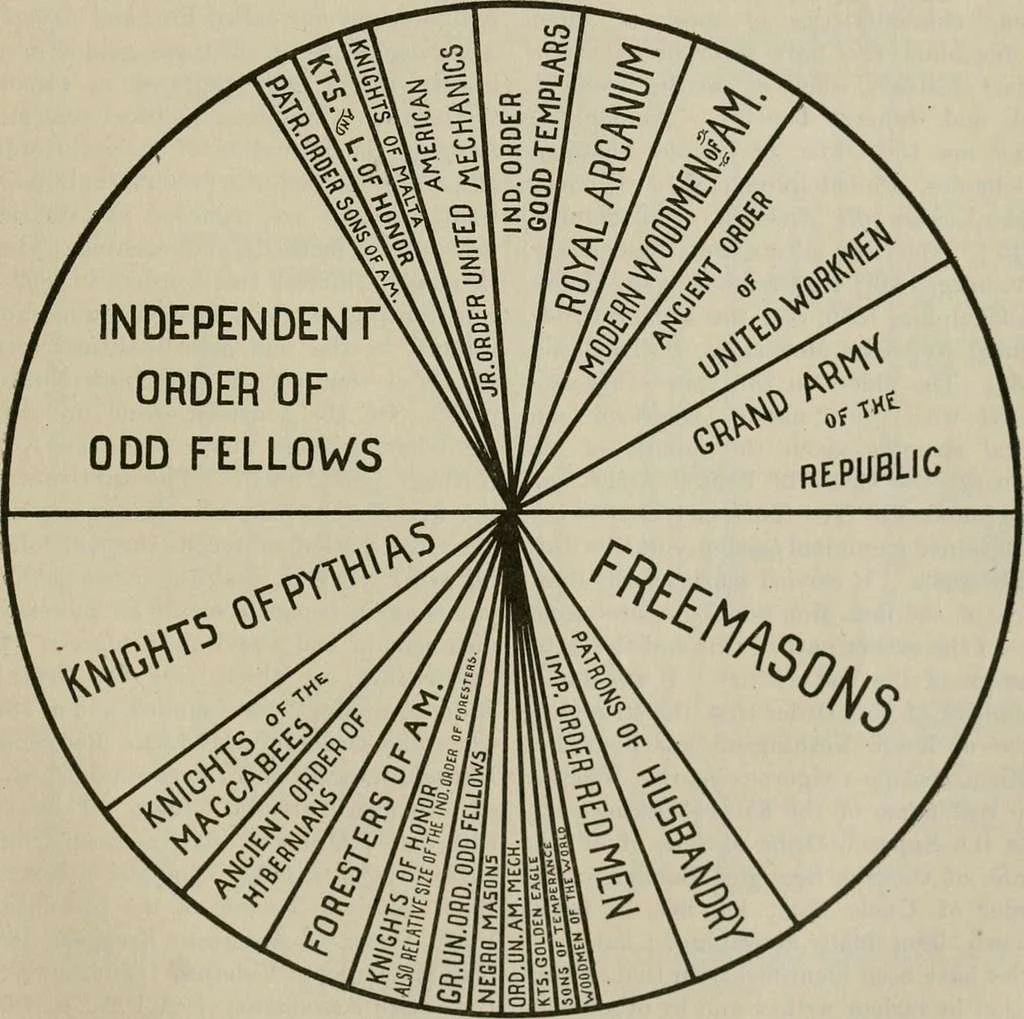
The Cyclopædia of Fraternities, 1899. Public domain.
Masons, Odd Fellows, Pythians, Elks, Rotarians and occultists: how to tell them apart, and why it matters when you find one in the record.
An 1890s obituary from Astoria might list a man as a Mason, an Odd Fellow, a member of the Workmen and a fireman, all in one sentence. To a family historian today those memberships can blur together into one vague idea of a "secret society." They were different things. Each order had its own purpose, its own way of recruiting, and its own kind of paper trail.
This article sorts the orders that met in Queens into types, explains what each was for, and shows where they overlapped. Freemasonry sits at the center, because so many other orders borrowed its forms. It was never the only show in town. For the full story, order by order, read The Lodges That Built Queens.
Secret or Private?
Freemasons have long described their fraternity as a society with secrets rather than a secret society. Lodge meetings, ritual and modes of recognition are private. Membership, meeting places and officers were not. Queens lodges published their elections in the newspapers, laid cornerstones in public and marched in parades. The same is true of most orders on this page. The truly secret part of fraternal life was the ritual, not the membership. (See also Why Secrecy Is Not the Same as Wisdom.)
Freemasonry
The oldest and most widespread of the orders, organized in local lodges under a Grand Lodge. Its purpose is moral and philosophical, taught through ritual, and it has never been an insurance society. A Masonic register usually records age, trade, birthplace and the date a man was raised, which makes it unusually good evidence. Related bodies, such as the Royal Arch, the Knights Templar commanderies and the Shrine, are open only to Master Masons. Read more: What Freemasonry Is and Raised in Queens.
Practical Fraternal Orders
These orders borrowed lodge forms and ritual but put mutual aid at the front: sick benefits, burial help and care for widows. The Other Brotherhoods covers them in depth.
Independent Order of Odd Fellows. Organized in the United States in 1819, when Washington Lodge No. 1 was instituted in Baltimore. Its lodges are led by a Noble Grand. Many early Astoria Masons were also Odd Fellows. Cornelius R. Morris and James Whitcomb of Advance Lodge appear on the rolls of Astoria Lodge No. 155, I.O.O.F.
Knights of Pythias. Founded in Washington, D.C., in 1864. Its local units are lodges, and their meeting places are called castle halls. A building named Castle Hall is a clue worth checking.
Benevolent and Protective Order of Elks. Founded in New York City in 1868 by actors and entertainers who first called themselves the Jolly Corks, then a national order. See The Bowling Alley and the Bronze Elk.
Loyal Order of Moose and Knights of the Golden Eagle. Later orders with strong mutual-aid and social sides.
Fraternal Benefit Societies
Some orders were, at heart, life insurance with ritual attached. The Ancient Order of United Workmen, founded in Meadville, Pennsylvania, in 1868, and the Royal Arcanum, founded in Boston in 1877, sold death benefits through local lodges. In Queens, John Allen of Advance Lodge organized John Allen Lodge No. 330 of the A.O.U.W., and Henry Clay Johnson was a past master of both. Arcanum Hall, a Royal Arcanum meeting place, also hosted Masonic lodges. A benefit-society certificate in family papers is a financial record as much as a fraternal one.
Religious and Ethnic Orders
Knights of Columbus. Founded in New Haven, Connecticut, and incorporated in 1882 as a Catholic fraternal benefit society, offering insurance and fellowship to Catholic men. Its councils left records in parish life. See Council and Parish.
Immigrant-language lodges. German-speaking lodges and societies were a large part of Queens fraternal life. The Whitestone temple is now reserved for the German Masonic District. See In the Mother Tongue.
Prince Hall Freemasonry
Prince Hall Masonry traces its origin to African Lodge No. 459 of Boston, warranted by the Grand Lodge of England on September 29, 1784. Shut out of white lodges, Black Masons built their own Grand Lodges, which became among the most important Black institutions in American life. Their history in Queens deserves its own careful article, written from the records that survive. For exclusion and access in Queens fraternal life, see The Door That Was Closed.
Women's Orders
The Order of the Eastern Star, open to Master Masons and their female relatives, gave women their own chapters and offices. It is different from the unpaid labor many women gave to men's lodges through dinners, fairs and fund drives, such as the fair that opened the Advance temple in 1916. Both kinds of work show up in the record, and they should be read differently. See Mrs. John and the Committee on Refreshments.
Service Clubs
Rotary, founded in Chicago in 1905, and Lions, organized in Chicago in 1917, look like fraternities but work differently. They recruit through business and professions, meet over lunch, and aim their work at community projects. They have no secret ritual. In local papers they appear alongside lodges, often with the same members. See The Weekly Lunch.
Esoteric Orders
The Hermetic Order of the Golden Dawn, founded in London in 1888, and later bodies such as the O.T.O. and various Rosicrucian groups are sometimes lumped in with fraternities. They are better understood as schools of occult study and practice. Their footprint in Queens is thin, and claims of continuity often come from the internet era, not the archive. Treat them with care. Read more: The Other Mysteries, Who Gave Freemasonry Its Occult Reputation? and The Lodge, the Thoughtform, and the Work.
Craft and Professional Societies
Some societies borrowed lodge habits without being lodges. The Society of American Magicians, founded at Martinka's magic shop in New York in 1902, had W. Golden Mortimer of Advance Lodge as its first president. Its forms resemble Masonic practice, which fits a founder steeped in lodge life, but the resemblance is not proof that it was modeled on Freemasonry.
A Quick Field Guide
Freemasonry. Purpose: moral and philosophical fellowship. Ritual: yes, private. Typical record: lodge register, Grand Lodge returns.
Practical fraternal orders. Purpose: mutual aid and sociability. Ritual: yes. Typical record: lodge rolls, sick-benefit records.
Fraternal benefit societies. Purpose: life insurance. Ritual: yes, light. Typical record: benefit certificates, policies.
Religious orders. Purpose: faith-based fellowship and insurance. Ritual: yes. Typical record: council records, parish papers.
Women's orders. Purpose: women's own fraternal work. Ritual: yes. Typical record: chapter rolls, officer lists.
Service clubs. Purpose: community service, business networking. Ritual: no. Typical record: club minutes, newspaper notices.
Esoteric orders. Purpose: occult study and practice. Ritual: yes, initiatory. Typical record: private papers, publications.
Reading the Record
When a membership shows up in an obituary, a census note or a family trunk, ask three questions. Which order exactly? What was it for? And what records would it have kept? The answers tell you where to look next, and stop a Workmen's insurance certificate from being mistaken for a Masonic one. For pins, aprons and certificates, see Same Apron, Different Animal.
Sources
Grand Lodge of Pennsylvania, I.O.O.F.: founding of Washington Lodge No. 1, Baltimore, 1819
Supreme Lodge, Knights of Pythias: history and founding, February 19, 1864
Phoenixmasonry Masonic Museum: Ancient Order of United Workmen, Meadville, 1868
Encyclopedia of Oklahoma History and Culture: Civic Clubs (Rotary, 1905; Lions, 1917)
Prince Hall Grand Lodge of Massachusetts: African Lodge No. 459
Museum of Freemasonry archive: The Hermetic Order of the Golden Dawn, founded 1888
Society of American Magicians (founded May 10, 1902, at Martinka's)
Advance Lodge No. 635 records; Astoria Lodge No. 155, I.O.O.F., member list
End Notes
Author’s note:
I write as an individual Freemason, historian, and researcher. This article reflects my personal research and interpretation and does not represent an official statement of Advance Service Mizpah Lodge No. 586, the Grand Lodge of New York, or any other Masonic organization.
Literary:
Albert Clark Stevens, The Cyclopædia of Fraternities: A Compilation of Existing Authentic Information and the Results of Original Investigation as to More Than Six Hundred Secret Societies in the United States, 1899, New York City and Paterson, N.J.: Hamilton Printing and Publishing Company; digitized by the University of California Libraries; public domain; via Wikimedia Commons/PICRYL.
