The Clashing Rocks
Why Every Serious Journey Requires a Test of Judgment
The Symplegades do not yield to brute force. Jason must watch, wait, interpret, and act at the right moment. The lesson is simple: courage without judgment is merely speed on the way to a collision.
Some problems cannot be solved by pushing harder.
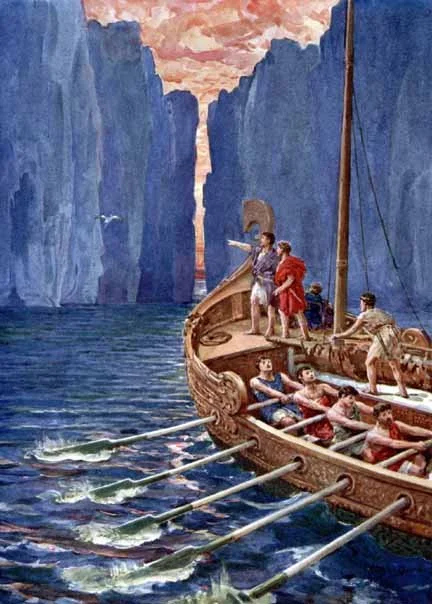
The Symplegades—the Clashing Rocks—guard the entrance to the Black Sea. They collide with such force that no ship can pass. The ancient world placed them at the edge of danger, where the known Mediterranean gives way to a region of remote peoples, unfamiliar rulers, and uncertain return.
The problem is clear.
A person facing the Rocks has several options.
He may panic.
He may charge.
He may form a subcommittee.
Jason does something rarer.
He takes counsel.
The blind seer Phineus tells the Argonauts to send a dove through first. If the bird makes it through, they must row with all their strength while the Rocks recoil. The dove survives, though it loses tail feathers. The Argo passes, though it loses part of its stern ornament. The ship is damaged, but not destroyed.
Everyone keeps the more essential equipment.
The point is not that success comes without damage.
The point is that judgment identifies the moment when courage may act effectively.
The dove before the ship
The dove is reconnaissance.
It is a small test before an irreversible commitment.
Ancient epic makes this picturesque. Ordinary life calls it due diligence.
The moral reader need not turn the bird into an esoteric code. Its function is already philosophical. A wise person tests reality before committing all his strength to it.
This is not cowardice. It is prudence.
Prudence has suffered from a public-relations problem. It is often confused with timidity, hesitation, caution for its own sake, or the dull preference for never doing anything that might produce a memorable story.
But ancient ethics gives prudence a stronger role. It is practical wisdom: the capacity to discern what should be done, when it should be done, by whom, and in what measure.
The prudent person does not avoid danger because danger exists.
He avoids stupidity because stupidity is not a virtue.
The Argonauts do not wait forever before the Rocks. They do not send five more doves while writing a report on the first dove’s tail. They test, interpret, decide, and act.
That is courage under the direction of judgment.
Counsel is not weakness
Jason’s leadership is often criticized because he needs help.
This criticism misses much of the poem’s deeper intelligence.
A leader who refuses counsel is not strong. He is merely alone with his errors.
The Argonauts survive because knowledge is distributed across the fellowship. Phineus sees what Jason cannot see. Orpheus gives harmony where strength is not enough. Argus builds. The sons of Boreas move quickly. The crew rows. Jason must decide, but he does not invent every element of the decision from himself.
This is how serious work usually happens.
The myth of the isolated leader is powerful because it flatters the imagination. One brilliant person sees the path, makes the choice, solves the crisis, and receives the credit while standing against a dramatic sky.
Reality is less photogenic.
Good leadership often consists of recognizing who knows what, listening before vanity fills the room, acting before caution becomes paralysis, and taking responsibility for the decision once counsel has been received.
Jason does not become less of a leader because he needs Phineus.
He becomes more of one because he understands that the voyage is not about proving that he already knows everything.
The discipline of the pause
The Clashing Rocks are what life feels like when urgency arrives before understanding.
A family decision cannot wait forever. A community crisis requires action. A lodge must make a difficult choice. A person must accept or refuse an opportunity. A relationship has reached the point where silence has become a decision of its own.
The temptation is to act quickly because movement feels like control.
But movement is not always progress.
The dove represents the disciplined pause: a moment of inquiry before irreversible action. It asks:
What do we know?
What do we assume?
What is the actual danger?
What test can be made before total commitment?
Who has knowledge that we lack?
What will it cost if we are wrong?
When is the moment to row?
This is not glamorous. It is the moral form of intelligence.
A person who can pause before acting has not lost courage. He has placed courage under command.
The Middle Chamber and discernment
The liberal arts and sciences train precisely this power.
Logic teaches a person not to confuse confidence with proof.
Rhetoric teaches that words can move people for good or ill.
Grammar teaches the difference between what has been said and what was actually meant.
Geometry teaches relation, measure, and proportion.
Arithmetic teaches that numbers do not become more truthful because they are shouted.
Astronomy teaches attention to an order beyond immediate appetite and local panic.
This is why education belongs to moral formation. It does not merely make a person informed. It can make him less easily manipulated by fear, hurry, flattery, and spectacle.
The Middle Chamber, read philosophically, is a school of discernment.
The Clashing Rocks are what happens when discernment is absent.
A person may have courage, energy, enthusiasm, resources, and a very impressive oar. Without judgment, he still rows into stone.
The necessary damage
There is another lesson in the passage.
The dove loses feathers. The Argo loses part of its stern.
The voyage succeeds, but it leaves marks.
This is honest.
A serious decision may be right and still cost something. A person may choose courage and still lose comfort. A fellowship may do what justice requires and still disappoint people. A leader may act prudently and still suffer criticism, misunderstanding, or damage.
The promise of wisdom is not that it will make every passage painless.
It is that it may prevent pain from becoming ruin.
The Argonauts do not pass the Rocks because they are fearless.
They pass because fear, courage, counsel, timing, and action are finally brought into right relation.
Endnotes and further reading
Apollonius Rhodius, Argonautica Book 2, for Phineus’ instructions and the Argonauts’ passage through the Symplegades.
Pindar, Pythian 4, also includes the Clashing Rocks among the dangers of Jason’s voyage.
On the Argonautica’s interest in vulnerable agency, counsel, and the uncertain nature of heroic success, see modern discussion of Apollonius’ morally and psychologically complex epic.[2][6]
Aristotle, Nicomachean Ethics Book VI, on phronēsis—practical wisdom or prudence.
Related reading: “The Middle Chamber of the Mind” and “The Argo Is Not a Solo Project.”