Penelope’s Loom, the Middle Chamber, and the Art of Returning Home
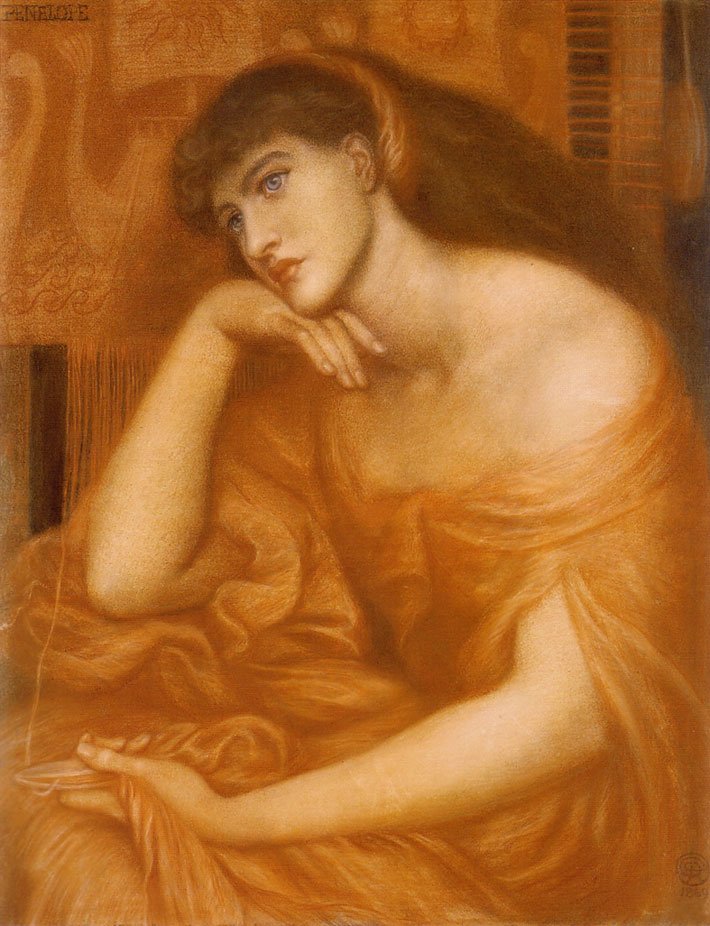
Penelope contemplating at her loom
Penelope weaves by day and unweaves by night. Ulysses wanders at sea. Between them lies one of the oldest philosophical questions: how does a life remain faithful to order while everything around it changes?
Penelope spends her days weaving a burial shroud and her nights quietly undoing the work.
It is one of the most famous acts of intelligent delay in literature. The suitors press her to choose a husband. She agrees—after she finishes the shroud for Laertes. By day she weaves; by night she unweaves. The deadline remains forever just around the corner, where it has an excellent view of the sea.
But Penelope’s loom is more than a clever plot device. In a philosophical reading of the Odyssey, it becomes an image of order maintained against disorder. While Ulysses wanders through a world of storms, enchantments, appetites, and false havens, Penelope preserves the possibility of home.
The soul’s return requires both figures: the voyager who learns through ordeal, and the weaver who keeps the pattern from being destroyed.
The household of the soul
The Odyssey ends not when Odysseus steps onto Ithacan soil, but when he reclaims his house. The suitors have consumed his wealth, dishonored his household, abused hospitality, and placed themselves between the rightful ruler and his home.
In a Platonic or Taylorian frame, they readily suggest disordered claims upon the soul: appetites, vanities, compulsions, false opinions, and intrusive desires that occupy the inner house while the rational principle is absent or weakened.
The image is not subtle, and it need not be. We all know what it is to return to ourselves and find the house in disorder. The furniture of attention has been moved. The cupboards of judgment are empty. The worst guests are still there, explaining why they cannot leave.
Odysseus’ task is not revenge in the narrow sense. It is restoration. The household needs rightful order.
Weaving as intellectual and moral work
Porphyry’s cave contains looms. The Nymphs weave purple garments, and Porphyry associates weaving with the formation of embodied life. The body is, in one sense, a garment the soul wears; life in the world is an intricate fabric of necessity, sensation, time, and form.[4][9]
Penelope’s loom gives the image an ethical dimension. A life must be woven. Character is made by repeated acts, remembered commitments, habits of attention, and the patient refusal to let every demand seize the pattern.
This is why education matters. The liberal arts do not merely fill time between youth and employment. They give the mind threads strong enough to weave with: language, number, proportion, evidence, reasoning, memory, rhythm, and the capacity to see a part in relation to a whole.
A person without these habits is not necessarily wicked. He is simply more vulnerable to being woven by someone else.
The Middle Chamber as a place of return
The Middle Chamber may be read, philosophically, as a destination of earned understanding. Its ascent suggests that knowledge has conditions: discipline, effort, memory, proportion, and a willingness to become more than one was at the foot of the stair.
Porphyry’s cave offers a related idea. The world is full of signs, forms, thresholds, and passages. But one must learn how to read them. Taylor’s Ulysses is not saved by being carried through the voyage unconscious. He returns by learning, suffering, choosing, and receiving help.
That is the philosophical heart of the Middle Chamber comparison. The Mason does not flee the world; he is educated to re-enter it with better judgment. Ulysses does not leave Ithaca behind for a superior fantasy; he returns to it able to restore its moral and domestic order.
The journey inward should make the outward life more responsible.
Home, finally
The word “home” has become sentimental from overwork. It suggests slippers, warm lamps, and an aggressively friendly casserole.
For the Platonist, home is more exacting. It is where the soul is properly ordered. It is where reason governs without tyranny, appetite serves without rebellion, courage protects without becoming rage, and justice gives each part its rightful place.
That sort of home is not handed to anyone. It is made, often slowly, and occasionally after a shipwreck.
Odysseus reaches Ithaca. Penelope preserves the pattern. The household is restored. The soul, after wandering, begins the more difficult work of living as if it has learned something.
Endnotes
Homer, Odyssey Books 2 and 19, on Penelope’s weaving; Book 23, on recognition and restoration; Book 24, on the final settlement of Ithaca.
Porphyry, On the Cave of the Nymphs, on the Nymphs’ looms, embodiment, and the symbolic structure of the Homeric cave.[4][9]
Thomas Taylor, “An Explanation of the Allegory of the Wanderings of Ulysses,” appended to his 1823 Select Works of Porphyry.[1][2]
Robert Lamberton, Homer the Theologian, for the wider late antique tradition of philosophical Homeric interpretation.[14][15]
K. Nilüfer Akçay, Porphyry’s On the Cave of the Nymphs in Its Intellectual Context, for modern scholarship on cosmology, soul, embodiment, and allegorical method in Porphyry.[7][8]