The Argo Is Not a Solo Project
Fellowship, Skill, and the Making of a Crew
The Argo carries heroes stronger, older, stranger, and in some cases more famous than Jason. Its real lesson is not individual greatness but the difficult art of gathering different gifts into one voyage.
The crew of the Argo is the ancient Greek equivalent of a committee assembled by a person with dangerous optimism.
It includes Heracles, Orpheus, Castor and Polydeuces, Peleus, Telamon, Argus the shipbuilder, Idmon the seer, Mopsus the prophet, and a parade of men who could individually ruin a quiet evening by mentioning their lineage.
Jason leads them.
This is the point.
Many of the Argonauts are more famous than Jason. Heracles is stronger. Orpheus has divine music. Castor and Polydeuces have extraordinary martial gifts. Peleus and Telamon possess heroic reputations that will echo into the next generation through Achilles and Ajax. Some members of the crew have clearer visions, more specialized skills, or more dramatic biographies.
Jason is not the most impressive man on the ship.
He is the man responsible for getting the ship moving.
A crew is not a crowd
A crowd may contain talent.
A fellowship requires relation.
This is the difference between gathering a room full of distinguished people and creating an institution capable of doing something worthy. The first can be accomplished with invitations. The second requires work.
The Argo works because its members are not asked to become identical. They are asked to become cooperative.
One sees. Another sings. Another builds. Another fights. Another counsels. Another rows. Another bears an emotional burden that no one else fully understands. The journey depends upon differences of ability, but it also depends upon the willingness of those abilities to serve something beyond individual prominence.
This is the ancient lesson hidden inside every committee, lodge, historical society, volunteer corps, orchestra, neighborhood group, and family dinner.
Different gifts do not automatically create harmony.
They often create rivalry.
The strong man expects to lead because he is strong. The clever man expects to lead because he sees what others miss. The well-spoken man expects to lead because he can explain the matter attractively. The experienced man expects to lead because he has been present longest. The enthusiastic newcomer expects to lead because no one has yet explained the budget.
A fellowship survives only when its members learn that capacity is not a private possession. It is a contribution.
The ship that speaks
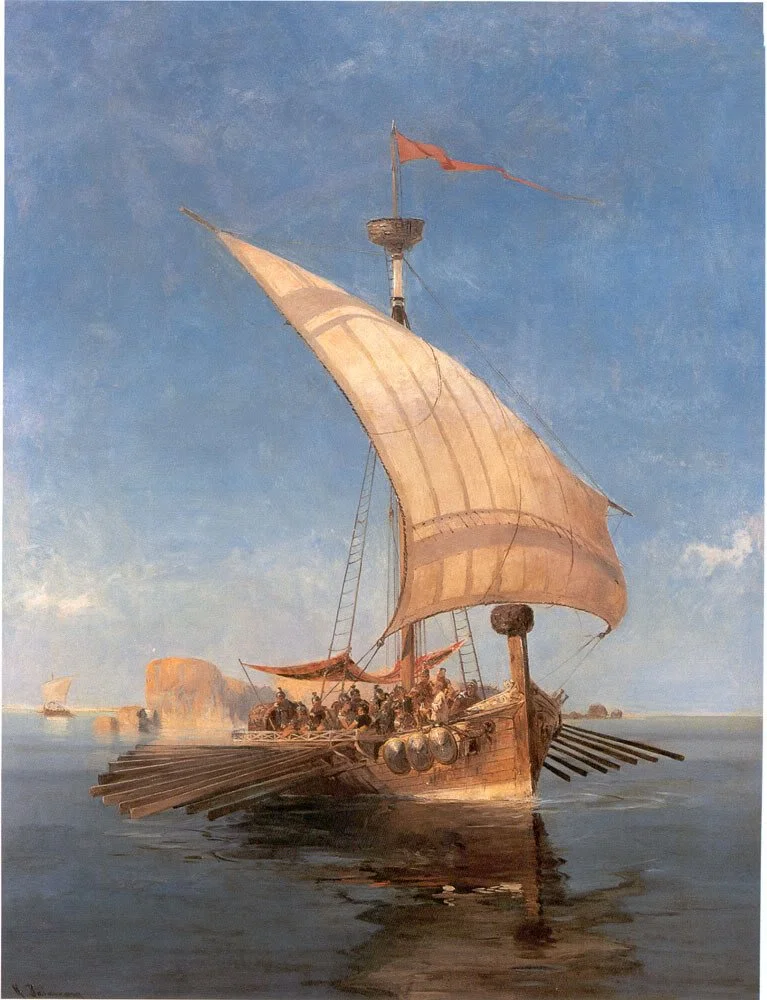
The Argo is no ordinary vessel.
In later tradition, a sacred piece of oak from Dodona—the oracle of Zeus—is built into its prow. The ship can speak. Whether one reads this literally as myth or symbolically as a poetic image, the idea is suggestive: the vessel carries not merely timber and sailors, but intelligence, memory, divine orientation, and common purpose.
A ship is a structure in which no one survives by private excellence for long.
The finest oarsman cannot row the whole vessel. The strongest warrior cannot fight a storm. The best navigator cannot guide a ship whose crew refuses to pull together. A vessel needs craft, discipline, leadership, courage, timing, and mutual dependence.
A lodge works similarly when it works well.
Its life is not reducible to the Worshipful Master, the officers, the best ritualist, the historian, the newest member, the oldest member, the best cook, the loudest voice, or the person who knows where the storage closet is.
A lodge is a vessel.
It exists to carry persons through shared work toward a common purpose. Its members may have very different talents. Its health depends upon whether those talents are joined by trust, proportion, responsibility, and the ability to place the whole above private display.
A ship can survive rough weather.
It cannot survive a crew that treats the voyage as a competition for the helm.
Orpheus: harmony before strength
Orpheus is essential to the Argo.
He is not merely a musician brought along to improve morale during long crossings. In Apollonius, his music establishes order. At the beginning of the voyage, he sings of the creation and ordering of the cosmos. His song places human action within a larger pattern. Later, he helps defeat threats that cannot be overcome by force alone, especially the Sirens, whose destructive music he counters with his own.[2][5]
Orpheus represents a truth that strong groups often forget.
Before a fellowship can confront monsters, it must learn not to become one.
Strength without harmony becomes noise.
Talent without measure becomes rivalry.
Speech without listening becomes confusion.
Ambition without shared purpose becomes faction.
Orpheus does not remove difference from the crew. He gives difference a common measure.
Music provides the right image. Harmony is not a single note played repeatedly by people who have agreed never to disagree. Harmony is distinct notes held in meaningful relation. A chorus does not become beautiful because every singer has the same voice. It becomes beautiful because the voices understand timing, proportion, and relation to the whole.
That is fellowship at its best.
Heracles leaves the ship
Heracles’ departure from the Argo after the loss of his beloved Hylas is one of the poem’s most revealing moments.
The strongest hero does not complete the voyage.
Heracles is indispensable in certain scenes. His presence lends force, prestige, and confidence to the expedition. Yet the Argonautic quest continues without him.
This is not an insult to Heracles. It is a lesson in proportion.
No fellowship can be organized entirely around one remarkable person’s strength, grief, reputation, or private mission. Individuals matter. Great individuals may matter enormously. But if a shared work can survive only while one person dominates every function, then it has not become a fellowship. It has become an entourage.
The Argo survives Heracles’ departure because the task is larger than any one hero.
This is useful for any fraternity or civic body. A lodge should honor distinguished brethren, skilled officers, gifted teachers, and devoted servants. It should not become incapable of continuing when one of them departs.
The work must be bigger than the personality.
The ship must keep moving.
Leadership without possession
Jason’s leadership is not the leadership of the solitary genius. It is not the leadership of a man who has every answer before anyone else finishes the question.
It is the leadership of someone who must gather counsel, receive help, distribute responsibility, face conflict, inspire action, and accept the difficult fact that others may possess gifts he does not.
This can feel less heroic than Heracles with a club.
It is often more difficult.
A leader who must always appear self-sufficient becomes a danger to the people he leads. He begins hiding uncertainty, rejecting correction, and treating help as an insult. He becomes alone with his errors.
Jason’s dependence is not always admirable. Later, it becomes morally troubling. But the voyage begins with a necessary lesson: no serious work is completed alone.
The Argo is not a solo project.
Neither is a life worth building.
Endnotes and further reading
Apollonius Rhodius, Argonautica Book 1, for the catalogue of Argonauts, Orpheus’ ordering song, and the departure of Heracles after Hylas’ disappearance.
On Orpheus as an active and significant figure in Apollonius’ epic, see scholarship on his role in the Argonautica.[5]
The later Orphic Argonautica gives Orpheus a still more prominent role; it is useful for reception history but should not be treated as evidence for Apollonius’ original poetic design.[2]
Richard L. Hunter, The Argonautica of Apollonius: Literary Studies.
Related reading: “The Friend Who Will Not Applaud at the Wrong Time” and “The Argo After the Voyage.”